Political, Social, Economic, and Technological Revolutions. Seven ELL-friendly illustrated lessons with clear explanations and printable PDF worksheets.
Original MOSAIC worksheet illustration · Topic 1.1, page 3.
Vocabulary
Vocab
Easy Definition
Colony
a territory controlled by another country
Parliament
Britain’s national law-making body
Taxation
a system through which a government collects money
Representation
having elected people speak and make political decisions
Easy Explanation
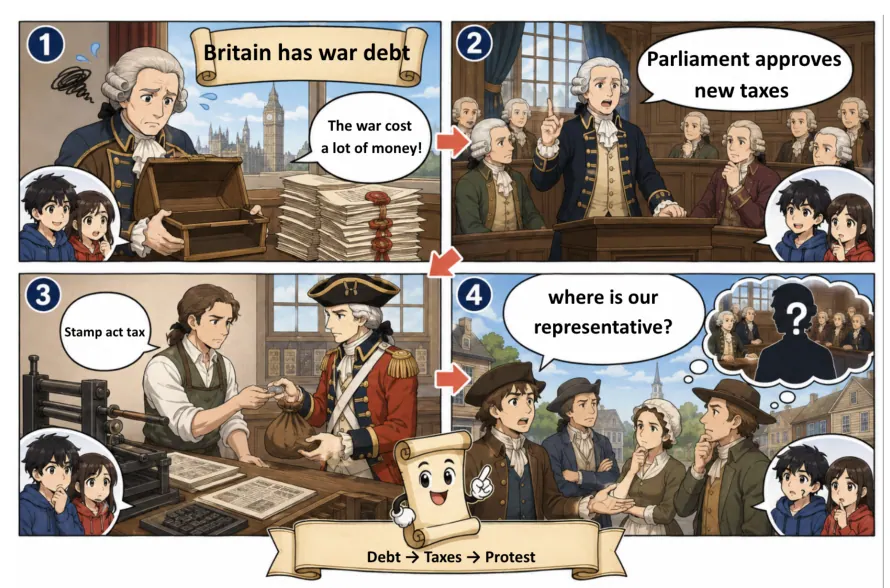
Britain controlled thirteen colonies on the east coast of North America.
The Seven Years’ War ended in 1763. Britain won, but the war left a large debt.
Britain introduced new taxes and controlled colonial trade more closely.
Many colonists argued that Parliament should not tax them without their political
consent.
Read the cartoon script
S1 Britain has war debt S2 Parliament approves new taxes
The war cost a lot of money.
S3 Stamp act tax S4 Where is our representative?
Debt → Taxes → Protest
Topic 1.1 · Lesson 2 · PDF page 5
How Did Protest Become War?
Original MOSAIC worksheet illustration · Topic 1.1, page 5.
Vocabulary
Vocab
Easy Definition
Petition
a written request asking a government to change something
Boycott
an organized refusal to buy something as a protest
Intolerable Acts
British laws that punished Massachusetts after the Boston Tea Party
Militia
a group of ordinary people trained to fight when needed
Easy Explanation
At first, many colonists wanted Britain to respect their rights. They did not immediately
demand independence.
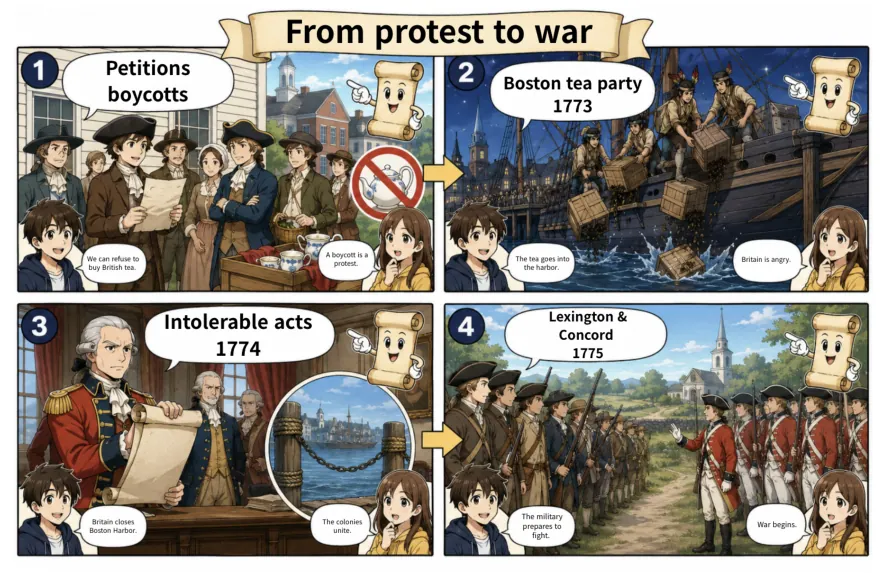
Colonists sent petitions, organized protests, and boycotted British products.
After the Boston Tea Party, Britain punished Massachusetts with the Intolerable Acts.
Fighting began at Lexington and Concord in April 1775.
Read the cartoon script
S1 Petition boycotts S2 Poston tea party 1773
We can refuse to buy British tea. The tea goes into the harbor.
A boycott is a protest. Britain is angry.
S3Intolerable acts 1774 S4 Lexington & Concord 1775
Britain closes Boston Harbor. The military prepares to fight.
The Colonies unite. War begins.
Topic 1.1 · Lesson 3 · PDF page 7
How Did the Americans Win?
Original MOSAIC worksheet illustration · Topic 1.1, page 7.
Vocabulary
Vocab
Easy Definition
Alliance
an agreement between countries to support each other
Saratoga
the 1777 American victory that helped bring France into the war
Yorktown
the 1781 battle where a major British army surrendered
Treaty
a formal agreement between countries
Easy Explanation
Britain had to move soldiers and supplies across the Atlantic Ocean.
George Washington kept the Continental Army together through serious difficulties.
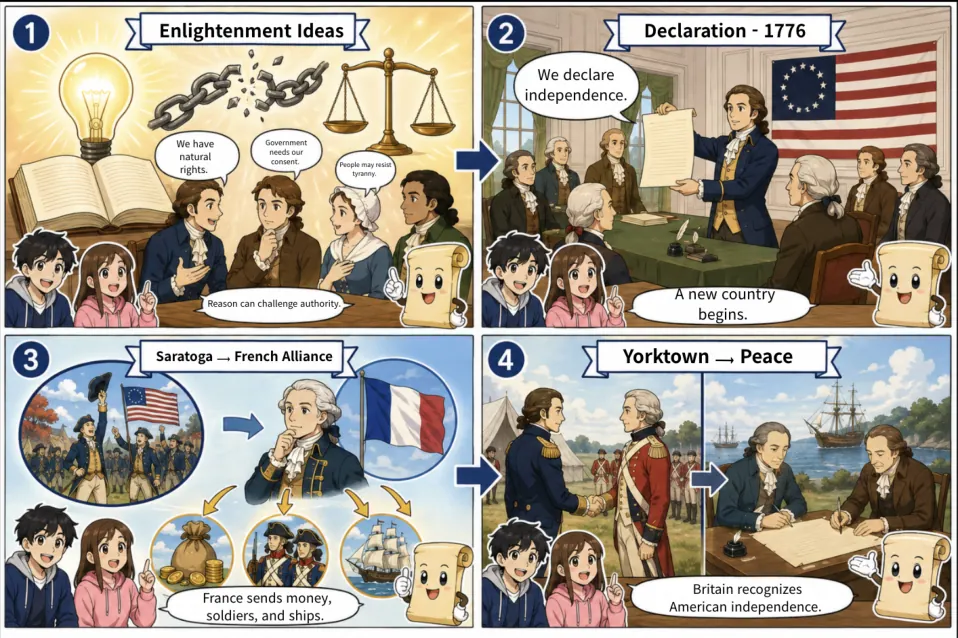
After Saratoga, France supplied money, weapons, soldiers, ships, and naval power.
The war officially ended with the Treaty of Paris in 1783. Britain recognized American
independence.
Read the cartoon script
S1 Enlightenment Ideas S2 Declaration - 1776
We have natural rights. We declare independence.
The government needs our consent. A new country begins.
People may resist tyranny.
Reason can challenge authority.
S3 Saratoga → French Alliance S4 Yorktown → Peace
France sends money, soldiers, and ships. Britain recognizes American independence.
Topic 1.1 · Lesson 4 · PDF page 9
Patriot, Loyalist, or Neutral?
Original MOSAIC worksheet illustration · Topic 1.1, page 9.
Vocabulary
Vocab
Easy Definition
Patriot
a colonist who supported American independence
Loyalist
a colonist who remained loyal to Britain
Neutral
a person who tried not to support either side
Civil conflict
a conflict that divides people within the same society
Easy Explanation
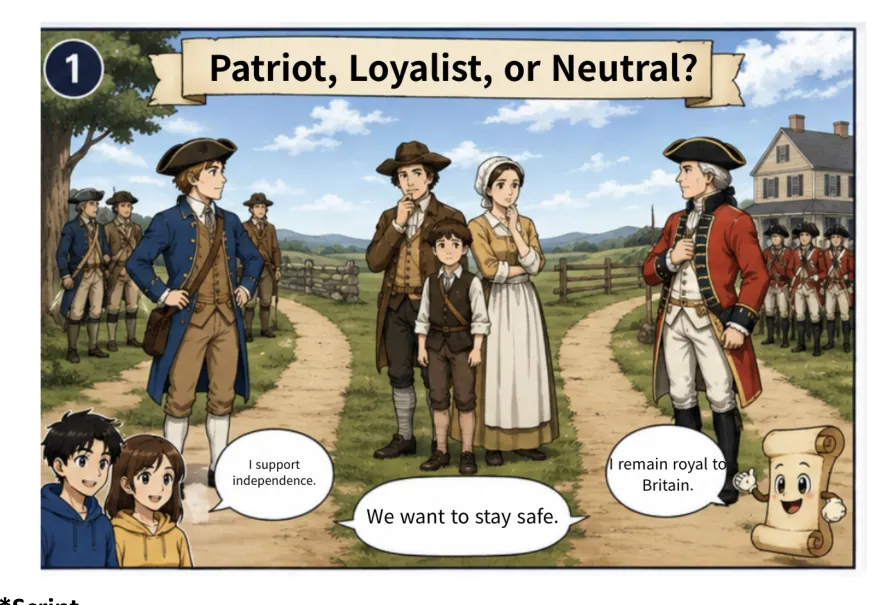
The colonists did not all support independence.
Families and communities were sometimes divided by the war.
People made choices based on safety, family, location, land, freedom, or economic
interests.
Many Loyalists later moved to other parts of British North America.
Read the cartoon script
Patriot, Loyalist, or Neutral?
Patriot : I support independence.
Neutral : We want to stay safe.
Loyalist : I remain royal to Britain.
Topic 1.1 · Lesson 5 · PDF page 11
Freedom for Whom?
Original MOSAIC worksheet illustration · Topic 1.1, page 11.
Vocabulary
Vocab
Easy Definition
Sovereignty
the authority of a nation or people to govern itself
Enslaved person
a person legally forced to work and denied freedom
Political rights
rights to vote, hold office, and influence government
Contradiction
a situation in which two ideas or actions do not agree
Easy Explanation
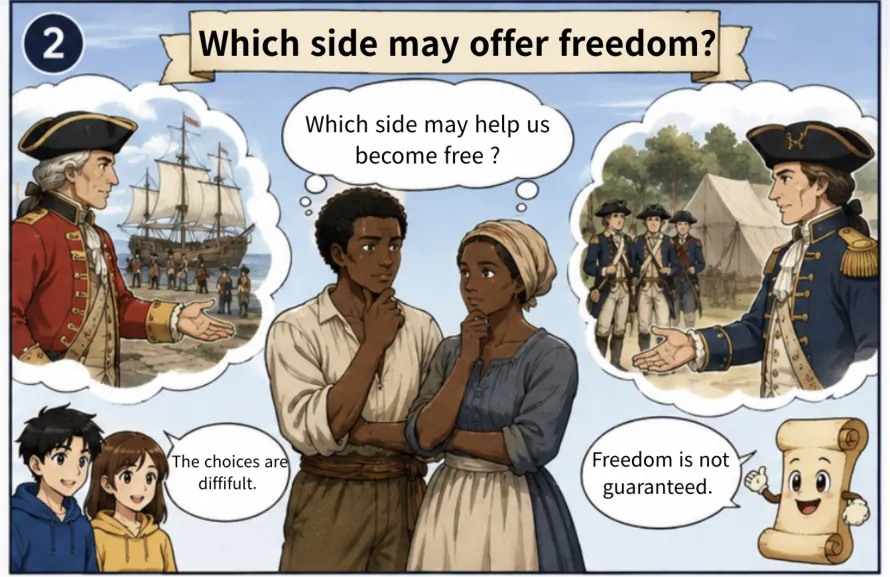
Enslaved people often chose the side that seemed more likely to offer freedom. Their
choices were not all the same.
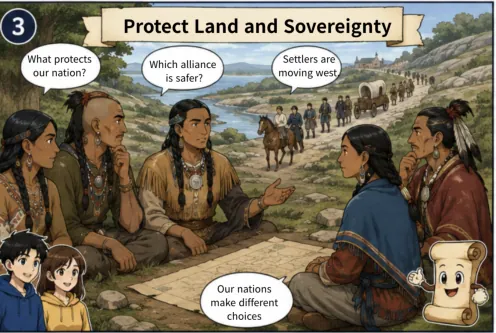
Indigenous nations made different strategic choices. Many feared that American
independence would increase settlement on their lands.
Women managed farms and businesses, produced supplies, and gathered information,
but they did not gain equal political rights.
The Declaration promoted liberty and equality, but its promises did not apply equally to
everyone.
Read the cartoon script
- Which side may offer freedom?
Two people in the middle : Which side may help us become free?
Two people (left side) The choices are difficult.
The paper : Freedom is not guaranteed.
Topic 1.1 · Lesson 6 · PDF page 13
What Changed After the Revolution?
Original MOSAIC worksheet illustration · Topic 1.1, page 13.
Vocabulary
Vocab
Easy Definition
Political consequence
a change involving government or political power
Social consequence
a change affecting groups, rights, or relationships in society
Economic consequence
a change involving trade, labour, debt, or money
Inflation
a general increase in prices and fall in the value of money
Easy Explanation
Politically, the thirteen colonies became an independent United States. Government by
popular consent became a powerful ideal.
Socially, ideas about liberty and equality spread, but slavery and unequal political rights
continued. Indigenous lands faced greater pressure.
Economically, the new country left British trade rules, but the war caused debt, inflation,
destruction, and interrupted trade.
The American Revolution influenced later revolutions, including the French and Haitian
revolutions.
Read the cartoon script
- Protect Land and Sovereignty
Person 1 : What protects our nation?
Person 2 : Which alliance is safer?
Person 3 : Our nations make different choices
Settlers : Settlers are moving west.
*Script - The promise and The Reality
Work changes. Political rights do not change.
WRAP-UP
Summary and review
Final Summary
Easy explanation
Britain’s war debt led to new taxes and tighter control.
Colonists protested because they lacked elected representation in Parliament.
Protest developed into war, and the colonies declared independence in 1776.
French assistance helped the Americans defeat Britain.
The Revolution expanded ideas about rights and consent, but freedom remained
unequal.
Check Your Understanding
1. Why did Britain introduce new colonial taxes after 1763?
______________________________________________________________________________
______________________________________________________________________________
2. What did “No taxation without representation” mean?
______________________________________________________________________________
______________________________________________________________________________
3. How did colonial resistance change between 1765 and 1776?
______________________________________________________________________________
______________________________________________________________________________
4. Why was French support important?
______________________________________________________________________________
______________________________________________________________________________
5. Explain one contradiction between the Declaration and American society.
______________________________________________________________________________
______________________________________________________________________________
6. Choose one group. How did the Revolution affect that group?
______________________________________________________________________________
______________________________________________________________________________
7. Was the Revolution a complete social revolution? Use two facts.
______________________________________________________________________________
______________________________________________________________________________
______________________________________________________________________________
TOPIC 1.2
French Revolution
Follow the illustrated explanations, build your vocabulary, and check your understanding using the PDF.
Original MOSAIC worksheet illustration · Topic 1.2, page 2.
Read the cartoon script
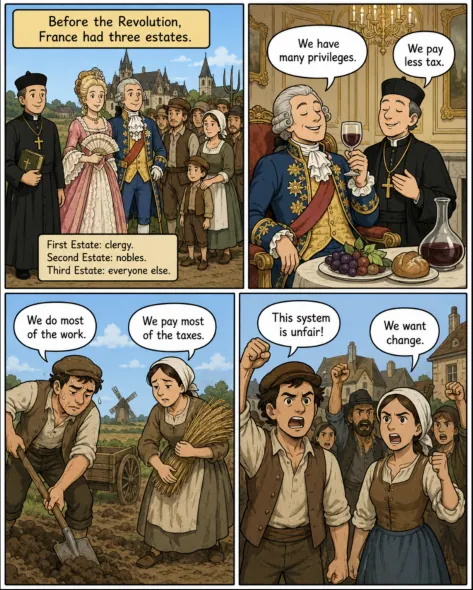
S1 Before the Revolution, France had three estates.
First estate : clergy
Second estate : nobles
Third estate : everyone else
S2
Second estate (nobles) : We have many privileges.
First estate (clergy) : We pay less tax.
S3
Third estate (everyone else) 1 : we do most of the work.
Third estate (everyone else) 2 : we pay most of the taxes.
S4
Third estate (everyone else) 1 : This system is unfair!
Third estate (everyone else) 2 : We want change.
Topic 1.2 · Lesson 2 · PDF page 3
The National Assembly
Original MOSAIC worksheet illustration · Topic 1.2, page 3.
Vocabulary
Vocab
Easy Definition
Estates-General
a meeting of the three social groups in France
Estate
a social class in France before the Revolution
clergy
church leaders such as priests
nobles
people with high social rank and special privileges
Third Estate
the common people; everyone else in France
vote
a choice made to make a decision
National Assembly
a new group formed by the Third Estate to represent the people
Easy Explanation
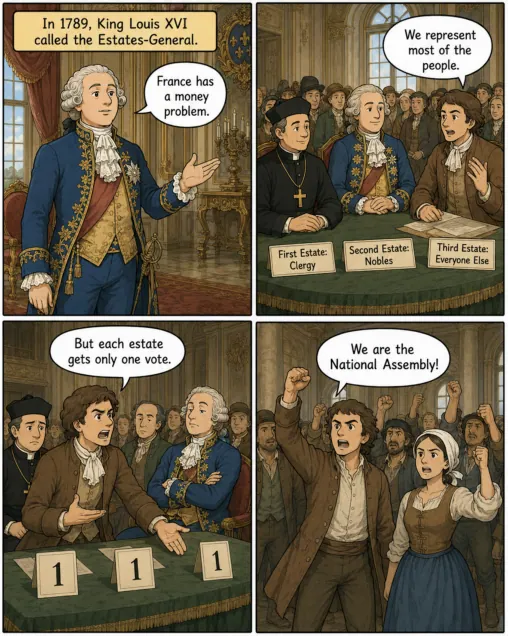
In 1789, King Louis XVI called the Estates-General because France had serious money
problems. The meeting included the First Estate, the Second Estate, and the Third Estate.
The Third Estate said they represented most of the people in France, but each estate still
got only one vote.
This was unfair to the Third Estate because the First Estate and the Second Estate always
conspired and got two votes in total.
Because of this, they broke away and called themselves the National Assembly.
Read the cartoon script
S1 In 1789, King Louis XVI called the Estates-General.
France has a money problem.
S2
We represent most of the people.
S3
But each estate gets only one vote.
S4
We are the National Assembly!
Topic 1.2 · Lesson 3 · PDF page 5
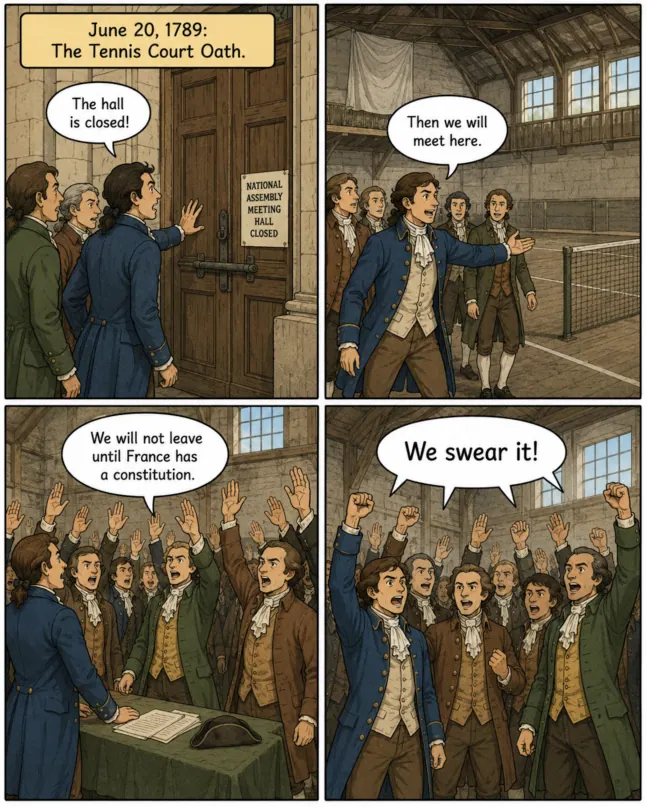
The Tennis Court Oath
Original MOSAIC worksheet illustration · Topic 1.2, page 5.
Vocabulary
Vocab
Easy Definition
oath
a serious promise
constitution
a set of basic laws for a country
assembly
a group of people who meet to make decisions
delegate
a person chosen to represent others
meeting hall
the place where people meet officially
swear
to make a strong promise
Easy Explanation
The members of the National Assembly found their meeting hall closed. Instead of giving
up, they went to an indoor tennis court. There, they made a strong promise. They said
they would not leave until France had a constitution. This promise became known as the
Tennis Court Oath.
Read the cartoon script
S1 June 20, 1789 : The Tennis Court Oath
Blue jacket guy : The hall is closed!
S2
Blue jacket guy : Then we will meet here.
S3
People : We will not leave until France has a constitution.
S4
People : We swear it!
Topic 1.2 · Lesson 4 · PDF page 7
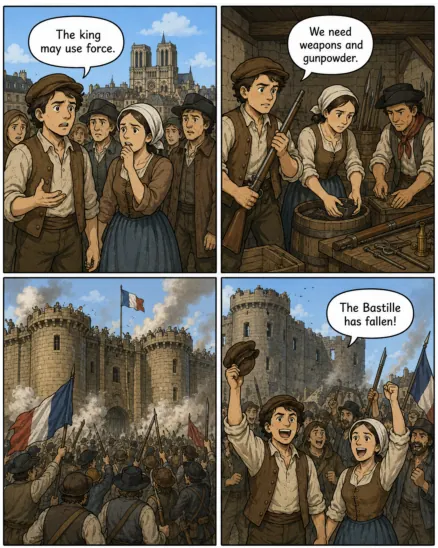
The Storming of the Bastille
Original MOSAIC worksheet illustration · Topic 1.2, page 7.
Vocabulary
Vocab
Easy Definition
Bastille
a prison fortress in Paris
force
violence or military power
weapon
something used for fighting
gunpowder
powder used in guns and cannons
fortress
a strong building used for defense
revolution
a big change in government by the people
Easy Explanation
Many people in Paris were afraid that the king would use force against them. They
wanted weapons and gunpowder to defend themselves. So, on July 14, 1789, they
attacked the Bastille. The Bastille was a symbol of the king’s power. When it fell, it
became a powerful symbol of the Revolution.
Read the cartoon script
S1 The king may use force. S2 We need weapons and gunpower.
S4 The Bastille has fallen!
Topic 1.2 · Lesson 5 · PDF page 9
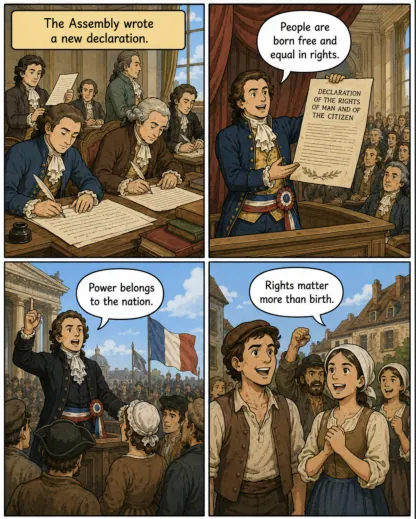
The Declaration of the Rights of Man and of the Citizen
Original MOSAIC worksheet illustration · Topic 1.2, page 9.
Vocabulary
Vocab
Easy Definition
declaration
an official statement
rights
freedoms and protections people should have
citizen
a member of a country with rights and duties
equal
the same in value, rights, or importance
nation
the people of a country
birth
the family or social class a person is born into
Easy Explanation
The Assembly wrote a new declaration about people’s rights. It said that people are born
free and equal in rights. It also said that power belongs to the nation, not only to the
king. This was a big change from the old system. It showed that a person’s birth should
not be more important than their rights.
Read the cartoon script
S1 The Assembly wrote a new declaration. S2 People are born free and equal in rights.
S3 Power belongs to the nation. S4 Rights matter more than birth.
Topic 1.2 · Lesson 6 · PDF page 11
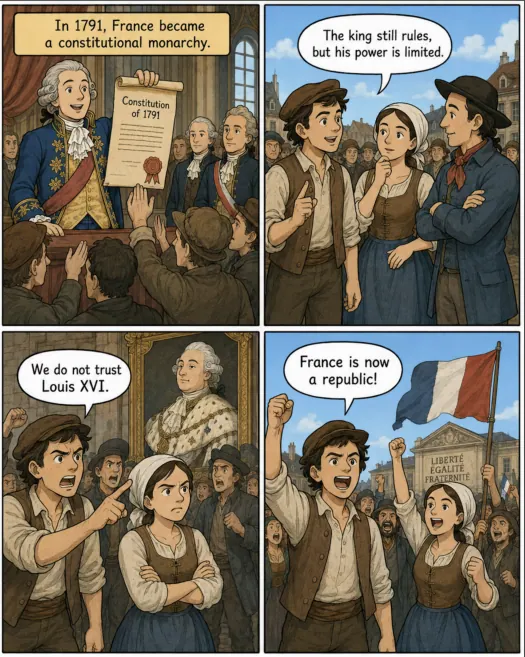
From Constitutional Monarchy to Republic
Original MOSAIC worksheet illustration · Topic 1.2, page 11.
Vocabulary
Vocab
Easy Definition
constitutional monarchy
a system where there is still a king, but his power is limited by law
limited
not complete; controlled by rules
monarchy
a government led by a king or queen
republic
a country without a king, where leaders represent the people
trust
to believe that someone will act honestly or correctly
Constitution of 1791
the law that limited the king’s power in France
Easy Explanation
In 1791, France became a constitutional monarchy. This meant the king still ruled, but
his power was limited by the constitution. However, many people did not trust Louis XVI.
They believed he was against the Revolution. Later, the monarchy ended, and France
became a republic.
Read the cartoon script
S1 In 1791, France became a constitutional monarchy.
S2 The king still rules, but his power is limited.
S3 We do not trust Louis XVI.
S4 France is now a republic!
Topic 1.2 · Lesson 7 · PDF page 13
The Execution of Louis XVI
Original MOSAIC worksheet illustration · Topic 1.2, page 13.
Vocabulary
Vocab
Easy Definition
guilty
responsible for doing something wrong
treason
acting against your own country
execute
to kill as a legal punishment
trial
a formal process to decide if someone is guilty
king
the male ruler of a monarchy
Louis XVI
the king of France during the Revolution
Easy Explanation
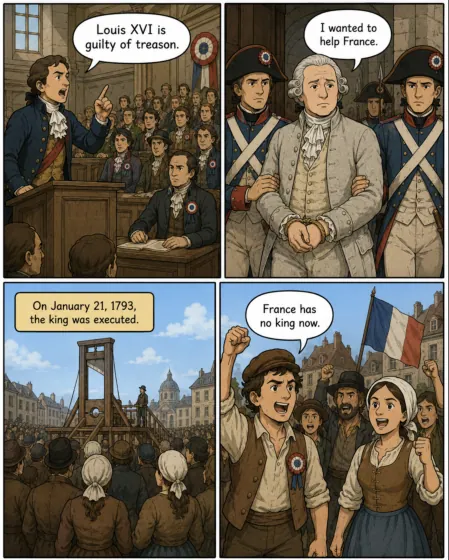
Louis XVI was put on trial during the Revolution. Many revolutionaries said he was guilty
of treason. On January 21, 1793, he was executed. After his death, France no longer had
a king. This showed that the Revolution had become much more radical.
Read the cartoon script
S1 Louis XVI is guilty of treason.
S2 I wanted to help France.
S3 On January 21, 1793, the king was executed.
S4 France has no king now.
Topic 1.2 · Lesson 8 · PDF page 15
The Reign of Terror
Original MOSAIC worksheet illustration · Topic 1.2, page 15.
Vocabulary
Vocab
Easy Definition
terror
great fear
enemy
a person or group seen as dangerous or against you
punish
to give a penalty for doing something wrong
accuse
to say that someone did something wrong
guillotine
a machine used to execute people by cutting off the head
fear
a strong feeling of being afraid
Easy Explanation
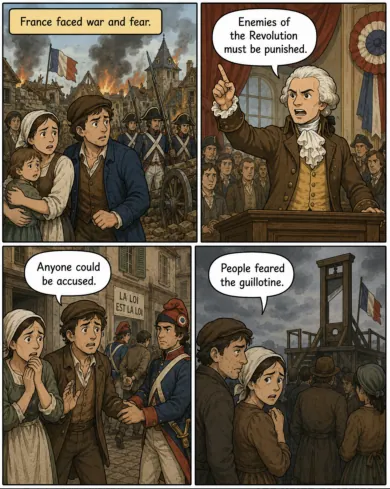
During the Reign of Terror, France faced war and fear. Revolutionary leaders said that
enemies of the Revolution had to be punished. Many people were accused, even when
there was little proof. Thousands were killed by the guillotine. This period showed how
the Revolution became violent and dangerous.
Read the cartoon script
S1 France faced war and fear.
S2 Enemies of the Revolution must be punished.
S3 Anyone could be accused.
S4 People feared the guillotine.
Topic 1.2 · Lesson 9 · PDF page 17
The Directory Rules France
Original MOSAIC worksheet illustration · Topic 1.2, page 17.
Vocabulary
Vocab
Easy Definition
Directory
the government that ruled France after the Reign of Terror
restore
to bring back
order
peace and control in society
unstable
not strong or secure; easily changed
government
the group that rules a country
army
the military forces of a country
Easy Explanation
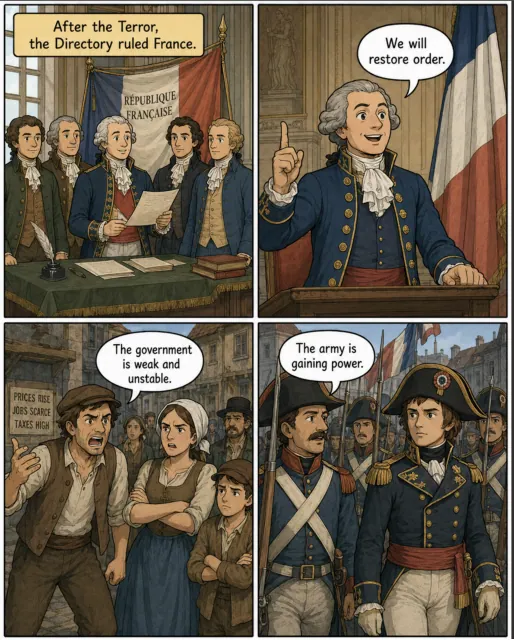
After the Reign of Terror, a new government called the Directory ruled France. It said it
would restore order. But the government was weak and unstable. People still faced
problems like high prices and job shortages. At the same time, the army became more
powerful.
Read the cartoon script
S1 After the Terror, the Directory ruled France.
S2 We will restore order.
S3 The government is weak and unstable.
S4 The army is gaining power.
Topic 1.2 · Lesson 10 · PDF page 19
Napoleon Seizes Power
Original MOSAIC worksheet illustration · Topic 1.2, page 19.
Vocabulary
Vocab
Easy Definition
seize power
to take control of the government
Napoleon
a French military leader who became ruler of France
order
peace and control
stage
a step or period in a process
revolution
a major change in government and society
power
control or authority over people and government
Easy Explanation
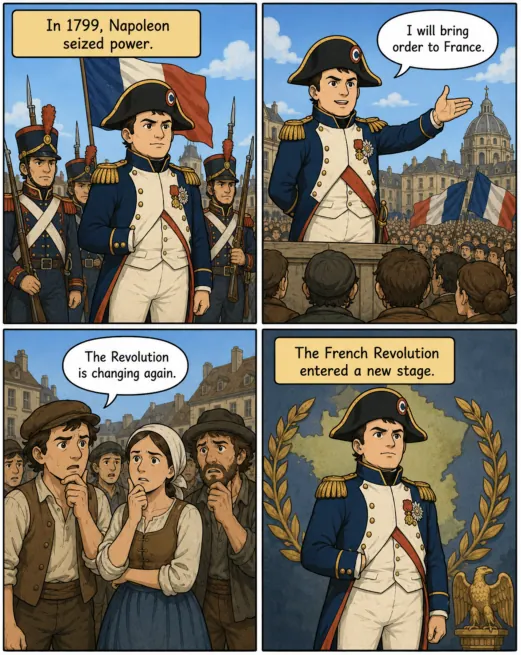
In 1799, Napoleon took control of France. He said he would bring order to the country.
Many people thought the Revolution was changing again. His rise marked a new stage in
French history. It is often seen as the end of the French Revolution.
Read the cartoon script
S1 In 1799, Napoleon seized power.
S2 Napoleon : I will bring order to France.
S3 The Revolution is changing again.
S4 The French Revolution entered a new stage.
WRAP-UP
Summary and review
Final Summary
Easy explanation
France’s unfair social system gave special privileges to the clergy and nobles, while the Third
Estate paid most taxes.
Government debt, high food prices, and Enlightenment ideas increased anger toward the
monarchy.
In 1789, the Third Estate formed the National Assembly, took the Tennis Court Oath, and
challenged the king’s authority.
The storming of the Bastille became a symbol of the Revolution, and the Declaration of the
Rights of Man and of the Citizen promoted liberty, equality, and national sovereignty.
France first became a constitutional monarchy, but distrust of Louis XVI grew. The monarchy
was later abolished, and France became a republic.
Louis XVI was executed in 1793. The Revolution then became more radical during the Reign of
Terror.
After the Terror, the Directory ruled France but remained weak and unstable.
In 1799, Napoleon seized power, bringing the Revolution into a new political stage.
The Revolution ended many legal privileges based on birth and promoted equality before the
law, but political and social equality remained incomplete. The 1791 Constitution formally
abolished hereditary distinctions and feudal privileges. (elysee.fr)
Check Your Understanding
1. Why was the Third Estate unhappy with the Old Regime?
2. Why did King Louis XVI call the Estates-General in 1789?
3. Why was the Tennis Court Oath important?
4. Why did the storming of the Bastille become an important symbol of the Revolution?
5. What new ideas were included in the Declaration of the Rights of Man and of the Citizen?
6. How did France change from a monarchy to a republic?
7. Why did the Revolution become more radical during the Reign of Terror?
8. Was the French Revolution successful in creating equality? Use two facts.
The cartoon-style illustrations are original educational artwork created for MOSAIC. They are
learning visuals, not primary sources.
TOPIC 1.3
Haitian Revolution
Follow the illustrated explanations, build your vocabulary, and check your understanding using the PDF.
Original MOSAIC worksheet illustration · Topic 1.3, page 2.
Vocabulary
Vocab
Easy Definition
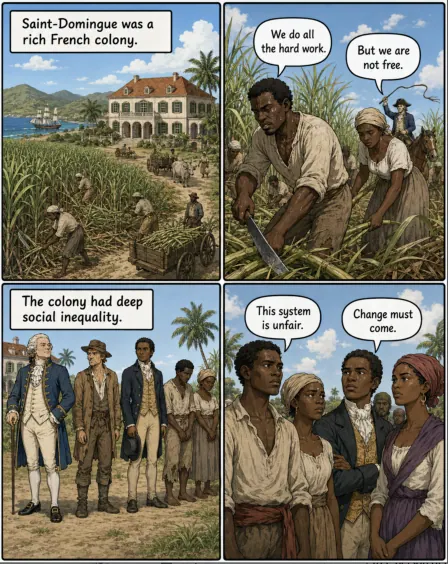
Saint-Domingue
the French colony that later became Haiti
colony
a place controlled by another country
plantation
a large farm that grows crops such as sugar or coffee
enslaved person
a person forced to work without freedom
social inequality
a situation where groups do not have the same rights, power, or opportunities
plantation owner
a person who owns a large plantation
free person of color
a non-white person who was legally free in Saint-Domingue
Easy Explanation
Before the Haitian Revolution, Haiti was a French colony called Saint-Domingue. It was very
wealthy because it produced large amounts of sugar and coffee. However, most of this wealth
came from the forced labor of enslaved Africans. Society was deeply unequal. White plantation
owners had great wealth and power, while enslaved people had almost no freedom or legal
rights.
Read the cartoon script
S1 Saint-Domingue was a rich French colony.
S2 Saint-Domingue people : We do all the hard work. But we are not free.
S3 The colony had deep social inequality.
S4 Saint-Domingue people : This system is unfair.
Topic 1.3 · Lesson 2 · PDF page 4
Revolutionary Ideas Reach Saint-Domingue
Original MOSAIC worksheet illustration · Topic 1.3, page 4.
Vocabulary
Vocab
Easy Definition
French Revolution
the revolution that began in France in 1789
liberty
freedom
equality
the idea that people should have equal rights
equal rights
the same legal and political rights for different groups
conflict
serious disagreement or fighting between groups
revolutionary ideas
new ideas that challenge the old political or social system
enslaved
forced to live and work without freedom
Easy Explanation
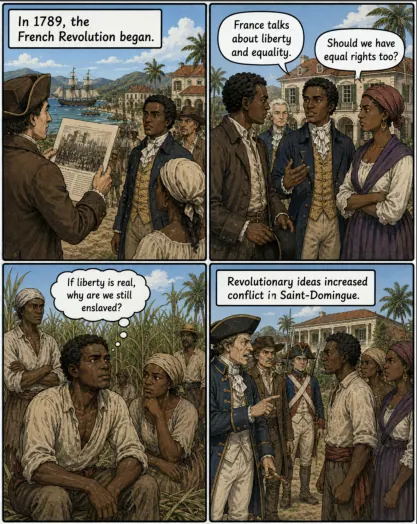
The French Revolution began in 1789 and spread ideas about liberty and equality. People in
Saint-Domingue heard about these ideas. Free people of color began asking why they did not
have the same rights as white citizens. Enslaved people also questioned why France spoke
about freedom while slavery still existed. These ideas increased tension in the colony.
Read the cartoon script
S1 In 1789, the French Revolution began.
S2 Saint-Domingue people : France talks about liberty and equality. Should we have equal rights
too?
S3 If liberty is real, why are we still enslaved?
S4 Revolutionary ideas increased conflict in Saint-Domingue.
Topic 1.3 · Lesson 3 · PDF page 6
The 1791 Slave Uprising
Original MOSAIC worksheet illustration · Topic 1.3, page 6.
Vocabulary
Vocab
Easy Definition
uprising
an organized fight against people in power
revolt
an attempt to fight against a government or system
slavery
a system in which people are owned and forced to work
rebel
a person who fights against the government or existing system
resistance
action against control or oppression
freedom
the ability to live without being controlled or enslaved
northern Saint-Domingue
the northern area of the French colony where the 1791 uprising spread quickly
Easy Explanation
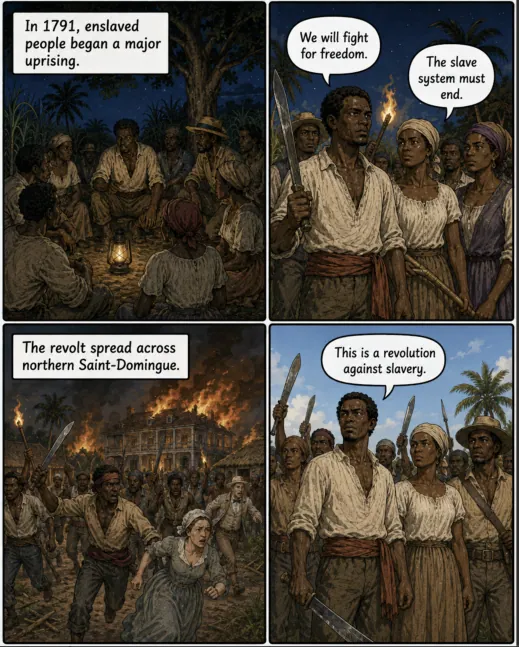
In August 1791, enslaved people in northern Saint-Domingue began a large uprising. They
organized secretly and then attacked plantations and other symbols of slavery. Their goal was
not simply to change the government. They were fighting directly against the slave system and
for their freedom. The revolt quickly spread across the northern part of the colony.
Read the cartoon script
S1 In 1791, enslaved people began a major uprising.
S2 Saint-Domingue people : We will fight for freedom. The slave system must end.
S3 The revolt spread across northern Saint-Domingue.
S4 Saint-Domingue people : This is a revolution against slavery.
Topic 1.3 · Lesson 4 · PDF page 8
France Abolishes Slavery
Original MOSAIC worksheet illustration · Topic 1.3, page 8.
Vocabulary
Vocab
Easy Definition
complex war
a war involving many different groups and goals
abolish
to officially end something
slavery
a system where people are forced to work as property
commissioner
an official sent by a government to carry out important duties
emancipation
the act of freeing people from slavery
colony
a territory controlled by another country
revolutionary France
the French government created during the French Revolution
Easy Explanation
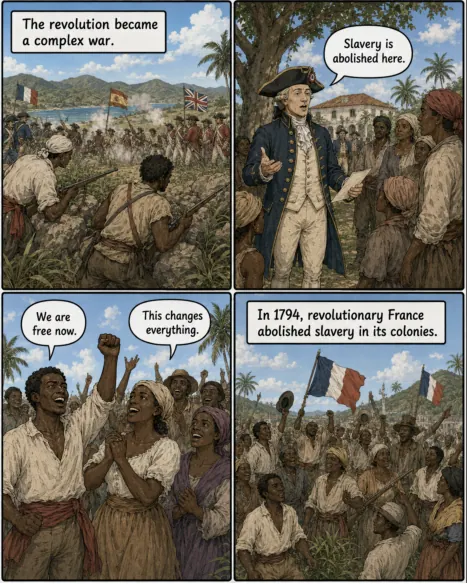
The Haitian Revolution became a complex war involving different groups inside Saint-Domingue
as well as France, Britain, and Spain. In 1793, French officials in Saint-Domingue began freeing
enslaved people. Then, in 1794, revolutionary France officially abolished slavery in its colonies.
This was a major turning point because the French government now formally recognized
freedom for formerly enslaved people.
Read the cartoon script
S1 The revolution became a complex war.
S2 Slavery is abolished here.
S3 Saint-Domingue people : We are free now. This changes everything!
S4 In 1794, revolutionary France abolished slavery in its colonies.
Topic 1.3 · Lesson 5 · PDF page 10
Toussaint Louverture Rises to Power
Original MOSAIC worksheet illustration · Topic 1.3, page 10.
Vocabulary
Vocab
Easy Definition
Toussaint Louverture
a formerly enslaved man who became a major military and political leader
leader
a person who guides or controls a group
military
connected to soldiers and war
rival
a person or group competing against another
defend
to protect something from attack
gain power
to become more politically or militarily powerful
Saint-Domingue
the French colony later known as Haiti
Easy Explanation
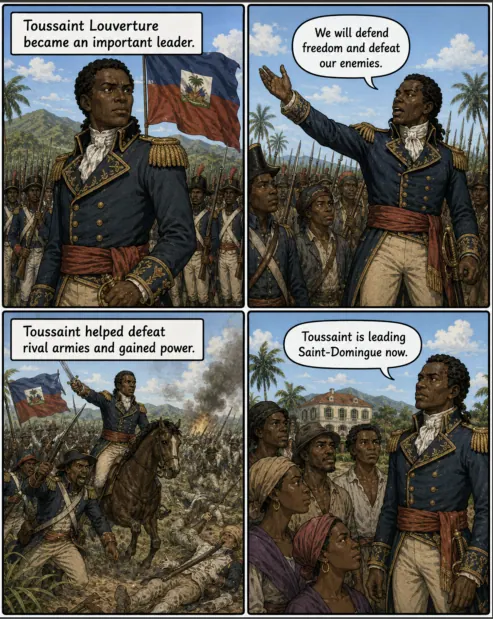
Toussaint Louverture became one of the most important leaders of the Revolution. He had
once been enslaved, but he became a skilled military commander and politician. After France
abolished slavery, Toussaint supported the French Republic and helped defeat enemy armies. By
the late 1790s, he had become the most powerful leader in Saint-Domingue.
Read the cartoon script
S1 Toussaint Louverture became an important leader.
S2 Toussaint Louverture : We will defend freedom and defeat our enemies.
S3 Toussaint helped defeat rival armies and gained power.
S4 Toussaint is leading Saint-Domingue now.
Topic 1.3 · Lesson 6 · PDF page 12
The Constitution of 1801
Original MOSAIC worksheet illustration · Topic 1.3, page 12.
Vocabulary
Vocab
Easy Definition
constitution
a set of basic laws for governing a country or territory
self-government
the ability of a place to govern itself
governor for life
a governor who is allowed to stay in power for the rest of his life
linked
still officially connected to something
slavery
the system that the constitution said could not return
authority
the power to make decisions and control government
Napoleon Bonaparte
the French leader who wanted stronger control over Saint-Domingue
Easy Explanation
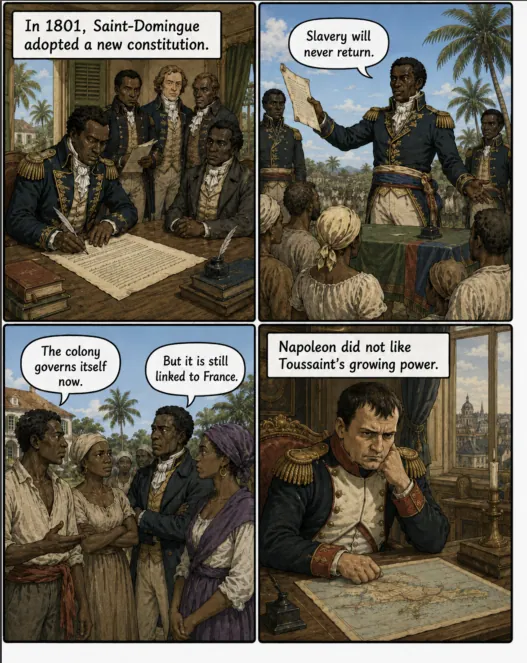
In 1801, Saint-Domingue adopted a new constitution under Toussaint Louverture. The
constitution confirmed that slavery would not return and gave the colony much more control
over its own government. Toussaint became governor for life. However, Saint-Domingue was
still officially connected to France. Napoleon saw Toussaint’s growing power as a threat to
French control.
Read the cartoon script
S1 In 1801. Saint-Domingue adopted a new constitution.
S2 Slavery will never return.
S3 The colony governs itself now. But it is still linked to France.
S4 Napoleon did not like Toussaint’s growing power.
Topic 1.3 · Lesson 7 · PDF page 14
Napoleon Sends Troops and Toussaint Is Captured
Original MOSAIC worksheet illustration · Topic 1.3, page 14.
Vocabulary
Vocab
Easy Definition
regain control
to take power over something again
expedition
a military force sent to another place for a special purpose
French troops
soldiers sent by France
capture
to take someone as a prisoner
freedom
the condition of not being enslaved
control
political or military power over a place
prison
a place where people are kept after being arrested or captured
Easy Explanation
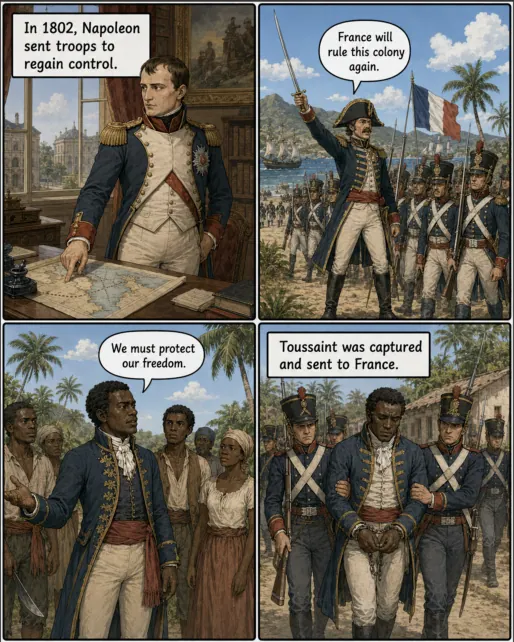
In 1802, Napoleon sent a large French army to Saint-Domingue to regain stronger control over
the colony. Many people feared that France might bring slavery back. Toussaint tried to protect
the freedom gained during the Revolution, but he was eventually captured by the French. He
was sent to France, where he later died in prison in 1803.
Read the cartoon script
S1 In 1802, Napoleon sent troops to regain control.
S2 France will rule this colony again.
S3 We must protect our freedom.
S4 Toussaint was captured and sent to France.
Topic 1.3 · Lesson 8 · PDF page 16
Dessalines and the Final Victory
Original MOSAIC worksheet illustration · Topic 1.3, page 16.
Vocabulary
Vocab
Easy Definition
Jean-Jacques Dessalines
a Haitian revolutionary leader who continued the fight after Toussaint
struggle
a difficult fight for a goal
slavery
the system Haitian revolutionaries feared France would restore
Haitian forces
the revolutionary army fighting against French control
Battle of Vertières
the major 1803 battle in which Haitian forces defeated the French
defeat
to win against an enemy
independence
freedom from control by another country
Easy Explanation
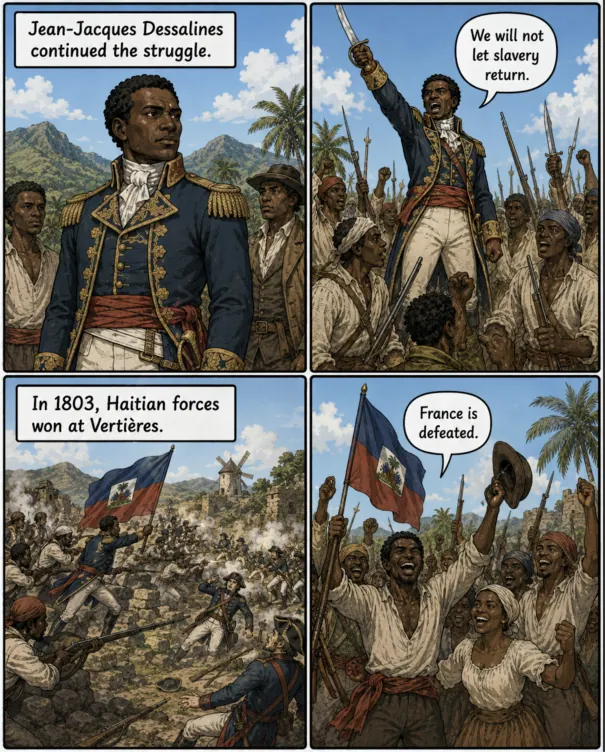
After Toussaint was captured, Jean-Jacques Dessalines became one of the main leaders of the
fight against France. Haitian revolutionaries believed they had to keep fighting to prevent
slavery from returning. In November 1803, Haitian forces defeated the French at the Battle of
Vertières. This victory effectively ended France’s attempt to regain control of the colony.
Read the cartoon script
S1 Jean-Jacques Dessalines continued the struggle.
S2 Jean-Jacques Dessalines : We will not let slavery return.
S3 In 1803, Haitian forces won at Vertieres.
S4 France is defeated.
Topic 1.3 · Lesson 9 · PDF page 18
Haiti Declares Independence
Original MOSAIC worksheet illustration · Topic 1.3, page 18.
Vocabulary
Vocab
Easy Definition
independence
the condition of governing yourself without another country controlling you
declare
to announce something officially
Haiti
the new independent country created from Saint-Domingue
republic
a country without a king, where political power is not inherited through monarchy
independent Black republic
a self-governing country led by Black people and free from colonial rule
colonial rule
control of one territory by another country
Haitian Revolution
the revolution that destroyed slavery and French colonial rule in Saint-Domingue
Easy Explanation
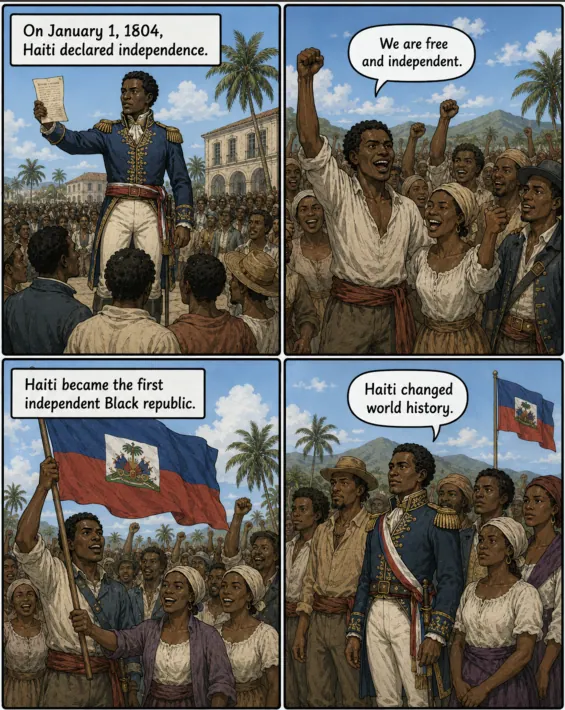
On January 1, 1804, Dessalines declared the colony independent from France and renamed it
Haiti. Haiti became the first independent Black republic and the second independent country in
the Americas. The Revolution was historically important because formerly enslaved people
successfully destroyed slavery in the colony and defeated a major European empire. Haiti’s
independence challenged both colonialism and racial slavery around the Atlantic world.
Read the cartoon script
S1 On January 1, 1804, Haiti declared independence.
S2 We are free and independent.
S3 Haiti became the first independent Black republic.
S4 Haiti changed world history.
WRAP-UP
Summary and review
Final Summary
Easy explanation
Saint-Domingue was a wealthy French colony, but its economy depended heavily on enslaved
African labor.
The French Revolution spread ideas about liberty and equality, causing free people of color and
enslaved people to demand greater rights and freedom.
In 1791, enslaved people began a major uprising against slavery, starting the Haitian Revolution.
France abolished slavery in its colonies in 1794, and Toussaint Louverture became a powerful
military and political leader in Saint-Domingue.
In 1802, Napoleon sent French troops to regain control. Toussaint was captured, but the
revolution continued under leaders such as Jean-Jacques Dessalines.
Haitian forces defeated the French in 1803, and Haiti declared independence on January 1,
1804.
The Revolution destroyed slavery and French colonial rule in Haiti, creating the first
independent Black republic. However, the new nation faced serious economic and international
challenges after independence.
Check Your Understanding
1. Why was Saint-Domingue an important colony for France?
2. How did the French Revolution influence people in
Saint-Domingue?
3. Why did enslaved people begin a major uprising in 1791?
4. Why was France’s abolition of slavery in 1794 important?
5. What role did Toussaint Louverture play in the Haitian
Revolution?
6. Why did Napoleon send French troops to Saint-Domingue in
1802?
7. How did the Haitian Revolution change from a slave uprising
into a war for independence?
8. Why was Haitian independence historically important? Use two
facts.
TOPIC 1.4
Red River Resistance & North-West Resistance
Follow the illustrated explanations, build your vocabulary, and check your understanding using the PDF.
Original MOSAIC worksheet illustration · Topic 1.4, page 2.
Vocabulary
Vocab
Easy Definition
Red River Settlement
a community in present-day Manitoba where many Métis lived
Métis
a distinct Indigenous people with their own culture, history, and communities
river lot
a long, narrow farm that stretches back from a river
surveyor
a person who measures land
land rights
legal rights to use, own, or control land
consulted
asked for opinions before a decision is made
Easy Explanation
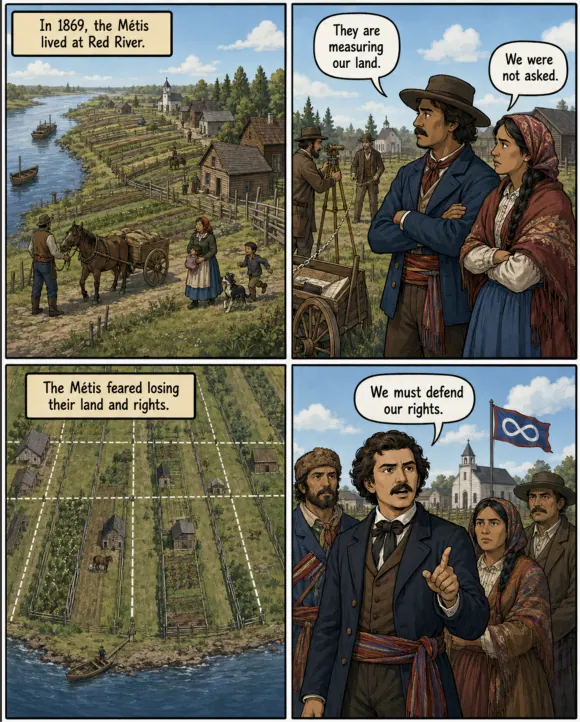
In 1869, many Métis families lived in the Red River Settlement. Their farms were
organized in long river lots. When Canadian surveyors entered the area and began
measuring land, Métis residents became worried. They had not been properly consulted,
and they feared that Canada’s new land system could threaten their farms and rights.
Read the cartoon script
S1 In 1869, the Metis lived at Red River.
S2 The Metis people : They are measuring our land. We were not asked.
S3 The Metis feared losing their land and rights.
S4 The Metis people : We must defend our rights.
Topic 1.4 · Lesson 2 · PDF page 4
The Red River Resistance Begins
Original MOSAIC worksheet illustration · Topic 1.4, page 4.
Vocabulary
Vocab
Easy Definition
resistance
organized action against control or unfair change
provisional government
a temporary government created during a political crisis
Upper Fort Garry
an important fort and political centre in the Red River Settlement
negotiate
to discuss a problem in order to reach an agreement
List of Rights
a document explaining the rights and protections the Métis wanted
political rights
rights connected to government and representation
Easy Explanation
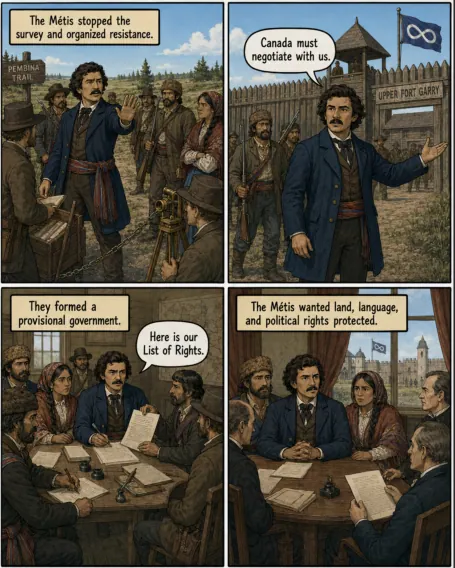
Louis Riel and other Métis leaders stopped Canadian surveyors and organized resistance.
They took control of Upper Fort Garry and formed a provisional government. The goal
was not simply to fight Canada. They wanted Canada to negotiate with them first. They
created a List of Rights asking for protection of land, language, religion, and political
representation.
Read the cartoon script
S1 The Metis stopped the survey and organized resistance.
S2 Canada must negotiate with us.
S3 They formed a provisional government.
Person 1 : Here is our list of rights.
S4 The Metis wanted land, language, and political rights protected.
Topic 1.4 · Lesson 3 · PDF page 6
The Manitoba Act and Unfinished Promises
Original MOSAIC worksheet illustration · Topic 1.4, page 6.
Vocabulary
Vocab
Easy Definition
Manitoba Act
the 1870 law that created the province of Manitoba
negotiation
discussion used to reach an agreement
province
a major political region within Canada
recognize
to officially accept or protect something
land promise
a government promise about land ownership or land rights
disputed
argued about or not fully agreed on
Easy Explanation
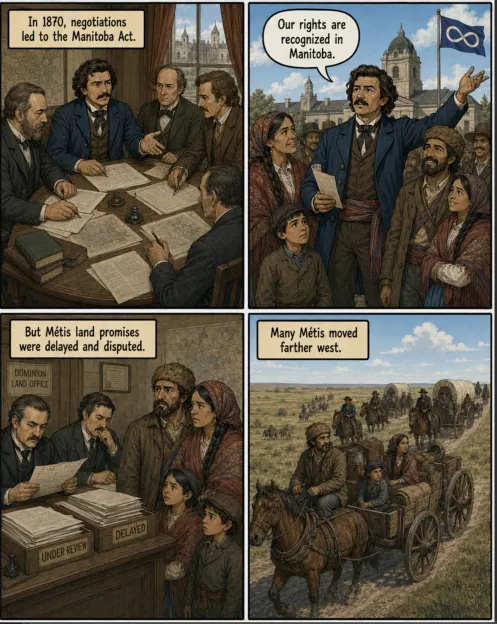
Negotiations between the Métis provisional government and Canada helped produce
the Manitoba Act of 1870. Manitoba became a province, and the Act included
protections for some Métis rights. However, many land promises were delayed or poorly
carried out. As more settlers arrived, many Métis families felt pressure and moved
farther west.
Read the cartoon script
S1 In 1870, negotiations led to the Manitoba Act.
S2 Our rights are recognized in Manitoba.
S3 But Metis land promises were delayed and disputed.
S4 Many Metis moved farther west.
Topic 1.4 · Lesson 4 · PDF page 8
Problems Grow in the North-West
Original MOSAIC worksheet illustration · Topic 1.4, page 8.
Vocabulary
Vocab
Easy Definition
North-West
the western territories of Canada before provinces such as Saskatchewan were created
petition
a formal written request to the government
grievance
a complaint about unfair treatment
treaty
a formal agreement between governments or nations
buffalo decline
the disappearance of large buffalo herds from the Plains
First Nations
Indigenous peoples in Canada who are not Métis or Inuit
Easy Explanation
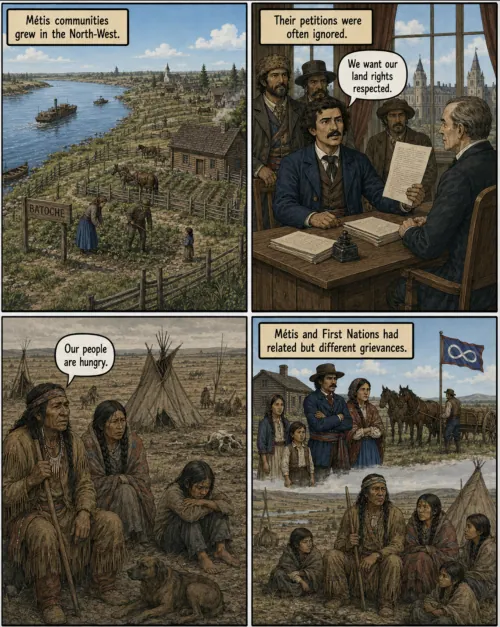
Métis communities later grew in the North-West, especially around Batoche. They again
faced problems with land surveys and legal land ownership. They sent petitions to the
Canadian government, but their concerns were often ignored. At the same time, many
First Nations communities faced hunger, the disappearance of the buffalo, and problems
connected to treaty promises. Their grievances were connected to western expansion,
but they were not exactly the same as Métis grievances.
Read the cartoon script
S1 Metis communities grew in the North-West.
S2 Their petitions were often ignored.
Person 1 : We want our land rights respected.
S3 Our people are hungry.
S4 Metis and First nations had related but different grievances.
Topic 1.4 · Lesson 5 · PDF page 10
Louis Riel Returns in 1884
Original MOSAIC worksheet illustration · Topic 1.4, page 10.
Vocabulary
Vocab
Easy Definition
Batoche
an important Métis community in present-day Saskatchewan
representation
having people speak for you in government
justice
fair treatment under laws and government
petition
a written request asking the government to act
crisis
a serious and dangerous problem
return
to come back to a place
Easy Explanation
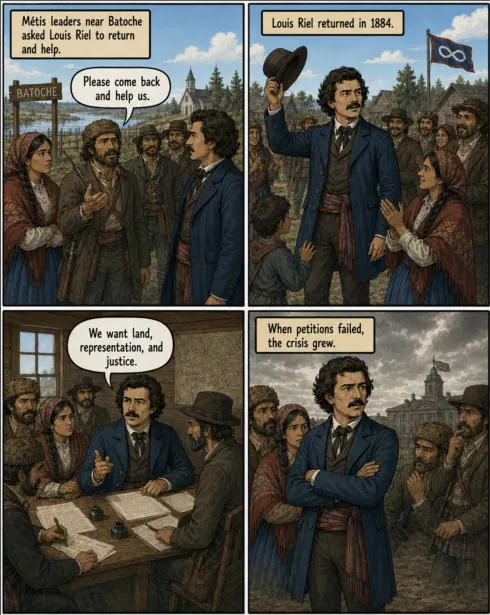
Métis leaders near Batoche asked Louis Riel to return and help them. Riel came back in
1884. He and local leaders continued to send petitions asking for land rights, political
representation, and fair treatment. When the government still did not respond
adequately, frustration increased and the political crisis became more serious.
Read the cartoon script
S1 Metis leaders near Batoche asked Louis Riel to return and help.
Metis leaders : Please come back and help us, Louis Riel.
S2 Louis Riel returned in 1884.
S3 We want land, representation, and justice.
S4 When the petition failed, the crisis grew.
Topic 1.4 · Lesson 6 · PDF page 12
The North-West Resistance Begins
Original MOSAIC worksheet illustration · Topic 1.4, page 12.
Vocabulary
Vocab
Easy Definition
North-West Resistance
the 1885 conflict involving Métis resistance and some First Nations fighting against Canadian forces
provisional government
a temporary government formed during a crisis
Gabriel Dumont
an important Métis military leader during the 1885 Resistance
Duck Lake
the location of an early battle in the North-West Resistance
military leader
a person who directs fighters or soldiers
armed conflict
fighting involving weapons
Easy Explanation
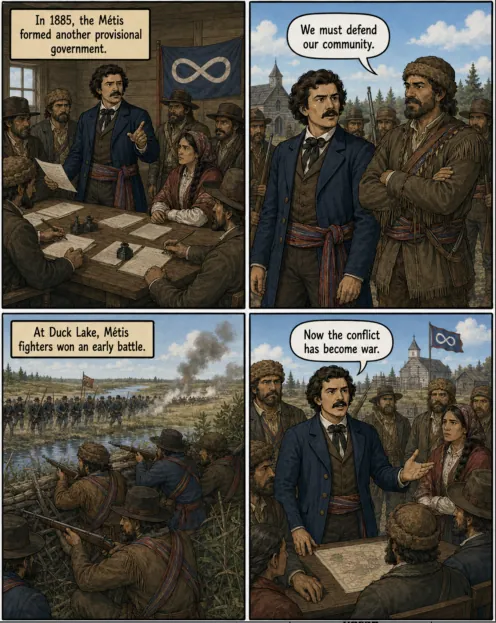
In 1885, Métis leaders formed another provisional government. Louis Riel became an
important political leader, while Gabriel Dumont helped lead the military resistance. At
Duck Lake, Métis fighters won an early battle against government forces. At this point,
the conflict had changed from petitions and political protest into open armed resistance.
Read the cartoon script
S1 In 1885, the Metis formed another provisional government.
S2 We must defend our community.
S3 At Duck Lake, Metis fighters won an early battle.
S4 Now the conflict has become war.
Topic 1.4 · Lesson 7 · PDF page 14
First Nations and the Wider Conflict
Original MOSAIC worksheet illustration · Topic 1.4, page 14.
Vocabulary
Vocab
Easy Definition
treaty promise
something the government agreed to provide under a treaty
buffalo
large animals that were central to the lives of many Plains First Nations
hunger
not having enough food
hardship
a serious difficulty or suffering
participate
to take part in something
nation
a distinct Indigenous political and cultural community
Easy Explanation
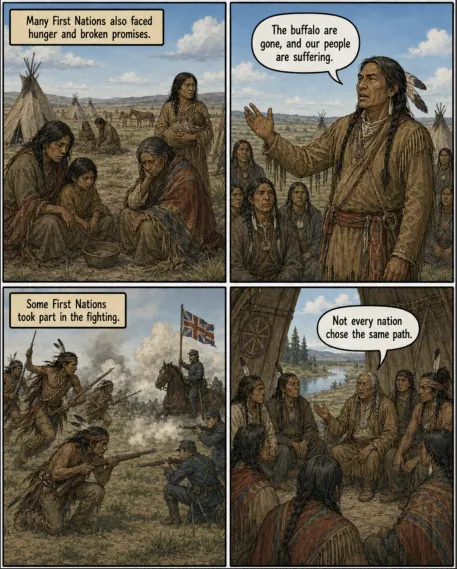
Many First Nations communities were also suffering because buffalo herds had
disappeared and government support was often inadequate. Some First Nations people
took part in fighting during the 1885 conflict. However, not every First Nation made the
same choice. Some leaders resisted Canadian forces, while others tried to stay out of the
fighting. It is important not to treat all First Nations as one single group.
Read the cartoon script
S1 Many First Nations also faced hunger and broken promises.
S2 Indigenous people : The buffalo are gone, and our people are suffering.
S3 Some First Nations took part in the fighting.
S4 Indigenous people : Not every nation chose the same path.
Topic 1.4 · Lesson 8 · PDF page 16
The Battle of Batoche
Original MOSAIC worksheet illustration · Topic 1.4, page 16.
Vocabulary
Vocab
Easy Definition
railway
a system of tracks used by trains
Canadian troops
soldiers sent by the Canadian government
rifle pit
a defensive hole or trench used by fighters
ammunition
bullets and other supplies used in weapons
defend
to protect a place from attack
Batoche
the main Métis centre and site of the decisive battle in 1885
Easy Explanation
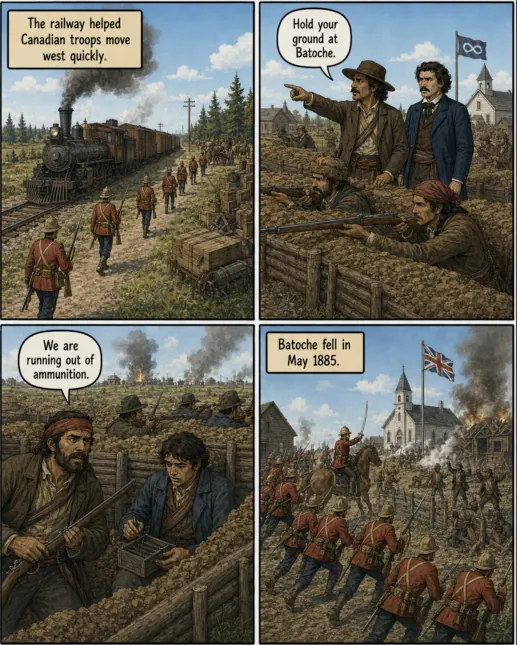
The Canadian government used the railway to move soldiers west much faster than it
could during the Red River Resistance. Métis fighters defended Batoche using rifle pits
and local knowledge. Gabriel Dumont helped direct the defense. However, the
defenders began to run out of ammunition. Canadian troops eventually broke through,
and Batoche fell in May 1885.
Read the cartoon script
S1 The railway helped Canadian troops move west quickly.
S2 Hold your ground at Batoche.
S3 Person 1 : We are running out of ammunition.
S4 Batoche fell in May 1885.
Topic 1.4 · Lesson 9 · PDF page 18
Riel’s Surrender, Trial, and Legacy
Original MOSAIC worksheet illustration · Topic 1.4, page 18.
Vocabulary
Vocab
Easy Definition
surrender
to stop fighting and give yourself to the enemy
treason
a serious crime of acting against your country or government
trial
a legal process used to decide if someone is guilty
execute
to kill someone as a legal punishment
legacy
the way a person or event is remembered later
founder
a person who helped create something important
Easy Explanation
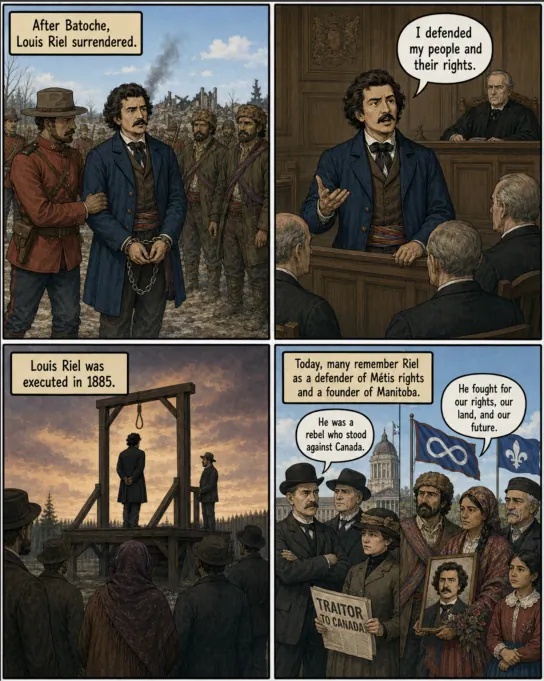
After Batoche fell, Louis Riel surrendered to Canadian authorities. He was tried for treason and
argued that he had defended Métis people and their rights. Riel was found guilty and executed
in 1885. His death deeply divided Canada. Today, many people remember him as a defender of
Métis rights and an important figure in the creation of Manitoba, while his actions remain part
of a complex historical debate.
Read the cartoon script
S1 After Batoche, Louis Riel surrendered.
S2 I defended my people and their rights.
S3 Louis Riel was executed in 1885.
S4 Today, many remember Riel as a defender of Metis rights and a founder of Manitoba.
Person 1 : He was a rebel who stood against Canada.
Person 2 : He fought for our rights, our land, and our future.
WRAP-UP
Summary and review
Final Summary
Easy explanation
Canada’s westward expansion threatened Métis land, political representation, language
rights, and local control.
In 1869, Métis leaders under Louis Riel stopped Canadian surveyors, formed a
provisional government, and negotiated with Canada.
Those negotiations led to the Manitoba Act, 1870, which created Manitoba and
recognized important rights, but many Métis land promises were delayed or poorly
carried out.
Many Métis families moved farther west, where similar land problems continued.
By the 1880s, Métis communities near Batoche were again asking the Canadian
government to respect their land rights and political demands.
At the same time, many First Nations faced hunger, the disappearance of the buffalo,
and serious problems connected to treaty promises and government policy.
Louis Riel returned in 1884, and when petitions failed, the conflict became armed
resistance in 1885.
Métis forces won an early battle at Duck Lake, but Canadian troops used the railway to
move west quickly and defeated the resistance at Batoche.
Riel surrendered, was convicted of treason, and was executed in 1885.
Today, the Red River and North-West Resistances are important for understanding Métis
rights, Canadian expansion, and the effects of government policy on Indigenous peoples.
Check Your Understanding
1. Why were the Métis worried when Canadian surveyors entered Red River in 1869?
2. Why did Louis Riel and the Métis form a provisional government?
3. What did the Manitoba Act of 1870 accomplish, and what problems remained?
4. Why did many Métis move farther west after 1870?
5. How were Métis and First Nations grievances in the North-West related but
different?
6. Why did the North-West Resistance become an armed conflict in 1885?
7. Why was the railway important during the North-West Resistance?
8. Was Louis Riel only a rebel against Canada, or also a defender of Métis rights? Use
two facts.
Parks Canada — Riel House National Historic Site: Historic Themes (Parks Canada)
Batoche National Historic Site: History of the North-West Resistance (Parks Canada)
Government of Canada — Indigenous Peoples and the North-West Resistance
TOPIC 1.5
Advances in Science and Technology
Follow the illustrated explanations, build your vocabulary, and check your understanding using the PDF.
Original MOSAIC worksheet illustration · Topic 1.5, page 2.
Vocabulary
Vocab
Easy Definition
industrialization
the change from making goods mostly by hand to making them with machines in factories
steam engine
a machine that uses steam to create power
water power
energy made by moving water
factory
a large building where many workers use machines to make goods
machine
a tool that helps people do work faster
mass production
making large numbers of the same product
textile
cloth or fabric made by weaving or knitting
Easy Explanation
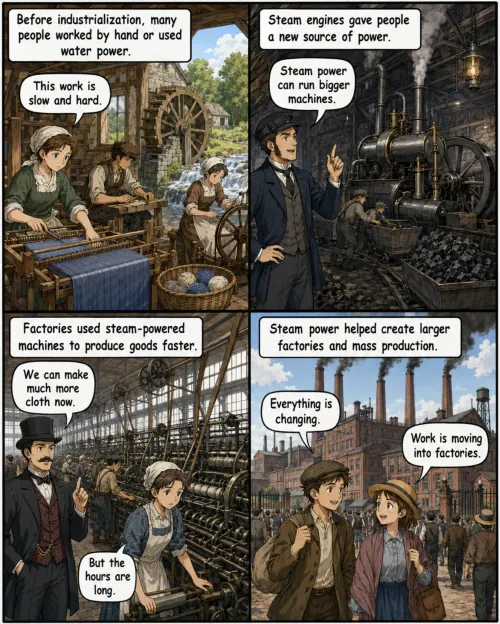
Before industrialization, many people made goods by hand or used water power. Steam
engines gave factories a new and stronger source of power. Machines could now
produce goods much faster. This helped factories become larger and led to mass
production. However, many workers still faced long hours and difficult working
conditions.
Read the cartoon script
S1 Before industrialization, many people worked by hand or used water power.
Worker 1 : This work is slow and hard.
S2 Steam engines gave people a new source of power.
Person 1 : Steam power can run bigger machines.
S3 Factories used steam-powered machines to produce goods faster.
Person 1 : We can make much more cloth now.
Worker 2 : But hours are long.
S4 Steam power helped create larger factories and mass production.
Person 3 : Everything is changing.
Person 4 : Work is moving into factories.
Topic 1.5 · Lesson 2 · PDF page 4
Coal, Iron, Steel, and Mass Production
Original MOSAIC worksheet illustration · Topic 1.5, page 4.
Vocabulary
Vocab
Easy Definition
coal
a black rock burned to produce energy
energy source
something used to create power
iron
a strong metal used for machines, tools, tracks, and bridges
steel
a strong metal made mainly from iron
industry
businesses and factories that produce goods
raw material
a natural material used to make products
mass production
making many identical products quickly
Easy Explanation
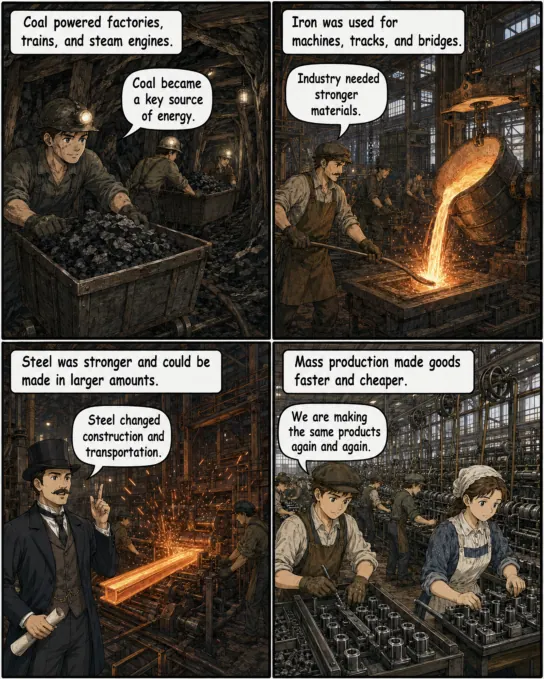
Industrial growth depended on important materials such as coal, iron, and steel. Coal
powered steam engines, factories, and trains. Iron was used to build machines and
railway tracks. Steel was stronger and became important for construction and
transportation. Factories also began producing large numbers of identical goods more
quickly and cheaply.
Read the cartoon script
S1 Coal powered factories, trains, and steam engines.
Worker 1 : Coal became a key source of energy.
S2 Iron was used for machines, tracks, and bridges.
Worker 2 : Industry needed stronger materials.
S3 Steel was stronger and could be made in larger amounts.
Person 1 : Steel changed construction and transportation.
S4 Mass production made goods faster and cheaper.
Worker 3 : We are making the same products again and again.
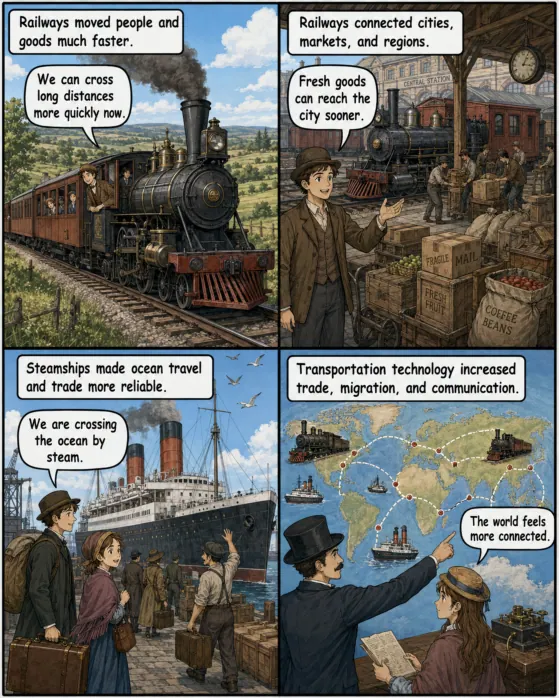
Topic 1.5 · Lesson 3 · PDF page 6
Railways and Steamships
Original MOSAIC worksheet illustration · Topic 1.5, page 6.
Vocabulary
Vocab
Easy Definition
railway
a system of tracks used by trains
locomotive
the engine that pulls a train
steamship
a ship powered by a steam engine
transportation
the movement of people and goods from one place to another
trade
buying and selling goods
migration
the movement of people from one place to another
market
a place or system where goods are bought and sold
Easy Explanation
Steam-powered transportation made travel much faster. Railways connected cities,
farms, factories, and markets. Goods could reach customers more quickly, and people
could travel farther in less time. Steamships made ocean travel more reliable and
increased international trade and migration. These technologies made different parts of
the world more connected.
Read the cartoon script
S1 Railways moved people and goods much faster.
Train : We can cross long distances more quickly now.
S2 Railways connected cities, markets, and regions.
Person 1 : Fresh goods can reach the city sooner.
S3 Steamships mode ocean travel and trade more reliably.
Person 2 : We are crossing the ocean by steam.
S4 Transportation technology increased trade, migration, and communication.
Person 3 : the world feels more connected.
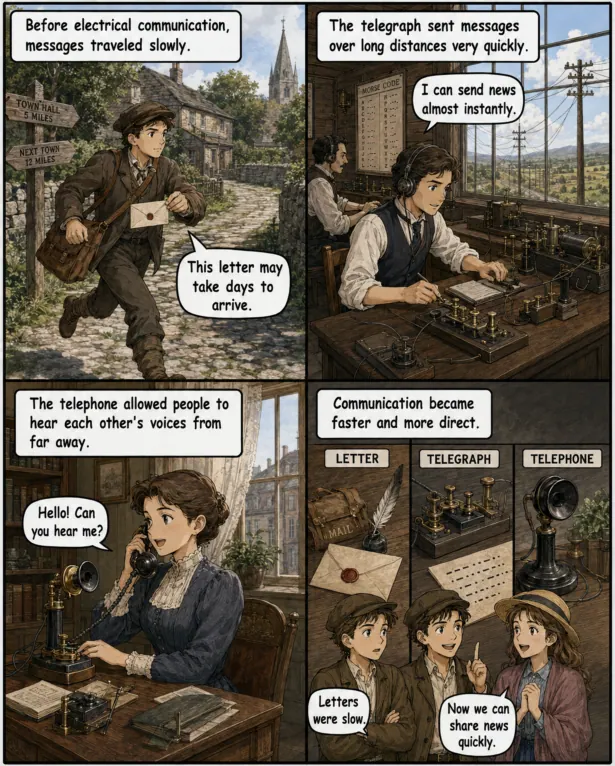
Topic 1.5 · Lesson 4 · PDF page 8
Telegraph and Telephone
Original MOSAIC worksheet illustration · Topic 1.5, page 8.
Vocabulary
Vocab
Easy Definition
communication
sharing information with other people
telegraph
a system that sends electrical messages through wires
Morse code
a system of dots and dashes used to send telegraph messages
telephone
a device that sends people’s voices over long distances
electrical communication
sending information using electricity
instantly
almost immediately
direct
happening without many steps in between
Easy Explanation
Before electrical communication, letters had to travel physically and could take days or
weeks to arrive. The telegraph allowed messages to travel over long distances very
quickly. Later, the telephone allowed people to hear each other’s voices from far away.
Communication became much faster and more direct.
Read the cartoon script
S1 Before electrical communication, messages traveled slowly.
Person 1 : This letter may take days to arrive.
S2 The telegraph sent messages over long distances very quickly.
Person 2 : I can send news almost instantly.
S3 The telephone allowed people to hear each other’s voices from far away.
Person 3 : Hello! Can you hear me?
S4 Communication became faster and more direct.
Person 4 : Letters were slow.
Person 5 : Now we can share news quickly.
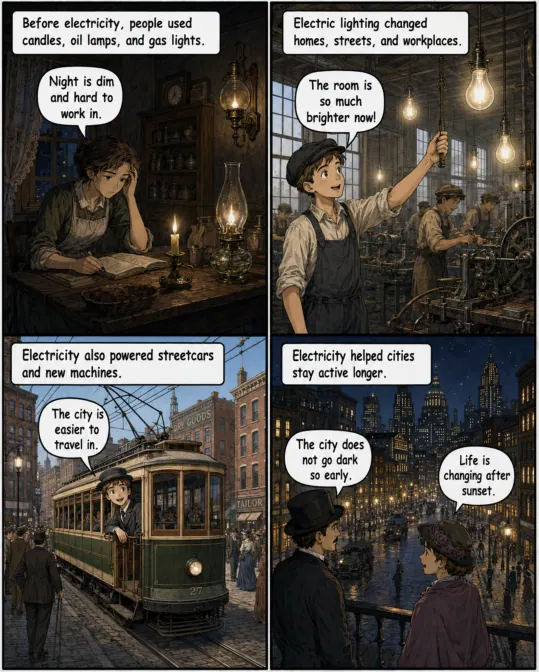
Topic 1.5 · Lesson 5 · PDF page 10
Electricity Changes Everyday Life
Original MOSAIC worksheet illustration · Topic 1.5, page 10.
Vocabulary
Vocab
Easy Definition
electricity
a form of energy used to power lights and machines
electric lighting
lighting powered by electricity
oil lamp
a lamp that burns oil to make light
gas light
a light that uses burning gas
streetcar
a city vehicle that runs on tracks, often powered by electricity
workplace
a place where people work
urban
connected to a city
Easy Explanation
Before electricity, people used candles, oil lamps, and gas lights. Electric lighting made
homes, streets, and workplaces brighter and safer. Electricity also powered new
machines and streetcars, making city travel easier. Cities could stay active later at night,
so everyday life began to change after sunset.
Read the cartoon script
S1 Before electricity, people used candles, oil lamps, and gas lights.
Person 1 : Night is dim and hard to work in.
S2 Electric lighting changed homes, streets, and workplaces.
Person 2 : The room is so much brighter now!
S3 Electricity also powered streetcars and new machines.
Person 3 : The city is easier to travel in.
S4 Electricity helped cities stay active longer.
Person 4 : The city does not go dark so early.
Person 5 : Life is changing after sunset.
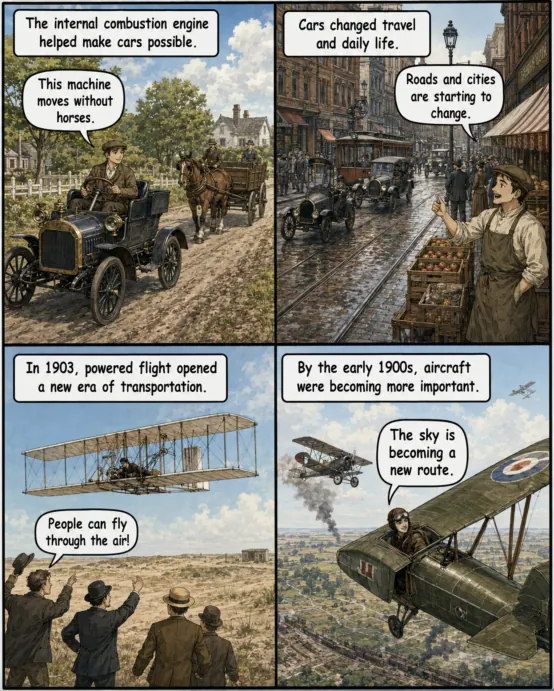
Topic 1.5 · Lesson 6 · PDF page 12
Cars and Airplanes
Original MOSAIC worksheet illustration · Topic 1.5, page 12.
Vocabulary
Vocab
Easy Definition
internal combustion engine
an engine that burns fuel inside itself to create power
automobile
another word for a car
powered flight
flight using an engine
aircraft
a machine that can fly
transportation
the movement of people or goods
route
a path used for travel
aviation
the use and development of aircraft
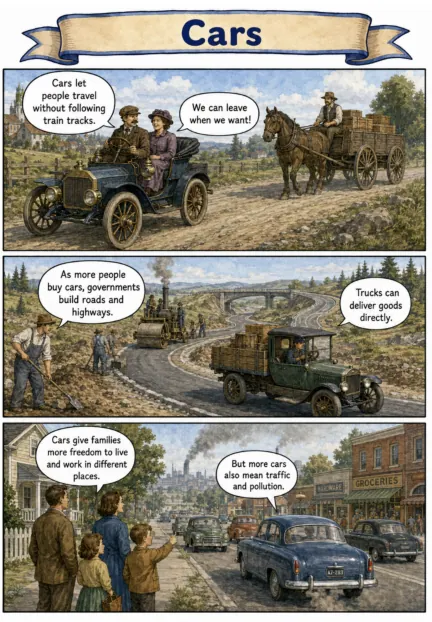
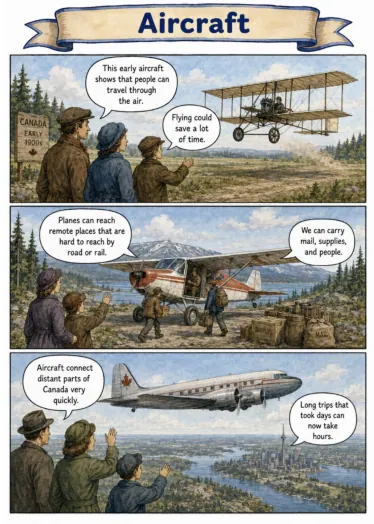
Easy Explanation
The internal combustion engine helped make cars practical. Cars changed how people
traveled and also changed roads and cities. In 1903, powered flight showed that people
could travel through the air. By the early 1900s, aircraft were becoming increasingly
important for transportation and military use.
Read the cartoon script
S1 The internal combustion engine helped make cars possible.
Person 1 : This machine moves without horses.
S2 Cars changed travel and daily life.
Person 2 : Roads and cities are starting to change.
S3 In 1903, powered flight opened a new era of transportation.
Person 3 : People can fly through the air!
S4 By the early 1900s, aircraft were becoming
Topic 1.5 · Lesson 7 · PDF page 14
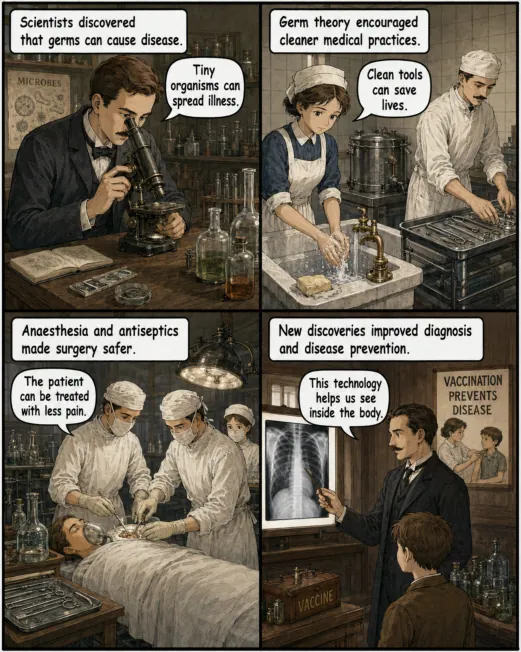
Science Changes Medicine
Original MOSAIC worksheet illustration · Topic 1.5, page 14.
Vocabulary
Vocab
Easy Definition
germ theory
the idea that tiny organisms can cause disease
microorganism
a very small living thing that can only be seen with a microscope
sterilize
to remove or kill germs on tools or surfaces
anaesthesia
medicine that prevents pain during surgery
antiseptic
a substance used to kill germs and prevent infection
X-ray
a technology used to see structures inside the body
vaccination
giving a vaccine to help protect a person from disease
diagnosis
finding out what disease or medical problem a person has
Easy Explanation
Scientists learned that germs can cause disease. This encouraged doctors and hospitals
to use cleaner tools and better sanitation. Anaesthesia reduced pain during surgery,
while antiseptics helped prevent infection. X-rays allowed doctors to see inside the body,
and vaccination helped prevent some diseases. Medicine became more scientific and
safer.
Read the cartoon script
S1 Scientists discovered that germs can cause disease.
Scientist 1 : Tiny organisms can spread illness.
S2 Germ theory encouraged cleaner medical practices.
Nurse 1 : Clean tools can save lives.
S3 Anaesthesia and antiseptics made surgery safer.
Doctor 1 : The patient can be treated with less pain.
S4 New discoveries improved diagnosis and disease prevention
Scientist 1 : This technology helps us see inside the body.
Topic 1.5 · Lesson 8 · PDF page 16
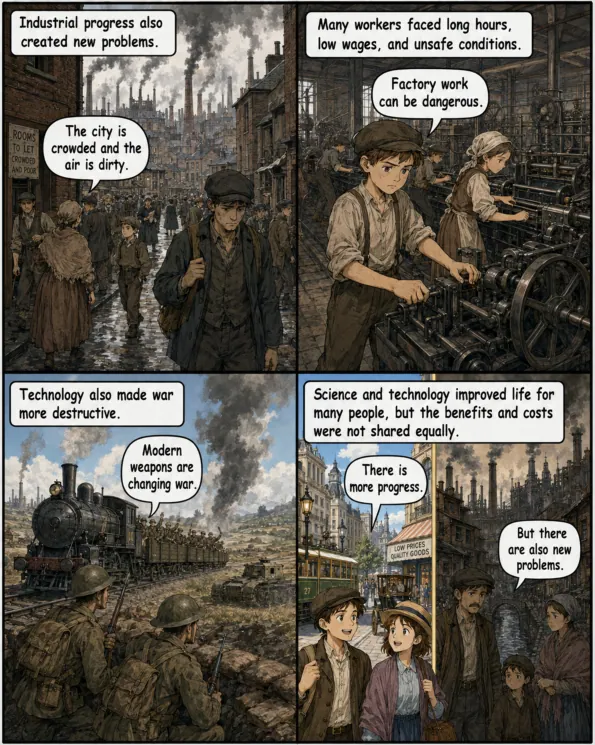
Progress Has Costs
Original MOSAIC worksheet illustration · Topic 1.5, page 16.
Vocabulary
Vocab
Easy Definition
industrial progress
growth caused by new factories, machines, and technology
pollution
harmful waste that makes air, water, or land dirty
working conditions
the situation workers experience at their jobs
low wages
being paid a small amount of money
child labour
work done by children, often in difficult or dangerous conditions
destructive
causing serious damage
inequality
a situation where people do not receive the same benefits or opportunities
consequence
a result of an action or change
Easy Explanation
Science and technology improved life in many ways, but they also created new
problems. Industrial cities often became crowded and polluted. Many workers faced
long hours, low wages, and dangerous conditions, and some children worked in
factories. New technology also made warfare more destructive. The benefits of progress
were important, but they were not shared equally by everyone.
Read the cartoon script
S1 Industrial progress also created new problems.
Person 1 : The city is crowded and the air is dirty.
S2 Many workers faced long hours, low wages, and unsafe conditions.
Person 2 : Factory work can be dangerous.
S3 Technology also made war more destructive.
Train : Modern weapons are changing war.
S4 Science and technology improved life for many people, but the benefits and costs were not
shared equally.
WRAP-UP
Summary and review
Final Summary
Easy explanation
Steam engines gave factories a new source of power and helped move production from
small workshops into large factories.
Coal, iron, and steel became important materials for machines, railways, bridges, ships,
and mass production.
Railways and steamships made the movement of people and goods much faster and
connected cities, markets, and regions.
The telegraph and telephone made communication much faster, while electricity
changed homes, factories, streets, and city life.
Cars and airplanes created new forms of transportation in the late 1800s and early
1900s.
Scientific discoveries such as germ theory, anaesthesia, antiseptics, vaccination, and
X-rays made medicine safer and more effective.
These advances improved life for many people, but industrialization also created
pollution, unsafe working conditions, child labour, and more destructive warfare.
The main lesson is that technological progress created both benefits and new problems,
and those effects were not shared equally.
Check Your Understanding
1. How did steam power change the way goods were produced?
2. Why were coal, iron, and steel important during industrialization?
3. How did railways and steamships change transportation and trade?
4. How did the telegraph and telephone change communication?
5. How did electricity change everyday life in cities?
6. Name two scientific or medical advances and explain how they improved health.
7. What were two negative effects of industrial or technological progress?
8. Was technological progress completely positive? Use two facts to explain your
answer.
1. Steam power allowed machines to run more efficiently and helped factories produce
goods faster and in larger amounts.
2. Coal provided energy, while iron and steel were used to build machines, railway
tracks, bridges, ships, and other industrial structures.
3. Railways and steamships moved people, raw materials, and goods much faster. They
connected cities and markets and increased trade and migration.
4. The telegraph allowed messages to travel quickly over long distances, while the
telephone allowed people to speak directly to each other from far away.
5. Electricity provided brighter lighting, powered machines and streetcars, and allowed
homes, businesses, and cities to remain active for longer hours.
6. Answers may include germ theory, anaesthesia, antiseptics, vaccination, or X-rays.
Strong answers explain that these developments helped prevent disease, reduce
infection or pain, or improve diagnosis.
7. Answers may include pollution, crowded cities, dangerous factory work, low wages,
child labour, or more destructive military technology.
8. Strong answers should explain both benefits and costs. For example, transportation
and medicine improved, but many workers faced unsafe conditions and industrial cities
became heavily polluted.
TOPIC 1.6
Industrialization
Follow the illustrated explanations, build your vocabulary, and check your understanding using the PDF.
Original MOSAIC worksheet illustration · Topic 1.6, page 1.
Vocabulary
Vocab
Easy Definition
cottage industry
a system where goods are made at home or in small workshops
factory system
a system where goods are made in large buildings using machines
steam power
power created by steam, often from burning coal
machine
a tool that helps people do work faster
industrialization
the change from hand production to machine and factory production
mass production
making large amounts of the same product quickly
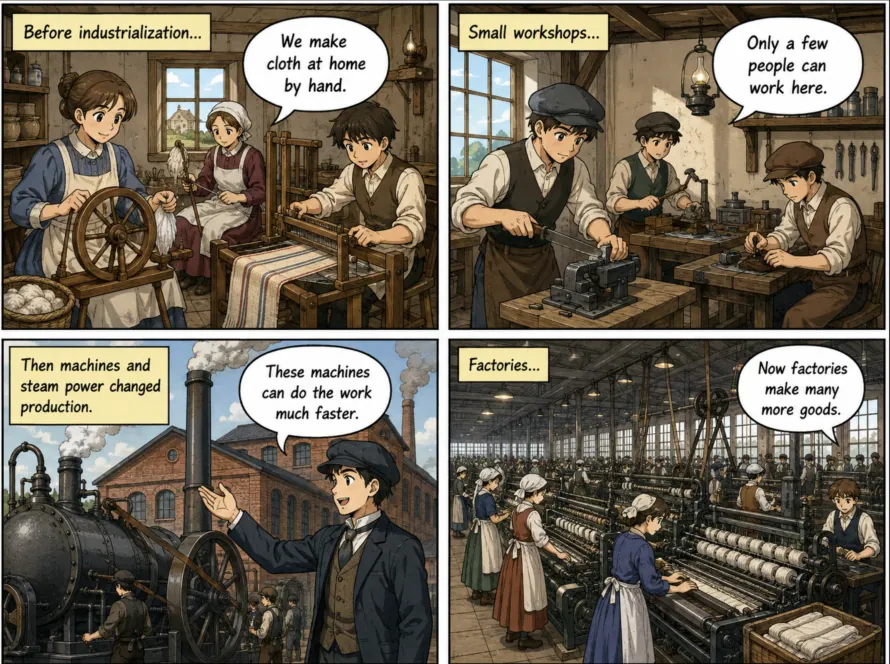
Easy Explanation
Before industrialization, many families made goods at home or in small workshops. New
machines and steam power allowed production to move into larger factories. Factories
could produce goods much faster and in much larger amounts. This shift was a major
part of industrialization.
Read the cartoon script
S1 Before industrialization..
Person 1 : We make cloth at home by hand.
S2 Small workshops…
Person 2 : Only a few people can work here.
S3 Then machines and steam power changed production.
Person 3 : These machines can do the work much faster.
S4 Factories…
Person 4 : Now factories make many more goods.
Topic 1.6 · Lesson 2 · PDF page 3
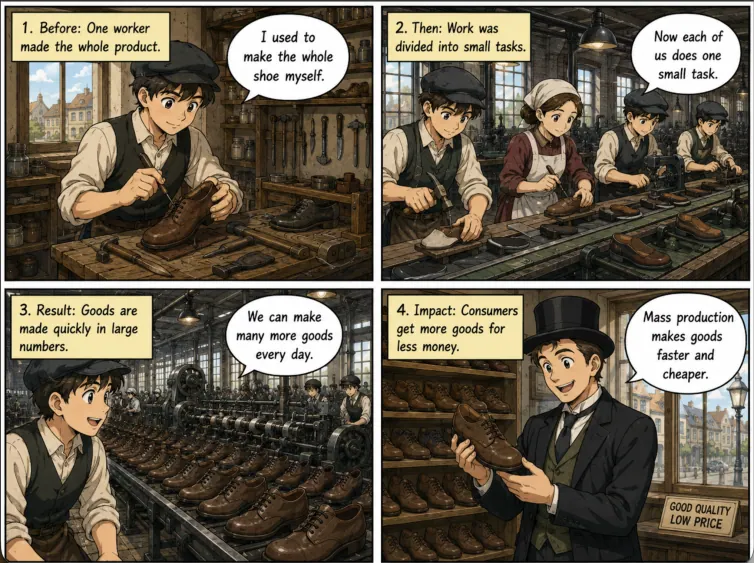
Division of Labour and Mass Production
Original MOSAIC worksheet illustration · Topic 1.6, page 3.
Vocabulary
Vocab
Easy Definition
division of labour
breaking one job into smaller tasks for different workers
task
one small part of a larger job
mass production
making many identical products quickly
efficiency
doing work with less time or effort
consumer
a person who buys goods
production
the process of making goods
Easy Explanation
Before factories, one worker might make an entire product. In factories, work was
divided into smaller tasks. Each worker repeated one part of the job. This made
production faster and helped factories create large numbers of goods. As a result, many
products became cheaper for consumers.
Read the cartoon script
S1 Before : One worker made the whole product.
Worker 1 : I used to make the whole shoe myself.
S2 Then : Work was divided into small tasks.
Worker 1 : Now each of us does one small task.
S3 Result : Goods are made quickly in large numbers.
Workers : We can make many more goods
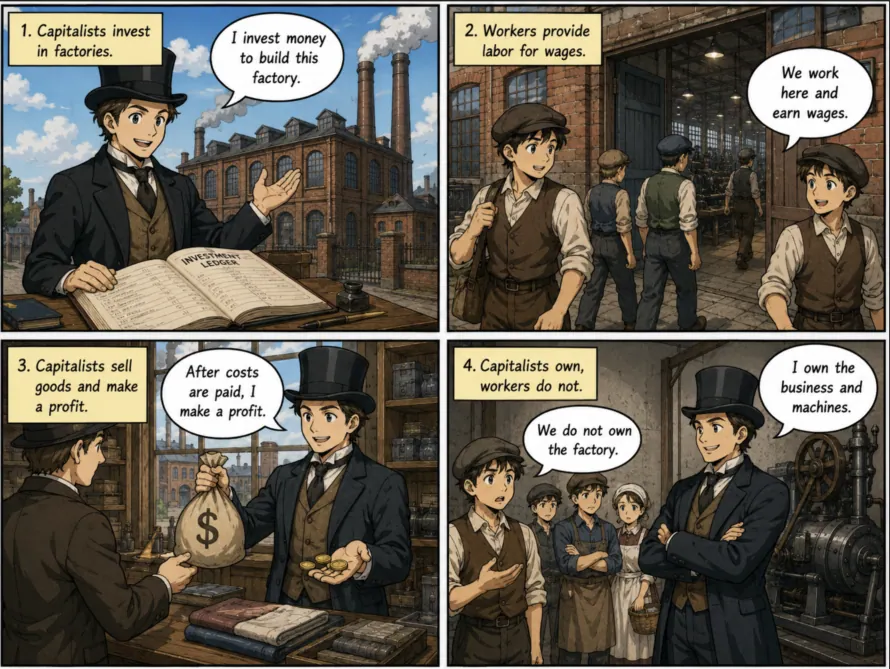
Topic 1.6 · Lesson 3 · PDF page 5
Capitalism, Owners, and Wage Workers
Original MOSAIC worksheet illustration · Topic 1.6, page 5.
Vocabulary
Vocab
Easy Definition
capitalism
an economic system where people can own businesses and invest money for profit
capitalist
a person who invests money in businesses or factories to make profit
investment
money put into a business to help it grow
wage
money paid to a worker for their labour
wage labour
working for another person or business in exchange for money
profit
money left after business costs are paid
factory owner
a person who owns a factory and its machines
Easy Explanation
Industrialization helped capitalism grow. Factory owners invested money in buildings,
machines, and materials. Workers did not usually own the factories. Instead, they
worked for wages. Factory owners sold the goods and tried to earn a profit. This created
clearer economic differences between owners and workers.
Read the cartoon script
S1 Capitalists invest in factories
Person 1 : I invest money to build this factory.
S2 Workers provide labor for wages.
Worker 1 : We work here and earn wages.
S3 Capitalists sell goods and make a profit.
Person 1 : After costs are paid, I make a profit.
S4 Capitalists own, workers do not.
Worker 1 : We do not own the factory.
Person 1 : I own the business and machines.
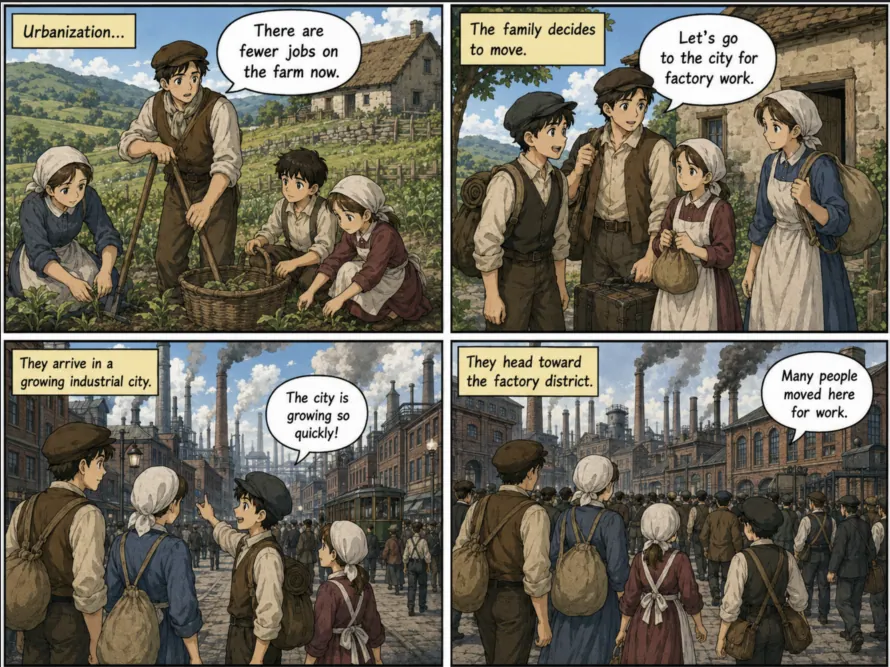
Topic 1.6 · Lesson 4 · PDF page 7
Urbanization
Original MOSAIC worksheet illustration · Topic 1.6, page 7.
Vocabulary
Vocab
Easy Definition
urbanization
the movement of people into growing towns and cities
rural
connected to the countryside or farming areas
urban
connected to a town or city
factory job
paid work in an industrial factory
migration
movement from one place to another
industrial city
a city that grows because of factories and industrial jobs
Easy Explanation
As farming changed and factories needed more workers, many people left rural areas.
Families moved to cities looking for factory jobs. This movement caused urbanization.
Industrial cities grew very quickly because large numbers of workers needed to live near
factories.
Read the cartoon script
S1 Urbanization
Worker 1 : There are fewer jobs on the farm now.
S2 The family decides to move.
Worker 1 : Let’s go to the city for factory work.
S3 They arrive in a growing industrial city.
Worker 2 : The city is growing so quickly!
S4 They head toward the factory district.
Worker 2 : Many people moved here for work.
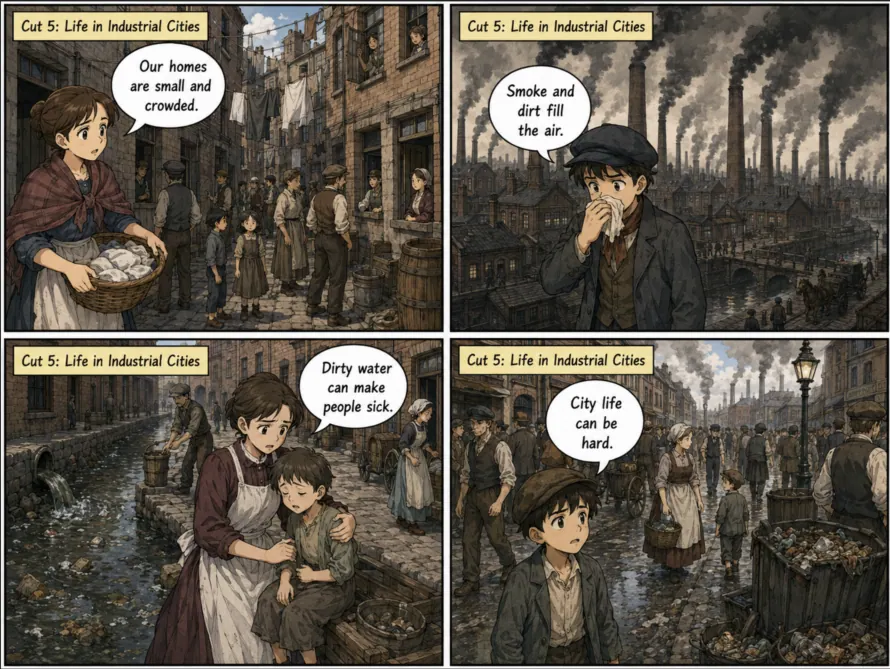
Topic 1.6 · Lesson 5 · PDF page 9
Life in Industrial Cities
Original MOSAIC worksheet illustration · Topic 1.6, page 9.
Vocabulary
Vocab
Easy Definition
overcrowding
too many people living in a small area
pollution
harmful smoke, waste, or chemicals that dirty the environment
sanitation
systems that help keep places clean and healthy
sewage
dirty waste water from homes and cities
contaminated water
water made unsafe by waste or germs
disease
an illness that affects people’s health
living conditions
the quality and safety of the place where people live
Easy Explanation
Industrial cities often grew faster than governments could build enough housing and
sanitation systems. Many working-class families lived in crowded neighborhoods.
Factory smoke polluted the air, while sewage could contaminate water. These poor living
conditions helped diseases spread more easily.
Read the cartoon script
S1
Person 1 : Our homes are small and crowded.
S2
Person 2 : Smoke and dirt fill the air.
S3
Person 3 : Dirty water can make people sick.
S4
Person 4 : City life can be hard.
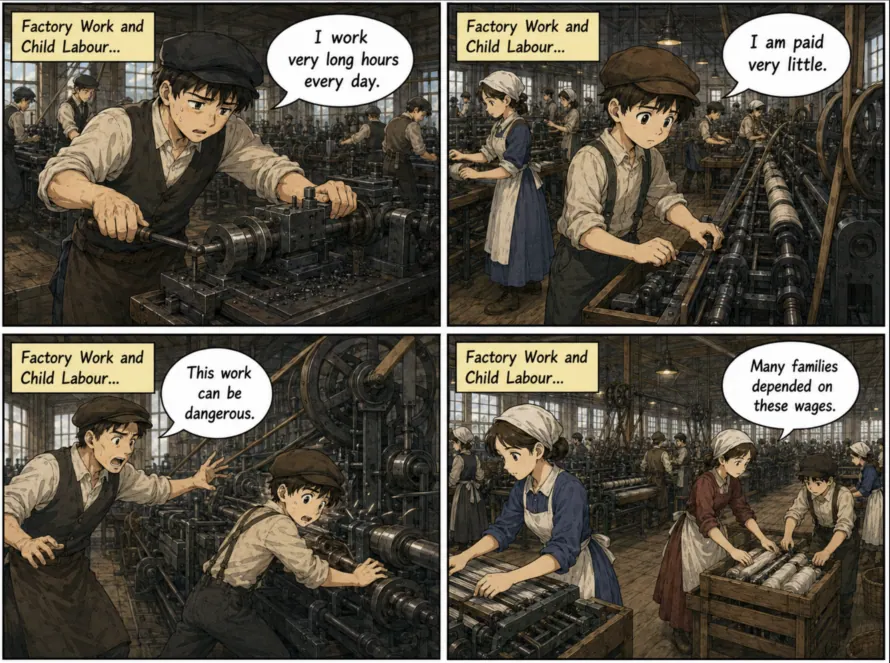
Topic 1.6 · Lesson 6 · PDF page 11
Factory Work and Child Labour
Original MOSAIC worksheet illustration · Topic 1.6, page 11.
Vocabulary
Vocab
Easy Definition
child labour
children working in jobs, often for long hours and low pay
working conditions
the situation workers experience in their workplace
low wages
receiving only a small amount of money for work
factory worker
a person who works in a factory
dangerous machinery
machines that can seriously injure workers
job security
confidence that a person will be able to keep their job
labour
physical or mental work
Easy Explanation
Factory work could be very difficult. Many workers had long hours, low wages, and
dangerous machines around them. Women and children also worked in factories and
mines. Children were often paid less than adults. At first, governments provided very
little protection for workers.
Read the cartoon script
S1 Factory work and child labour…
Worker 1 : I work very long hours every day.
S2
Child worker 1 : I am paid very little.
S3
Worker 2 : This work can be dangerous.
S4
Worker 3 : Many families depend on these wages.
Topic 1.6 · Lesson 7 · PDF page 13
Workers Demand Reform
Original MOSAIC worksheet illustration · Topic 1.6, page 13.
Vocabulary
Vocab
Easy Definition
trade union
an organization of workers that tries to improve pay and working conditions
strike
when workers stop working together to demand change
labour reform
changes intended to make work safer and fairer
Factory Act
a law created to regulate factory working conditions
factory inspector
a government worker who checks if factories follow labour laws
organize
to join together to work toward the same goal
regulation
an official rule controlling how something is done
Easy Explanation
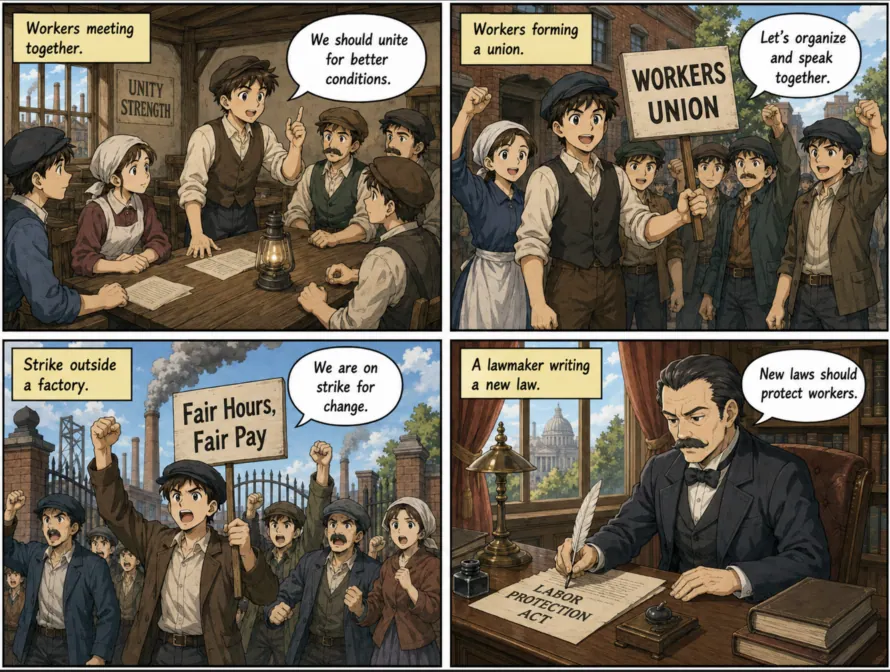
Workers began organizing because they wanted better conditions. They created trade
unions and sometimes went on strike. Reformers also demanded government action.
Laws such as the Factory Acts gradually limited child labour, reduced working hours for
some workers, and introduced factory inspections.
Read the cartoon script
S1 Workers meeting together
Worker 1 : We should unite for better conditions.
S2 Workers forming a union
Worker 1 : Let’s organize and speak together.
S3 Strike outside a factory
Worker 1 : We are on strike for change.
S4 A lawmaker writing a new law
Person 1 : New laws should protect workers.
Topic 1.6 · Lesson 8 · PDF page 15
Industrialization Changes the World
Original MOSAIC worksheet illustration · Topic 1.6, page 15.
Vocabulary
Vocab
Easy Definition
global trade
buying and selling goods between different countries
market
a place or system where goods are bought and sold
inequality
an unfair difference in wealth, power, or opportunity
imperialism
when a powerful country extends control over other lands or peoples
raw material
a natural resource used to make a product
environmental damage
harm done to nature, such as pollution or resource loss
economic growth
an increase in production, trade, and wealth
Easy Explanation
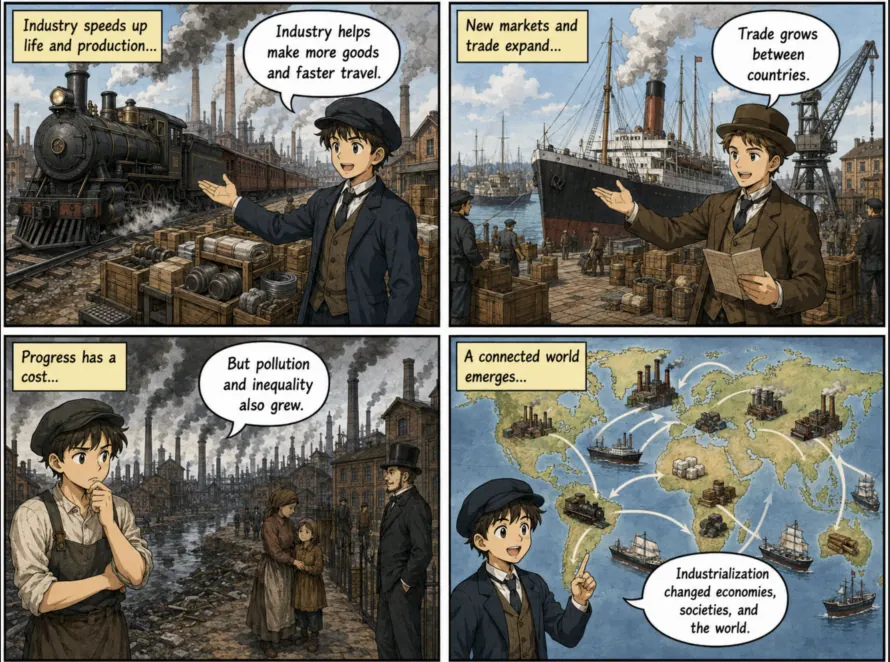
Industrialization increased production, trade, transportation, and economic growth.
Countries could make more goods and connect with distant markets.
However, industrialization also increased inequality and environmental damage.
Industrial countries wanted more raw materials and markets, which also helped
encourage imperialism.
Industrialization therefore changed economies, societies, and global relationships.
Read the cartoon script
S1 Industry speeds up life and production…
Person 1 : Industry helps make more goods and faster travel.
S2 New markets and trade expand…
Person 2 : Trade grows between countries.
S3 Progress has a cost…
Person 3 : But pollution and inequality also grew.
S4 A connected world emerges..
Person 4 : Industrialization changed economies, societies, and the world.
WRAP-UP
Summary and review
Final Summary
Easy explanation
Industrialization changed production from mostly handmade goods and small workshops
to machines, factories, and large-scale manufacturing.
The factory system increased production through division of labour and mass
production.
Industrial capitalism grew as factory owners invested money for profit and workers
increasingly depended on wages.
Factories attracted people from rural areas, causing rapid urbanization and the growth
of industrial cities.
Industrial cities often had overcrowding, pollution, poor sanitation, and disease.
Factory workers, including many women and children, often faced long hours, low
wages, and dangerous working conditions.
Workers organized trade unions, strikes, and reform movements to demand safer and
fairer conditions.
Industrialization increased trade and economic growth, but it also created inequality,
environmental damage, and stronger links to imperial expansion.
Check Your Understanding
1. What is industrialization, and how did it change production?
2. How did division of labour and mass production make factories
more efficient?
3. What was the relationship between factory owners and wage
workers?
4. Why did industrialization cause urbanization?
5. What problems did people face in rapidly growing industrial
cities?
6. Why were child labour and factory working conditions major
concerns?
7. How did workers try to improve their working conditions?
8. Was industrialization completely positive? Use two facts to
support your answer.
Encyclopaedia Britannica — Industrial Revolution
TOPIC 1.7
New Methods of Transportation
Follow the illustrated explanations, build your vocabulary, and check your understanding using the PDF.
Original MOSAIC worksheet illustration · Topic 1.7, page 2.
Vocabulary
Vocab
Easy Definition
railway
a system of tracks used by trains
distance
the amount of space between two places
labourer
a person who does difficult physical work
Chinese railway workers
Chinese labourers who helped build important Canadian railways
dangerous conditions
working situations that can cause serious injury or death
crop
a plant grown by farmers for food or sale
settlement
a place where people begin to live and build a community
trade
buying, selling, and moving goods
Easy Explanation
Canada is very large, so travelling between the east and west was difficult. Railways
helped connect distant parts of the country.
Building the railway was dangerous work. Many Chinese railway workers helped build
tracks through mountains and difficult land. They often faced dangerous conditions, low
pay, discrimination, and serious risks.
After the railway was built, trains could carry people, crops, and goods over long
distances. New towns and settlements grew near railway lines, and trade became easier.
Read the cartoon script
S1
Person (left) : Canada is huge. Many places are far apart.
Person (right) : We need a way to connect the east and the west.
S2
Person (left) : Workers, including many Chinese labourers, built the railway in dangerous
conditions.
Person (right) : The work was hard and risky.
S3
Train : The railway carries people, crops, and goods across long distances.
House : It helps new towns grow and connects the country.
Topic 1.7 · Lesson 2 · PDF page 5
Steamships: Faster and More Reliable Water Travel
Original MOSAIC worksheet illustration · Topic 1.7, page 5.
Vocabulary
Vocab
Easy Definition
steamship
a ship powered by a steam engine
sailing ship
a ship that moves mainly because of wind
engine
a machine that provides power
reliable
able to work regularly and dependably
passenger
a person travelling in a ship or vehicle
goods
products or items that are moved or sold
market
a place or system where goods are bought and sold
connect
to link people or places together
Easy Explanation
Before steamships, many ships depended on wind, so travel could be slow or uncertain.
Steamships used engines, which made travel on rivers and lakes faster and more
reliable.
Steamships could carry more passengers and goods between communities. They helped
towns trade with larger markets and made different places easier to connect.
Read the cartoon script
S1
Man : The wind is weak today. Sailing can be slow and uncertain.
Child : We ned a faster way to move people and goods.
S2
Ship : This steamship uses an engine, so it does not depend only on the wind!
Ship 2 : Now travel on rivers and lakes is more reliable.
S3
Person (left) : Steamships carry passengers and goods more quickly.
Person (right) : They help connect towns and markets.
Topic 1.7 · Lesson 3 · PDF page 7
Cars: More Freedom and New Road Networks
Original MOSAIC worksheet illustration · Topic 1.7, page 7.
Vocabulary
Vocab
Easy Definition
automobile
another word for a car
railway track
the metal tracks that trains travel on
highway
a major road used for longer-distance travel
road network
a connected system of roads
truck
a road vehicle used to carry goods
deliver
to take goods to a person or place
mobility
the ability to move easily from one place to another
traffic
many vehicles moving or waiting on roads
pollution
harmful materials released into the environment
Easy Explanation
Cars gave people more freedom because they did not have to follow train tracks or train
schedules. People could choose when to leave and where to travel.
As more people used cars, governments built more roads and highways. Trucks also
became important because they could deliver goods directly to stores, businesses, and
communities.
Cars increased people's mobility, but more cars also created more traffic and pollution.
Read the cartoon script
S1
Person 1 : Cars let people travel without following train tracks.
Person 2 : We can leave when we want!
S2
Farmer : As more people buy cars, governments build roads and highways.
Truck driver : Trucks can deliver goods directly.
S3
Family : Cars give families more freedom to live and work in different places.
Blue car : But more cars also mean traffic and pollution.
Topic 1.7 · Lesson 4 · PDF page 10
Aircraft: Reaching Remote Places Faster
Original MOSAIC worksheet illustration · Topic 1.7, page 10.
Vocabulary
Vocab
Easy Definition
aircraft
a machine that can fly, such as an airplane
powered flight
flight using an engine
remote
far away from cities or major transportation routes
bush plane
a small plane used to reach remote areas
supplies
useful things such as food, tools, or medicine
mail
letters and packages sent to people
long-distance travel
travelling between places that are very far apart
travel time
the amount of time needed to reach a place
region
a large area of a country
Easy Explanation
Early aircraft showed that people could travel through the air using engines. This created
a much faster way to travel over long distances.
Aircraft were especially useful in Canada's remote areas. Bush planes could carry
people, mail, and supplies to places that were difficult to reach by road or railway.
As air travel improved, aircraft connected distant regions of Canada much faster. Trips
that once took days could eventually take only hours.
Read the cartoon script
S1
Person 1 : This early aircraft shows that people can travel through the air.
Person 2 : Flying could save a lot of time.
S2
Plane : Planes can reach remote places that are hard to reach by road or rail. We can carry mail,
supplies, and people.
S3
Person 3 : Aircraft connect distant parts of Canada very quickly.
The tower : Long trips that took days can now take hours.
WRAP-UP
Summary and review
Final Summary
Easy explanation
Steamships made water travel faster and more reliable because they used engines
instead of depending only on wind.
Railways connected distant parts of Canada and helped move people, crops, and goods
over long distances.
Many Chinese labourers helped build the railway, often in dangerous conditions and
while facing discrimination.
Cars gave people more freedom to travel and encouraged the growth of roads,
highways, and truck transportation.
Aircraft made long-distance travel much faster and helped connect remote parts of
Canada.
Check Your Understanding
1. Why were steamships more reliable than sailing ships?
2. How did railways help connect Canada?
3. What challenges did many Chinese railway workers face?
4. How did cars change the way people travelled?
5. Why did governments build more roads and highways?
6. Why were aircraft especially useful in Canada?
7. Which transportation technology do you think changed Canada the most? Use two
facts to explain your answer.
Parks Canada — History of early steam transportation and aviation in Canada
Canadian Museum of History — Canadian Pacific Railway and the Last Spike
Parks Canada — Railway development and transportation history in Canada
The manga-style illustrations are original educational artwork created for MOSAIC. They
are learning visuals, not primary sources.
DOWNLOAD WORKSHEETS
Choose a topic
Open the original PDF worksheets in a new tab. URLs assume the Supabase folder worksheets/bc-social-studies-9/topic-1.