TOPIC 4.1
What is the universe, and how do we make sense of it?
Understanding the Universe: Space, Stories, and Perspectives
Big Question:
How do people understand the universe in different ways?
Looking at the Night Sky

Context / Background
People have always looked at the sky.
They used the sky to tell stories, ask questions, and explain the world.
Some people understand the universe through science.
Some people understand it through stories, culture, and place.
Both are ways of making sense of what we see.
What Does “Universe” Mean?
Easy Explanation
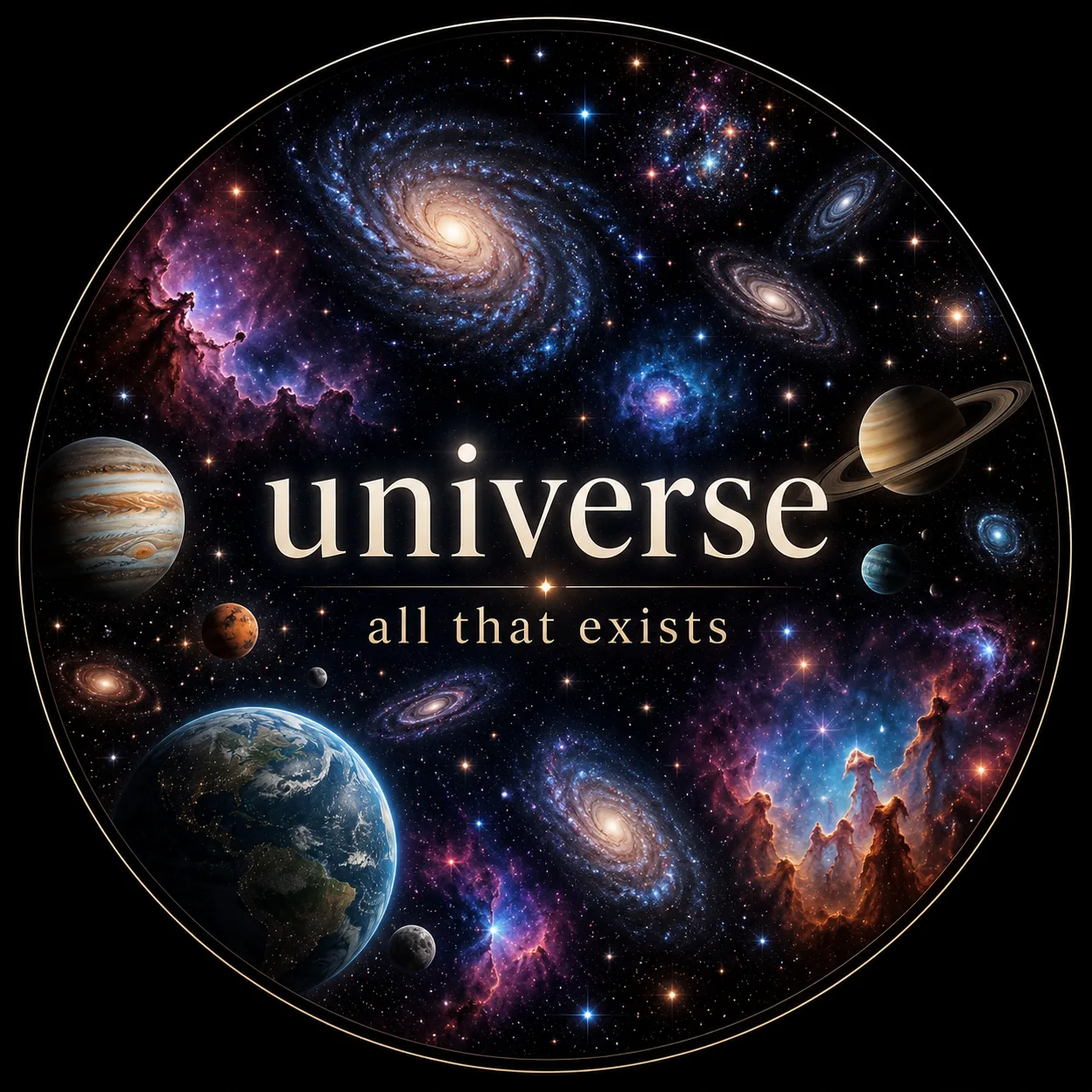
The universe means all that exists.
It includes:
space / stars / planets / galaxies / energy / matter
But people may understand the word “universe” differently.
Your idea of the universe can depend on what you know,
where you live, and when you live.
Different Views of the Same Universe
Background
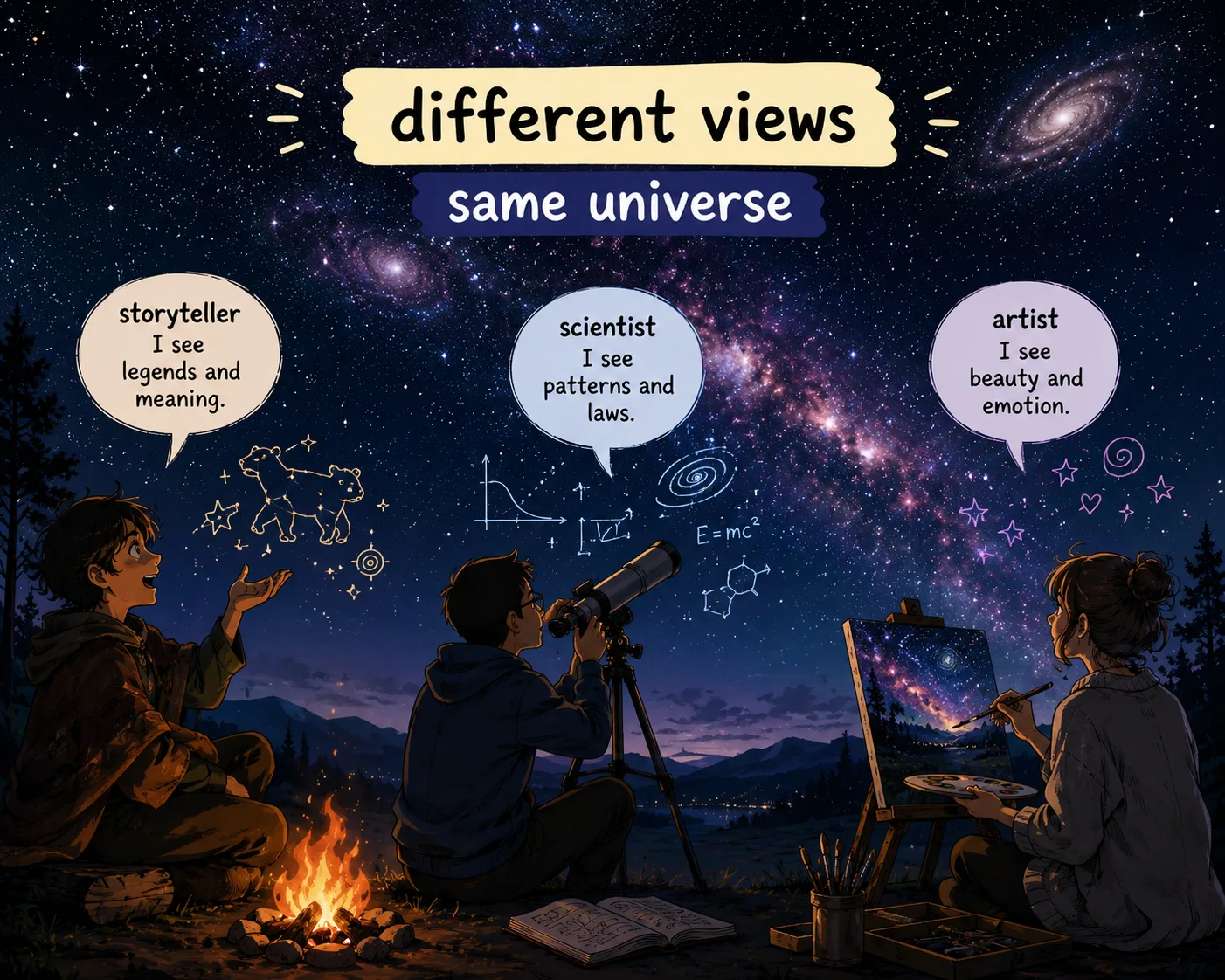
People can look at the same sky and understand it in different ways.
A scientist may ask,
“How far away are those stars?”
A storyteller may ask,
“What story does this pattern tell?”
An artist may ask,
“How does this sky feel?”
Different perspectives can all help us understand the universe.
The Universe Is Very Large
Easy Explanation
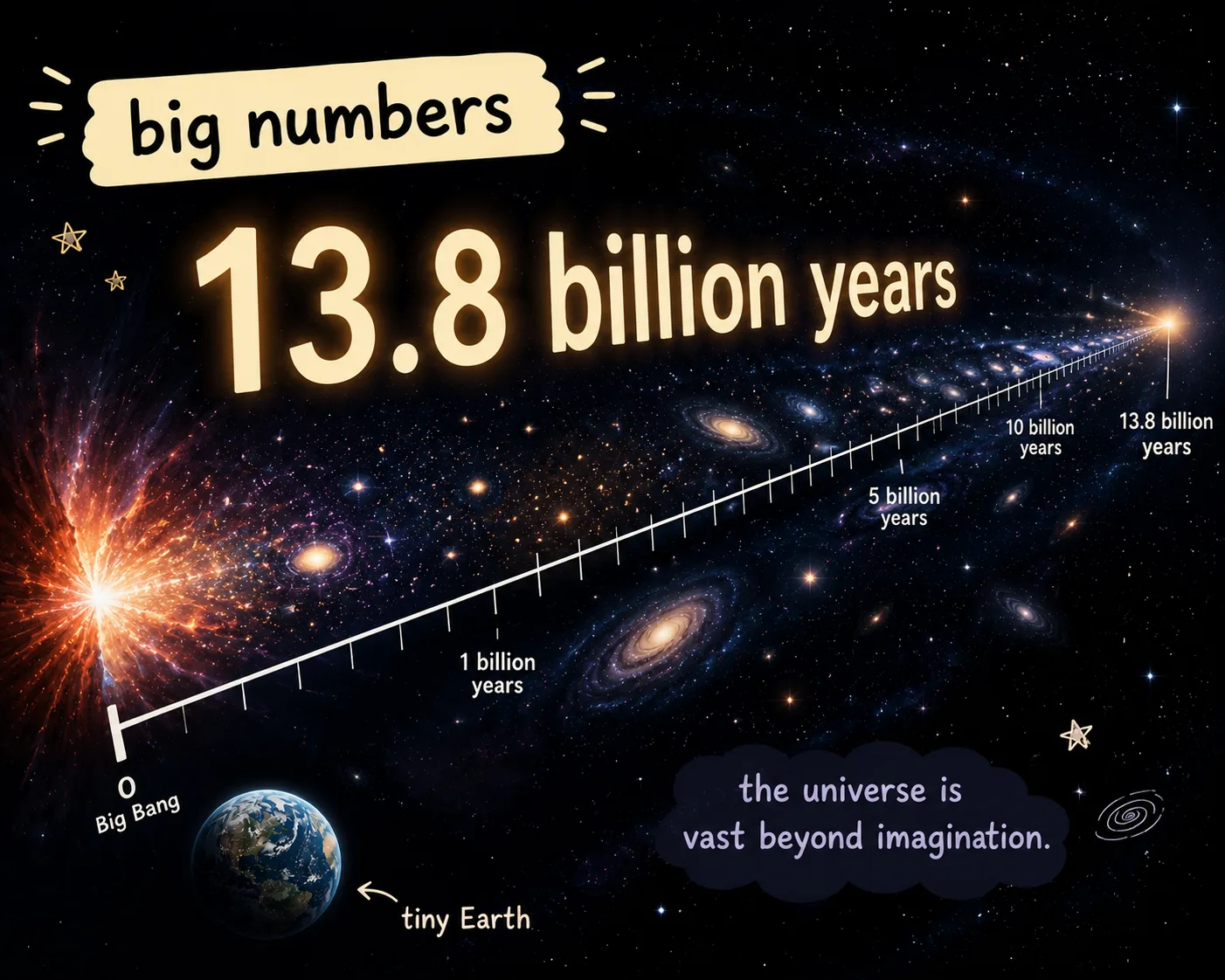
Scientists estimate that the universe began about
13.8 billion years ago.
That number is very difficult to imagine.
A worksheet should help students make large numbers easier to understand.
Example:
13.8 billion years is much longer than human history.
It is longer than the history of dinosaurs.
It is almost impossible to picture without models or analogies.
Tiny View, Huge Universe
Easy Explanation
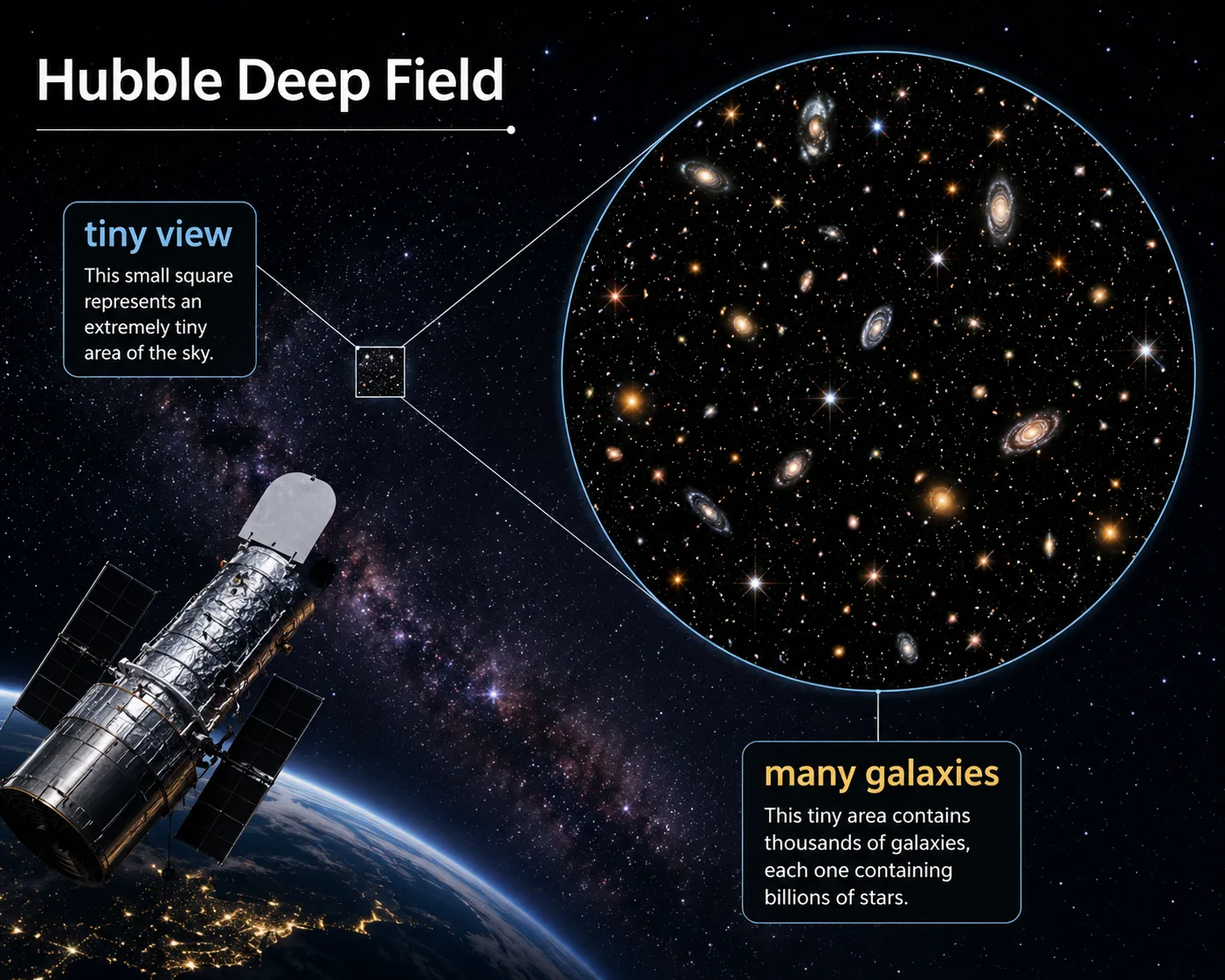
A small part of the sky can contain many galaxies.
This shows that the universe is much larger than what we can see
with our eyes.
Modern technology helps scientists observe deeper into space.
The “Bowl of the World” Analogy
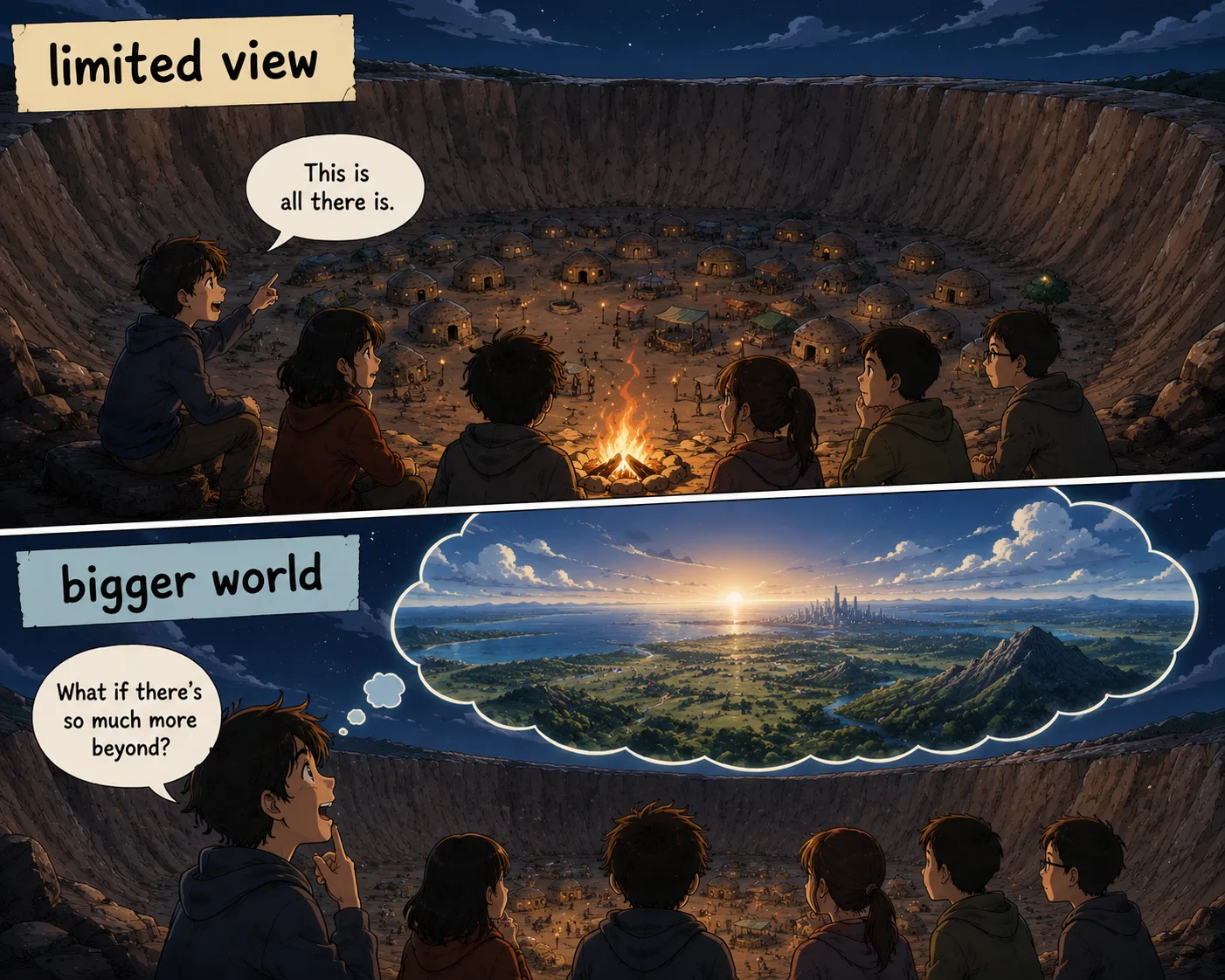
Easy Explanation
If someone lived inside a crater,
they might think that the crater is their whole world.
But if they climbed above the crater wall,
they would see much more.
This is like our understanding of the universe.
People’s understanding can change when they gain new knowledge.
Time, Place, and Knowledge Change Understanding

Easy Explanation
People from different times may understand the world differently.
Technology changes what people can observe, communicate, and know.
A person from the past might find modern technology confusing.
A person today might find older technology unfamiliar too.
This shows that understanding depends on time and context.
Light Pollution
Easy Explanation
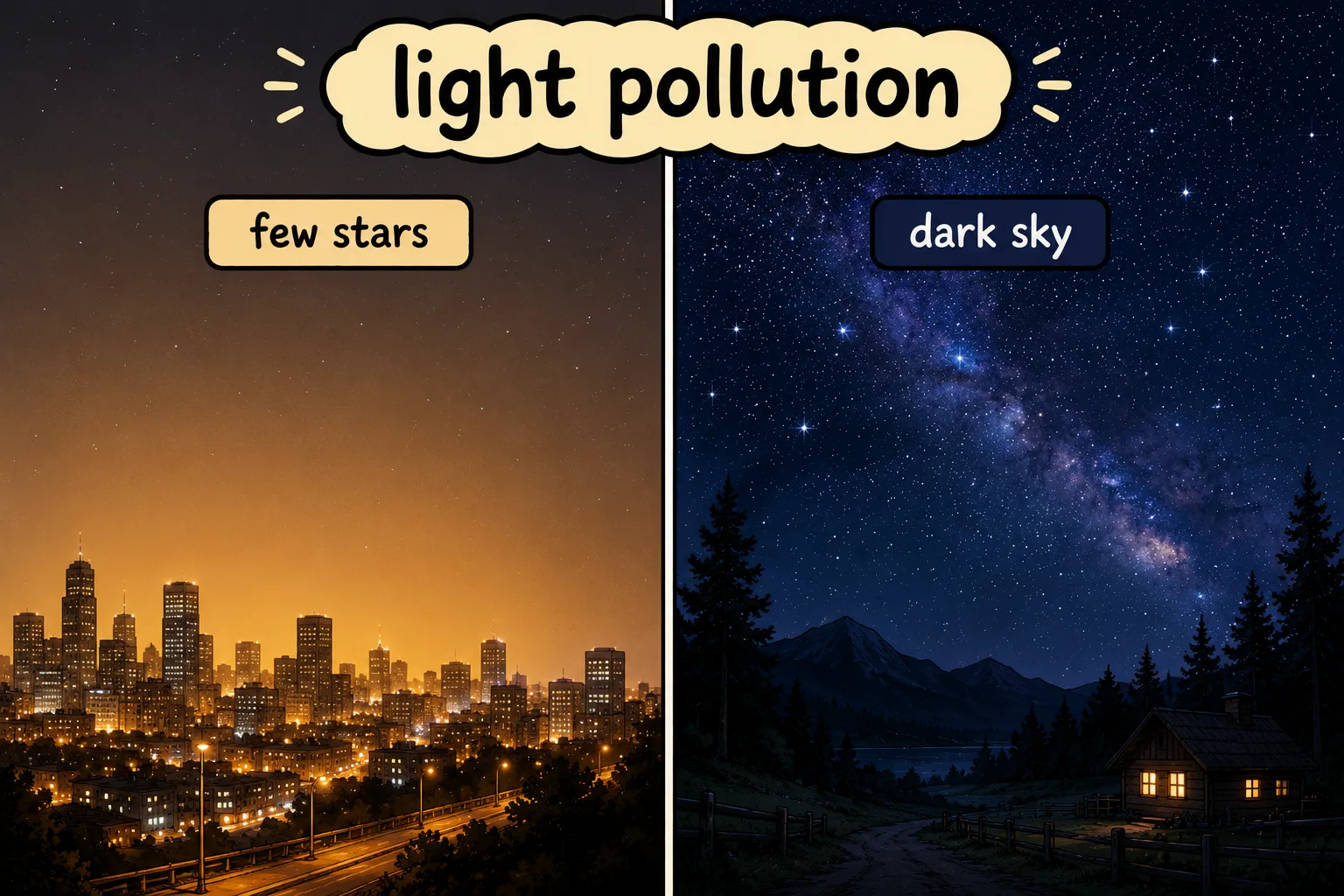
Light pollution happens when artificial light
makes the night sky too bright.
In cities, it can be hard to see stars.
In darker places, more stars are visible.
Light pollution can also affect living things.
Living Things and Light Pollution
Easy Explanation
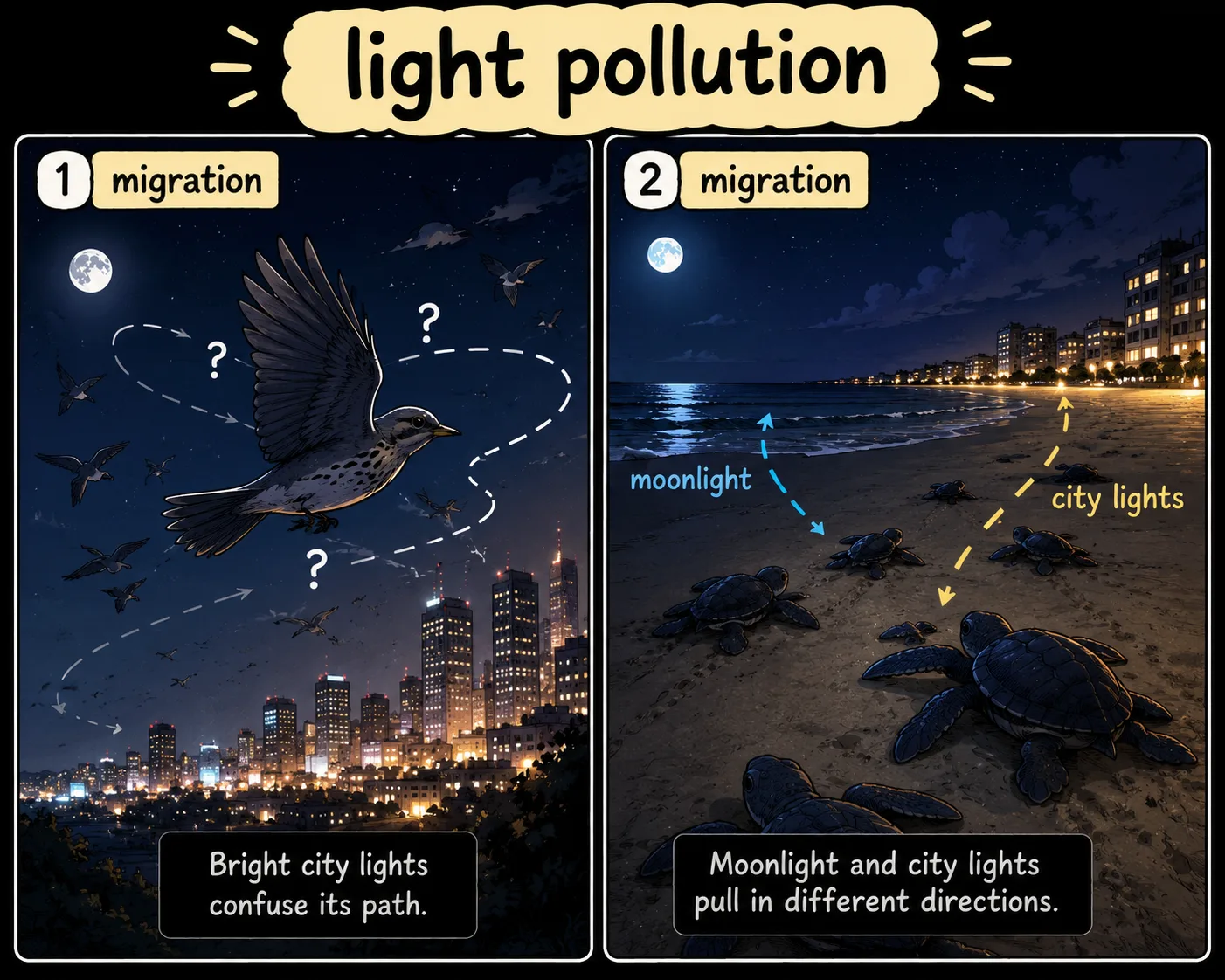
Some animals use natural light to move or find direction.
Birds may use stars during migration.
Sea turtles may use moonlight near the ocean.
Artificial light can confuse them.
Asking Scientific Questions
Easy Explanation
Science begins with observation.
When we look at the night sky, we can ask questions.
Examples:
- How far away are the stars?
- Why are some stars brighter?
- Why do stars have different colours?
- Are there other galaxies?
Good questions can lead to investigations.
Mini Activity
Write one question you have about space:
FINAL SUMMARY
Final Explanation
People make sense of the universe in many ways.
They observe the sky.
They tell stories.
They use science and technology.
They learn from culture, place, and time.
The universe is not only something we study.
It is also something people connect to through meaning and perspective.
TOPIC 4.2
What can we know from the visible sky?
The Visible Sky: Patterns, Stories, and Sky Models
Big Question:
What can people learn about the universe by observing the sky with only their eyes?
What Can We See in the Sky?
Easy Explanation
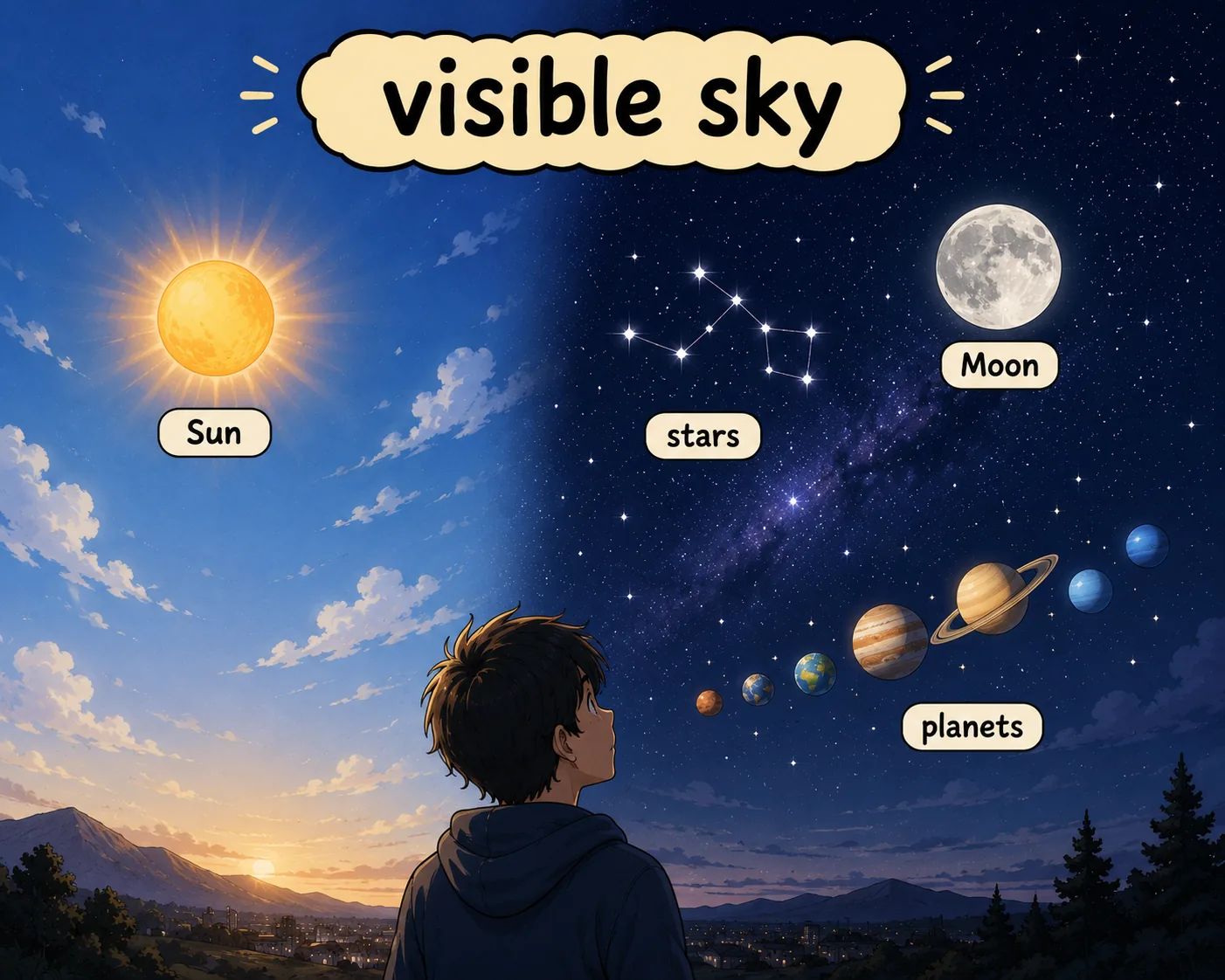
People can see many objects in the sky without a telescope.
We can see the Sun during the day.
At night, we can see the Moon, stars, and sometimes planets.
These objects appear in patterns.
Many of these patterns are predictable.
The Sun: The Daytime Object
Easy Explanation
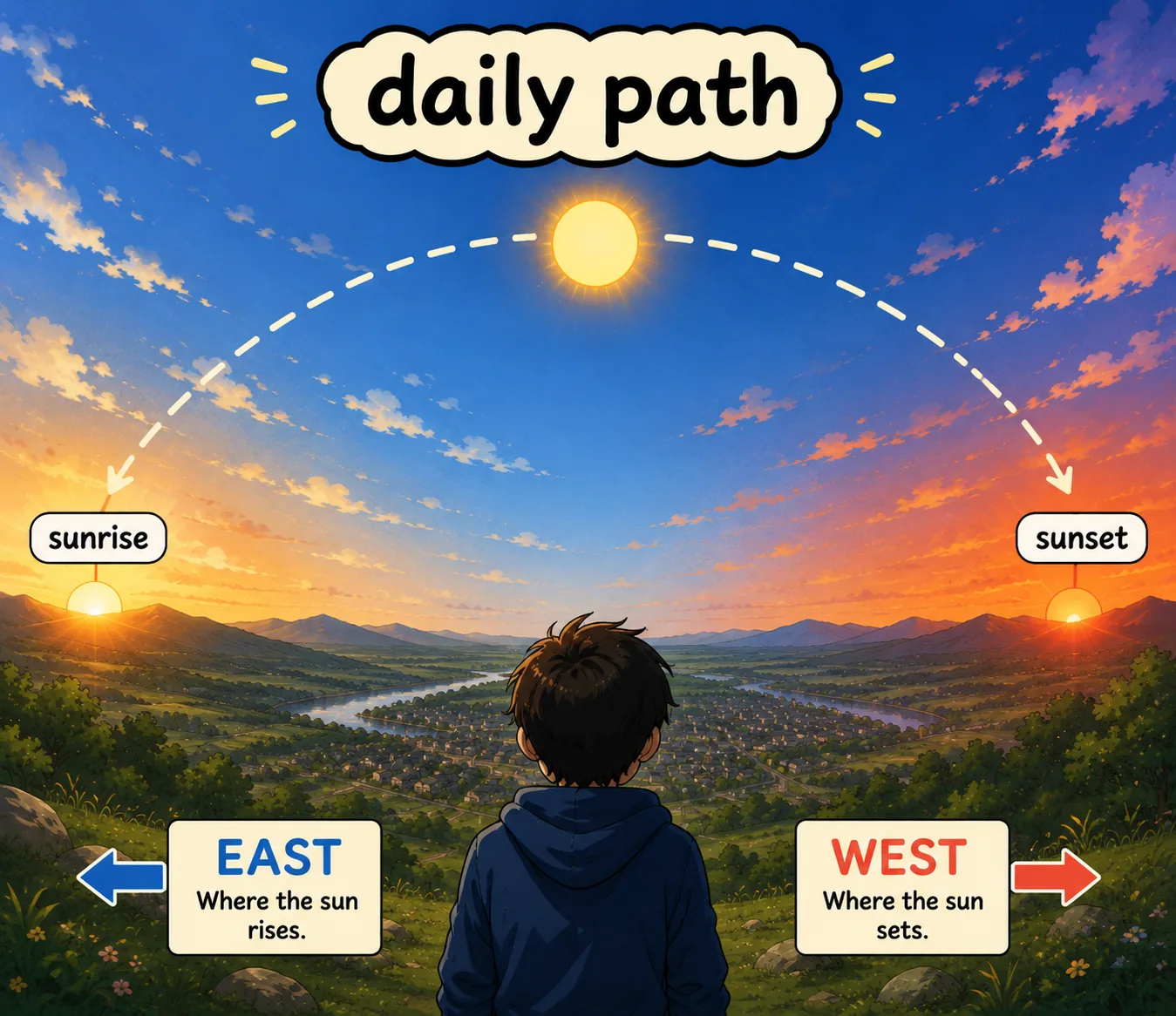
The Sun appears to move across the sky each day.
It rises in the east.
It sets in the west.
This happens because Earth rotates.
The Sun helps people tell time, seasons, and directions.
Stars: Patterns in the Night Sky
Easy Explanation
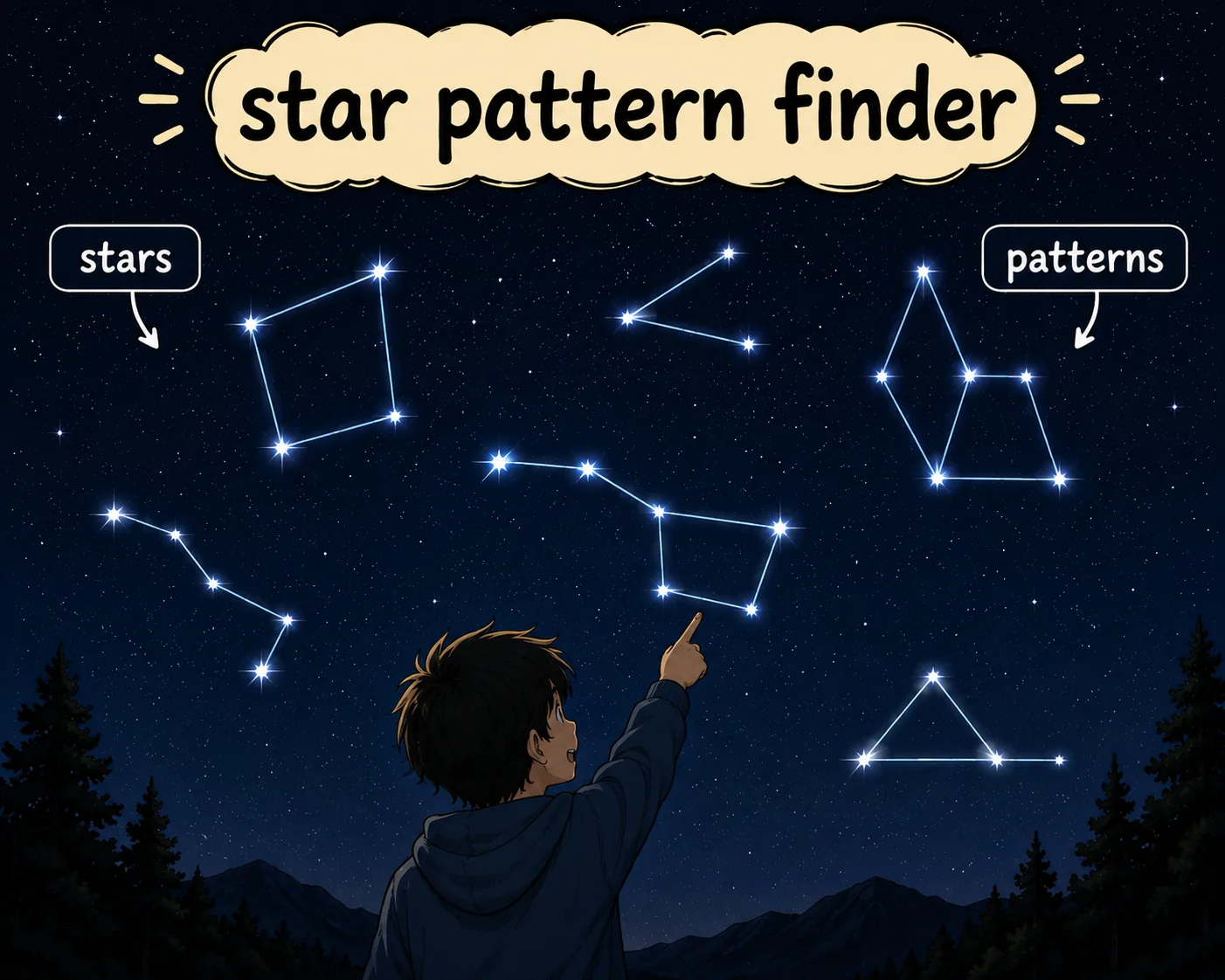
Stars appear as points of light in the night sky.
Some stars look brighter than others.
People notice patterns among stars.
These patterns helped people remember the sky.
They also helped with stories, calendars, and navigation.
Constellations
| Vocab |
What it means |
| Constellation |
A group of stars that forms a pattern |
Easy Explanation
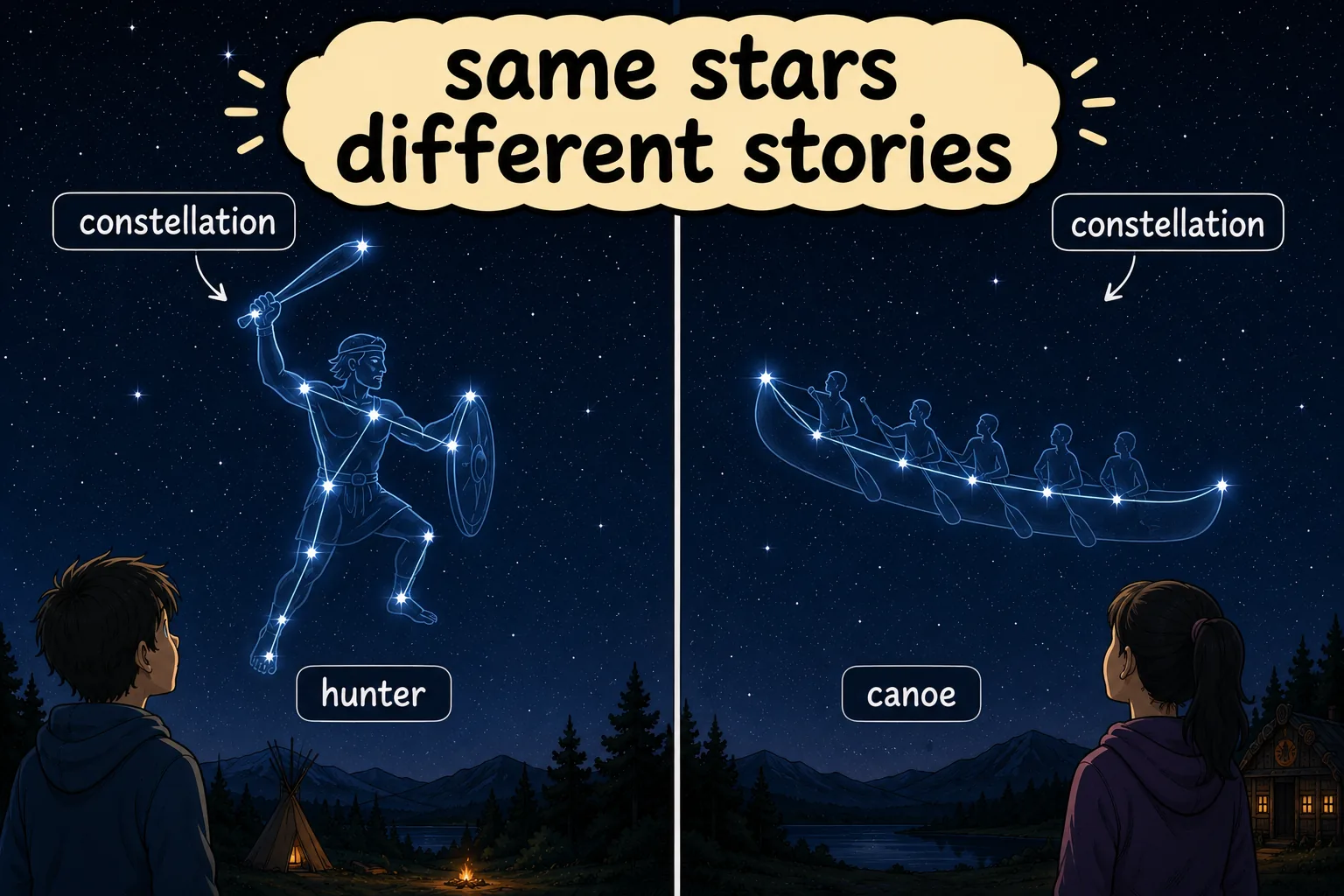
A constellation is a group of stars that forms a pattern.
Different cultures may see different shapes in the same stars.
One group may see a hunter.
Another group may see a canoe.
The stars are the same, but the story can be different.
Evidence from the Past
Easy Explanation
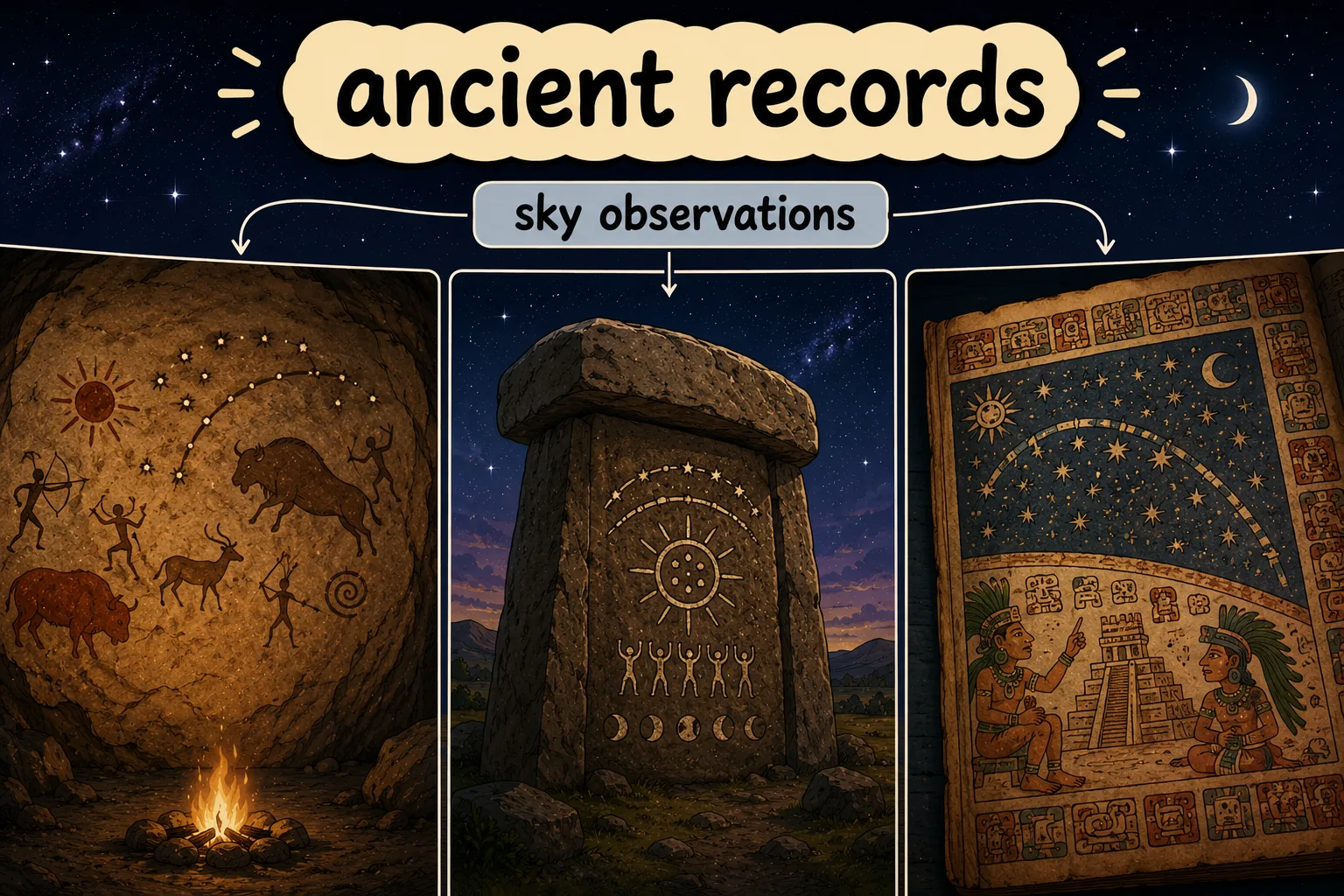
People long ago observed the sky carefully.
They recorded sky patterns in different ways.
Examples:
cave paintings / stone circles / carvings / ancient books
These records show that people studied the Sun, Moon, stars, and planets.
The Moon and Its Cycle
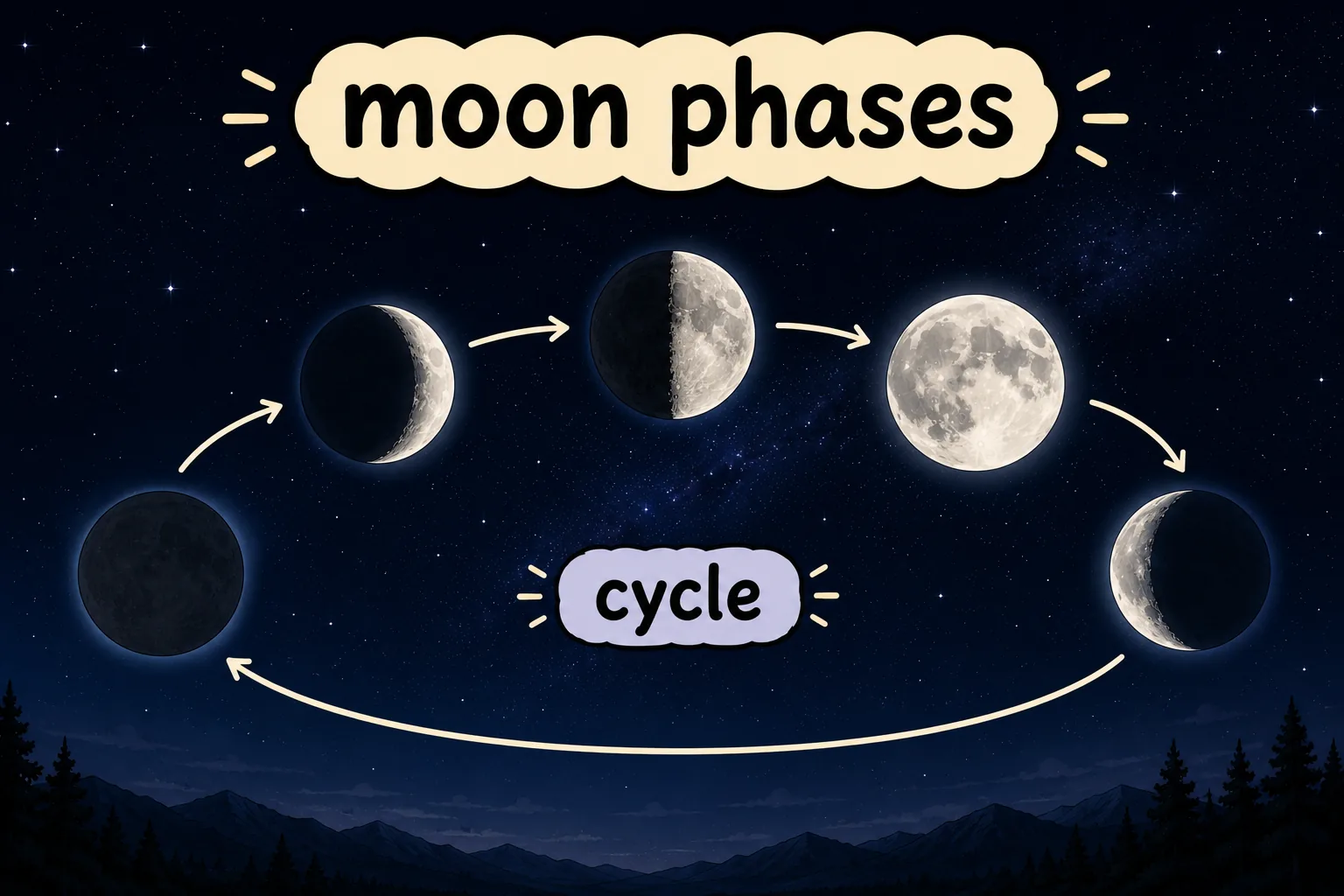
| Vocab |
What it means |
| Moon Phase |
The Moon changes appearance from night to night |
Easy Explanation
One full cycle takes about one month.
People used the Moon to track time and make calendars.
The Celestial Sphere
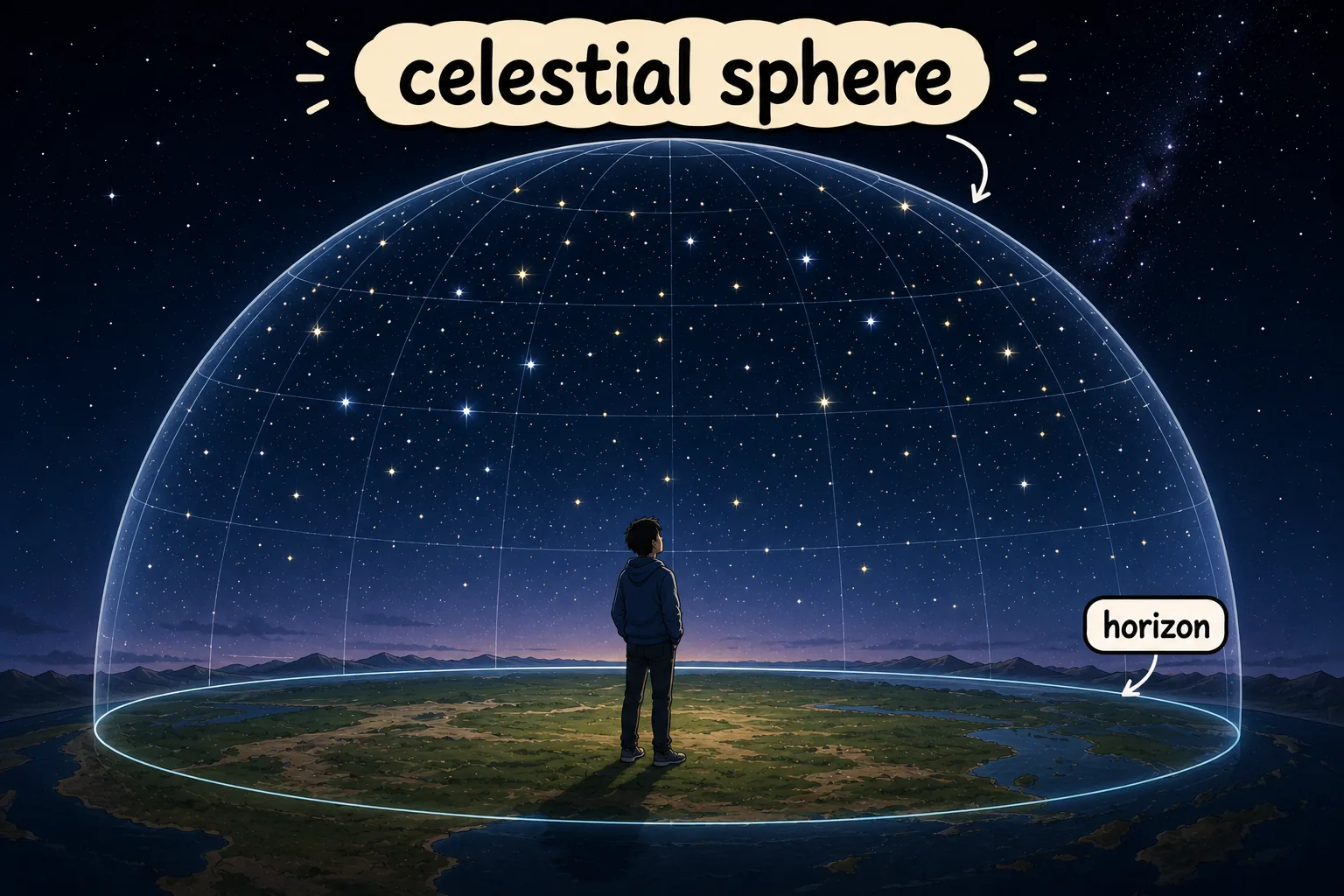
| Vocab |
What it means |
| Celestial sphere |
An imaginary model of the sky.
It helps us describe where objects appear.
|
Easy Explanation
From Earth, the sky looks like a dome around us.
The stars seem to move across this dome.
This is a model.
It helps us understand what we observe.
Stars Appear to Move
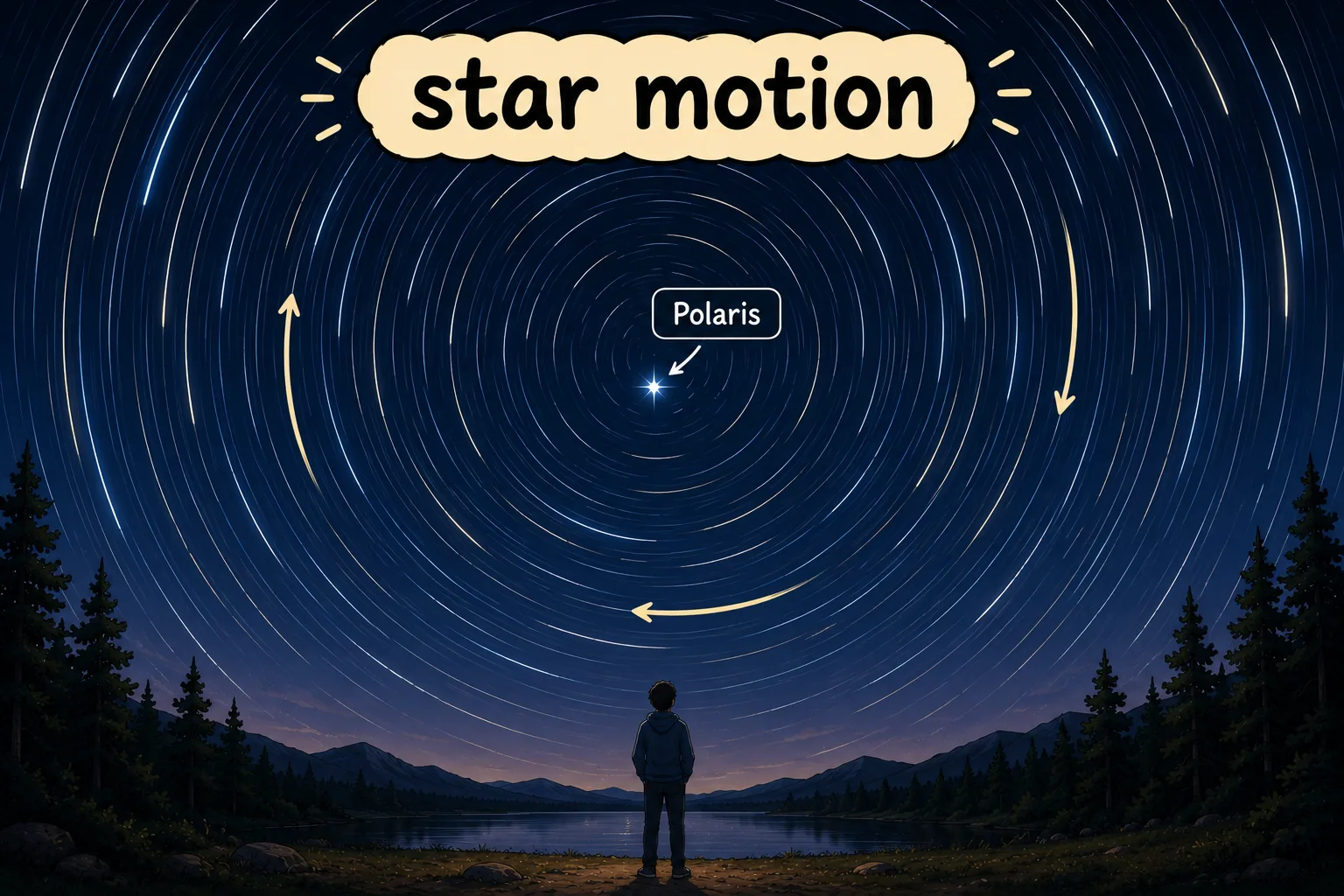
| Vocab |
What it means |
| Polaris (North Star) |
A bright yellow supergiant star.
It sits very close to the north pole.
It is a key tool for navigation since it sits there.
|
Easy Explanation
Stars appear to move across the night sky.
In the northern hemisphere, many stars appear to circle around Polaris.
Polaris is called the North Star.
This happens because Earth rotates.
The Ecliptic
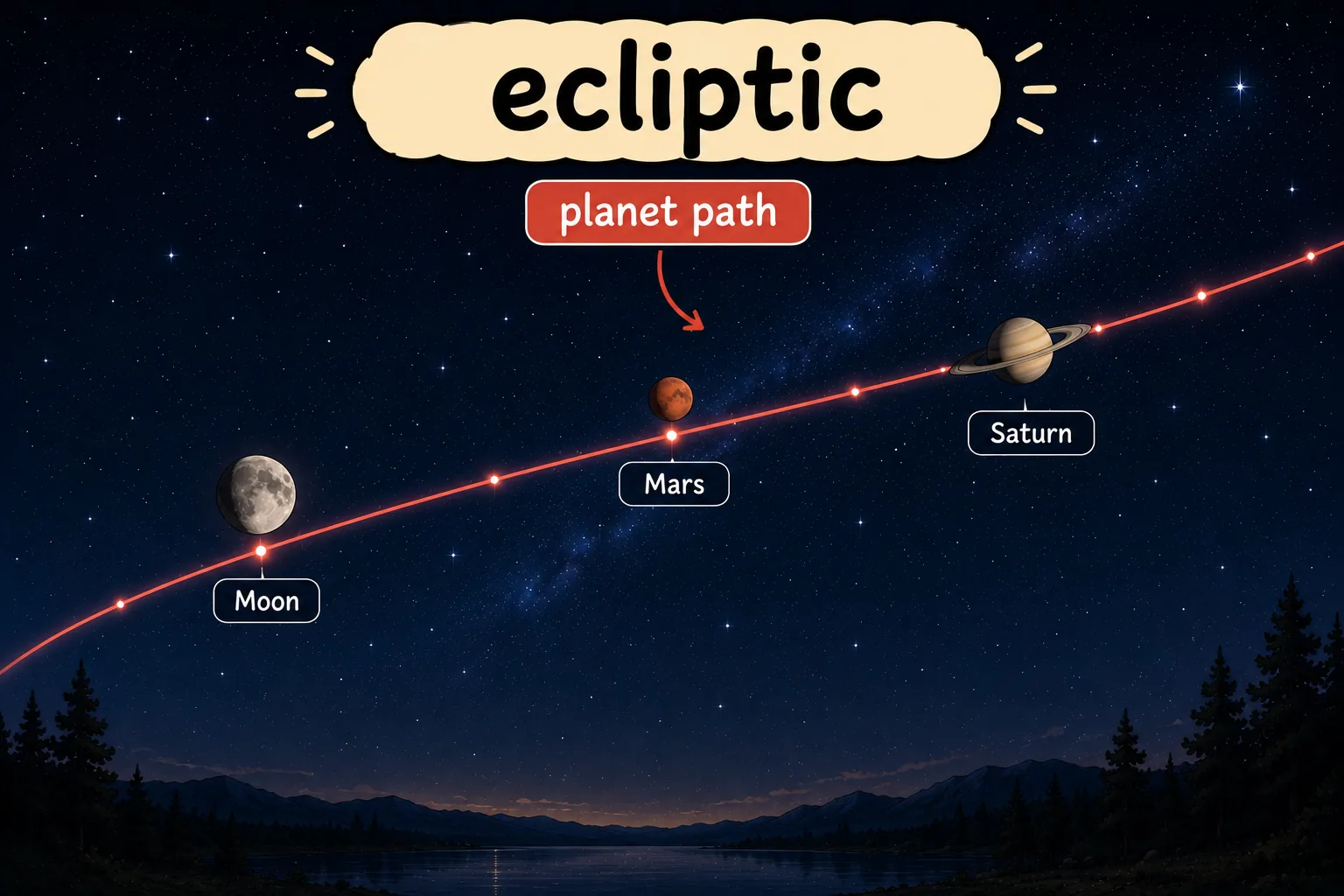
| Vocab |
What it means |
| Ecliptic |
The path the Sun appears to follow across the sky over a year.
The Moon and planets often appear near this path.
|
Easy Explanation
This helps people locate planets in the sky.
Changing Night Sky by Season
Easy Explanation
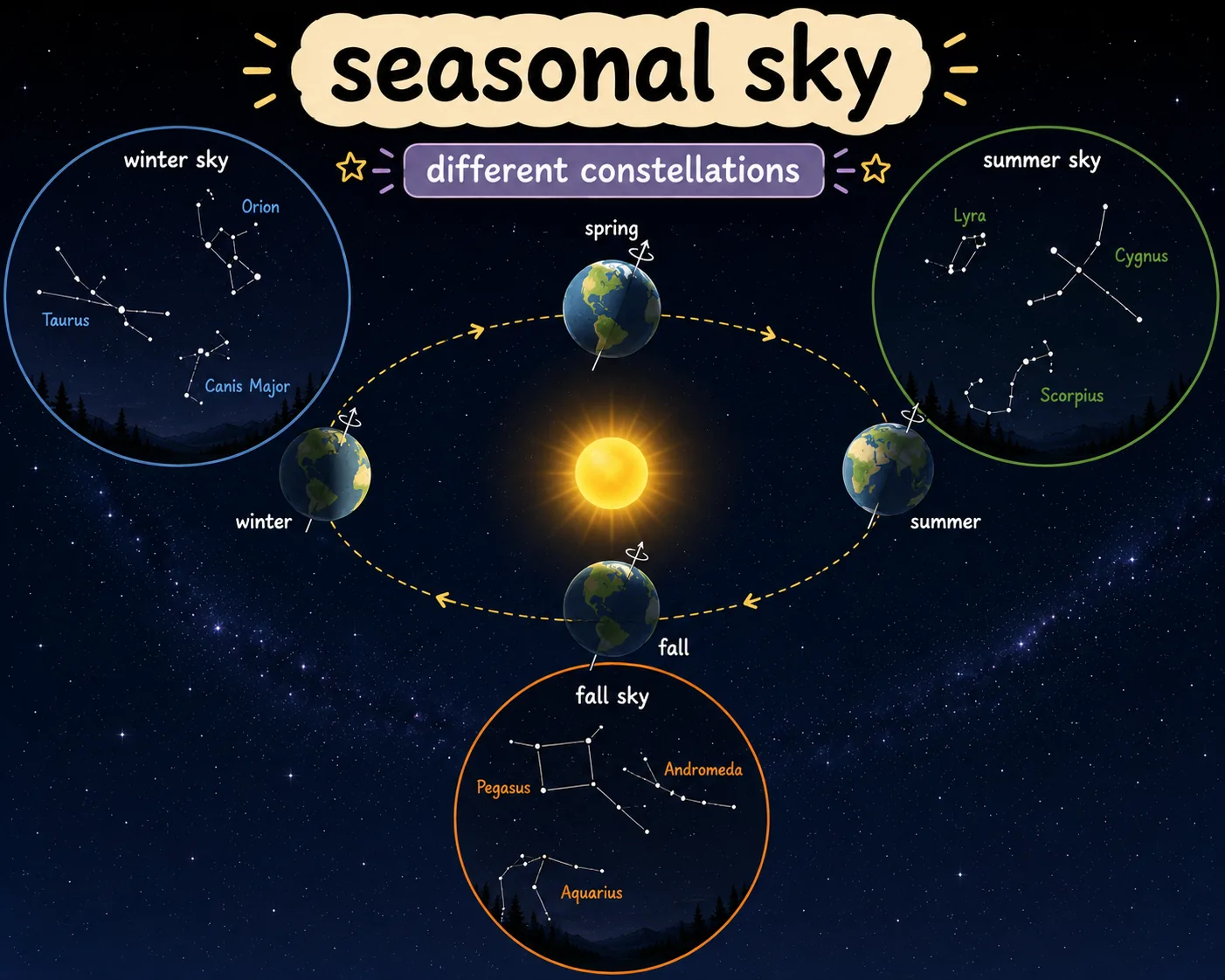
We do not see the same stars all year.
As Earth moves around the Sun, our nighttime view changes.
Some constellations are visible in winter.
Others are visible in summer.
Retrograde Motion
| Vocab |
What it means |
| Retrograde Motion |
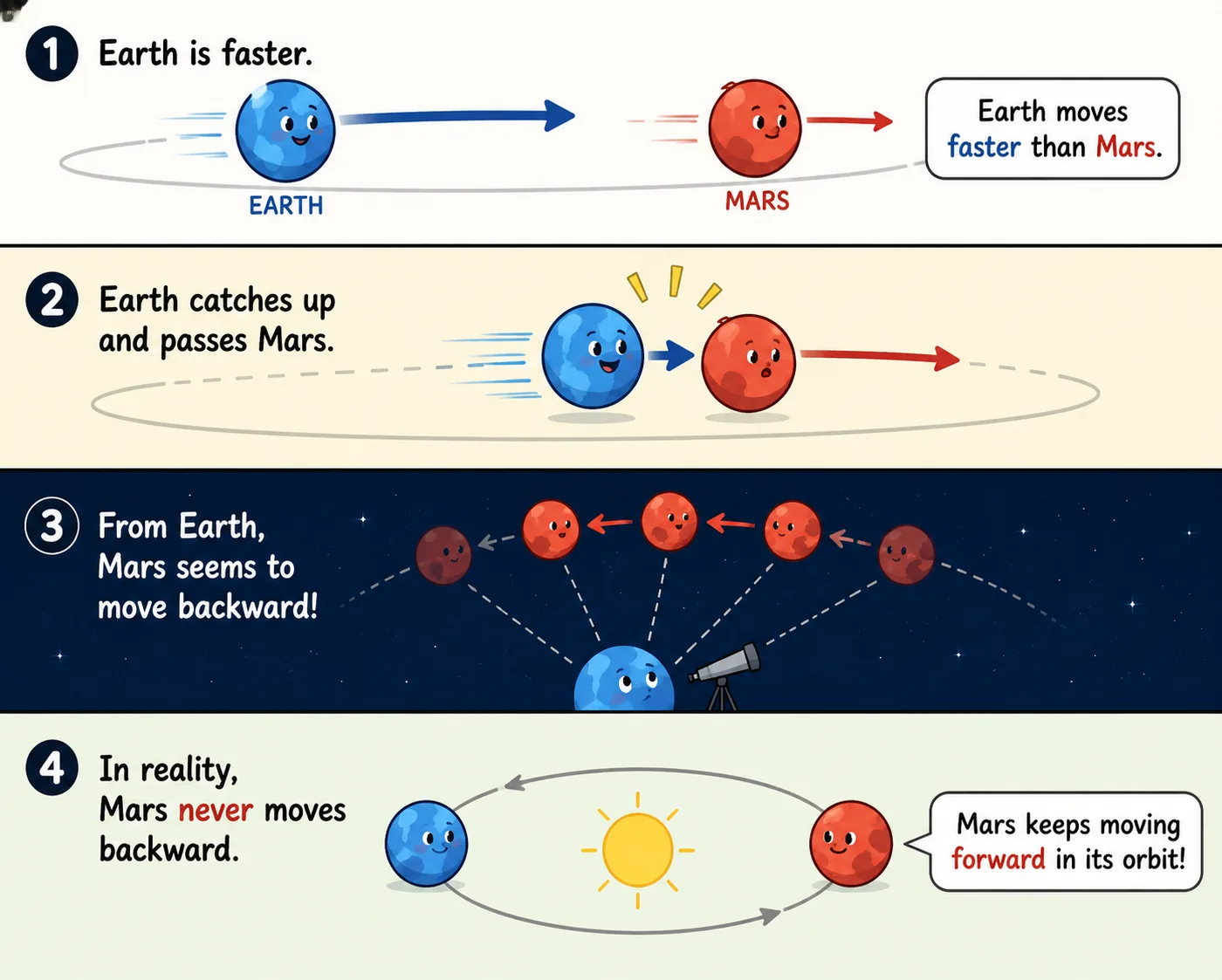
Planets usually appear to move one way across the sky.
Sometimes a planet appears to slow down, move backward, and loop.
This is called retrograde motion.
|
Easy Explanation
It is an apparent motion.
It happens because Earth and the planet move at different speeds around the Sun.
Azimuth and Altitude
| Vocab |
What it means |
| Azimuth |
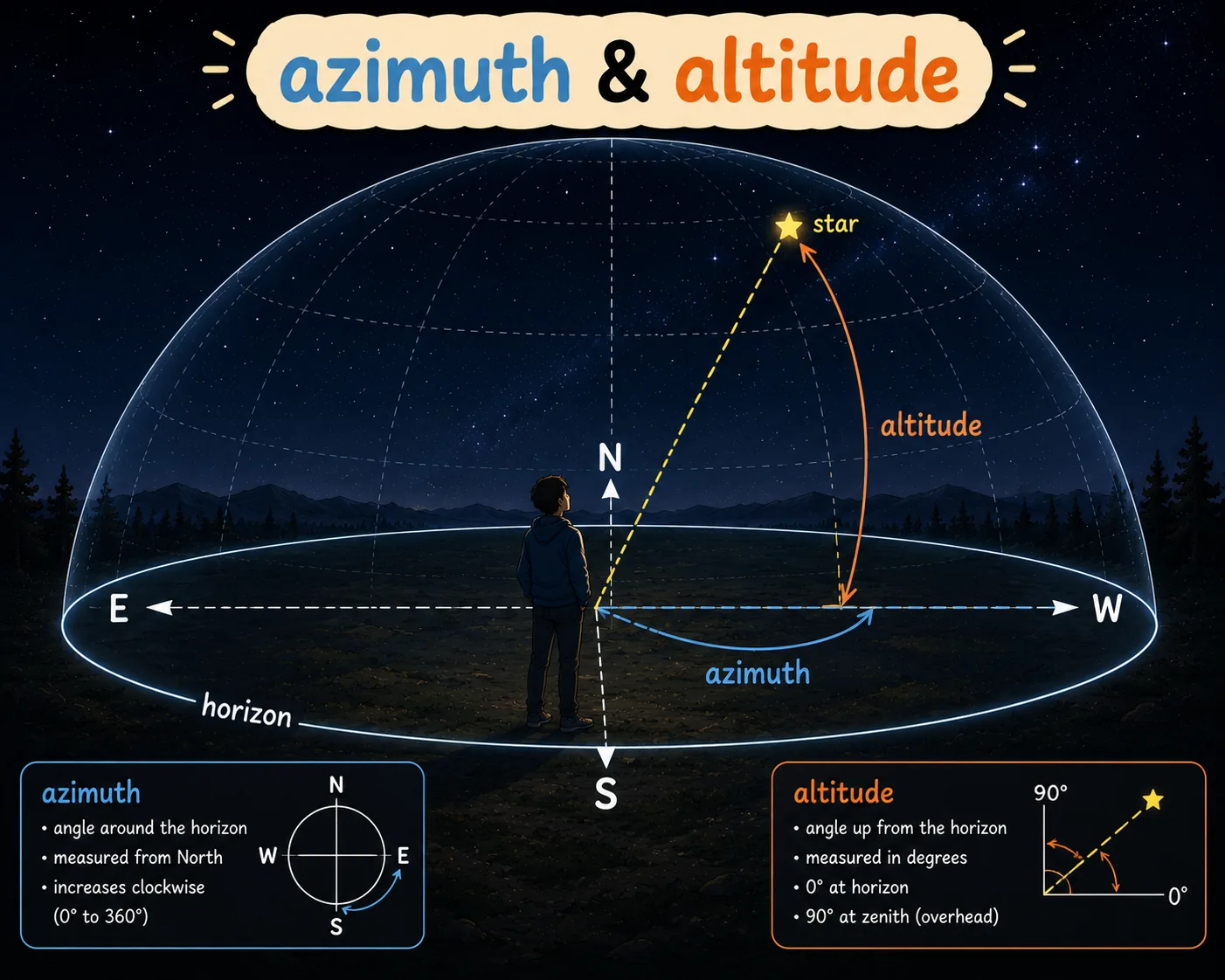
Direction along the horizon |
| Altitude |
Height above the horizon |
Easy Explanation
We can describe where an object is in the sky.
Azimuth tells direction along the horizon.
Altitude tells height above the horizon.
Together, they help locate a sky object.
FINAL SUMMARY
Final Explanation
People can learn a lot from the sky without telescopes.
They can observe objects.
They can notice patterns.
They can create stories and calendars.
They can use models like the celestial sphere.
They can use tools like azimuth and altitude to describe positions.
TOPIC 4.3
How Technology Expands Our View of the Universe
Space Technology: Seeing Farther and Understanding More
Big Question:
How does technology help us learn things about space that our eyes cannot see?
Technology Helps Us See More
| Naked Eye |
Technology |
More Detail |
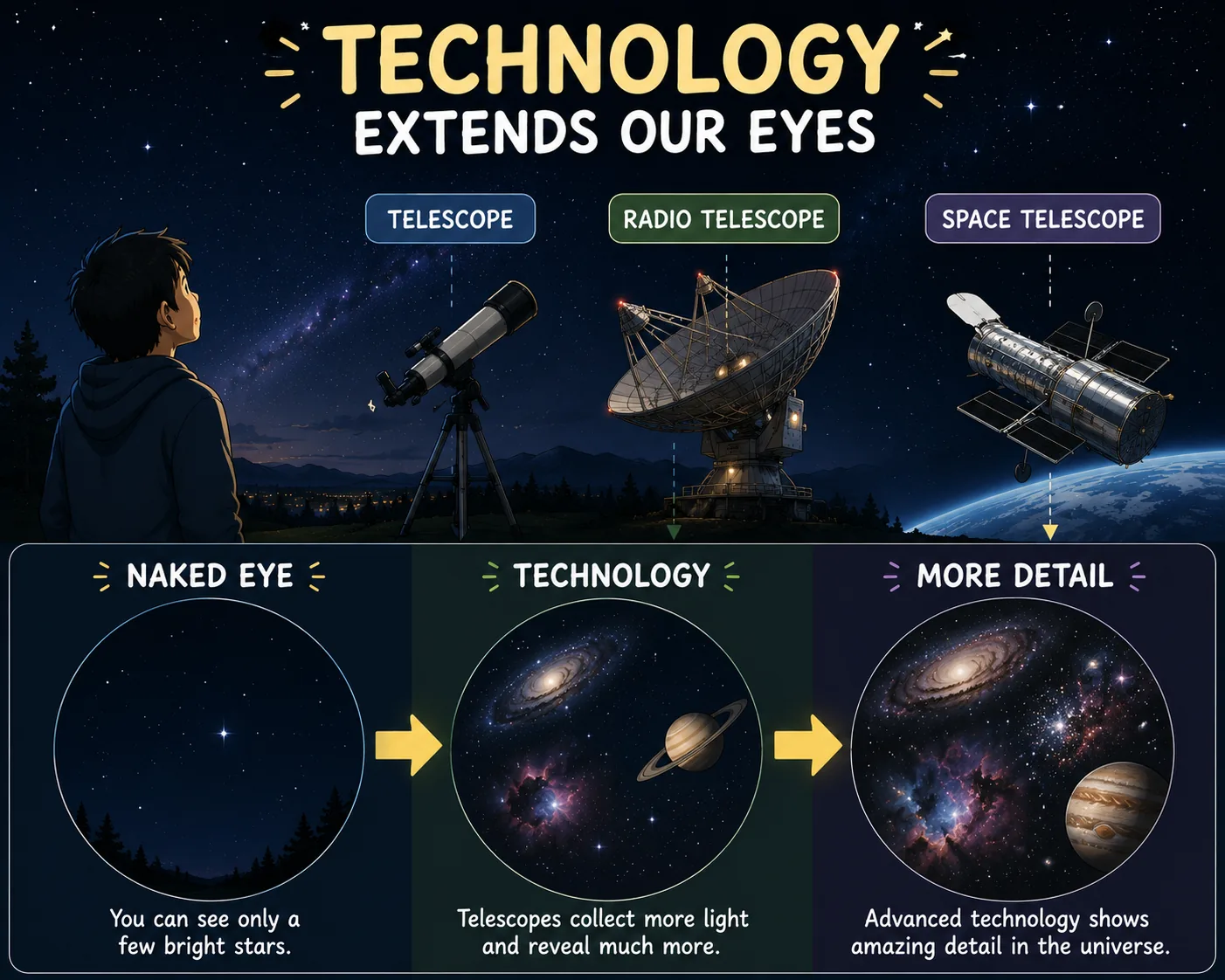
| You can see only a few bright stars. |
Telescopes collect more light and reveal much more. |
Advanced technology shows amazing detail in the universe. |
Easy Explanation
Our eyes can see some objects in space.
But our eyes cannot see everything.
Technology helps us see farther.
Technology also helps us see different kinds of light.
This gives us more information about the universe.
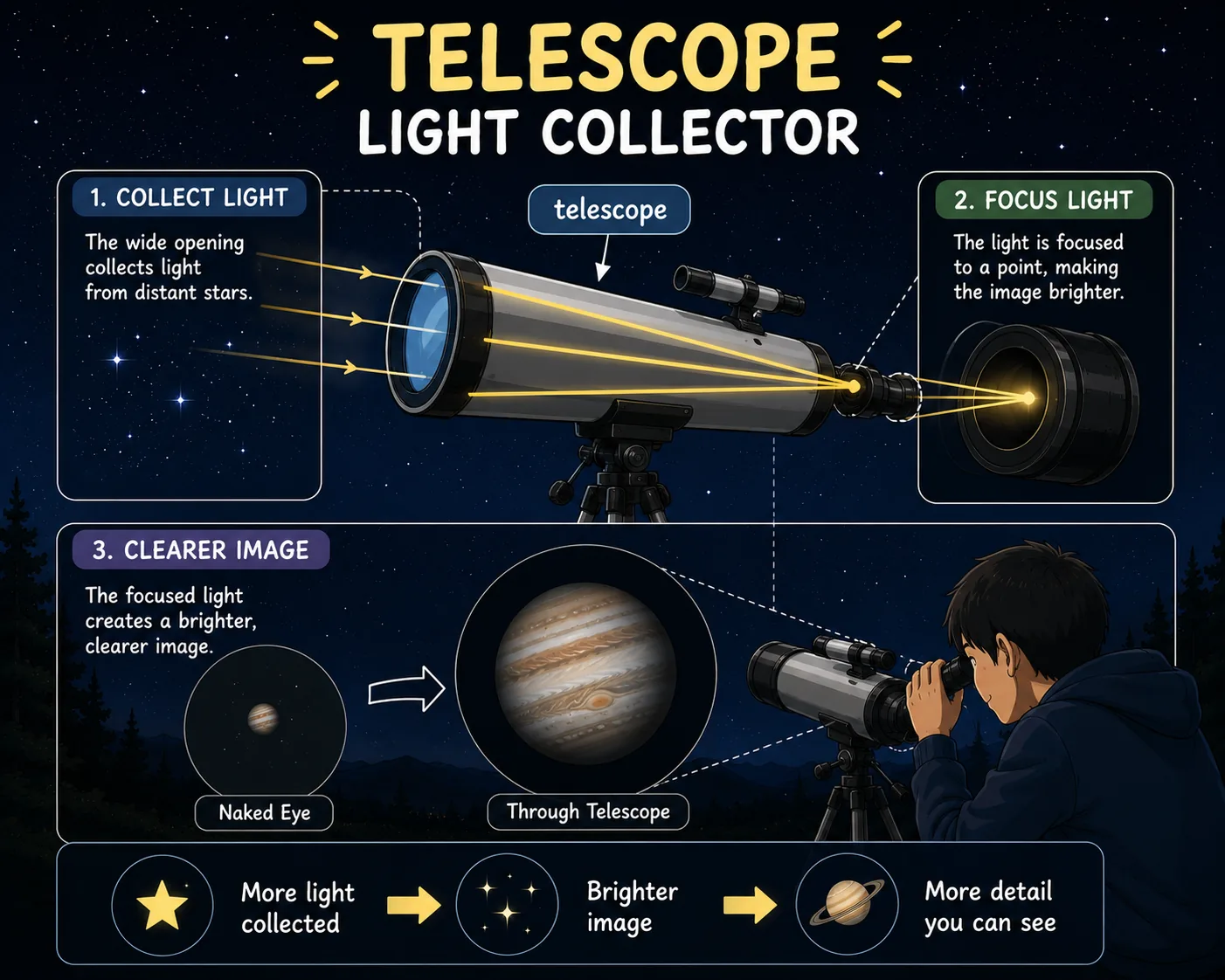
Telescopes
| Vocab |
What it means |
| Telescope |
It collects light.
It makes far objects look brighter and clearer.
|
Easy Explanation
Galileo used a telescope to see things people could not see with eyes alone.
He saw moons around Jupiter.
He also observed Saturn in more detail.
Different Wavelengths
Easy Explanation
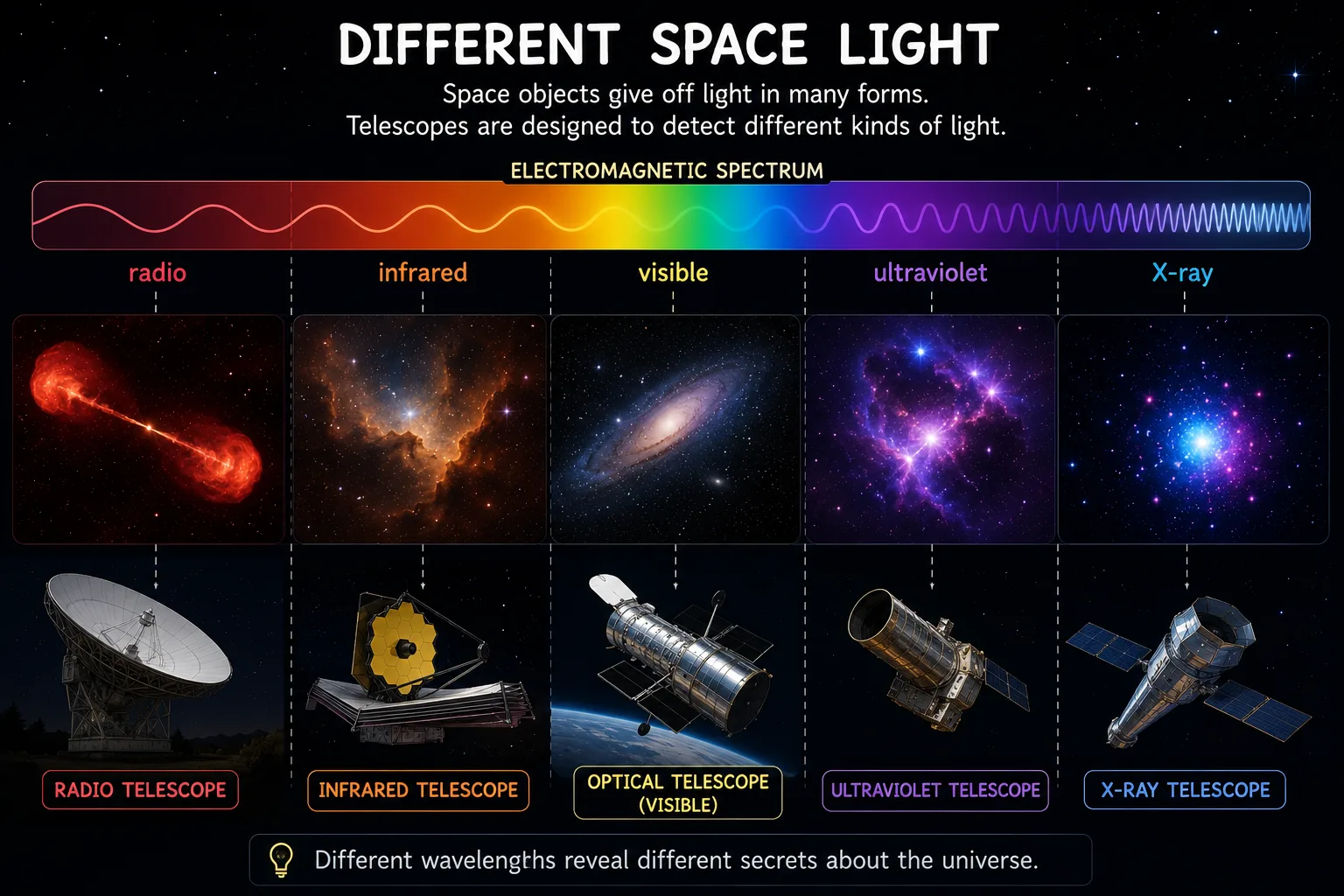
Visible light is only one kind of light.
Space objects also give off radio waves, infrared, ultraviolet,
X-rays, and gamma rays.
Different telescopes detect different wavelengths.
Each wavelength can show different information.
Telescopes in Space
Easy Explanation
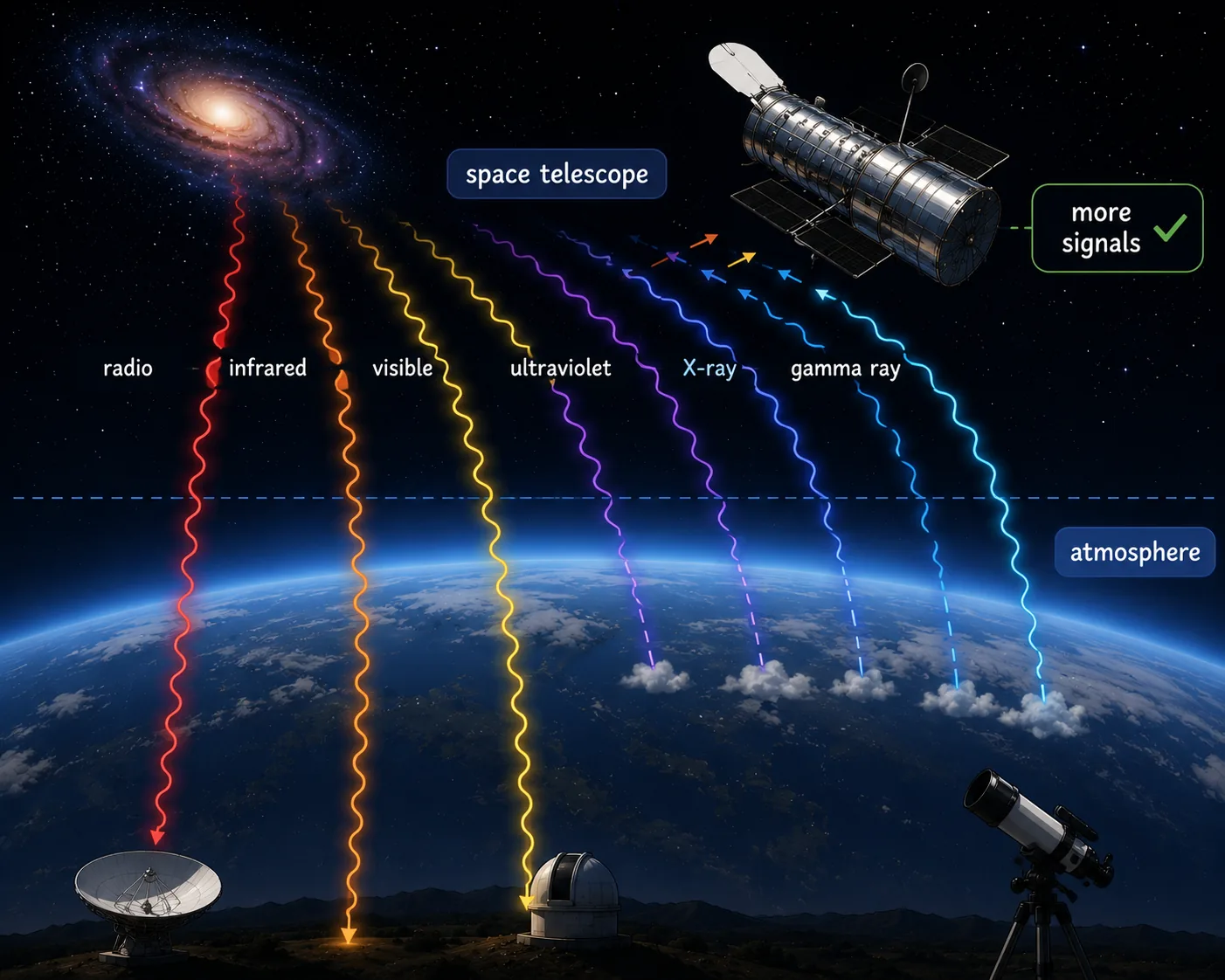
Earth’s atmosphere blocks some radiation from space.
Some telescopes work better above the atmosphere.
That is why some telescopes are placed in space.
Space telescopes can collect information that ground telescopes may miss.
Same Object, Different Views
| Wavelength |
What it shows |
| Visible |
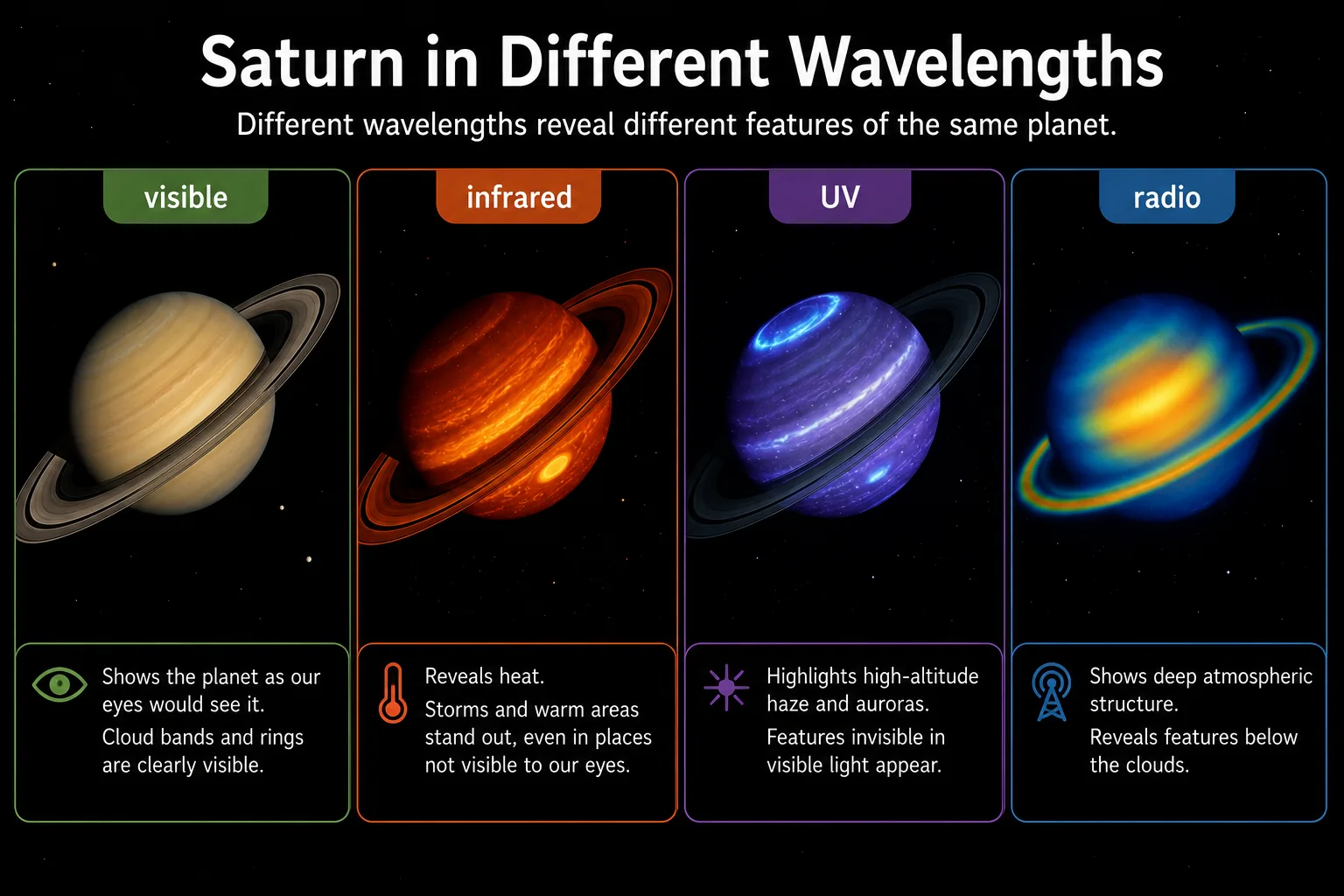
It shows the planet as our eyes would see it.
Cloud bands and rings are clearly visible.
|
| Infrared |
It reveals heat.
Storms and warm areas can stand out.
|
| UV |
It highlights high-altitude haze and auroras.
It shows features using invisible light.
|
| Radio |
It shows deep atmospheric structure.
It can reveal features below clouds.
|
Easy Explanation
The same object can look different in different wavelengths.
Visible light shows what our eyes might see.
Infrared can show heat or hidden features.
Radio waves and X-rays can show other invisible information.
Using many wavelengths gives a fuller picture.
The Milky Way Galaxy
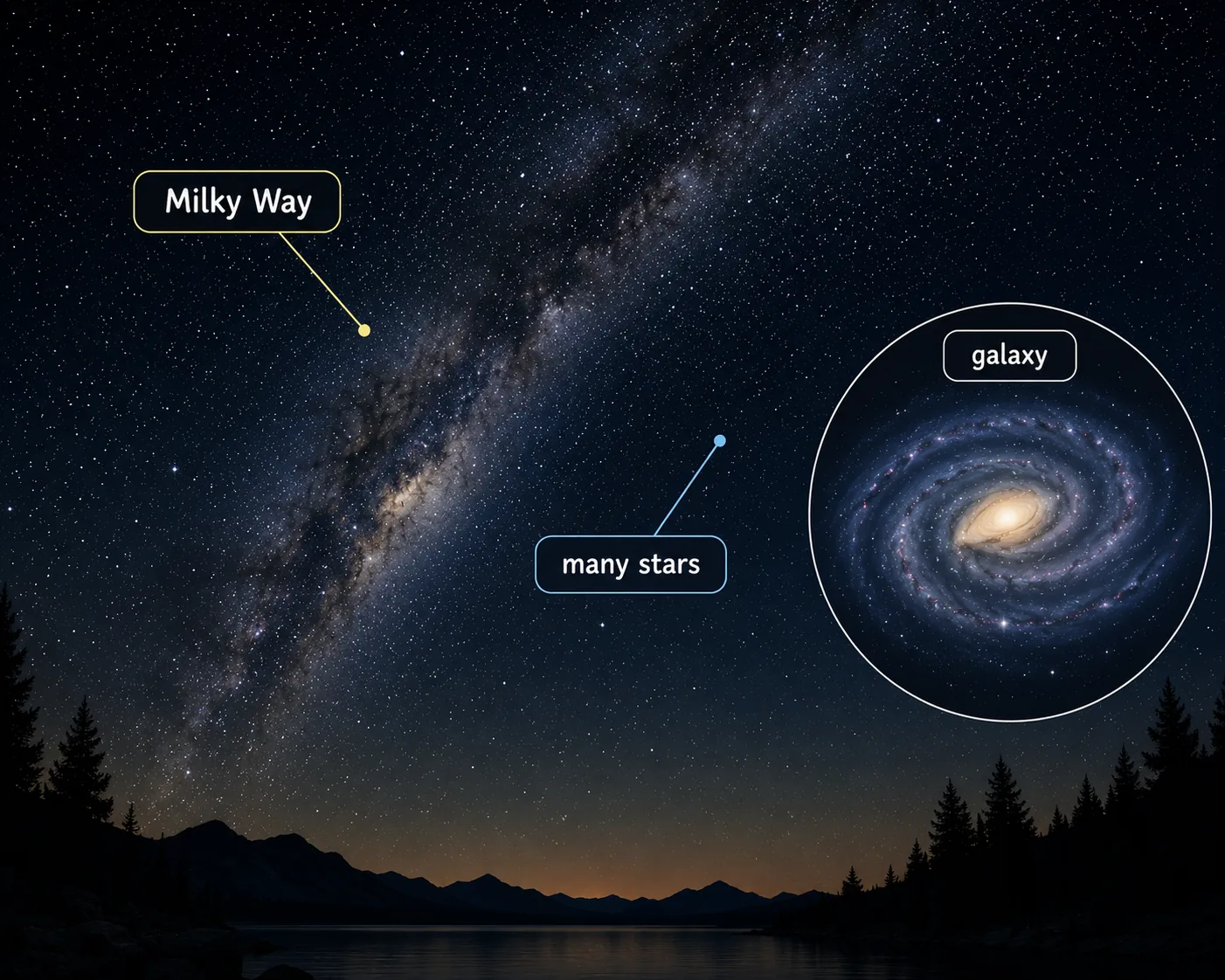
| Vocab |
What it means |
| Galaxy |
A huge collection of stars, gas, and dust held together by gravity
|
Easy Explanation
The Milky Way is our galaxy.
The Milky Way looks like a cloudy band in a dark sky.
It is not a cloud.
It is made of many stars, gas, and dust.
Shapes of Galaxies
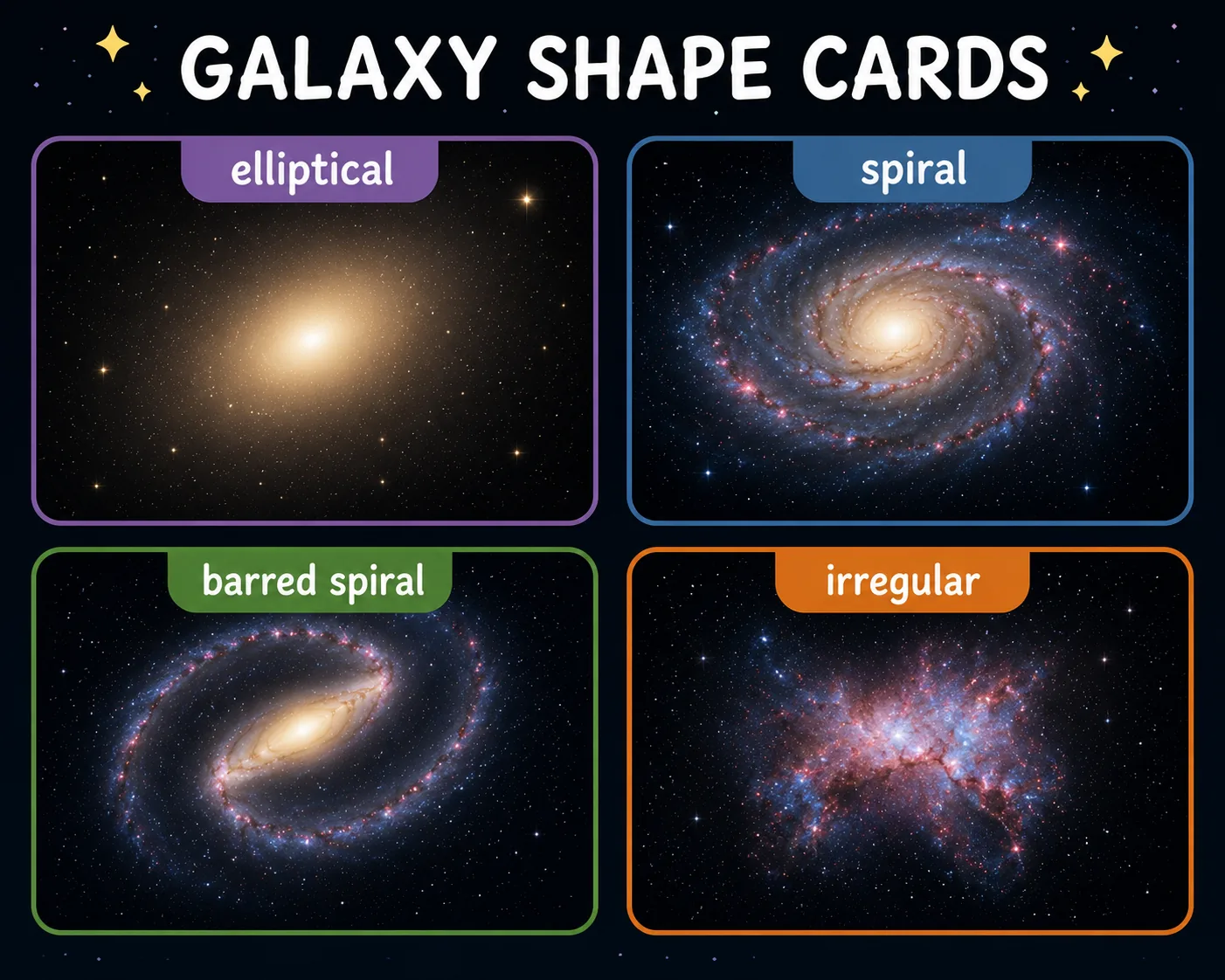
Easy Explanation
Galaxies come in different shapes.
Some are round or oval.
Some are spiral.
Some have a bar across the middle.
Some have no clear shape.
Our Milky Way is a spiral galaxy.
Star Clusters
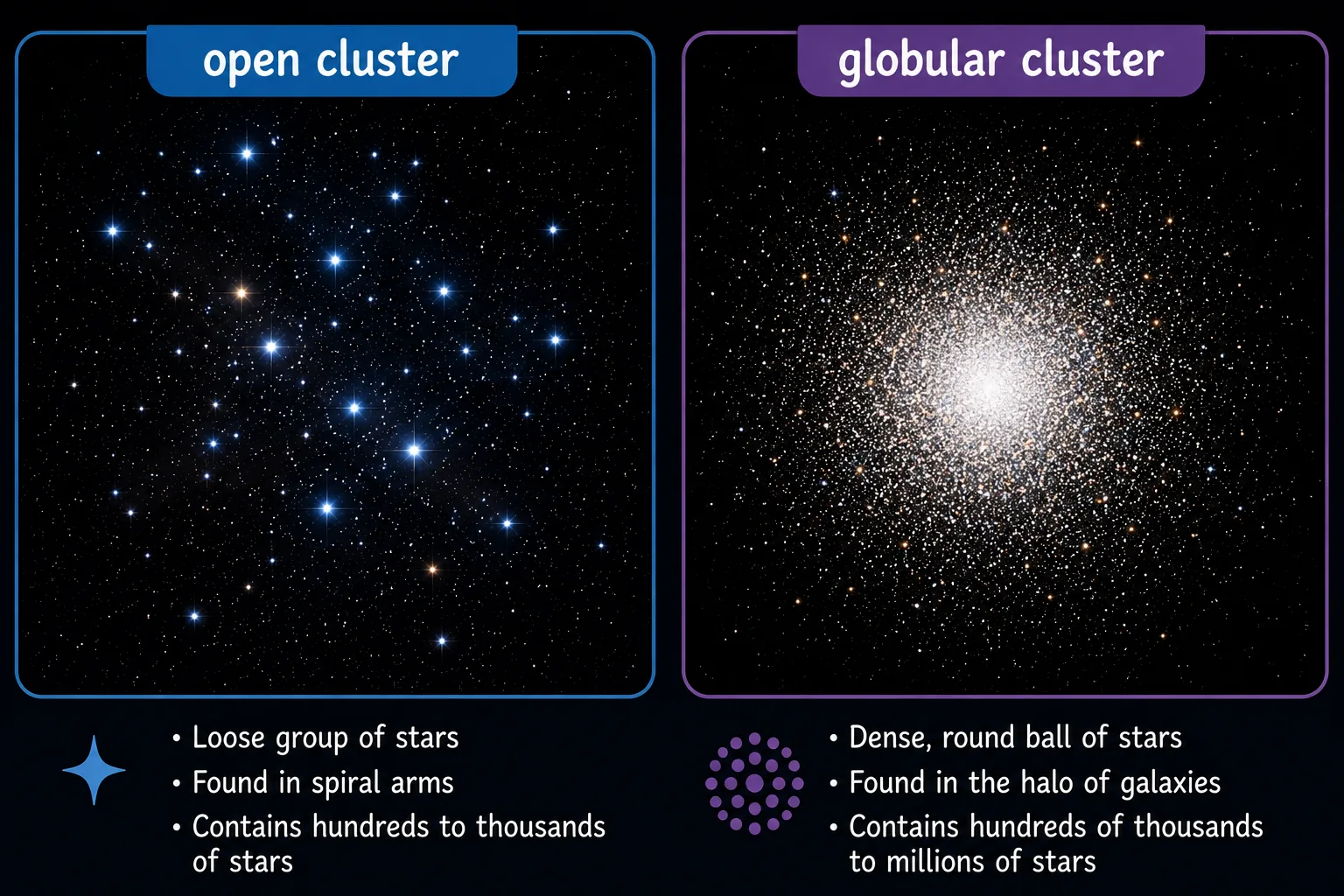
| Open Cluster |
Globular Cluster |
| Loose group of stars |
Dense, round ball of stars |
| Found in spiral arms |
Found in the halo of galaxies |
| Contains hundreds to thousands of stars |
Contains hundreds of thousands to millions of stars |
Easy Explanation
A star cluster is a group of stars held together by gravity.
Open clusters are loose groups of stars.
Globular clusters are round and very crowded.
Astronomers used star clusters to learn about the shape and centre
of the Milky Way.
Local Group
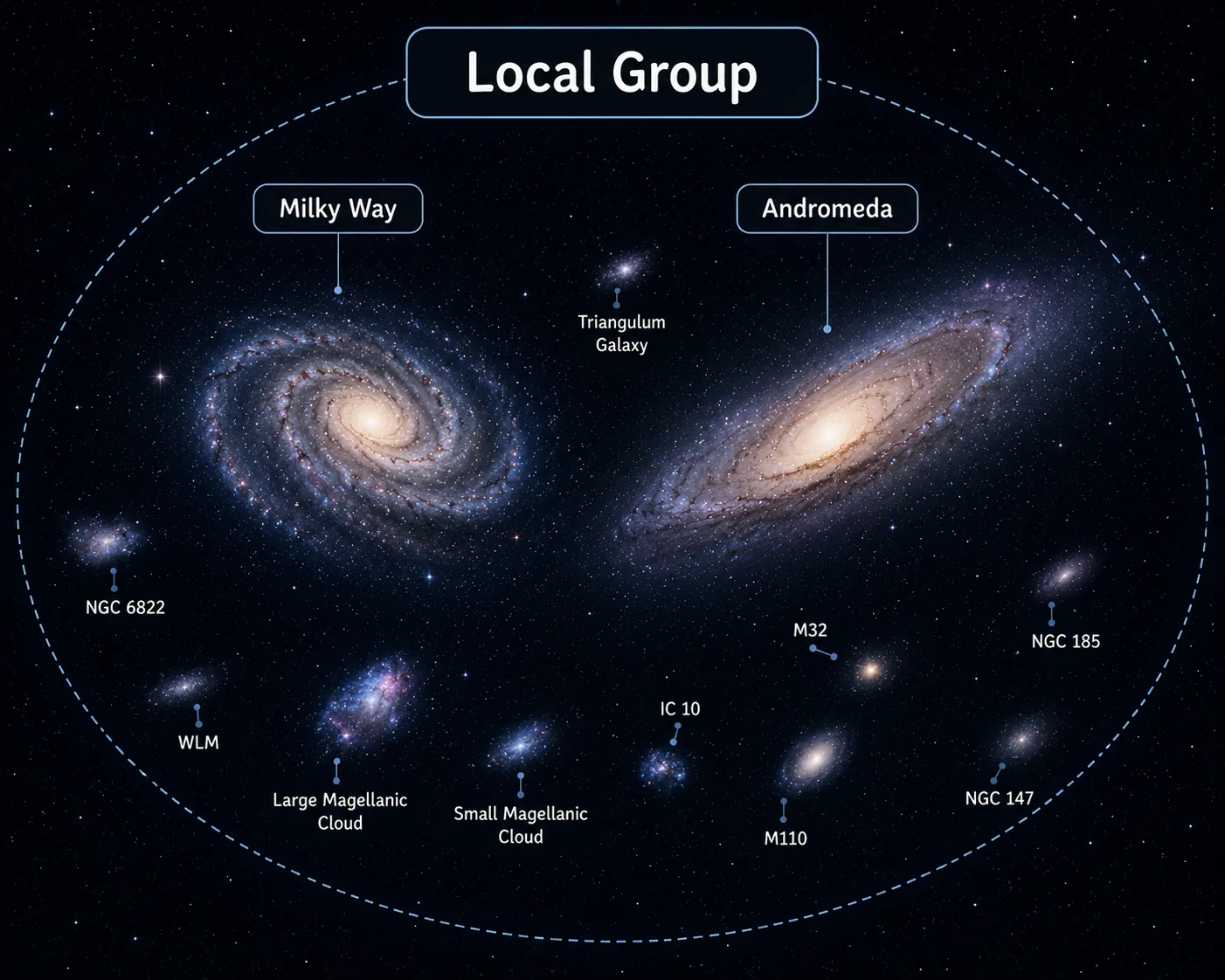
| Vocab |
What it means |
| Local Group |
A group of galaxies |
Easy Explanation
The Milky Way is not alone.
It belongs to a group of galaxies called the Local Group.
The Andromeda Galaxy is another large galaxy near us.
The universe contains many groups and clusters of galaxies.
Huge Distances in Space

| Vocab |
What it means |
| Light-Year |
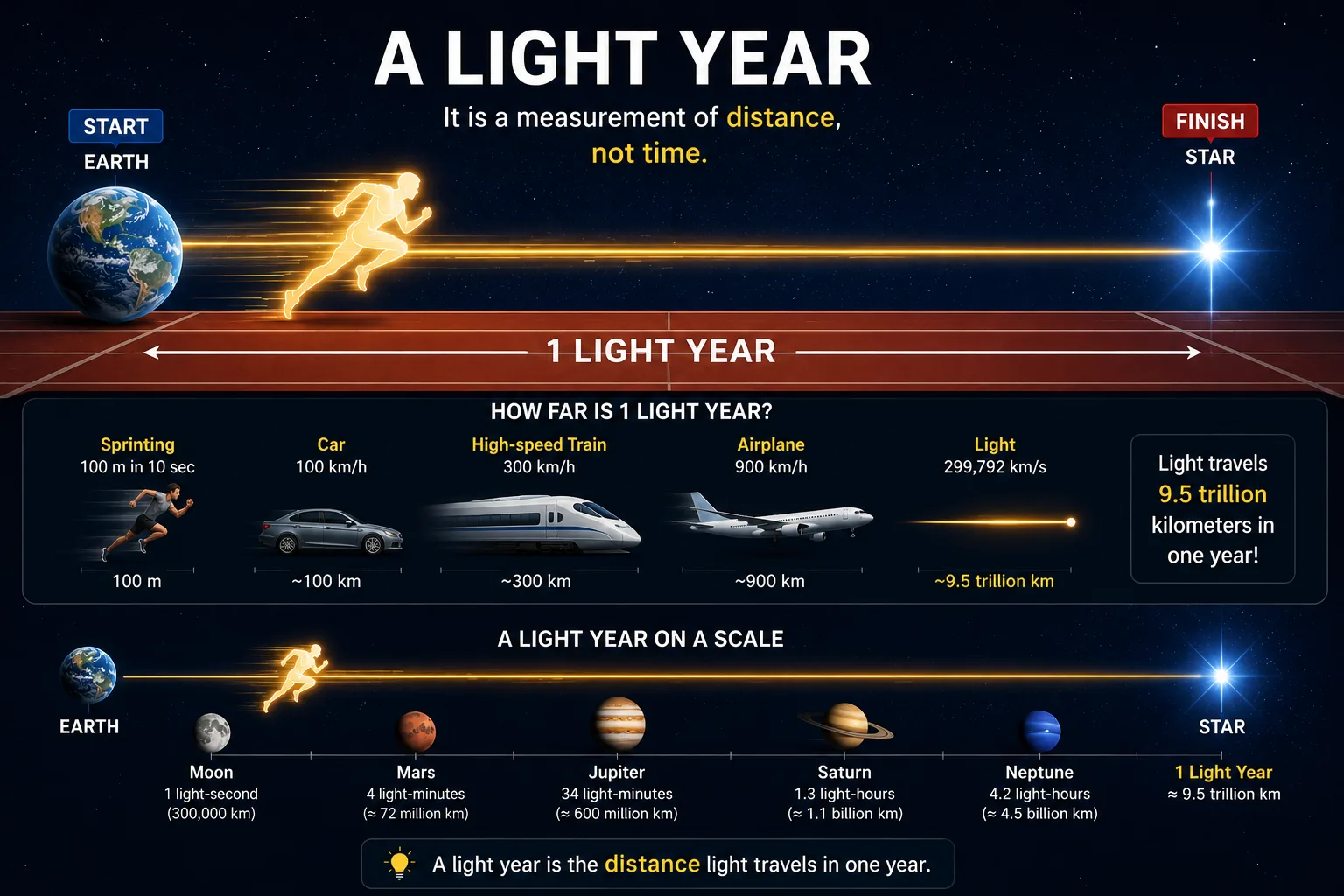
It is a measurement of distance, not time.
It is the total distance that a beam of light travels through
space in one Earth year.
|
Light-Year
Easy Explanation
Space distances are very large.
Kilometres are useful on Earth.
Astronomical units, or AU, are useful in the solar system.
Light-years are useful for stars and galaxies.
A light-year is a distance, not a time.
Looking Back in Time
Easy Explanation
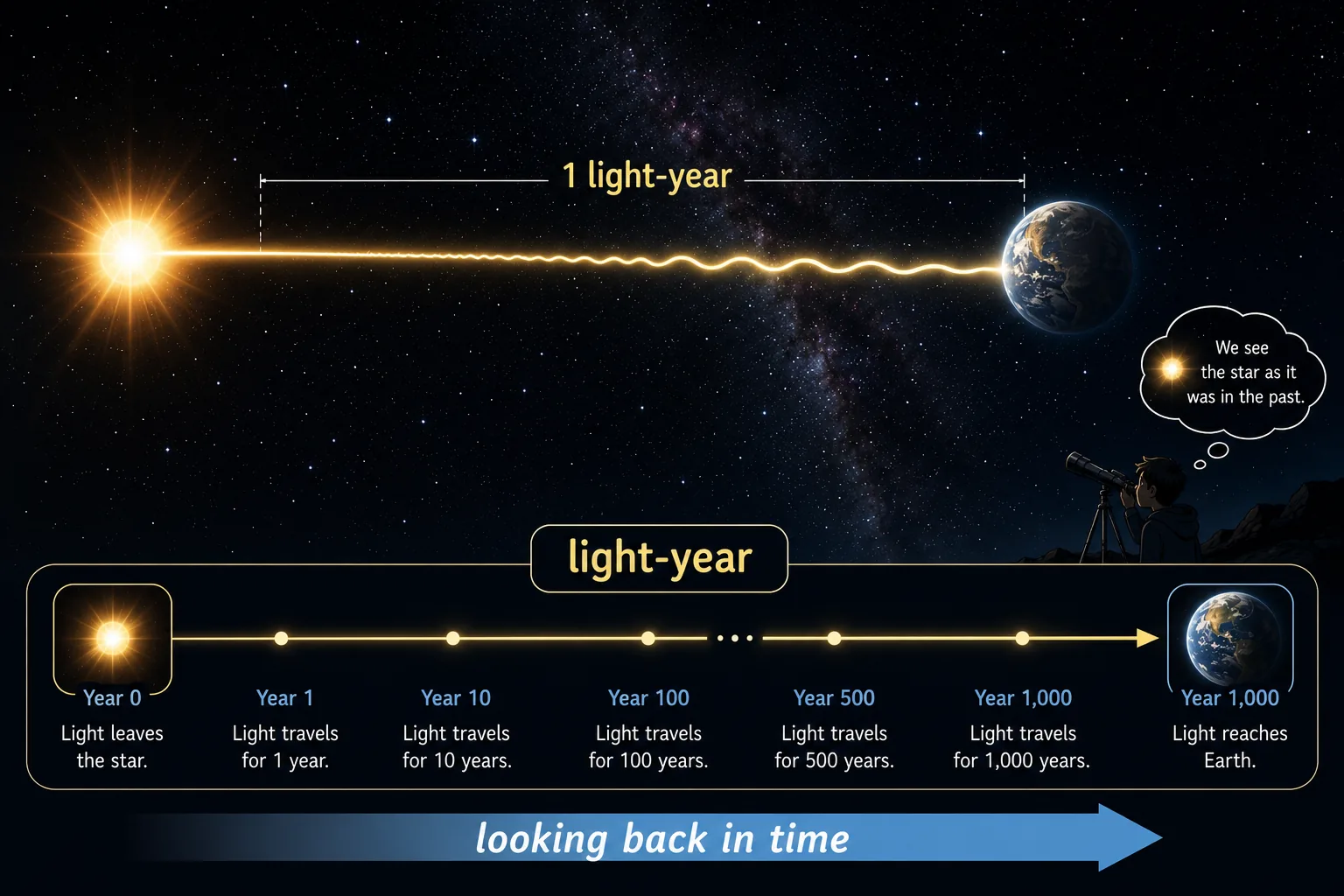
Light takes time to travel.
The farther a star is, the older its light is when it reaches us.
When we look at distant stars, we are seeing the past.
This is why astronomy is like looking back in time.
Parallax
| Vocab |
What it means |
| Parallax |
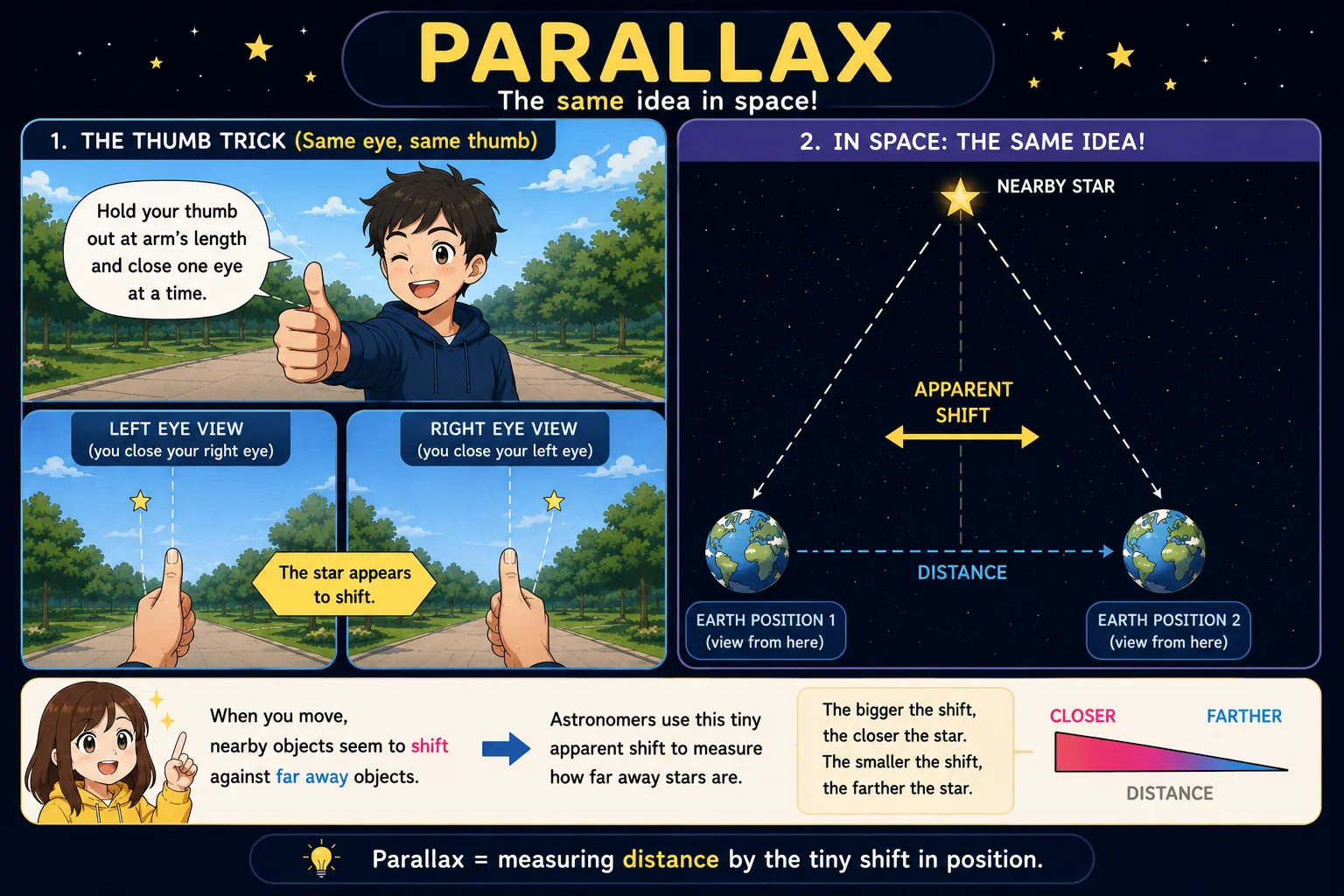
An apparent shift in position |
Easy Explanation
You can see it by holding your thumb out and closing one eye at a time.
Astronomers use a similar idea to measure distances to nearby stars.
A larger parallax shift means the object is closer.
Star Brightness
| Vocab |
What it means |
| Luminosity |
The total energy a star gives off each second |
| Apparent brightness |
How bright it looks from Earth |
Easy Explanation
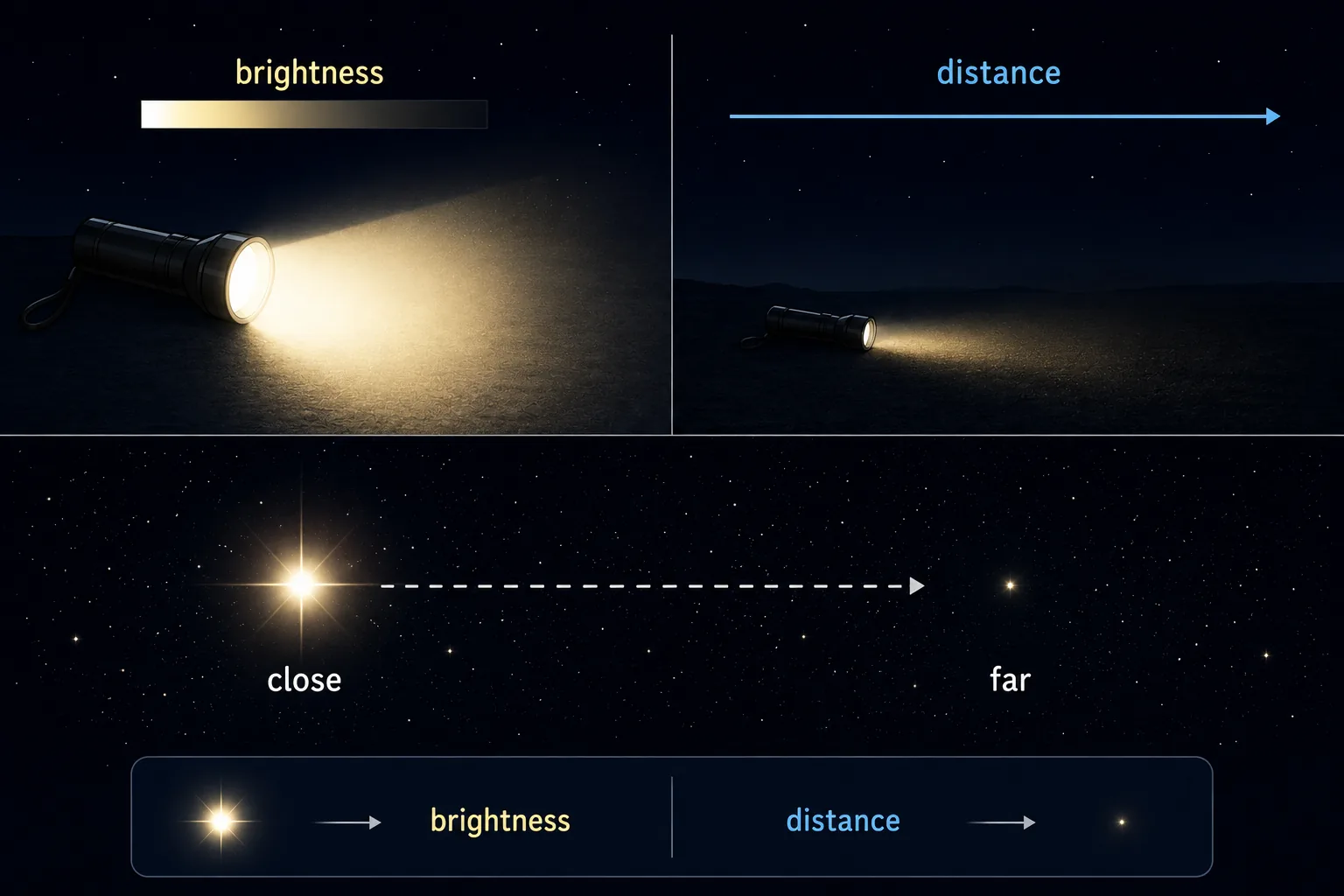
A star can look bright for two reasons.
It may be very close.
Or it may give off a lot of energy.
Luminosity means the total energy a star gives off each second.
Apparent brightness means how bright it looks from Earth.
Star Colour and Temperature
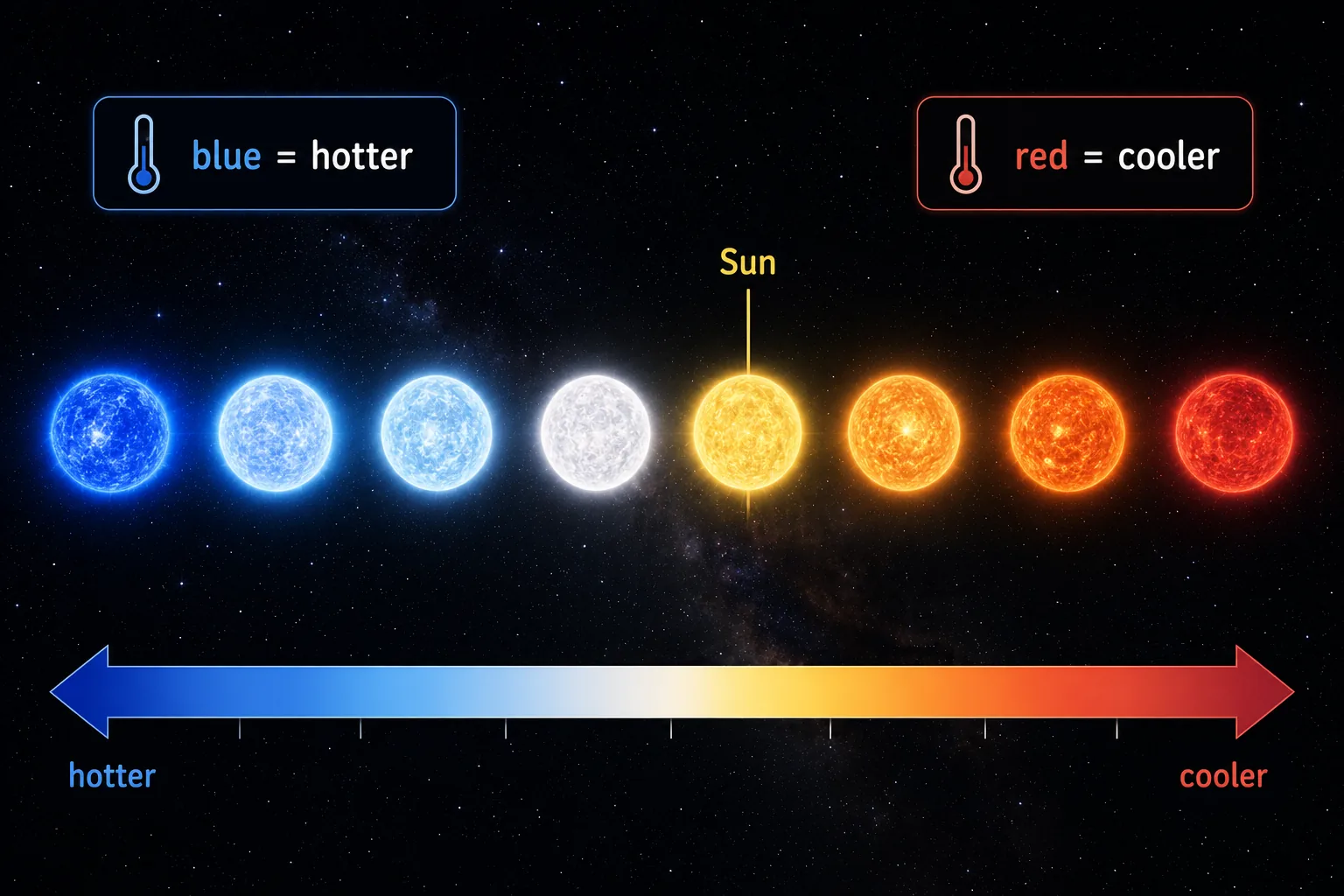
| Colour |
Temperature |
| More blue |
Hotter |
| More red |
Cooler |
Easy Explanation
A star’s colour tells us about its temperature.
Blue stars are hotter.
Red stars are cooler.
The Sun looks yellowish because it is in the middle range.
Star Composition
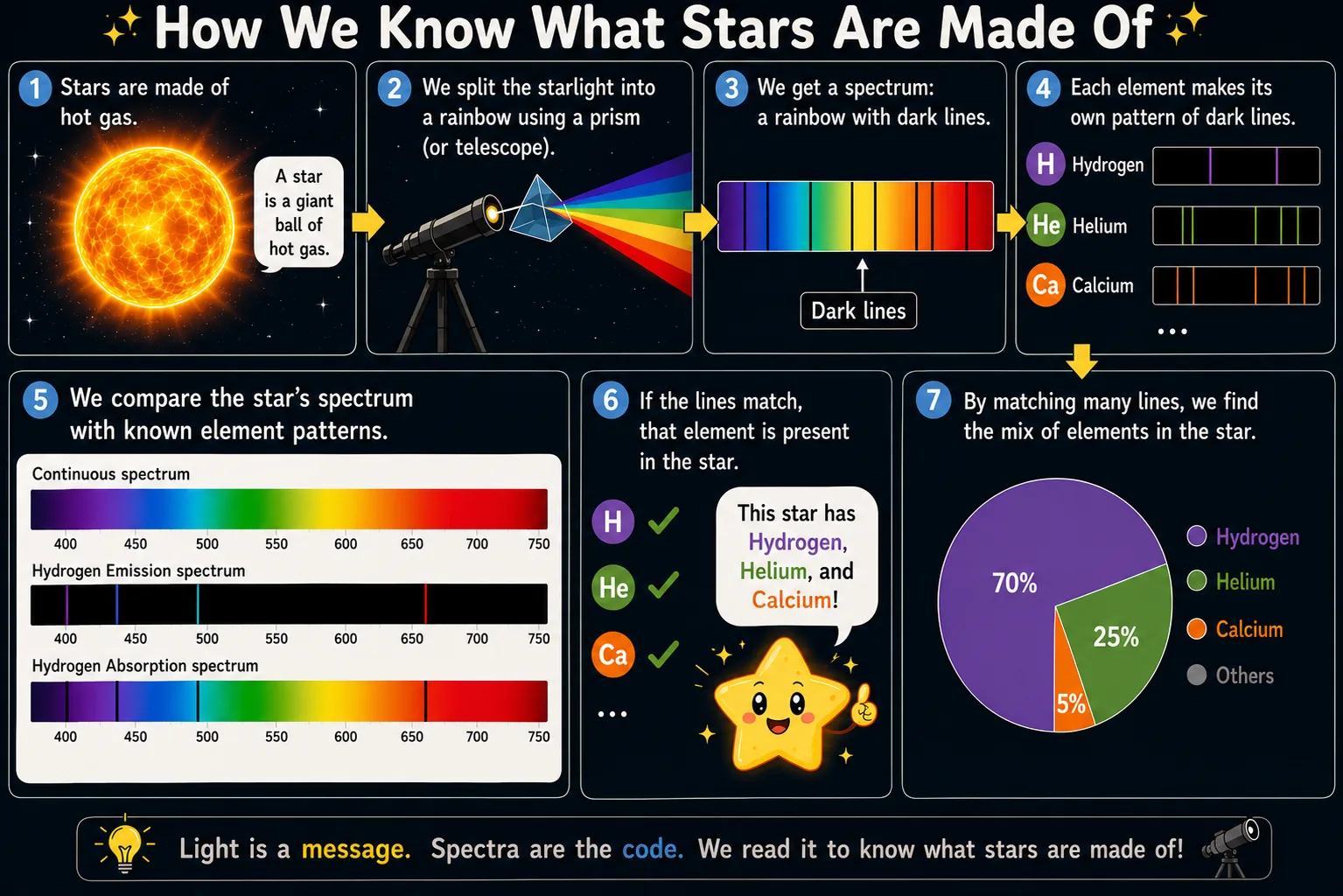
How We Know What Stars Are Made Of
- Stars are made of hot gas.
- We split the starlight into a rainbow using a prism or telescope.
- We get a spectrum: a rainbow with dark lines.
- Each element makes its own pattern of dark lines.
- We compare the star’s spectrum with known element patterns.
- If the lines match, that element is present in the star.
- By matching many lines, we find the mix of elements in the star.
Light is a message. Spectra is the code.
We read it to know what stars are made of.
Easy Explanation
Astronomers use a spectroscope to study star light.
A spectrum has special lines.
Each element makes a unique pattern of lines.
The pattern works like a fingerprint.
This helps scientists know what stars are made of.
H-R Diagram
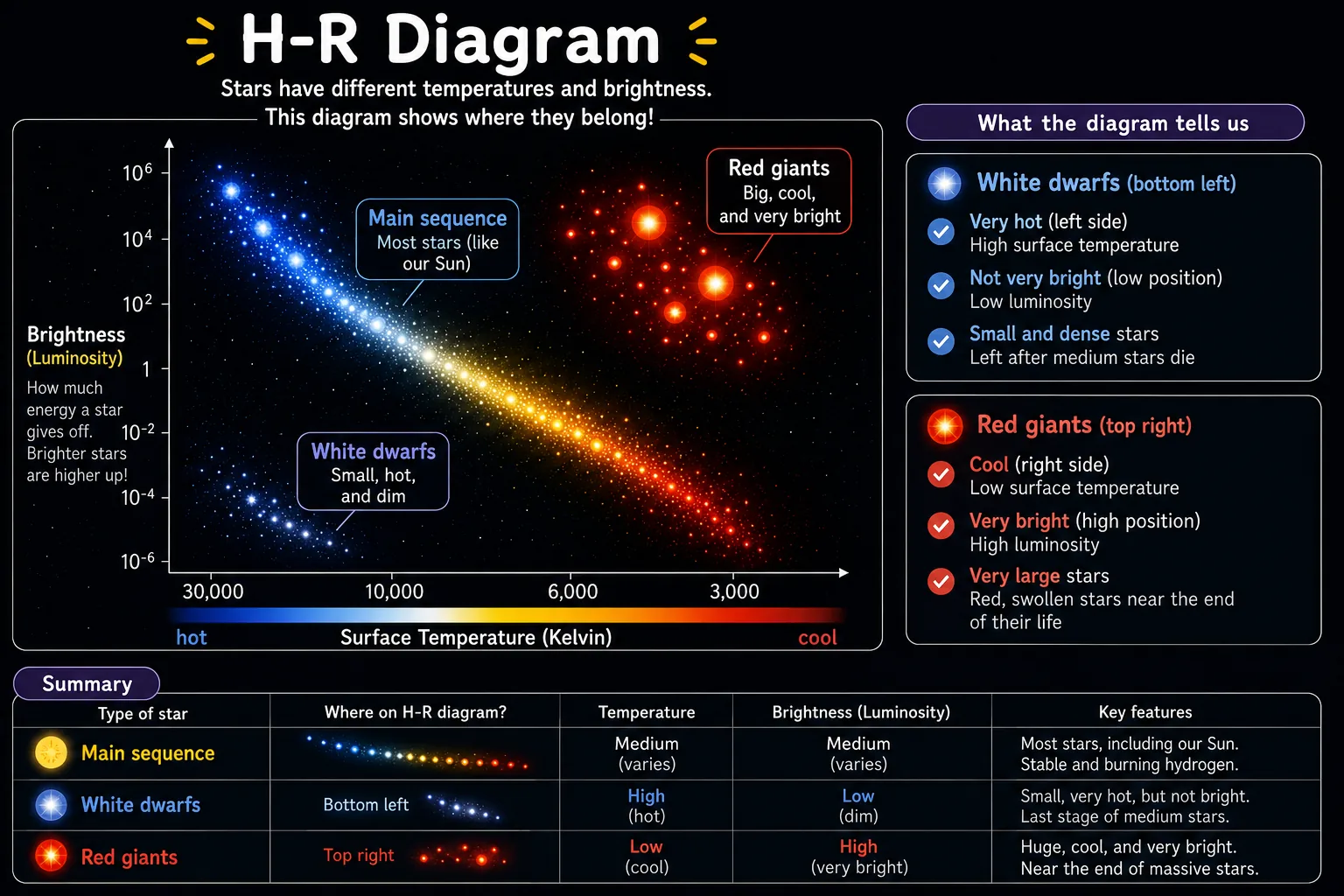
| Part of the Diagram |
What it means |
| Left side |
Very hot; high surface temperature |
| Right side |
Cool; low surface temperature |
| Higher position |
Very bright; high luminosity |
| Lower position |
Not very bright; low luminosity |
| White dwarfs |
Bottom left; small and dense stars |
| Red giants |
Top right; very large stars |
Easy Explanation
The H-R diagram is a graph about stars.
It compares star temperature and brightness.
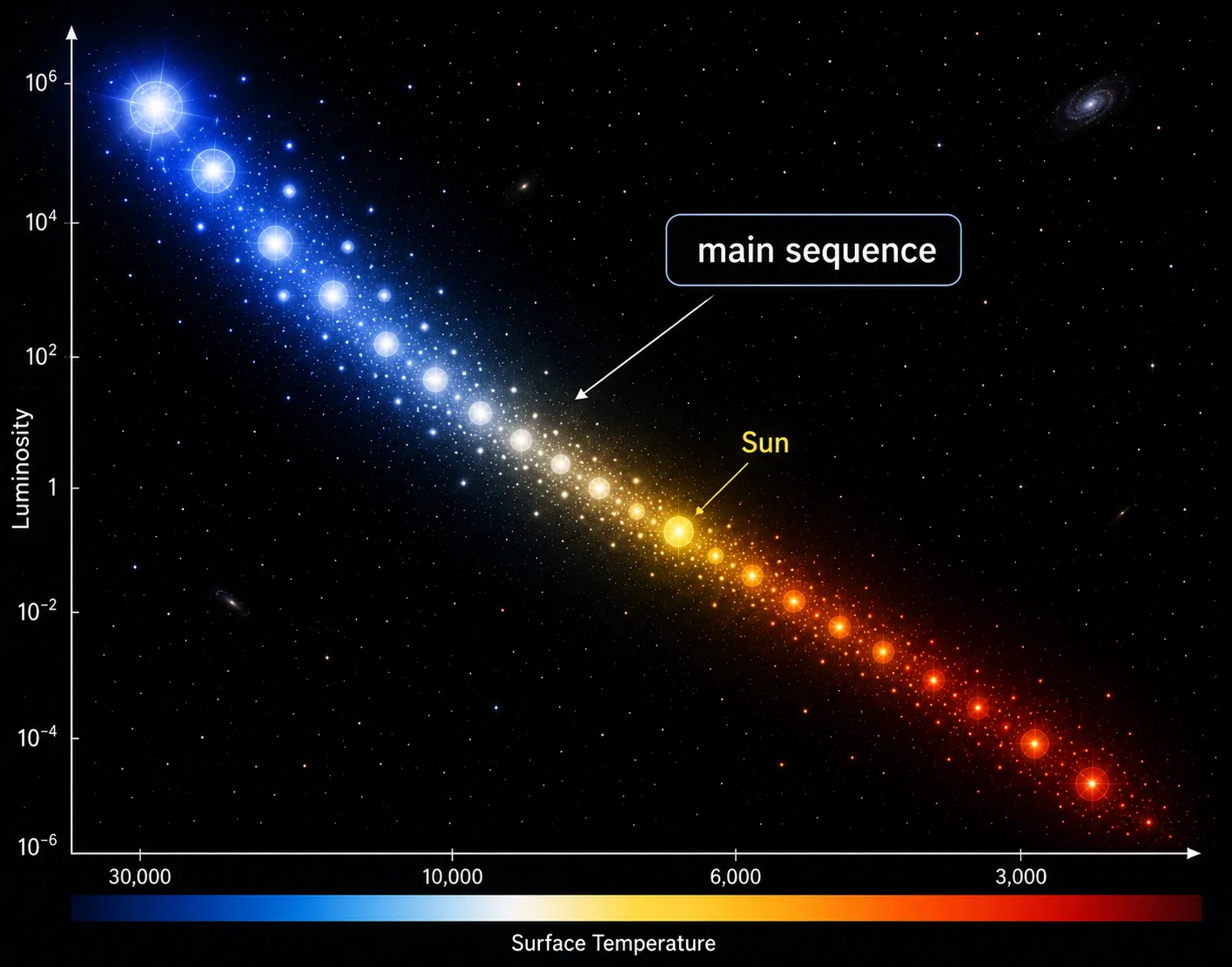
Most stars are in a band called the main sequence.
The H-R diagram helps astronomers understand star types
and star life cycles.
Main Sequence Stars
Easy Explanation
Most stars are main sequence stars.
Main sequence stars make energy by nuclear fusion.
The Sun is a main sequence star.
A star’s mass affects how hot, bright, and long-lived it is.
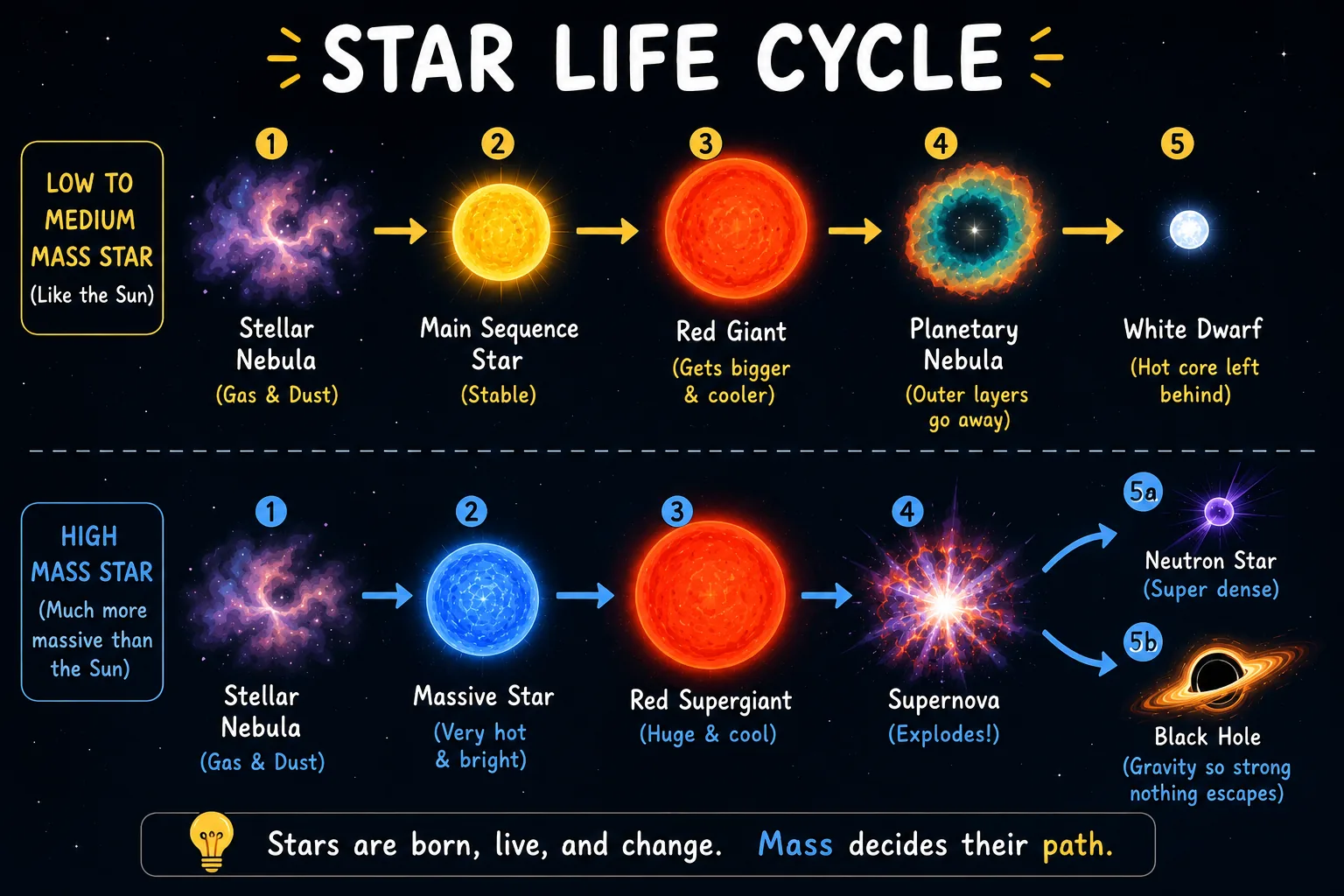
Star Life Cycle Overview
| Vocab |
Definition |
| Nebulae |
Clouds of gas and dust where stars are born |
Easy Explanation
Stars are born in clouds of gas and dust called nebulae.
A star’s life cycle depends mostly on its mass.
Sun-like stars become red giants and then white dwarfs.
Massive stars can explode as supernovae.
After a supernova, the core may become a neutron star or a black hole.
Supernova
| Vocab |
What it means |
| Supernova |
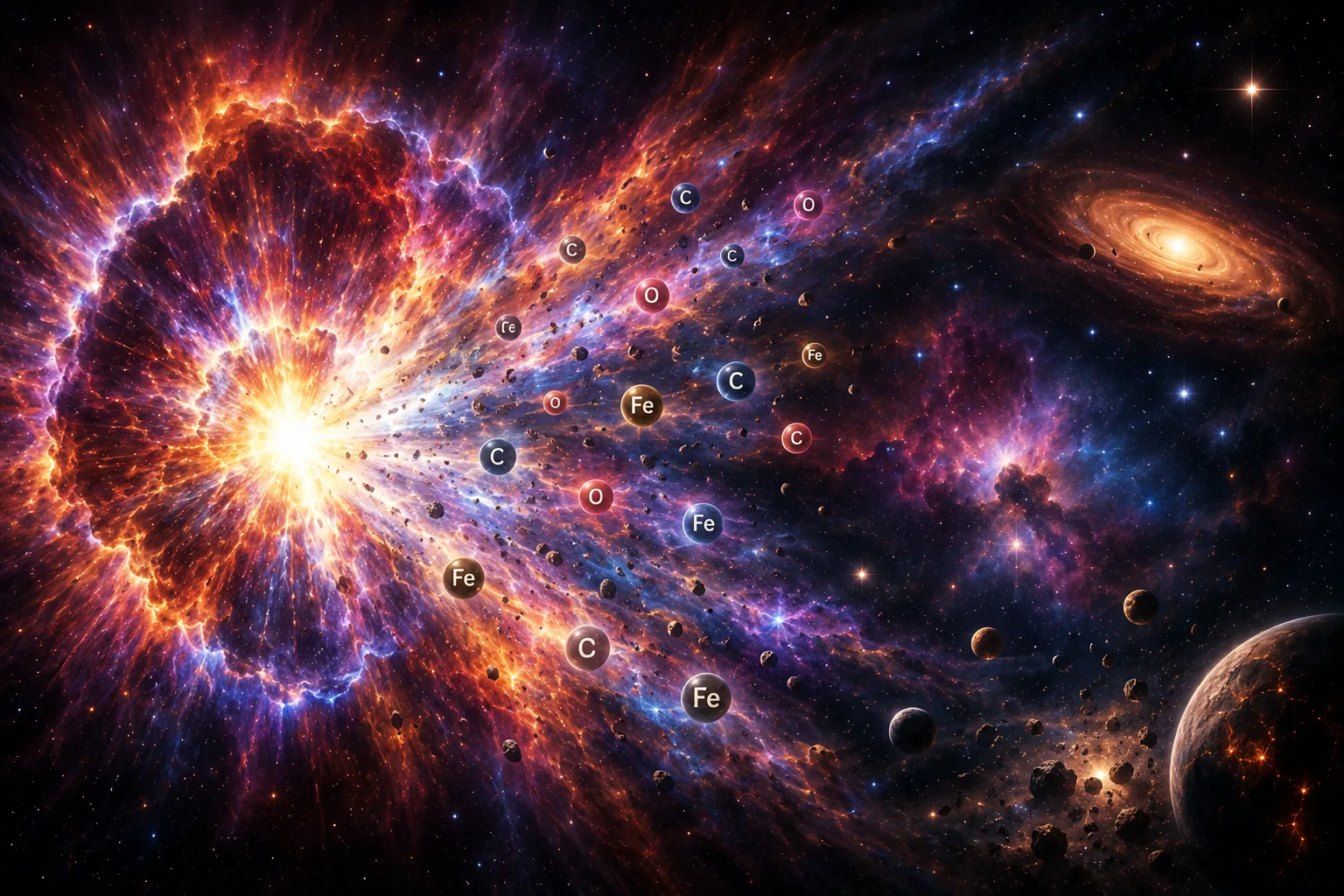
A huge explosion of a massive star.
It spreads heavy elements into space.
|
Easy Explanation
A supernova is a huge explosion of a massive star.
It spreads heavy elements into space.
Some of these elements later become parts of new stars,
planets, and living things.
This means many atoms in our bodies were made in old stars.
Neutron Stars
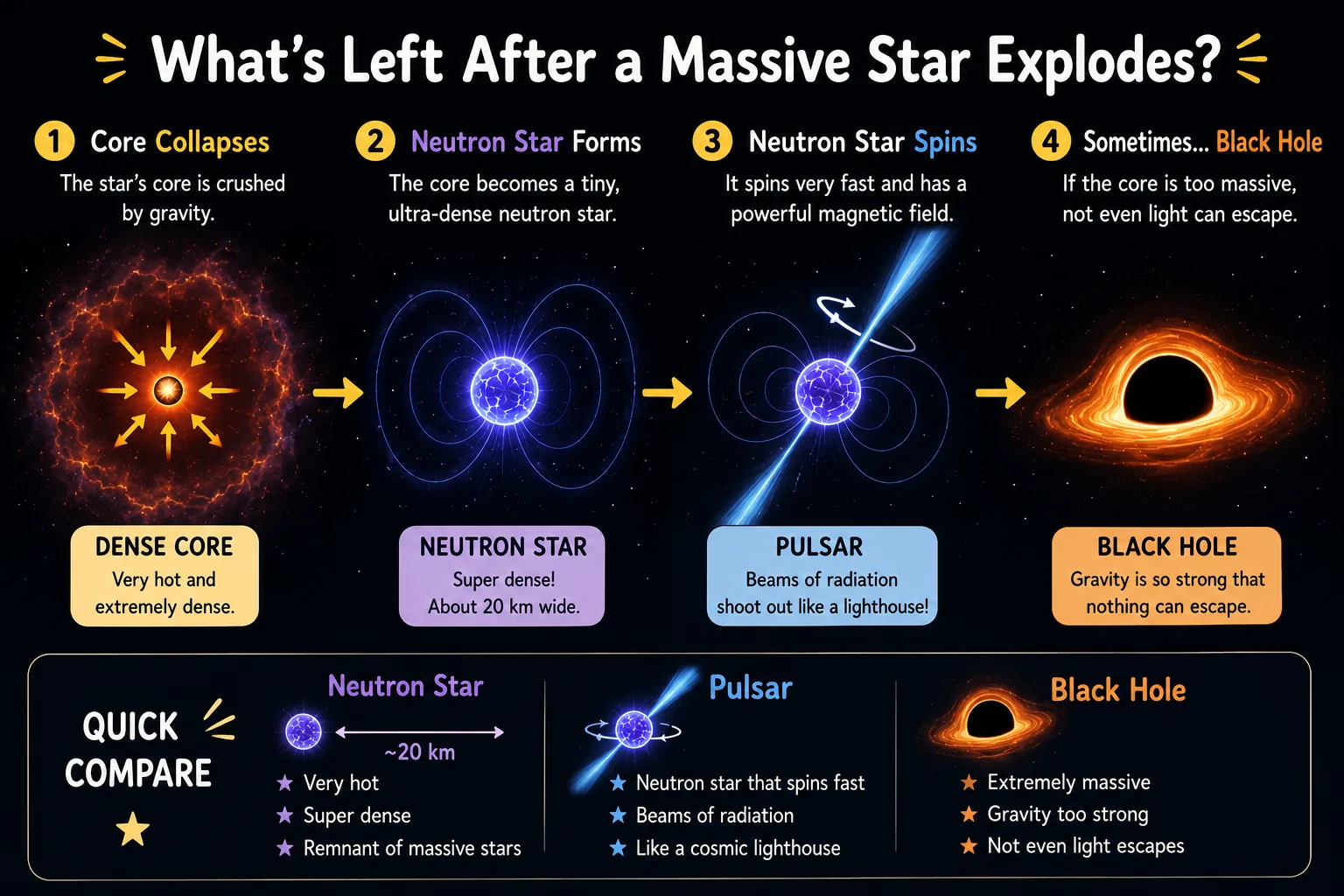
What’s Left After a Massive Star Explodes?
| Stage |
What happens |
| Core Collapses |
The star’s core is crushed by gravity. |
| Neutron Star Forms |
The core becomes a tiny, ultra-dense neutron star. |
| Neutron Star Spins |
It spins very fast and has a powerful magnetic field.
|
| Sometimes: Black Hole |
If the core is too massive, not even light can escape.
|
Neutron Star, Pulsar, and Black Hole

| Object |
Characteristics |
| Neutron Star |
Very hot.
Super dense.
Remnant of massive stars.
|
| Pulsar |
A neutron star that spins fast.
Produces beams of radiation.
Acts like a cosmic lighthouse.
|
| Black Hole |
Extremely massive.
Gravity is very strong.
Not even light escapes from inside it.
|
| Vocab |
What it means |
| Neutron Star |
The dense core left after some supernovae
|
| Pulsar |
Beams of radiation like a lighthouse |
Easy Explanation
A neutron star is the dense core left after some supernovae.
It is very small but extremely dense.
Some neutron stars spin quickly.
They send out beams of radiation like a lighthouse.
These are called pulsars.
Black Holes
| Vocab |
What it means |
| Black Hole |
A very dense object with extremely strong gravity
|
Easy Explanation
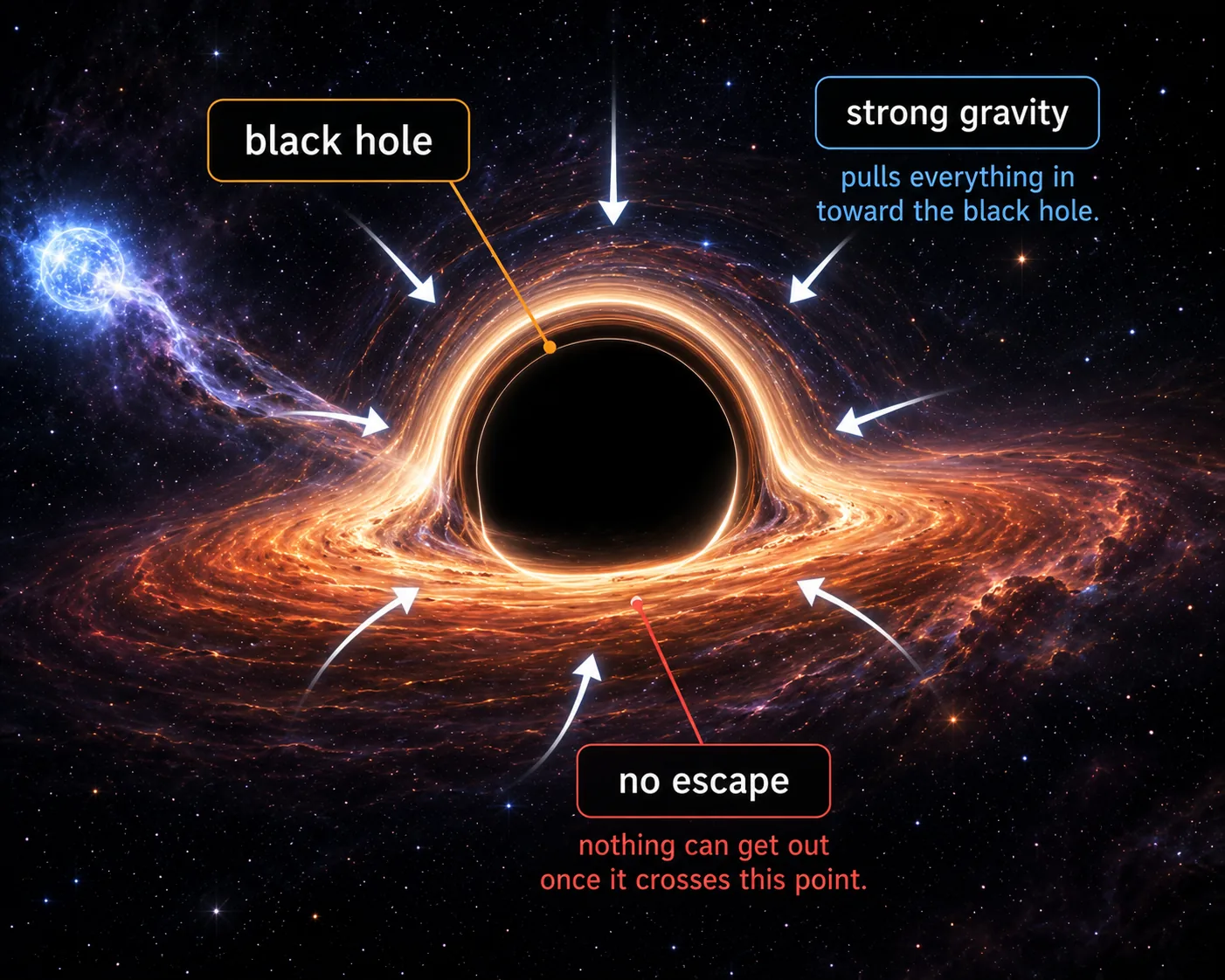
A black hole is a very dense object with extremely strong gravity.
It pulls everything in toward the black hole.
Nothing can escape from inside it.
Even light cannot escape.
Scientists usually detect black holes by their effects on nearby
gas, stars, and radiation.
FINAL SUMMARY
Final Explanation
Technology helps us learn more than our eyes can see.
Telescopes collect light.
Different wavelengths reveal hidden information.
Astronomers use light-years and parallax to measure distance.
They study star brightness, colour, temperature, composition, and mass.
These properties help explain how stars live and die.
TOPIC 4.4
Big Bang Theory and the Expanding Universe
Big Bang Theory: Evidence, Expansion, and Mystery
Big Question:
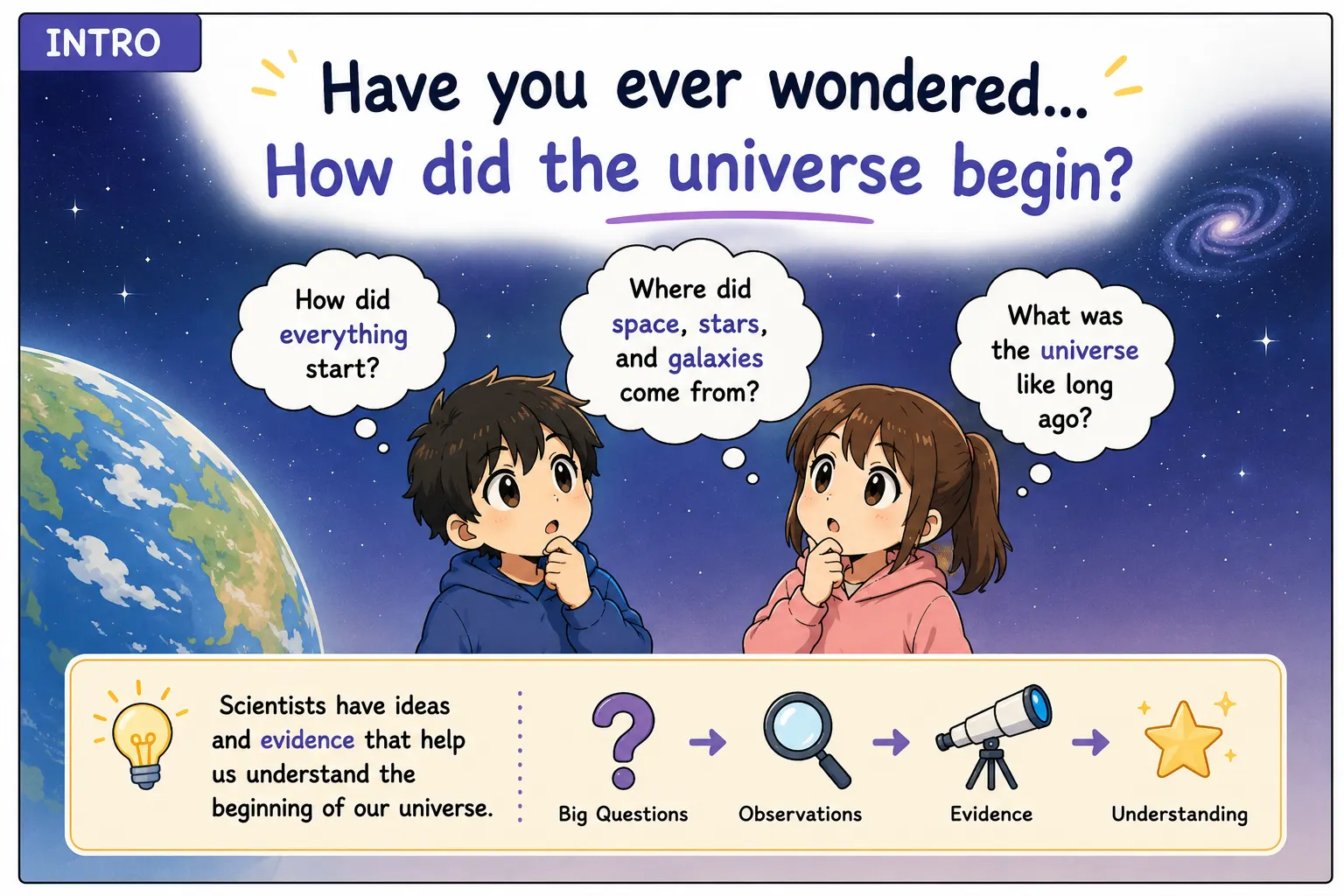
How does the big bang theory explain what we know about the universe?
Big Bang Theory
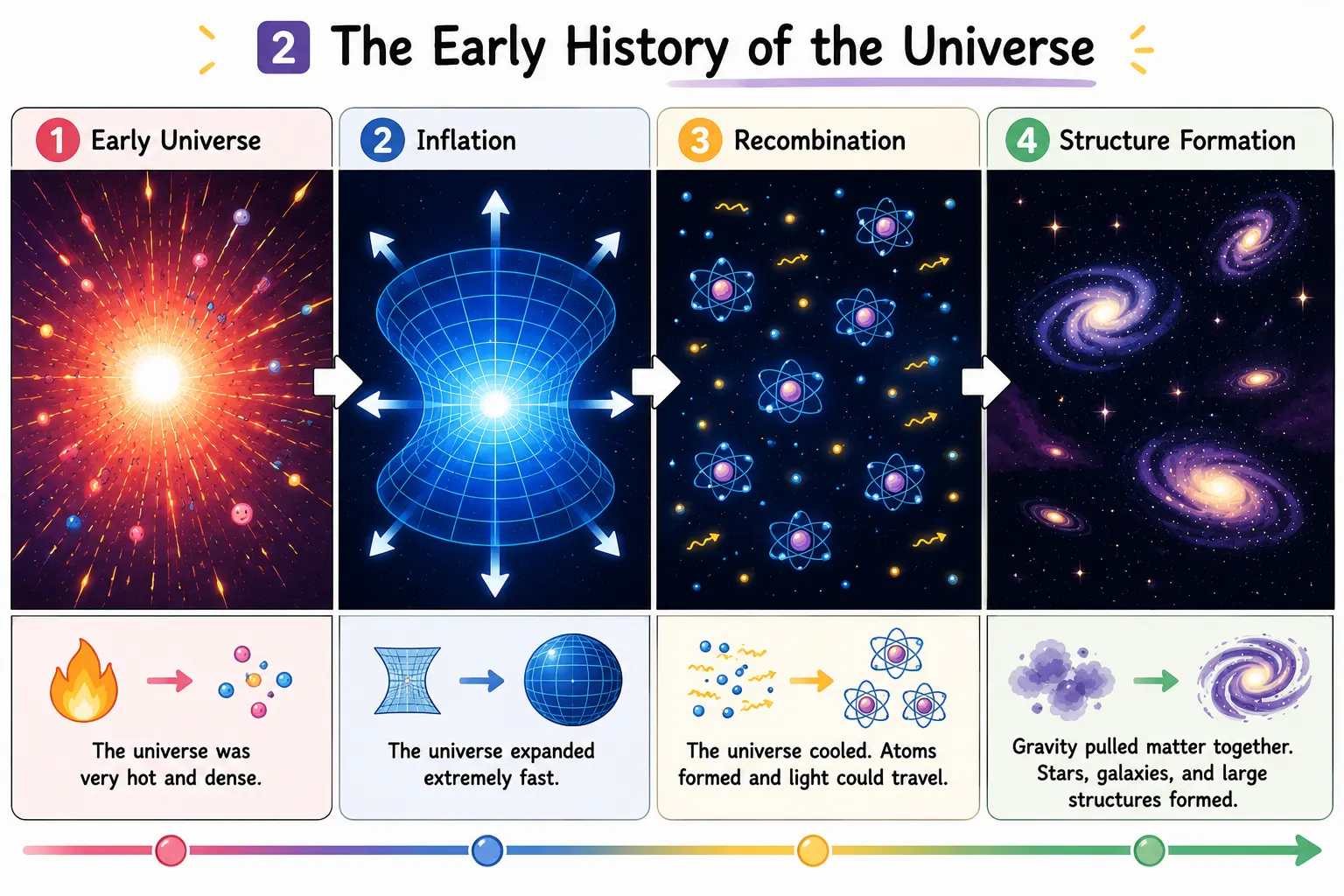
The Early History of the Universe
| Stage |
What happened |
| 1. Early Universe |
The universe was very hot and dense. |
| 2. Inflation |
The universe expanded extremely fast. |
| 3. Recombination |
The universe cooled.
Atoms formed and light could travel.
|
| 4. Structure Formation |
Gravity pulls matter together.
Stars, galaxies, and large structures formed.
|
| Vocab |
What it means |
| Big bang theory |
It says that:
1) the universe began very hot and very dense
2) space expanded
|
Evidence Supporting the Big Bang Theory
| Evidence |
What it shows |
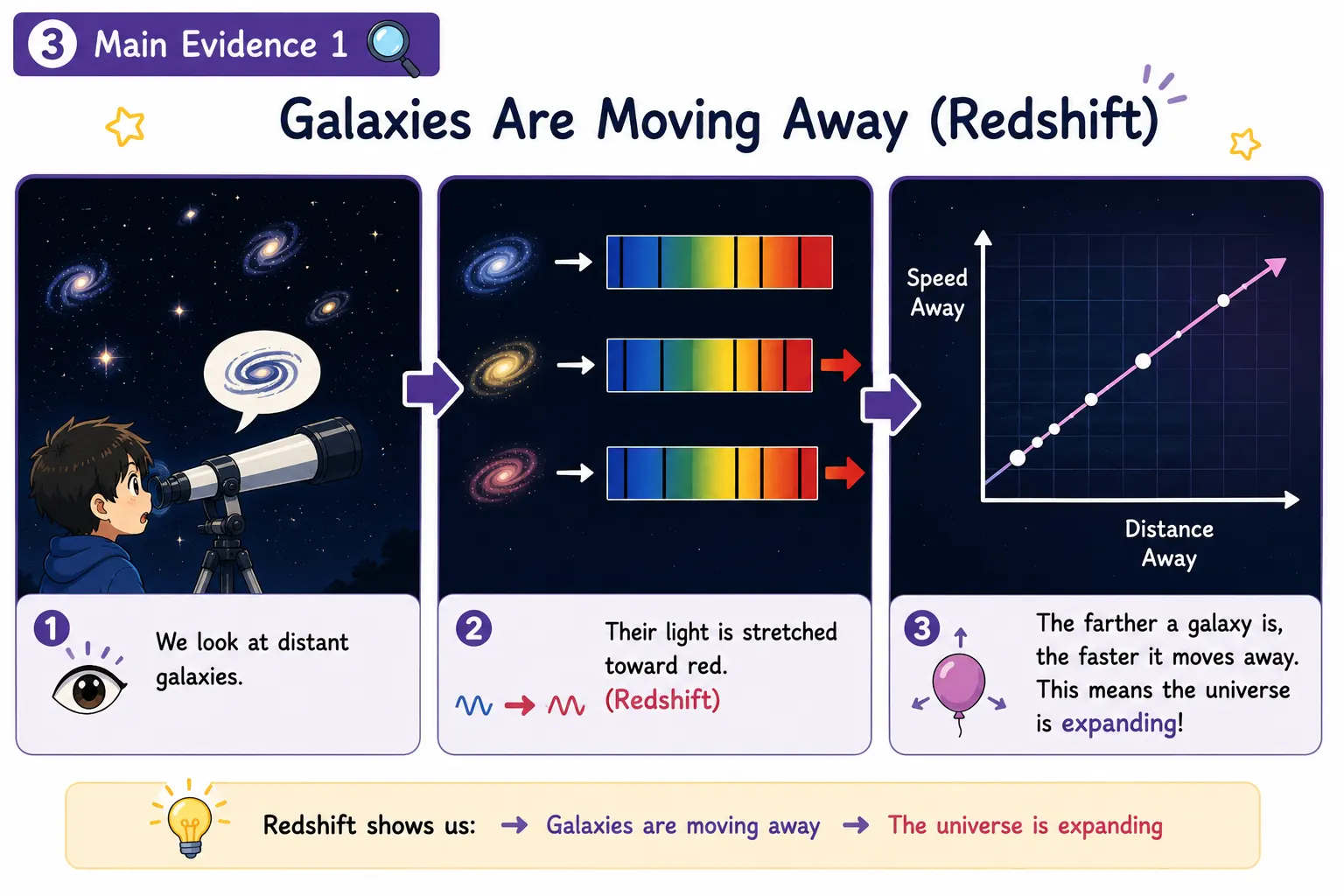
| Redshift |
Light from galaxies is stretched toward red.
As a light source moves away, its light shifts toward the red colour.
|
| CMB radiation |
Leftover light from the early universe.
It gives information about the universe when it was hot and dense.
Today, faint microwave radiation can be detected from all directions.
|
Easy Explanation
The big bang theory explains how the universe began and changed over time.
It says the universe began very hot and very dense.
Then space expanded.
The main evidence is redshift and cosmic microwave background radiation.
Doppler Effect
| Vocab |
What it means |
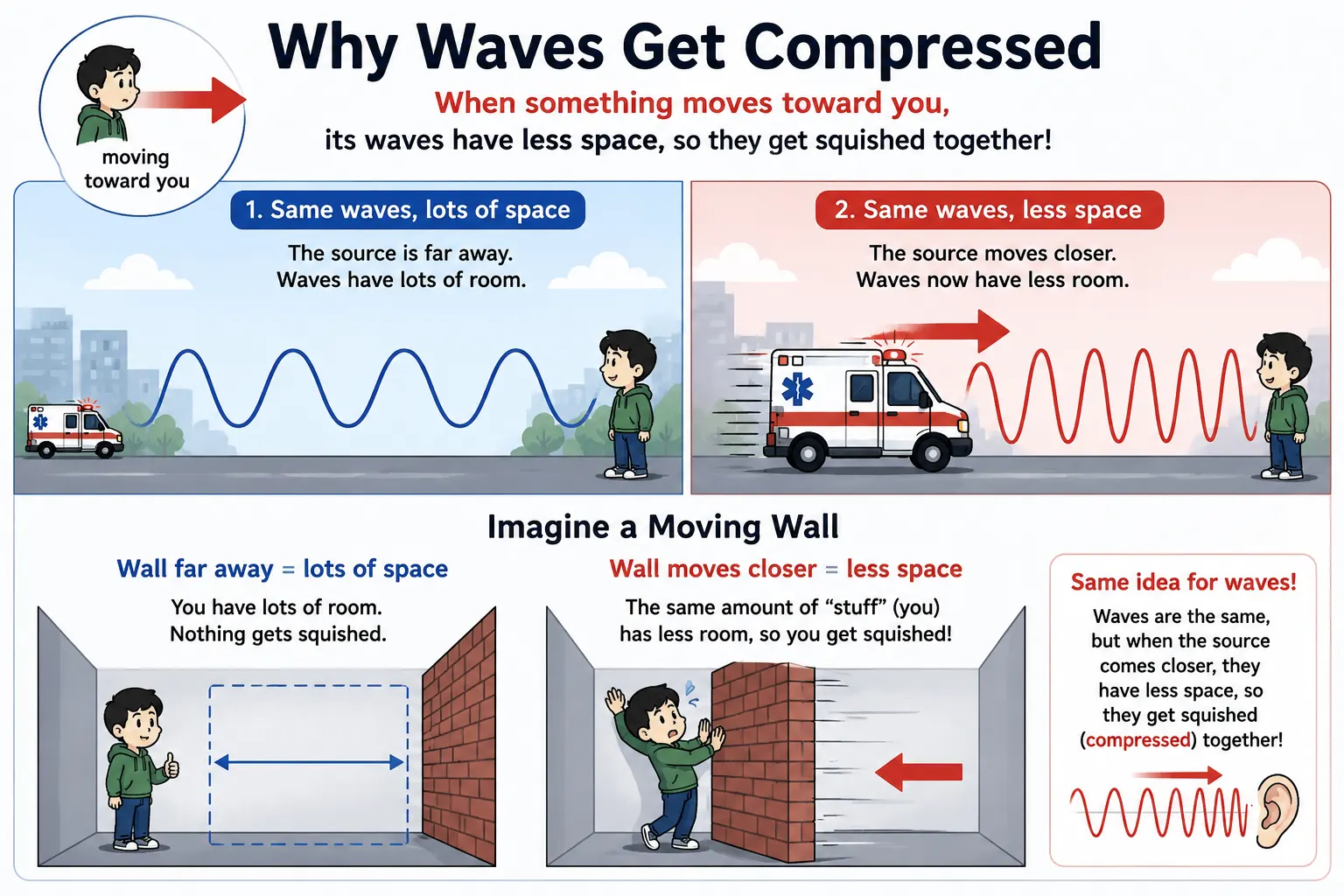
| Doppler effect |
The change in the frequency or height of a wave when the source
and the observer move closer to or farther away from each other.
|
Easy Explanation
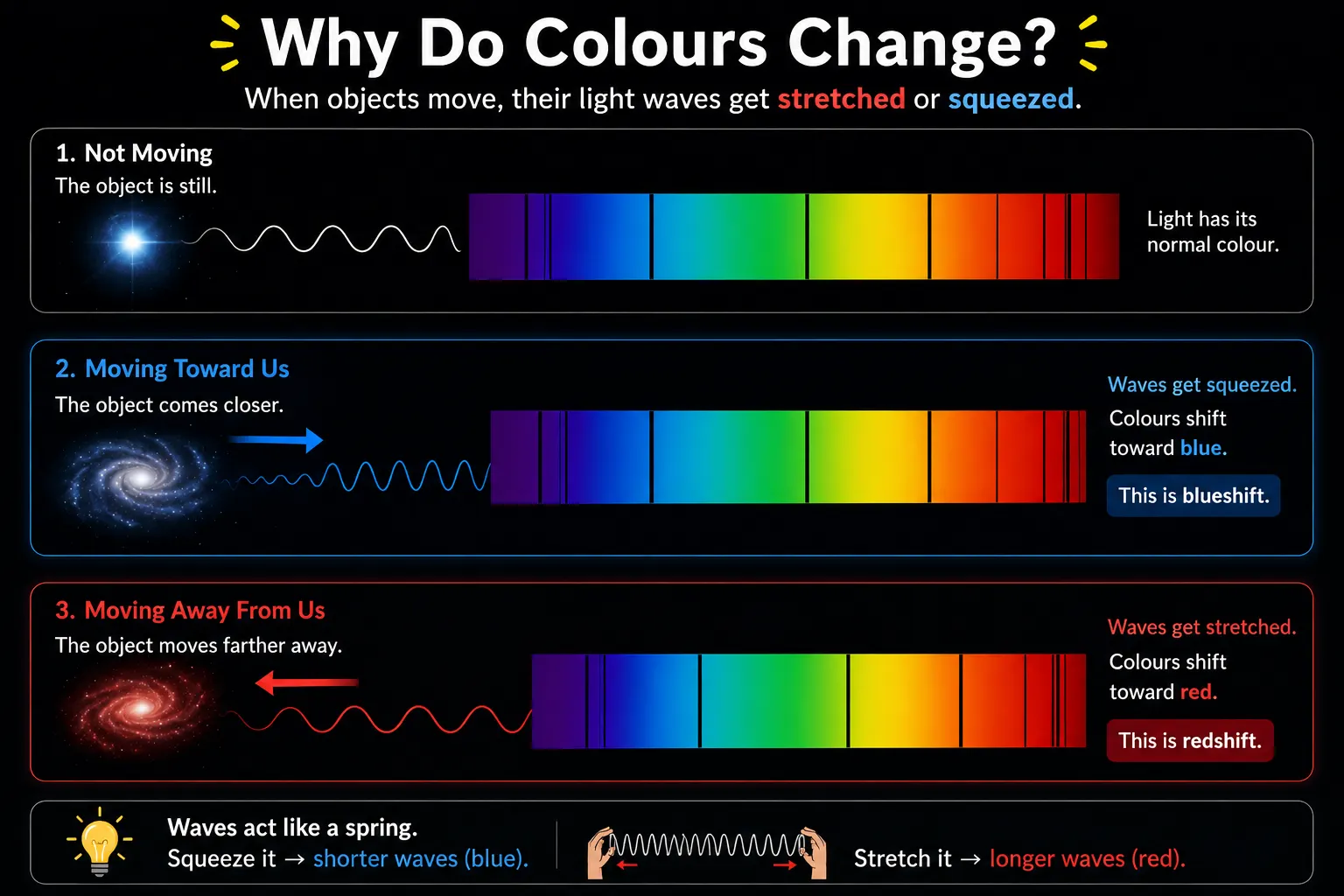
The Doppler effect happens when waves change because the source is moving.
When something moves toward you, its waves are compressed.
When something moves away from you, its waves are stretched.
This happens with sound waves and light waves.
Redshift and Blueshift
| Vocab |
What it means |
Why? |
| Blueshift |
Colours shift toward blue. |
The object comes closer.
Waves get squeezed.
|
| Redshift |
Colours shift toward red. |
The object moves farther away.
Waves get stretched.
|
Recap:
Purple → Navy → Blue → Green → Yellow → Orange → Red
Purple is the shortest reach-point.
If colour shifts toward purple, the object comes closer.
Red is the farthest reach-point.
If colour shifts toward red, the object moves away.
Easy Explanation
Light waves change colour when objects move.
If an object moves toward us, its light shifts toward blue.
This is called blueshift.
If an object moves away from us, its light shifts toward red.
This is called redshift.
Galaxies Are Moving Away
Easy Explanation
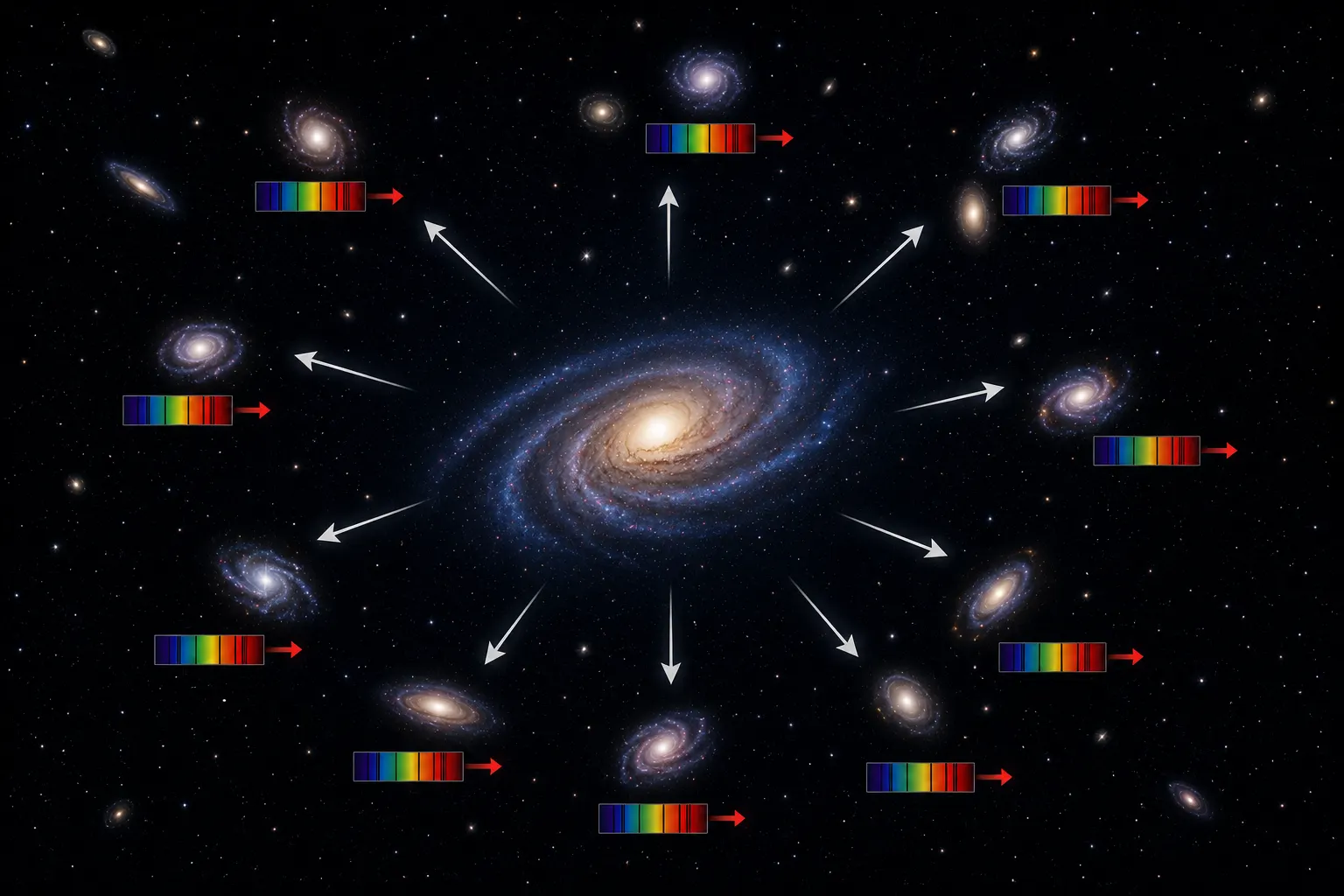
Hubble studied light from distant galaxies.
He found that most distant galaxies are redshifted.
This means most galaxies are moving away from us.
This was evidence that the universe is expanding.
Expanding Universe
Easy Explanation
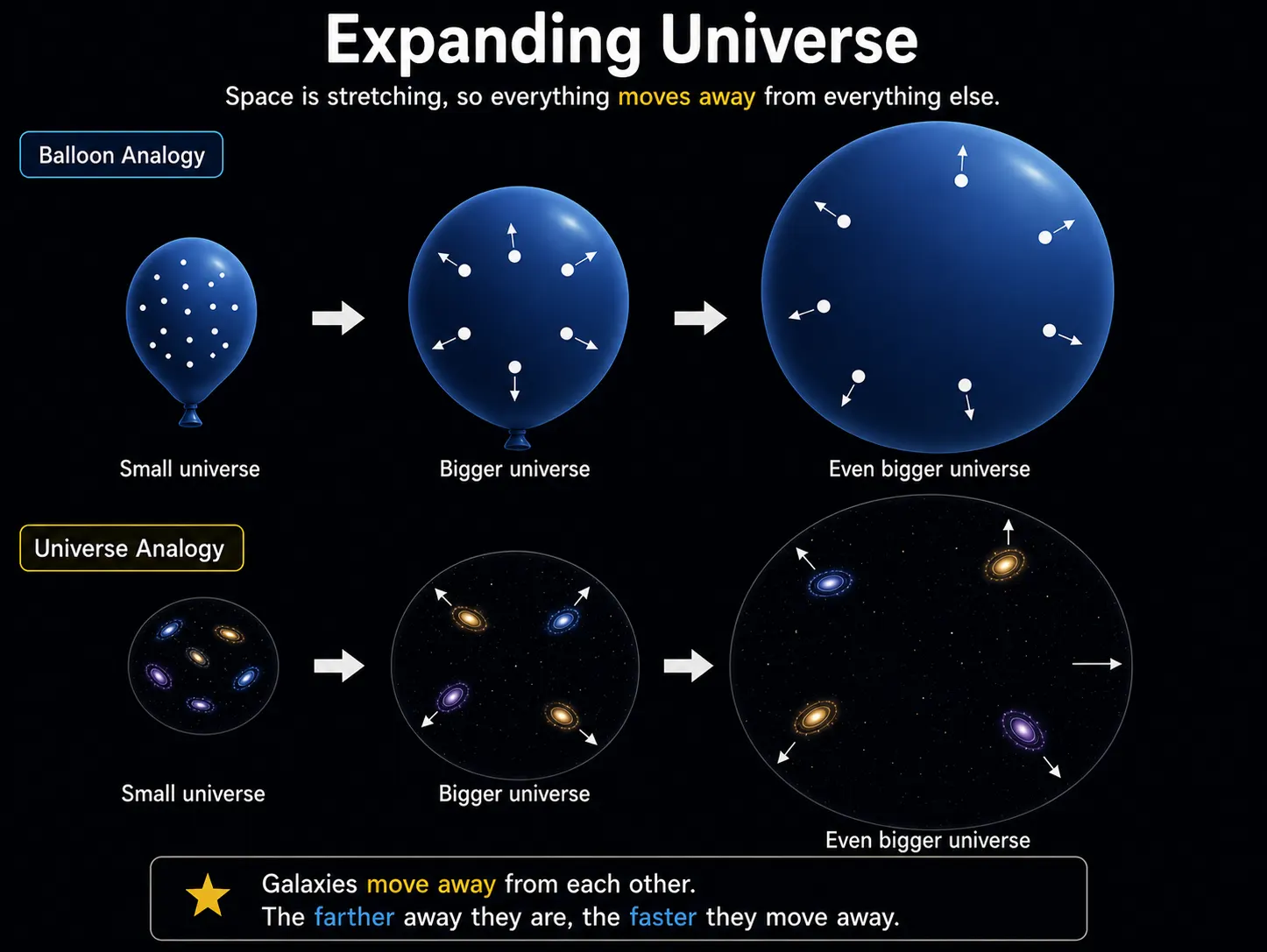
The universe is expanding.
This does not mean galaxies are flying through empty space like rockets.
It means the space between galaxies is increasing.
A balloon with dots can model this idea.
As the balloon expands, the dots move farther apart.
Hubble’s Law
| Vocab |
What it means |
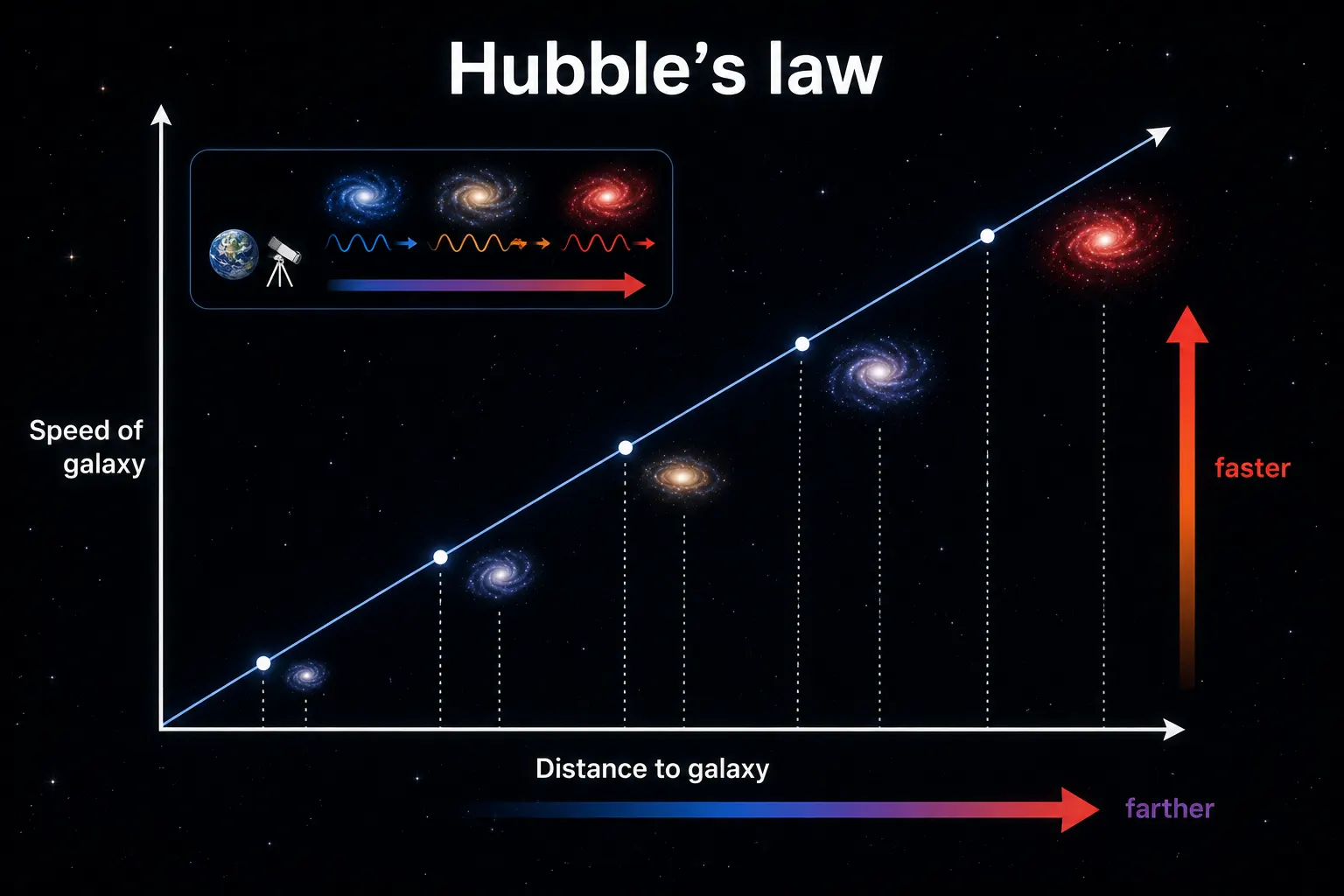
| Hubble’s law |
It says farther galaxies move away faster. |
Easy Explanation
A graph shows this as an upward line.
The farther a galaxy is, the greater its redshift.
Most galaxies are moving away from us.
This supports the idea that the universe is expanding because galaxies
must have been closer together in the past.
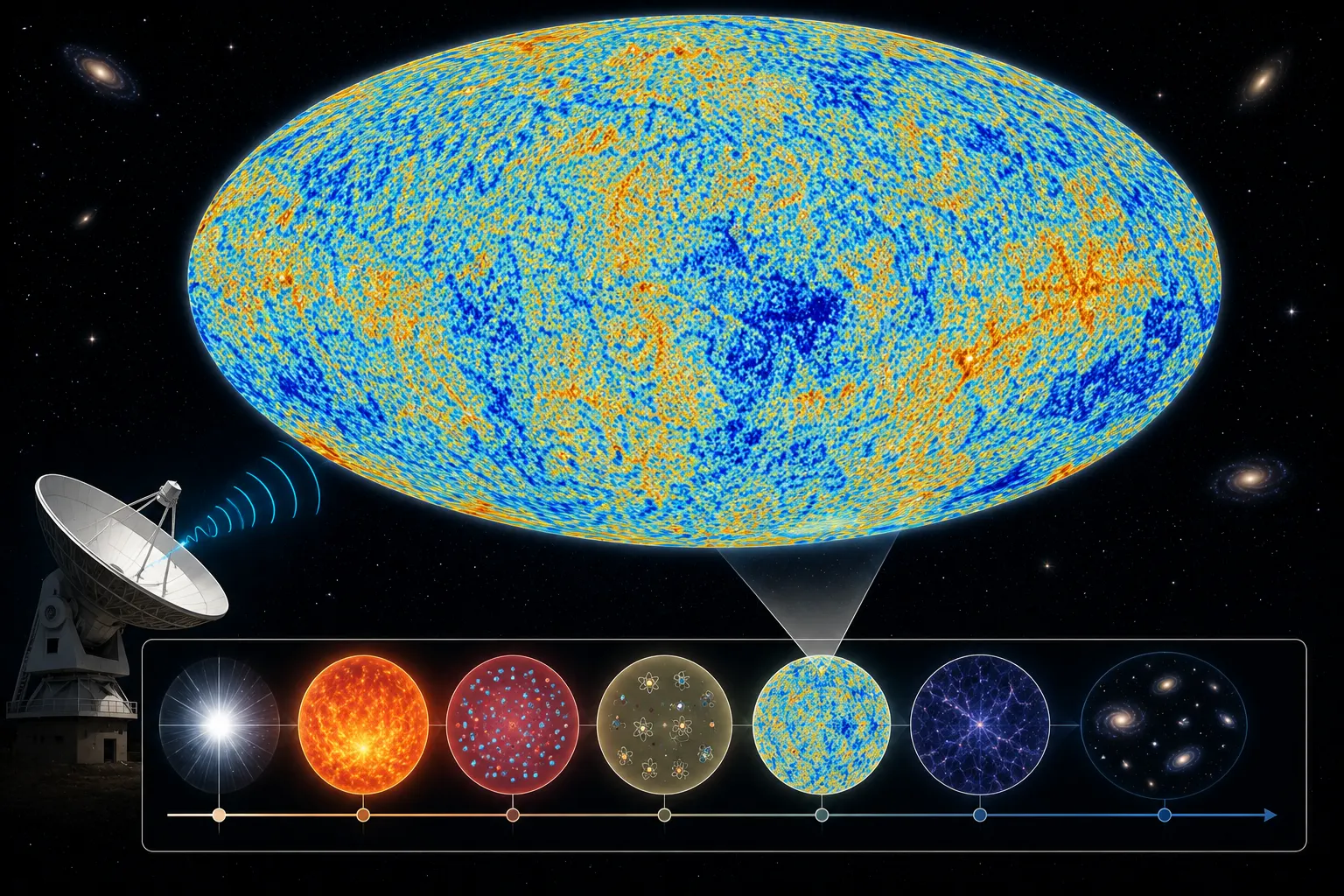
Cosmic Microwave Background Radiation
| Vocab |
What it means |
| Cosmic Microwave Background Radiation |
Leftover radiation from the early universe.
It shows how hot the universe was.
|
Easy Explanation
Cosmic microwave background radiation is leftover radiation
from the early universe.
It fills the universe.
It is very cold today.
It is evidence that the universe was once very hot and dense.
Why CMB Supports Big Bang Theory
| Vocab |
What it means |
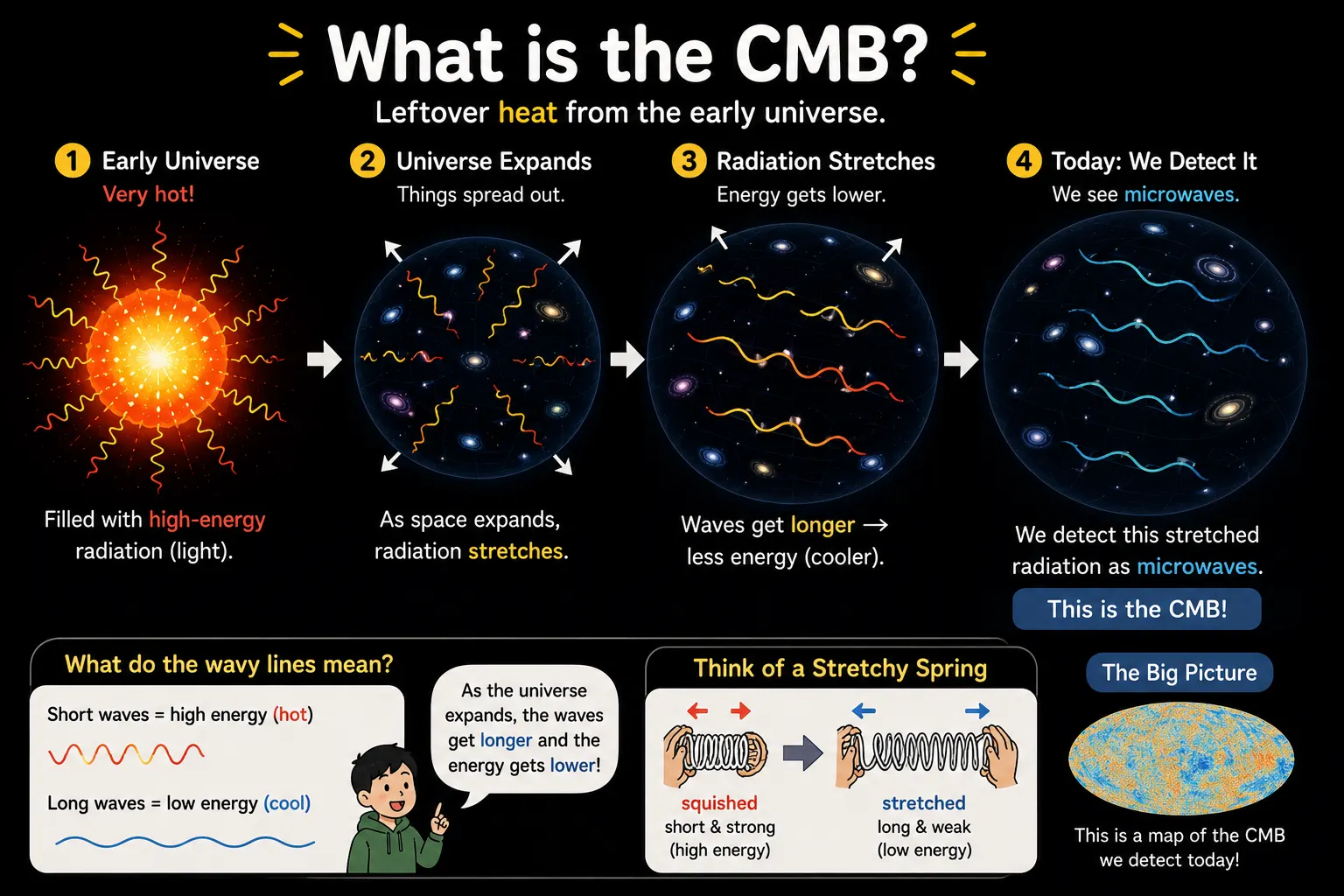
| CMB |
The stretched radiation seen as microwaves when the universe expanded.
|
Easy Explanation
The early universe was very hot.
It was filled with high-energy radiation.
As the universe expanded, the radiation stretched.
Today, we detect this stretched radiation as microwaves.
This is the CMB.
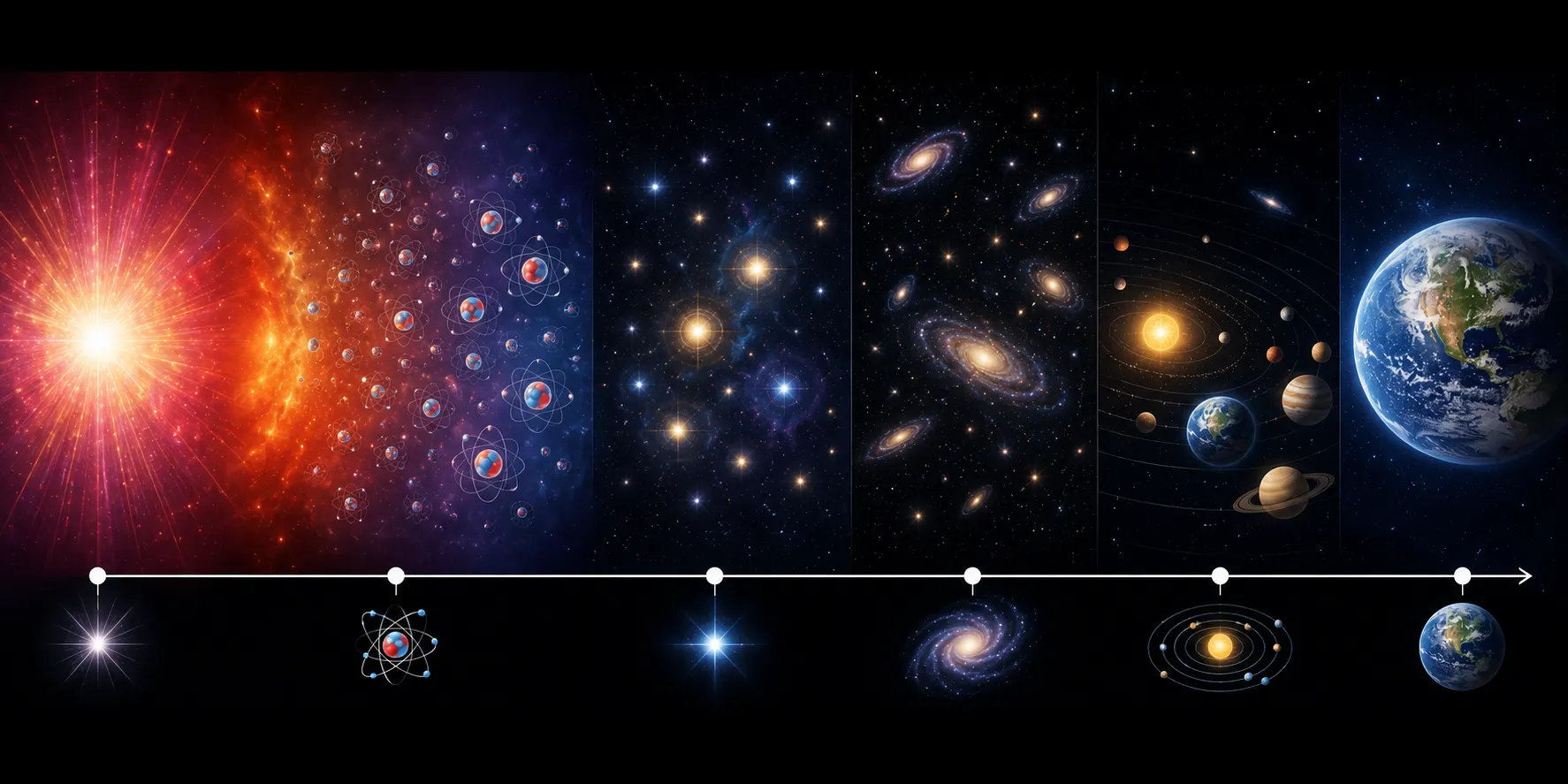
Timeline of the Universe
Easy Explanation
The big bang theory helps describe how the universe changed over time.
First, the universe was extremely hot and dense.
Later, atoms formed.
Then stars and galaxies formed.
Much later, the Sun and solar system formed.
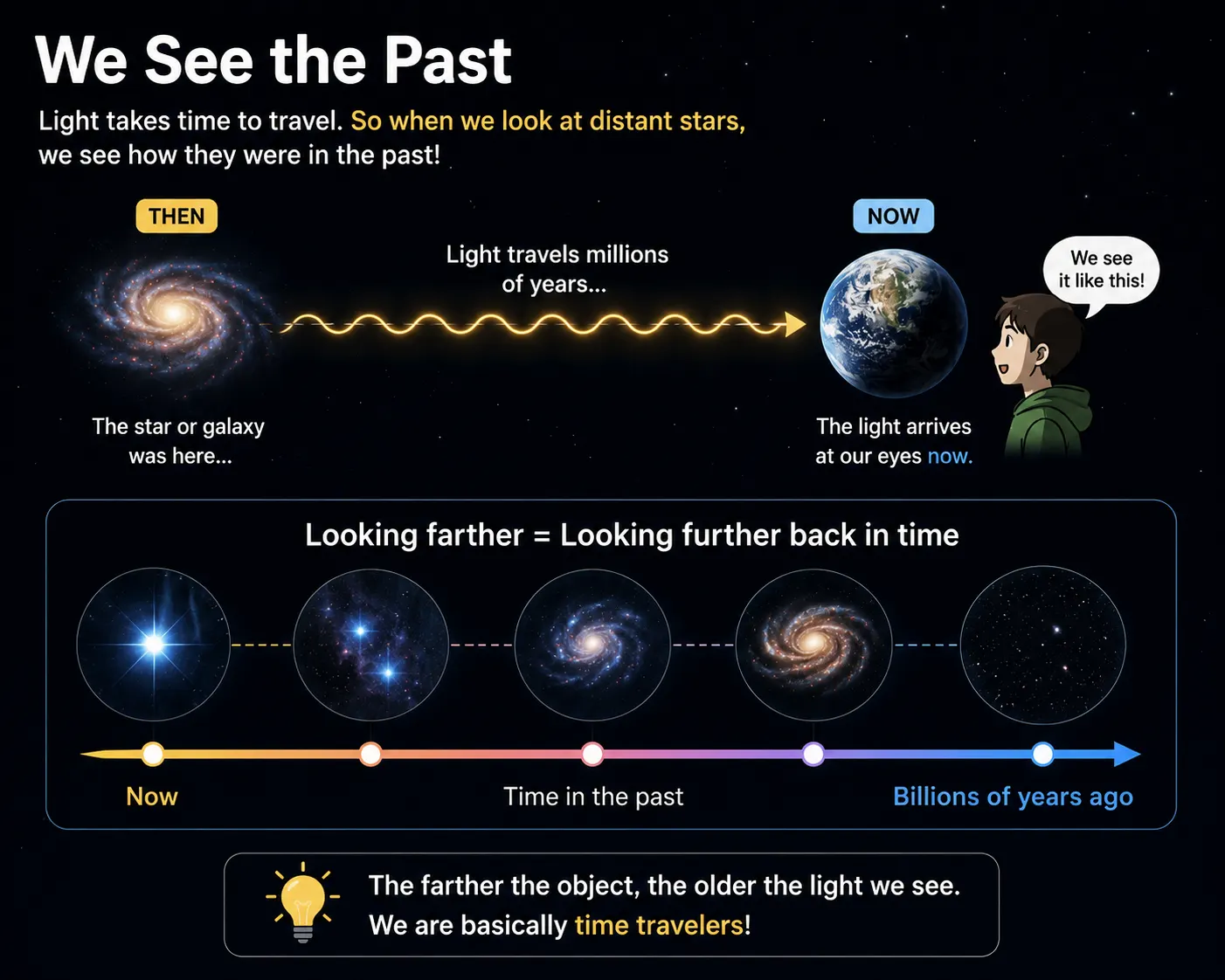
Looking Back in Time
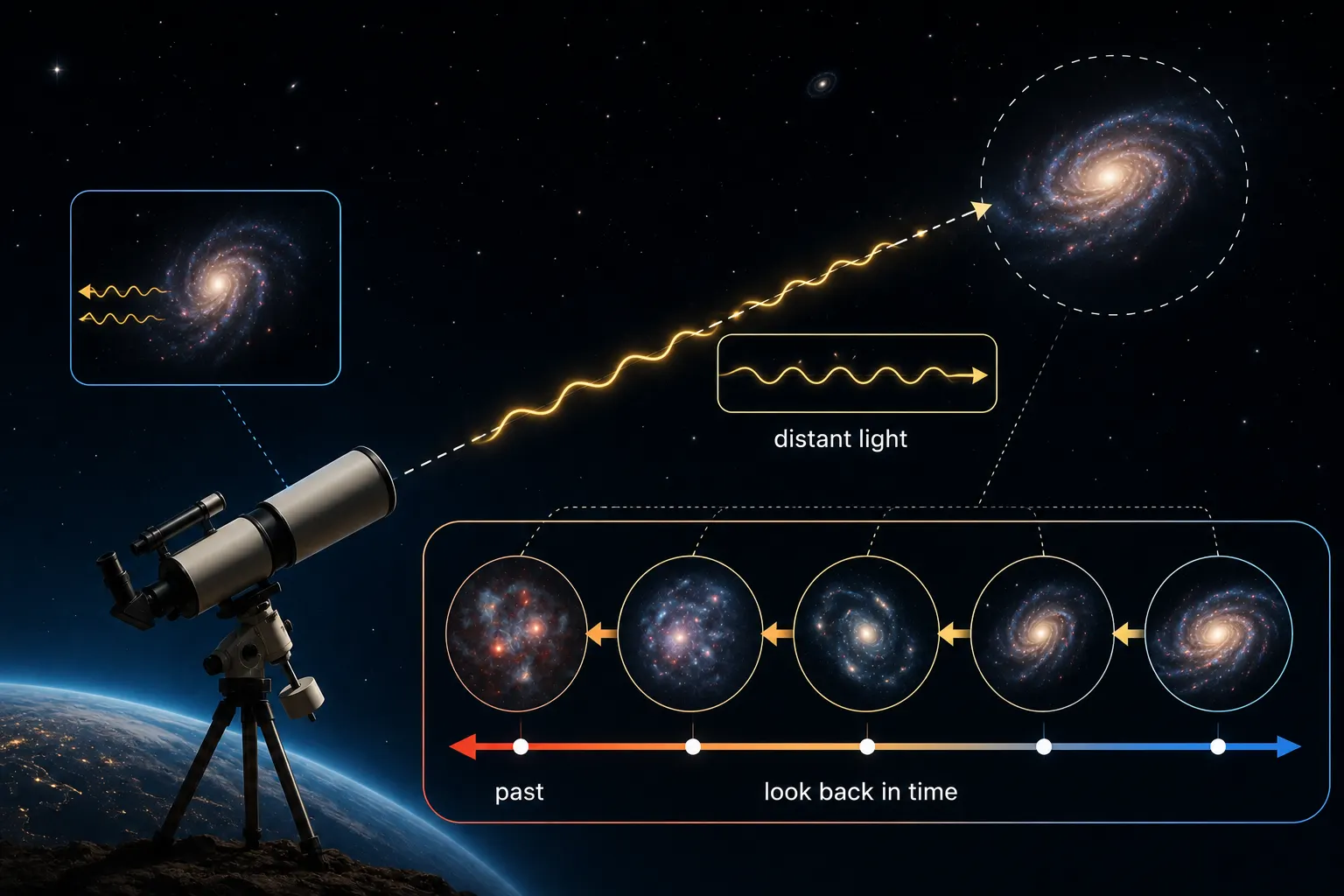
Easy Explanation
Light takes time to travel.
When we look far into space, we see old light.
That means we are looking into the past.
Modern telescopes help us study the early universe.
Dark Matter
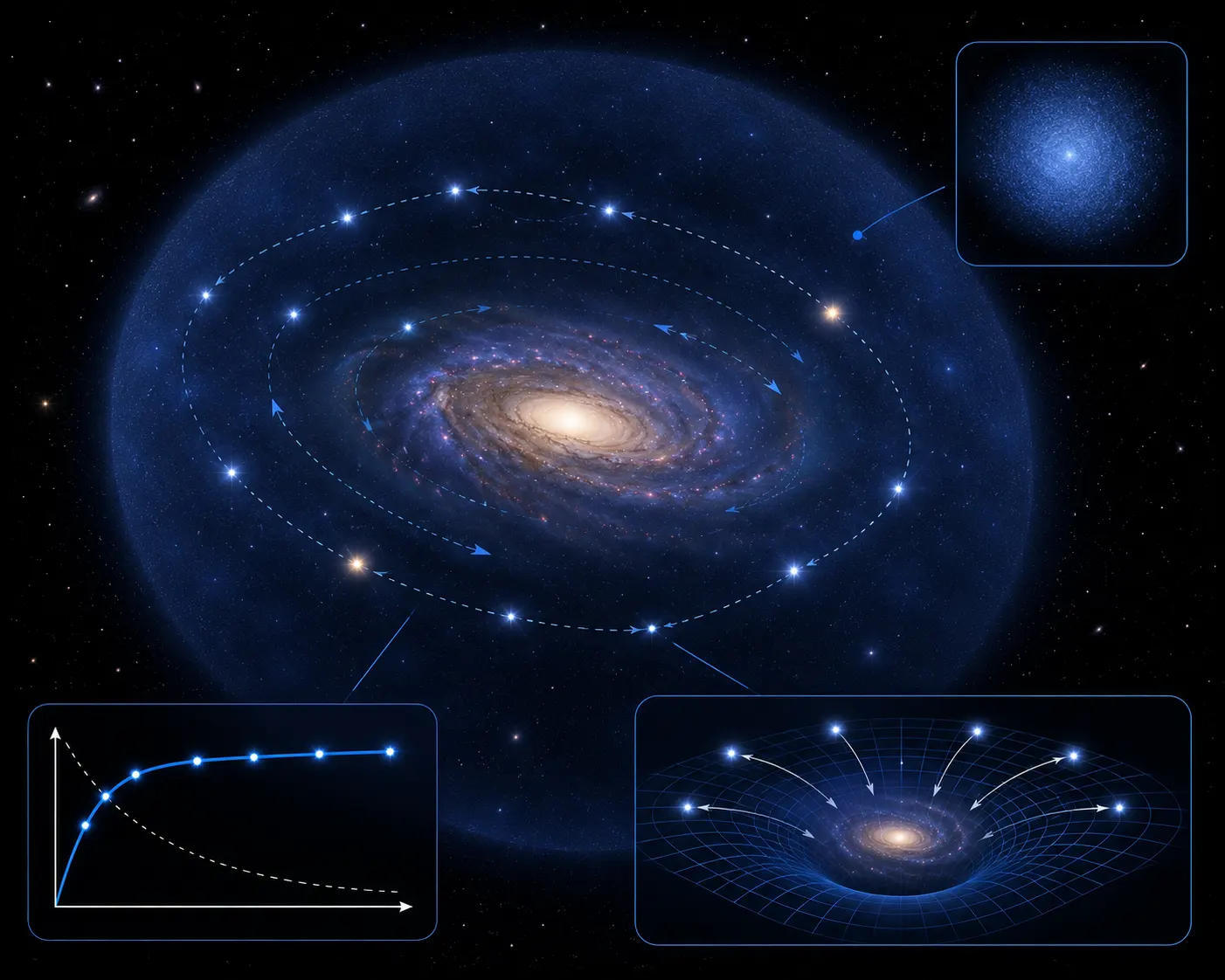
Easy Explanation
Dark matter is matter we cannot see directly.
It does not give off light.
Scientists infer it exists because of gravity.
Galaxies move as if there is more mass than we can see.
So scientists think invisible matter surrounds galaxies.
Dark Matter and Visible Matter
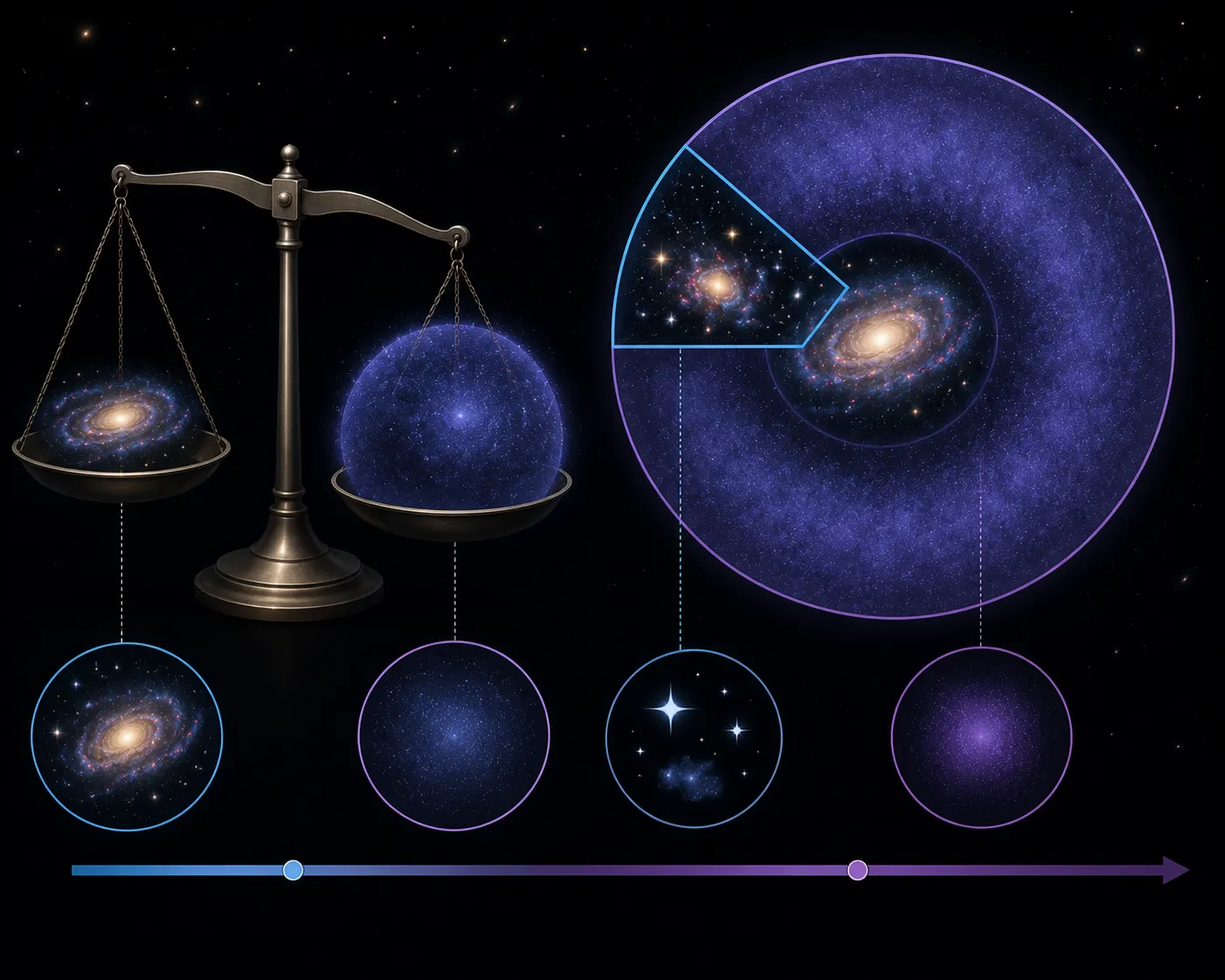
| Vocab |
What it means |
| Visible matter |
The matter we can see |
| Dark matter |
The matter we cannot see directly |
Easy Explanation
Visible matter is the matter we can see.
Stars, planets, gas, and galaxies are visible matter.
But visible matter is not enough to explain galaxy motion.
Dark matter may make up much more mass than visible matter.
Dark Energy
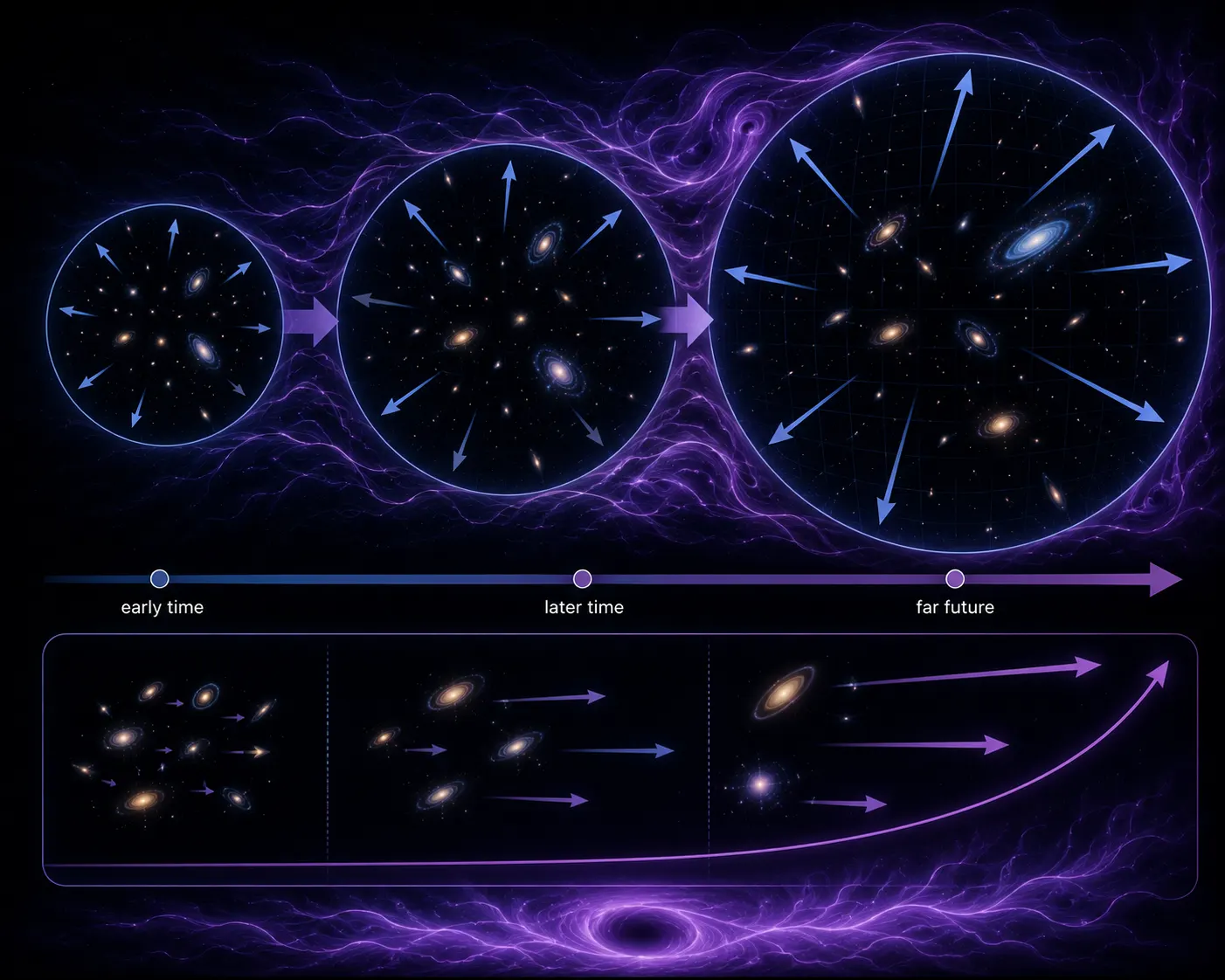
| Vocab |
What it means |
| Dark energy |
The unknown cause that speeds up the expansion of the universe
|
Easy Explanation
Scientists expected gravity to slow the expansion of the universe.
But observations showed that expansion is speeding up.
Scientists call the unknown cause that speeds up the expansion
of the universe dark energy.
Dark energy is still not fully understood.
What We Still Cannot Explain
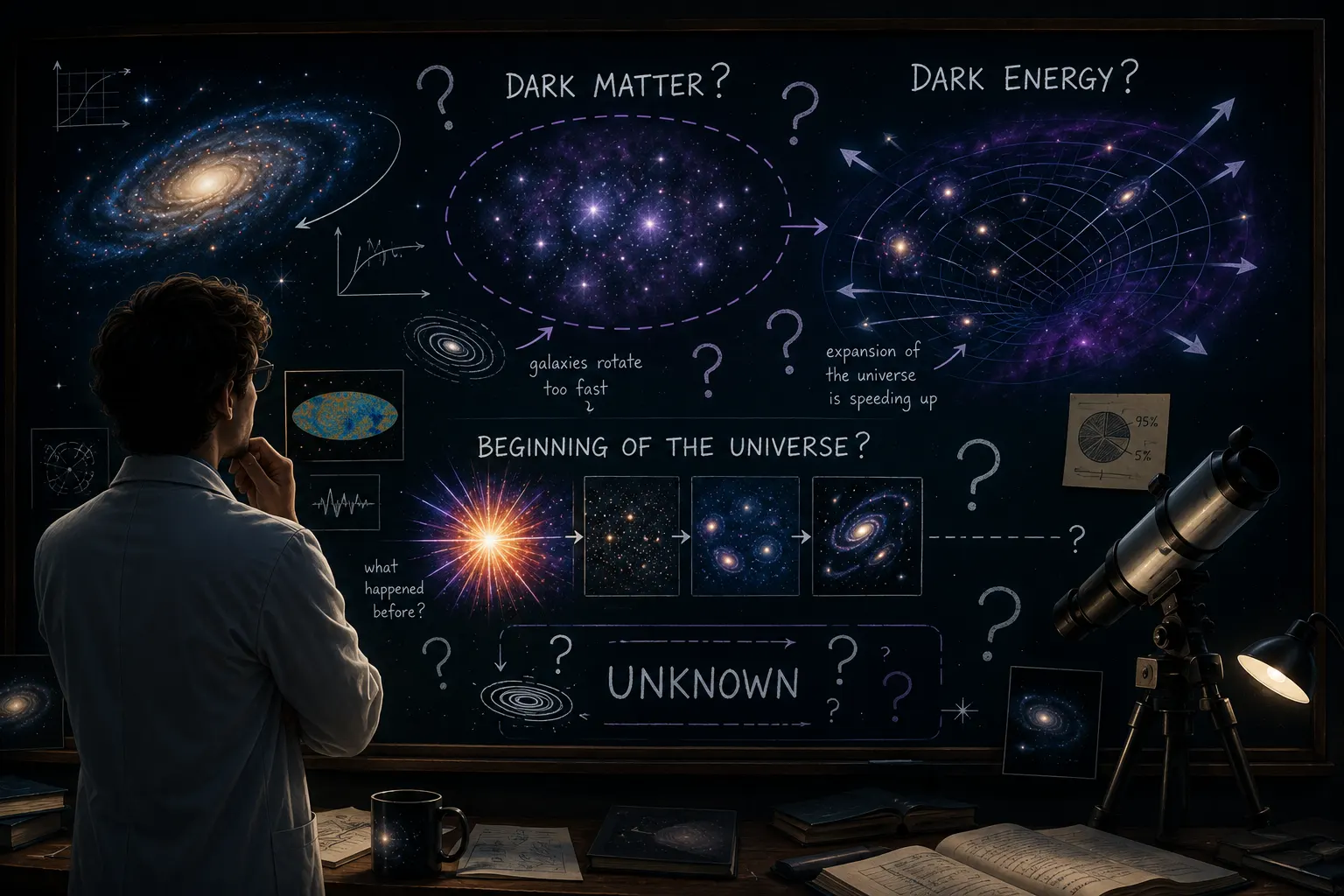
Easy Explanation
Science has explained many things about the universe.
But there is still much we do not know.
Dark matter and dark energy are major mysteries.
The big bang theory is strong, but it does not answer every question.
FINAL SUMMARY
Final Explanation
The big bang theory explains that the universe began hot and dense
and has expanded over time.
Redshift shows that most galaxies are moving away.
Hubble’s law shows that farther galaxies move away faster.
CMB radiation is leftover radiation from the early universe.
Dark matter and dark energy show that the universe still has many mysteries.