BC SCIENCE 10 · CHEMISTRY

Learn chemistry
piece by piece.

ELL-friendly Chemistry 10 lessons with illustrated explanations, simple vocabulary, and downloadable PDFs. Explore all four topics one concept at a time.

CHOOSE A TOPIC

Topic 2.1

Chemical Processes in Our Lives

Big Question: How are chemical processes part of our lives?

Pages 2–3

Chemistry Is Everywhere
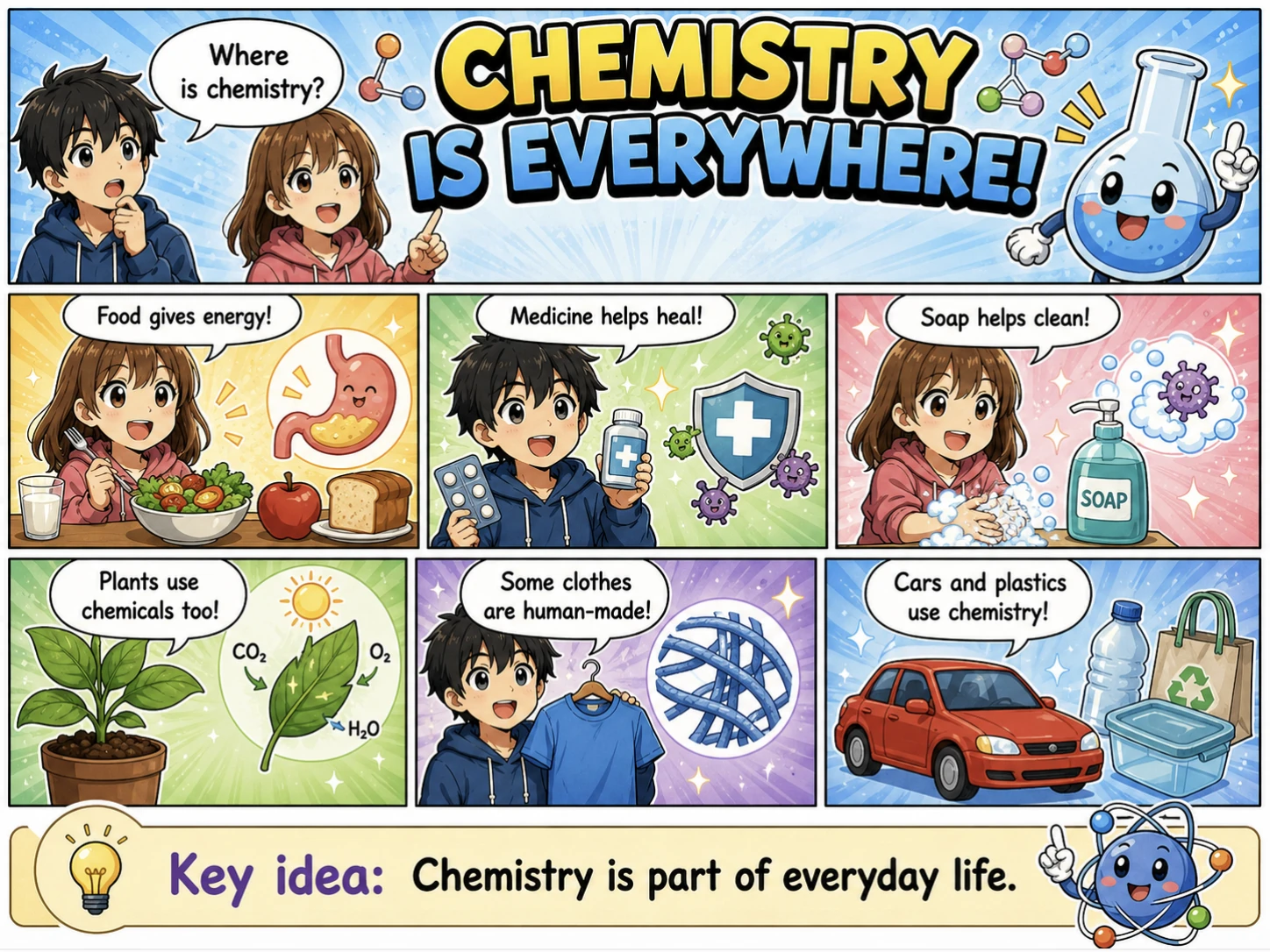
MOSAIC Chemistry Topic 2.1: Chemistry Is Everywhere illustration from source PDF page 2
Original MOSAIC Chemistry visual · Topic 2.1, PDF page 2
VocabWhat it means
Chemical processsomething involving chemicals changing or interacting
Synthetichuman-made

Easy explanation

Chemistry is part of everyday life.

It is in food.

It is used in medicine.

It is used to make personal care products. Can

It is used to make materials such as plastics and synthetic fibres.

Chemical processes also happen inside living things.

Some chemical processes are easy to see.

For example, fireworks make light, heat, gas, and colour.

Other chemical processes happen without us noticing them.

Think of chemistry like the backstage work behind everyday life.

We may not always see it, but it helps many things happen.

Chemistry can be useful.

But chemicals and chemical processes can also create hazards for people and the environment.

The textbook uses food, medical imaging, personal-care products, plants, transportation, plastics, and synthetic fabrics as examples of chemistry in modern life.
Pages 4–5

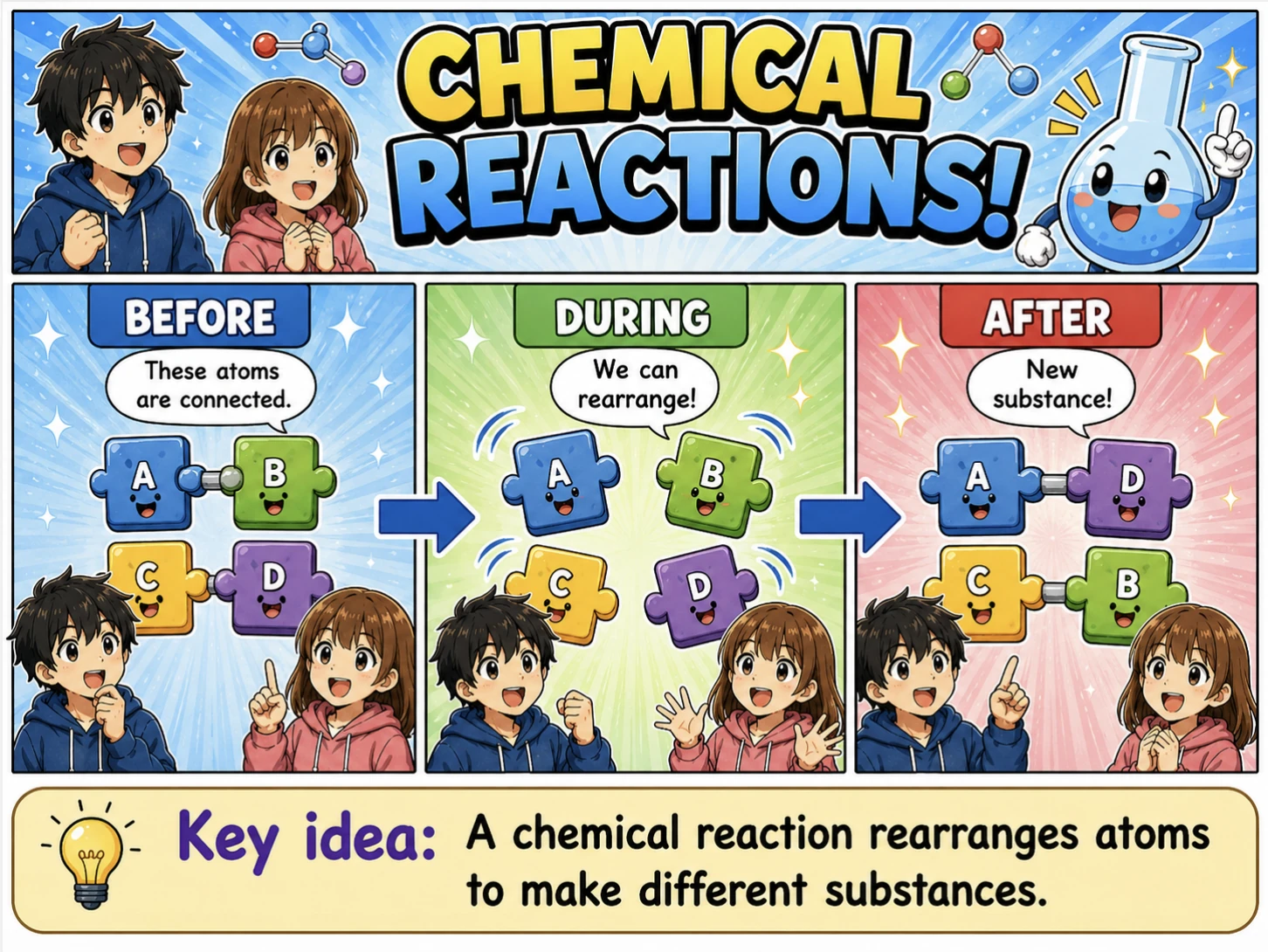
Chemical Reactions

MOSAIC Chemistry Topic 2.1: Chemical Reactions illustration from source PDF page 4
Original MOSAIC Chemistry visual · Topic 2.1, PDF page 4

Key Idea : A chemical reaction rearranges atoms to make different substances.

VocabWhat it means
Chemical reactiona process where atoms are rearranged to form different substances
Substancea type of matter

Easy explanation

A chemical reaction makes different substances.

The atoms are rearranged.

Imagine atoms are building blocks.

You start with blocks connected one way.

Then you reconnect the blocks in a new way.

Now you have something different.

Before reaction → atoms arranged one way

Chemical reaction → atoms rearrange

After reaction → different substances

Some reactions are easy to notice.
They may make light, heat, gas, smoke, or colour.
Other reactions happen quietly.

For example, chemical reactions help the body break down food.

Key idea:

Atoms rearrange → different substances form

The textbook defines a chemical reaction as a process in which atoms of one or more substances are rearranged to form different substances.

Pages 6–7

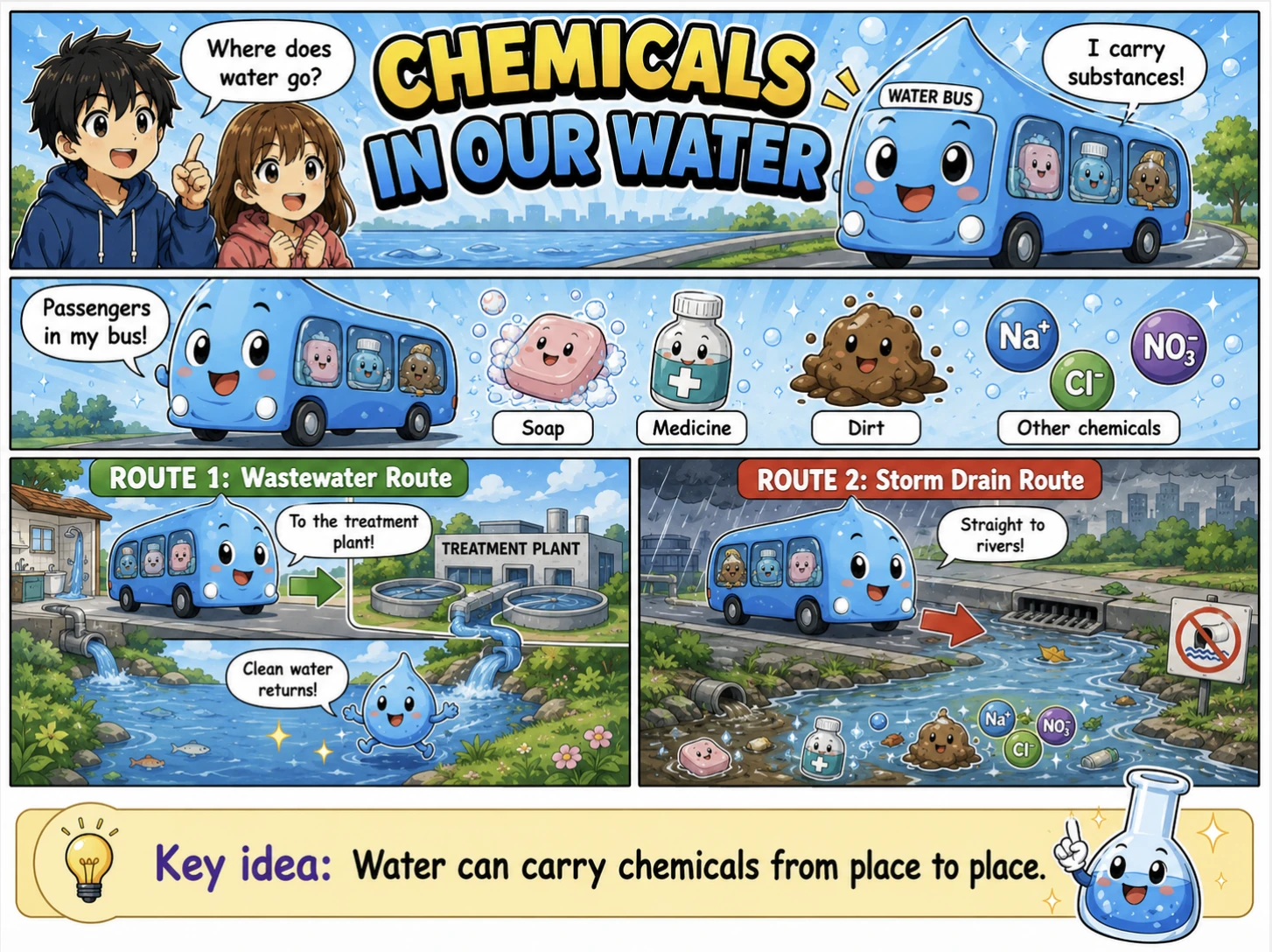
Chemicals in Our Water

MOSAIC Chemistry Topic 2.1: Chemicals in Our Water illustration from source PDF page 6
Original MOSAIC Chemistry visual · Topic 2.1, PDF page 6

Key idea : Water can carry chemicals from place to place.

VocabWhat it means
Dissolvemix into a liquid
Wastewaterused water from homes, schools, and other buildings
Water treatment facilitya place where wastewater is treated
Pollutantsomething that makes the environment dirty or unsafe
Storm drainan opening that carries rainwater and runoff away from streets

Easy explanation

Natural water contains dissolved substances.

Water can dissolve many different substances.

You can think of water like a carrier.

It can pick up substances and move them from one place to another.

Some substances come from nature.

For example, metals and ions can come from soil.

Other substances come from human activities.

Waste from homes, mining, and industry can enter water.

Wastewater

Water from homes, schools, and other buildings usually enters a sewer system.

The sewer carries the water to a treatment facility.

The treatment facility removes many pollutants.

But even very efficient facilities cannot remove all polluting chemicals.

Storm drains

A storm drain is different.

Rainwater and runoff enter storm drains.

This water can pick up pollutants from streets, driveways, and parking lots.

Storm-drain water can go directly into local lakes and rivers without treatment.

Think of it like this:

Wastewater → treatment → environment

but

Storm drain → environment

Key idea: What enters our water can travel through the environment.

Pages 8–9

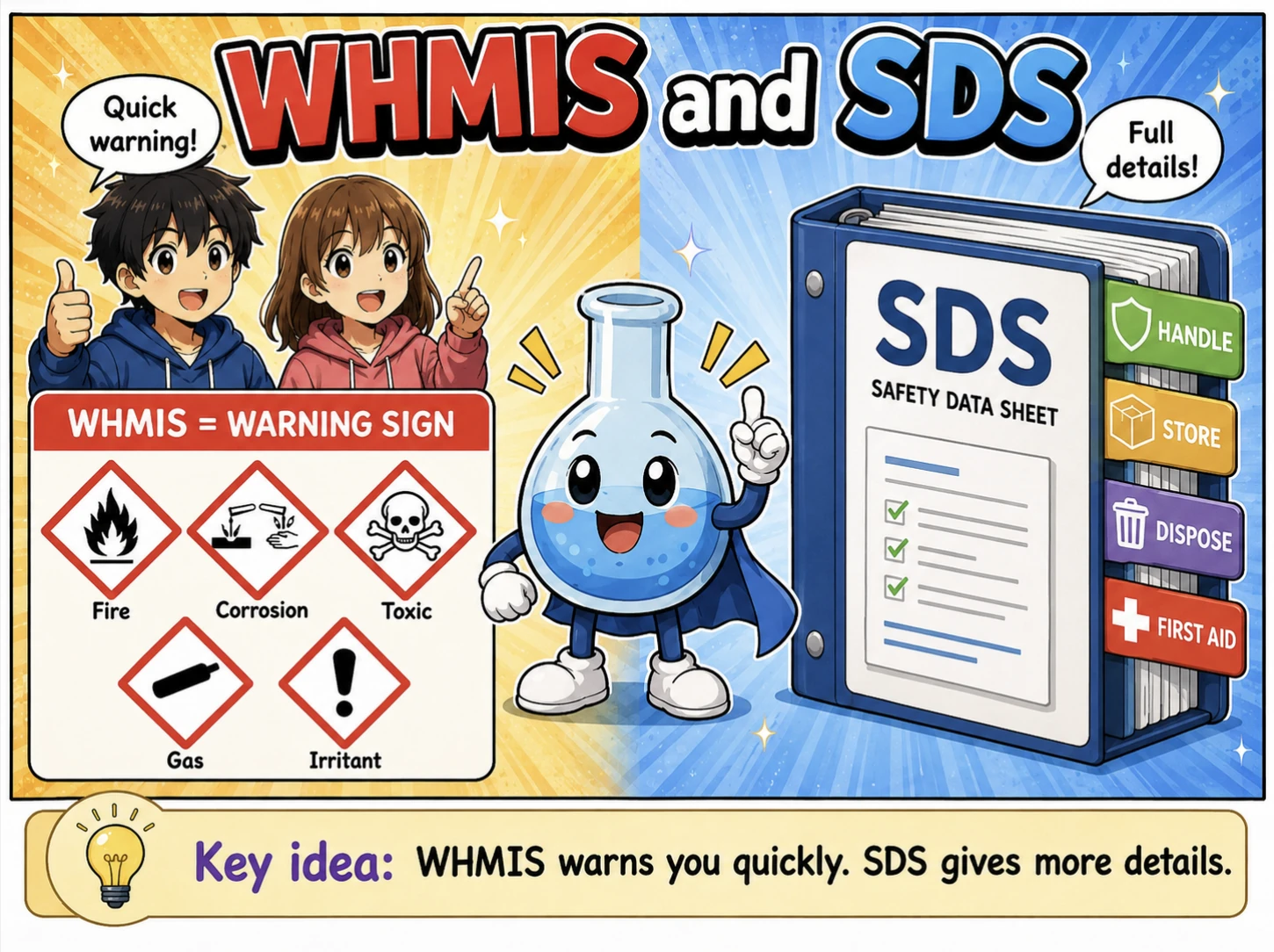
Chemical Safety: WHMIS and SDS

MOSAIC Chemistry Topic 2.1: Chemical Safety: WHMIS and SDS illustration from source PDF page 8
Original MOSAIC Chemistry visual · Topic 2.1, PDF page 8
VocabWhat it means
Hazardsomething that can cause harm
WHMISWorkplace Hazardous Materials Information System
SDSSafety Data Sheet

Easy explanation

Some chemicals can be dangerous.

We need information before we use them.

WHMIS uses symbols and labels.

The symbols warn us about different hazards.

For example: Fire, Explosion, Corrosion, Poison, Gas under pressure, Serious health effects

Think of WHMIS like a warning sign.

It gives you important information quickly.

An SDS gives more information.

It tells you about:

how to handle the chemical

how to store it

how to dispose of it

its hazards

what to do if an accident happens

Think of it like this:

WHMIS = quick warning sign

SDS = full instruction manual

The textbook explains that WHMIS labels give information about chemicals in laboratories and workplaces, while Safety Data Sheets provide more detailed information about properties, handling, storage, disposal, hazards, and first aid.

Pages 10–11

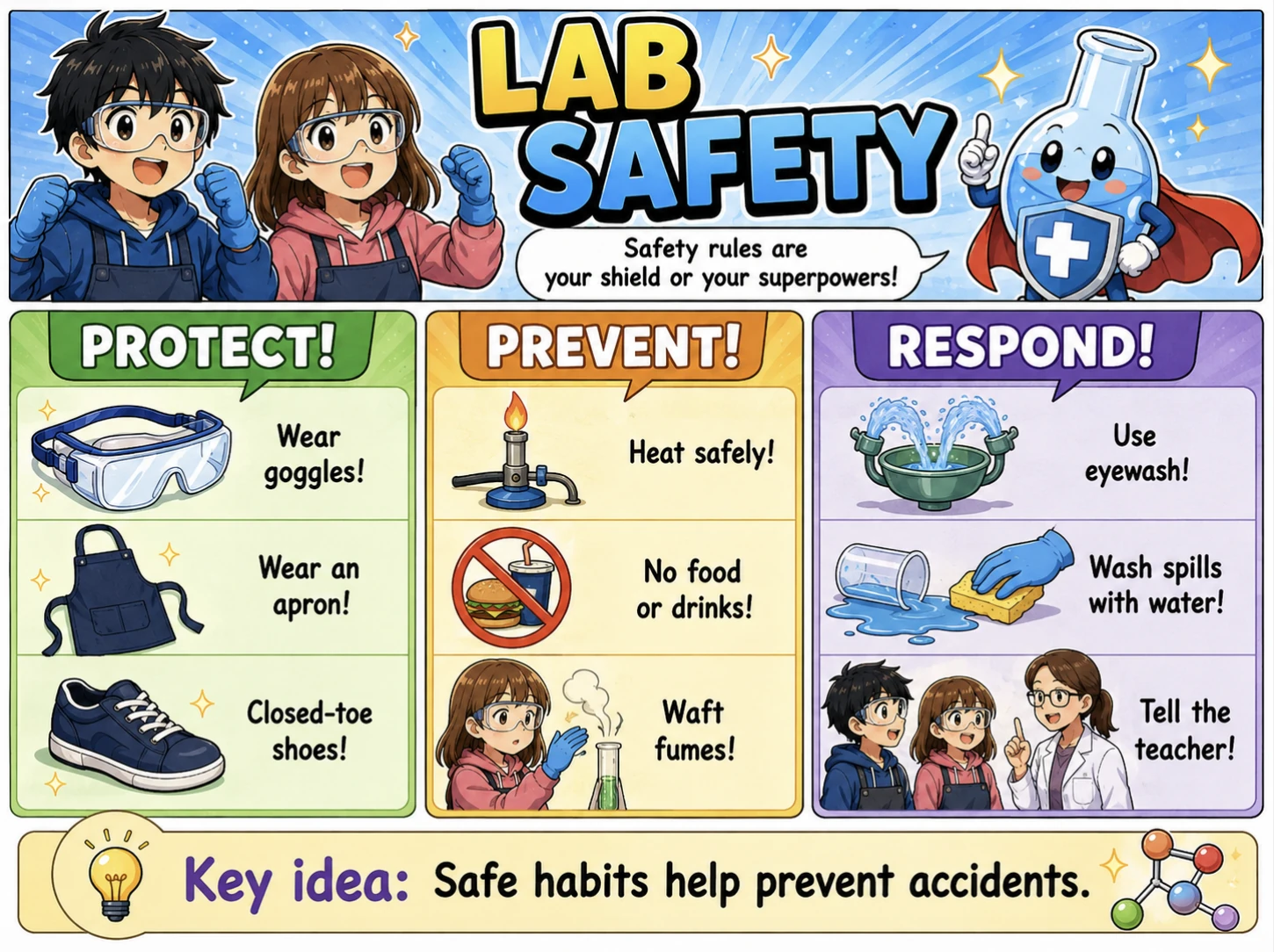
Lab Safety

MOSAIC Chemistry Topic 2.1: Lab Safety illustration from source PDF page 10
Original MOSAIC Chemistry visual · Topic 2.1, PDF page 10
VocabWhat it means
Protective equipmentequipment worn to help protect your body
Eyewash stationequipment used to rinse chemicals from the eyes
Waftgently move fumes toward your nose instead of smelling directly

Easy explanation

Lab safety has three important jobs:

Protect yourself.

Prevent accidents.

Respond correctly if an accident happens.

Protect

Wear safety goggles.

Wear a lab coat or apron.

Tie back long hair.

Wear shoes that cover your toes.

Prevent

Do not eat food or chew gum.

Keep chemicals away from your face.

Never leave an open flame alone.

When heating a container, point the opening away from people.

If you are told to smell something, waft the fumes toward your nose.

Do not smell it directly.

Respond

Know where emergency exits and safety equipment are.

If a solid chemical gets on you, brush it off immediately.

If a liquid spills on you, wash the area with water.

If something gets in your eyes, use the eyewash station and tell the teacher immediately.

Easy memory trick:

PROTECT → PREVENT → RESPOND

Pages 12–13

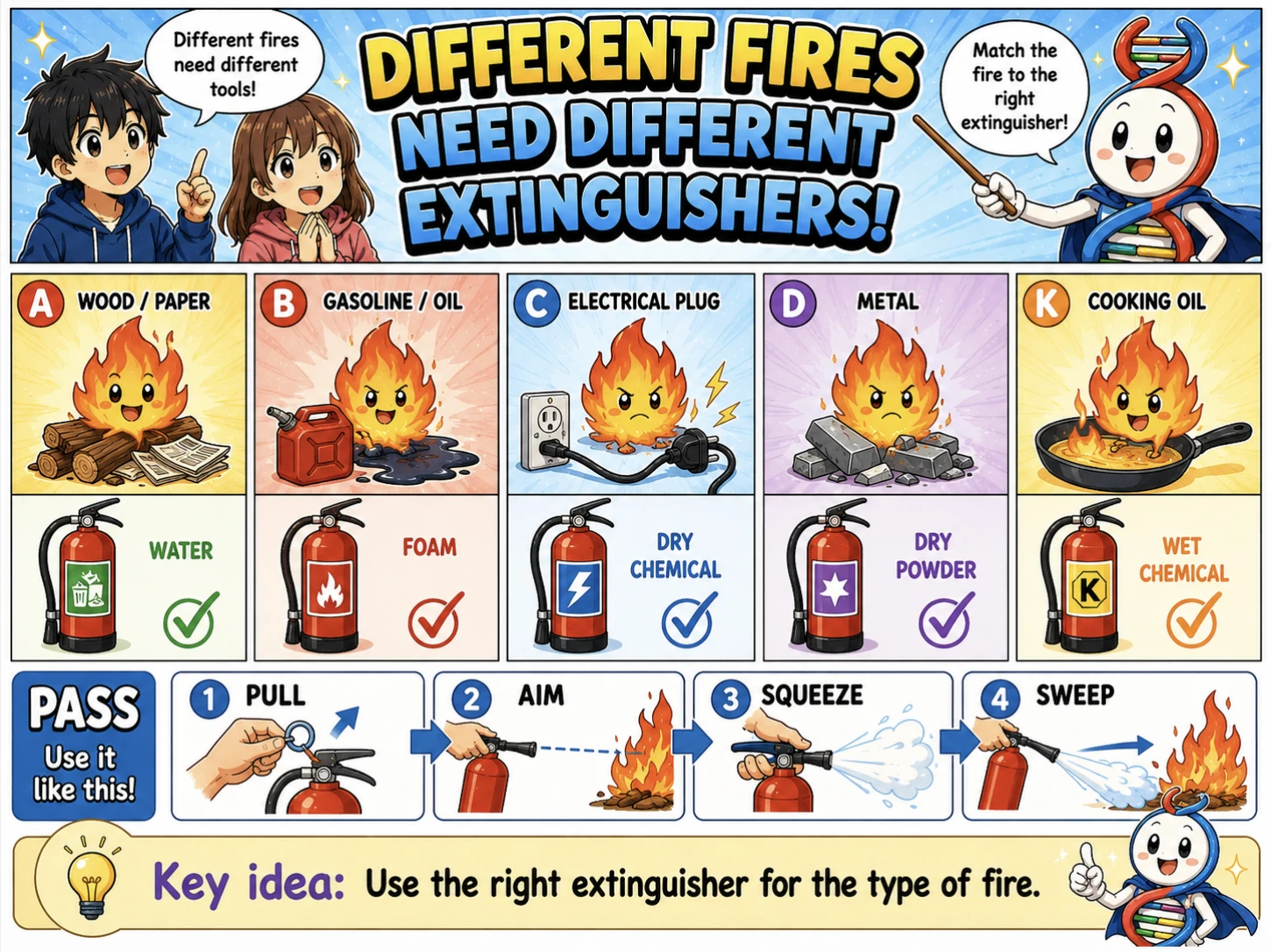
Different Fires Need Different Extinguishers

MOSAIC Chemistry Topic 2.1: Different Fires Need Different Extinguishers illustration from source PDF page 12
Original MOSAIC Chemistry visual · Topic 2.1, PDF page 12
VocabWhat it means
Fire extinguisherequipment used to put out a fire
Fire classa group of fires based on what is burning
Fuelthe material that is burning
PASSsteps used when operating a fire extinguisher

Easy explanation

Not all fires are the same.

Different materials can burn.

The material that burns is the fuel.

Different fuels need different fire extinguishers.

Using the wrong extinguisher can make a fire more dangerous.

Fire classWhat is burningTextbook extinguisher examples
Awood, paper, cloth, plasticwater, dry chemical, chemical foam
Bgasoline, petroleum oil, paint, flammable gasescarbon dioxide, dry chemical, chemical foam
Celectrical equipment with live electricitycarbon dioxide, dry chemical
Dcombustible metals such as magnesium and titaniumspecial dry powder
Kcooking oils and fatswet chemical

The textbook warns that water can spread fires involving flammable liquids and cooking oils, and using water on an electrical fire can cause dangerous electrocution.

PASS

A simple way to remember how to operate a fire extinguisher is:

P — Pull the pin

A — Aim at the base

S — Squeeze the trigger

S — Sweep

The textbook's page 12 fire-extinguisher diagram presents PASS as the four-step memory aid for extinguisher use.

Page 14

Summary

Short explanation

Chemistry is everywhere.

Chemical reactions rearrange atoms to make different substances.

Chemistry gives us useful products, medicine, materials, and technology.

But chemicals can also create risks.

Chemicals can enter water and move through the environment.

WHMIS symbols warn us about hazards.

SDS documents give detailed safety information.

Good lab habits help prevent accidents.

Different types of fires need different types of fire extinguishers.

Big idea:

Chemistry can help us → but we must understand it and use chemicals safely.

The textbook frames Topic 2.1 around these same two ideas: applications of chemistry are everywhere, and safe chemical handling protects people and the environment.

Topic 2.2

What Happens to Atoms in a Chemical Reaction?

Big Question: What happens to atoms when substances change into new substances?

Pages 2–3

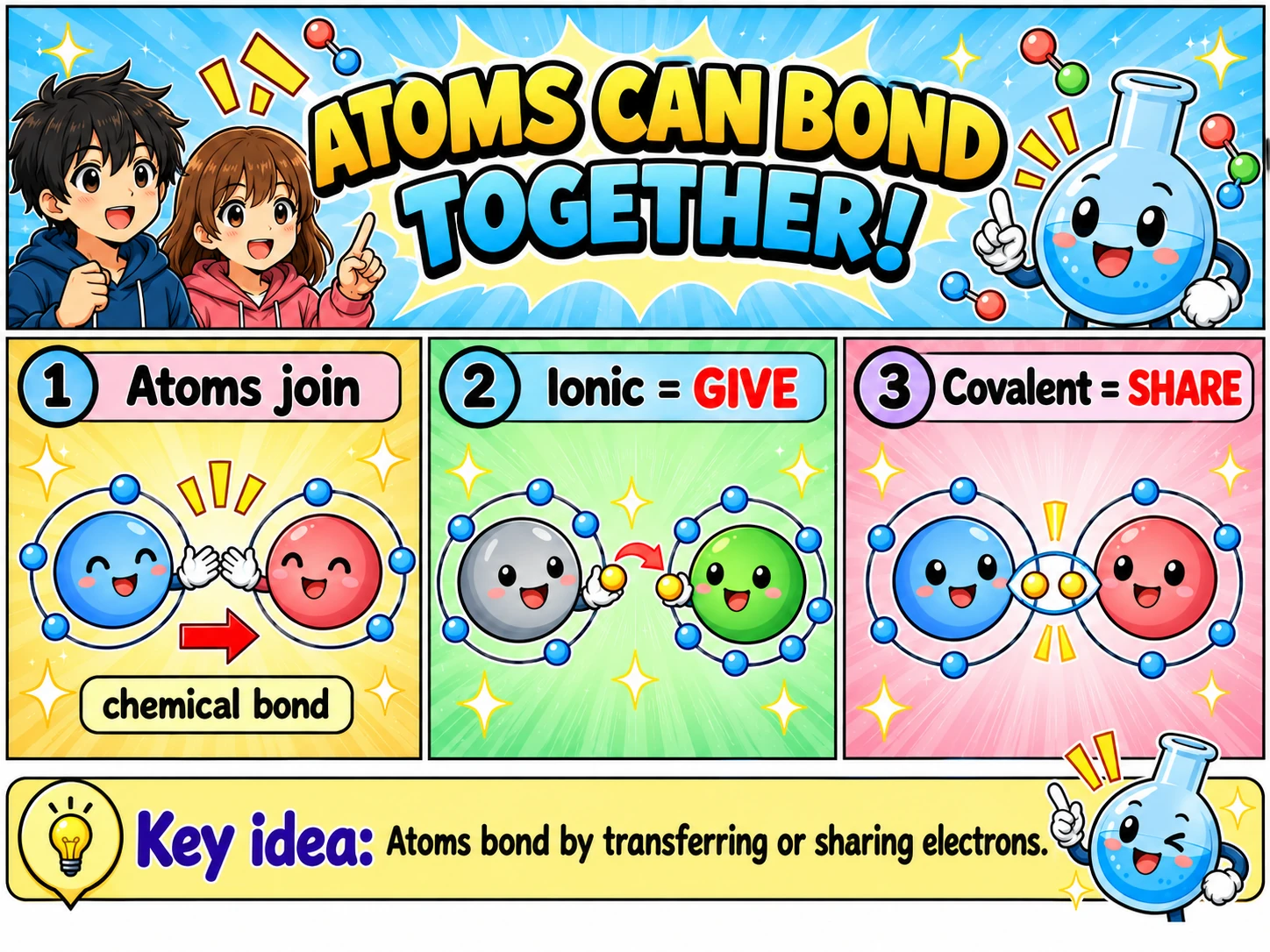
Atoms Can Bond Together

MOSAIC Chemistry Topic 2.2: Atoms Can Bond Together illustration from source PDF page 2
Original MOSAIC Chemistry visual · Topic 2.2, PDF page 2
VocabWhat it means
Chemical bondan attraction that holds atoms or ions together
Compounddifferent elements chemically joined together

Easy explanation

Atoms can join together.

When atoms join, they form chemical bonds.

Different elements can join to make a compound.

There are two important types in this topic:

Ionic compounds

and

Covalent compounds

The difference is what happens to the electrons.

Ionic bond → electrons are transferred

Covalent bond → electrons are shared

Atoms form these bonds in ways that can give them greater stability.

Pages 4–5

Ions — Losing and Gaining Electrons

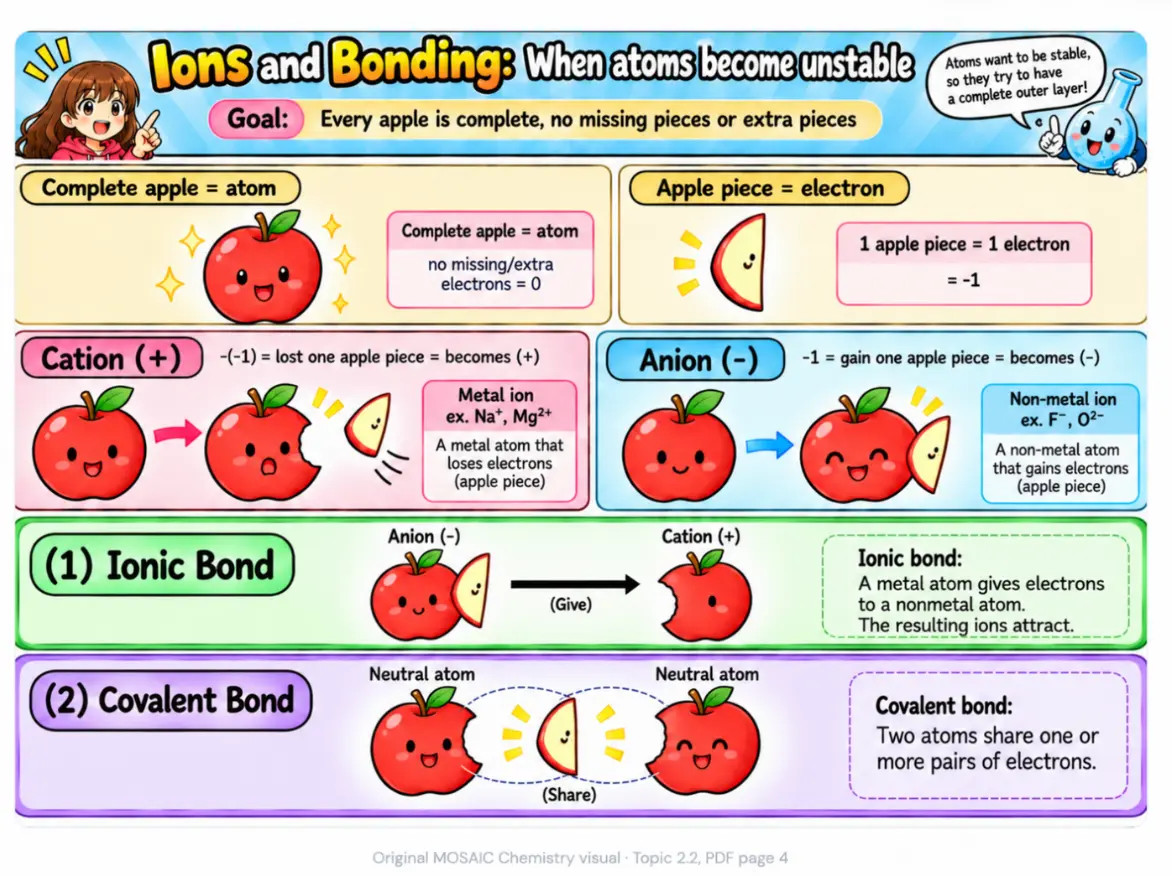
MOSAIC Chemistry Topic 2.2: Ions — Losing and Gaining Electrons illustration from source PDF page 4 (corrected bonding explanations)
Original MOSAIC Chemistry visual · Topic 2.2, PDF page 4
VocabWhat it means
Ionan atom with a charge
Cationa positive ion
Aniona negative ion
Electrona negatively charged particle
Valence electronan electron in the outer shell of an atom

Easy explanation

Atoms can lose or gain electrons.

Electrons have a negative charge.

So:

Lose electron → lose negative charge → become positive

Gain electron → gain negative charge → become negative

A positive ion is called a cation.

A negative ion is called an anion.

Example

Sodium loses one electron:

Na → Na⁺

Na⁺ is a cation.

Chlorine gains one electron:

Cl → Cl⁻

Cl⁻ is an anion.

This electron transfer can give the ions full valence shells and greater stability.

Easy memory:

Cation = +

Anion = −

Pages 6–7

Ionic Bonding

MOSAIC Chemistry Topic 2.2: Ionic Bonding illustration from source PDF page 6
Original MOSAIC Chemistry visual · Topic 2.2, PDF page 6
VocabWhat it means
Ionic compounda compound made of positive and negative ions
Ionic bondattraction between oppositely charged ions
Cationpositive ion
Anionnegative ion

Easy explanation

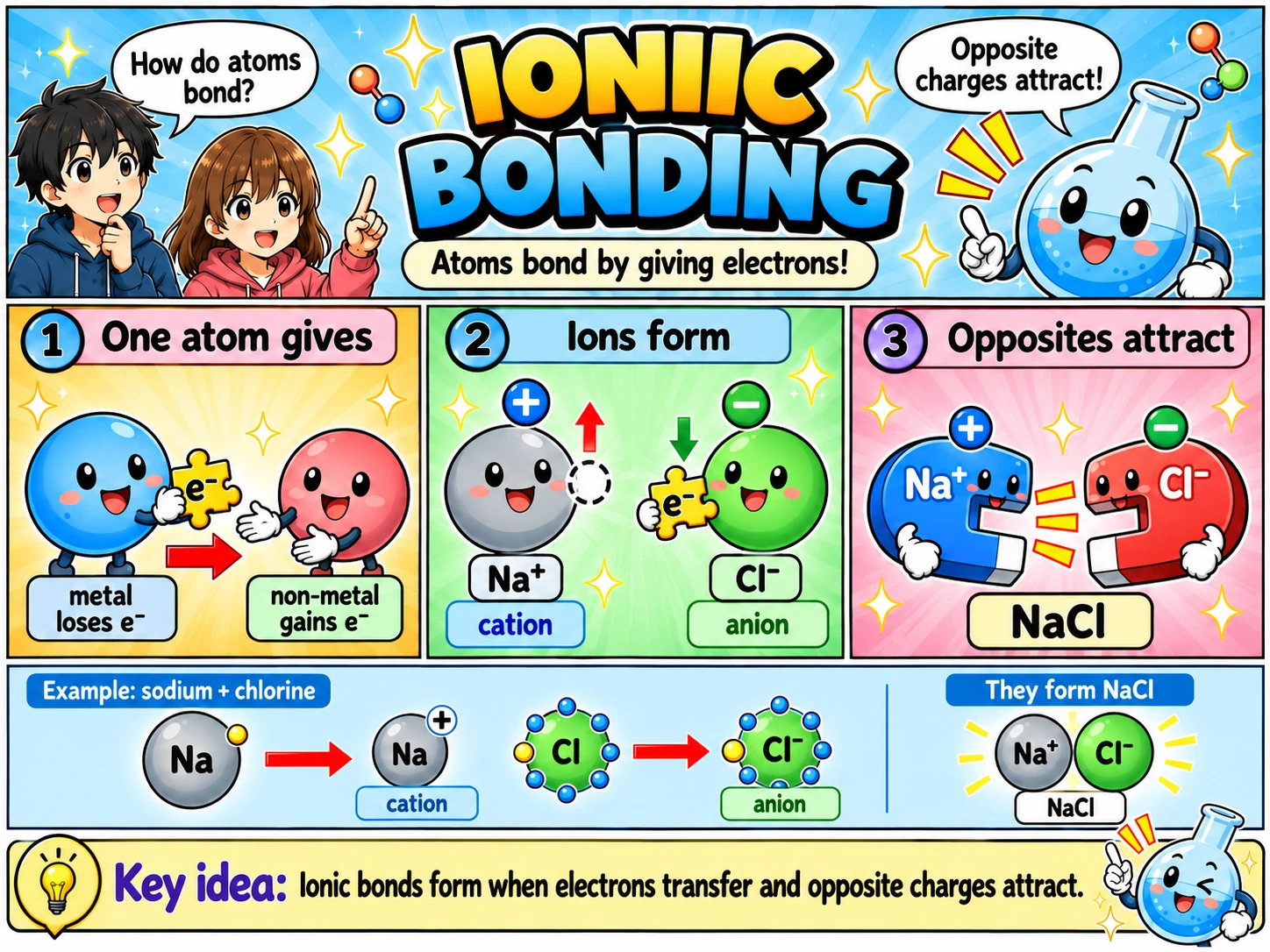
An ionic bond forms when electrons are transferred.

Usually:

metal → loses electron(s)

non-metal → gains electron(s)

After the transfer:

the metal becomes a positive ion

and

the non-metal becomes a negative ion.

Positive and negative charges attract.

It is similar to two opposite sides of magnets pulling together.

That attraction is the ionic bond.

Example: sodium chloride

Sodium gives an electron to chlorine.

Na → Na⁺

Cl → Cl⁻

Then:

Na⁺ attracts Cl⁻

Together they form sodium chloride:

NaCl

In short:

transfer electrons → ions form → opposite charges attract → ionic compound

Pages 8–9

Ionic Compounds Form Crystal Structures

MOSAIC Chemistry Topic 2.2: Ionic Compounds Form Crystal Structures illustration from source PDF page 8
Original MOSAIC Chemistry visual · Topic 2.2, PDF page 8
VocabWhat it means
Crystal latticea repeating 3-D arrangement of ions
Formula unitthe smallest whole-number ratio of ions in an ionic compound

Easy explanation

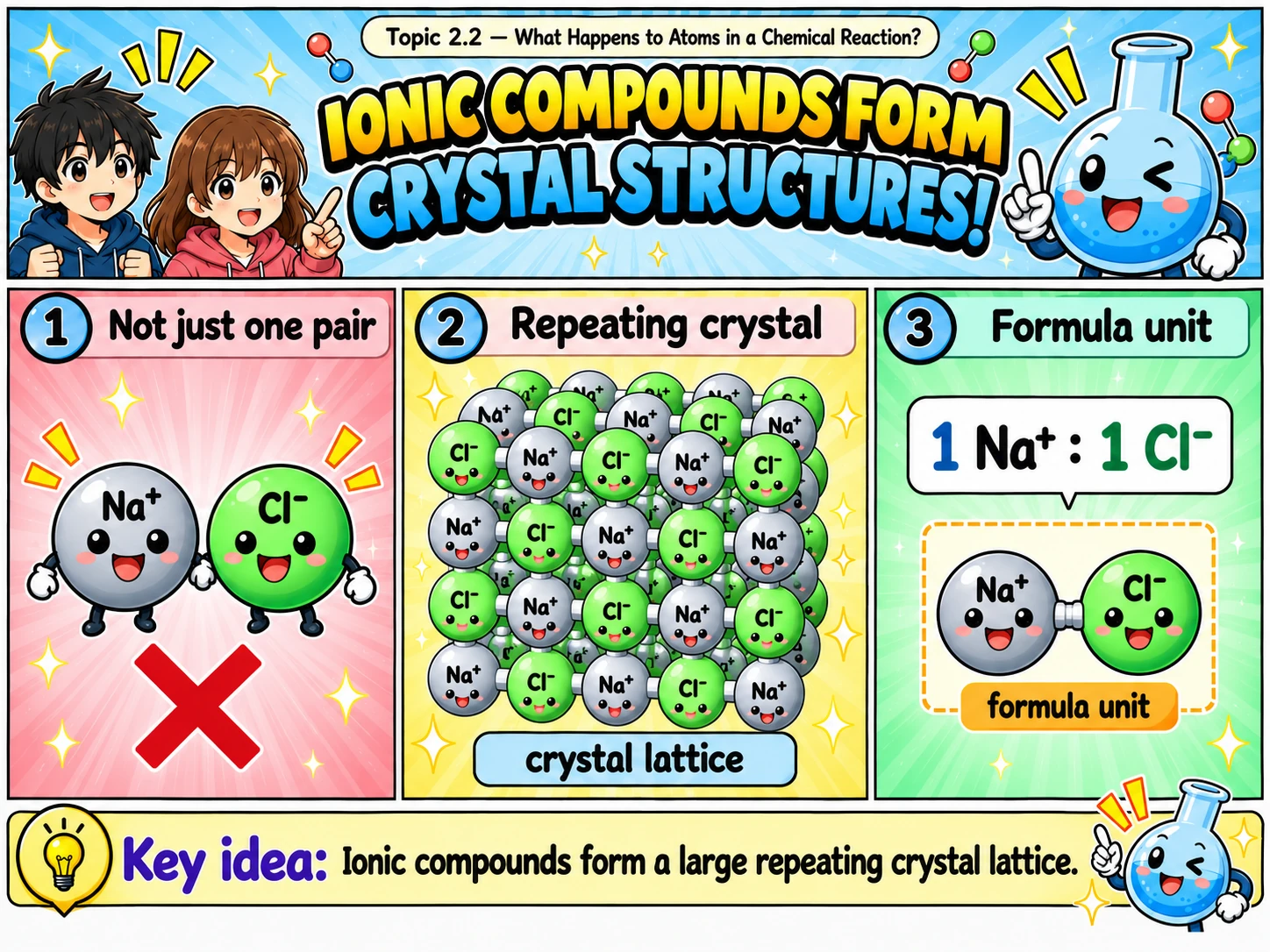
Ionic compounds usually do not exist as separate little molecules.

The ions form a large repeating structure.

This is called a crystal lattice.

For sodium chloride:

positive Na⁺ ions and negative Cl⁻ ions repeat through the crystal.

The formula NaCl tells us the simplest ratio:

1 Na⁺ : 1 Cl⁻

That is the formula unit. The textbook contrasts this continuous ionic arrangement with covalent substances, which often exist as individual molecules.

Pages 10–11

Covalent Bonding

MOSAIC Chemistry Topic 2.2: Covalent Bonding illustration from source PDF page 10
Original MOSAIC Chemistry visual · Topic 2.2, PDF page 10
VocabWhat it means
Covalent compounda compound whose atoms are joined by covalent bonds
Covalent bonda bond formed when atoms share valence electrons
Moleculetwo or more atoms joined by covalent bonds

Easy explanation

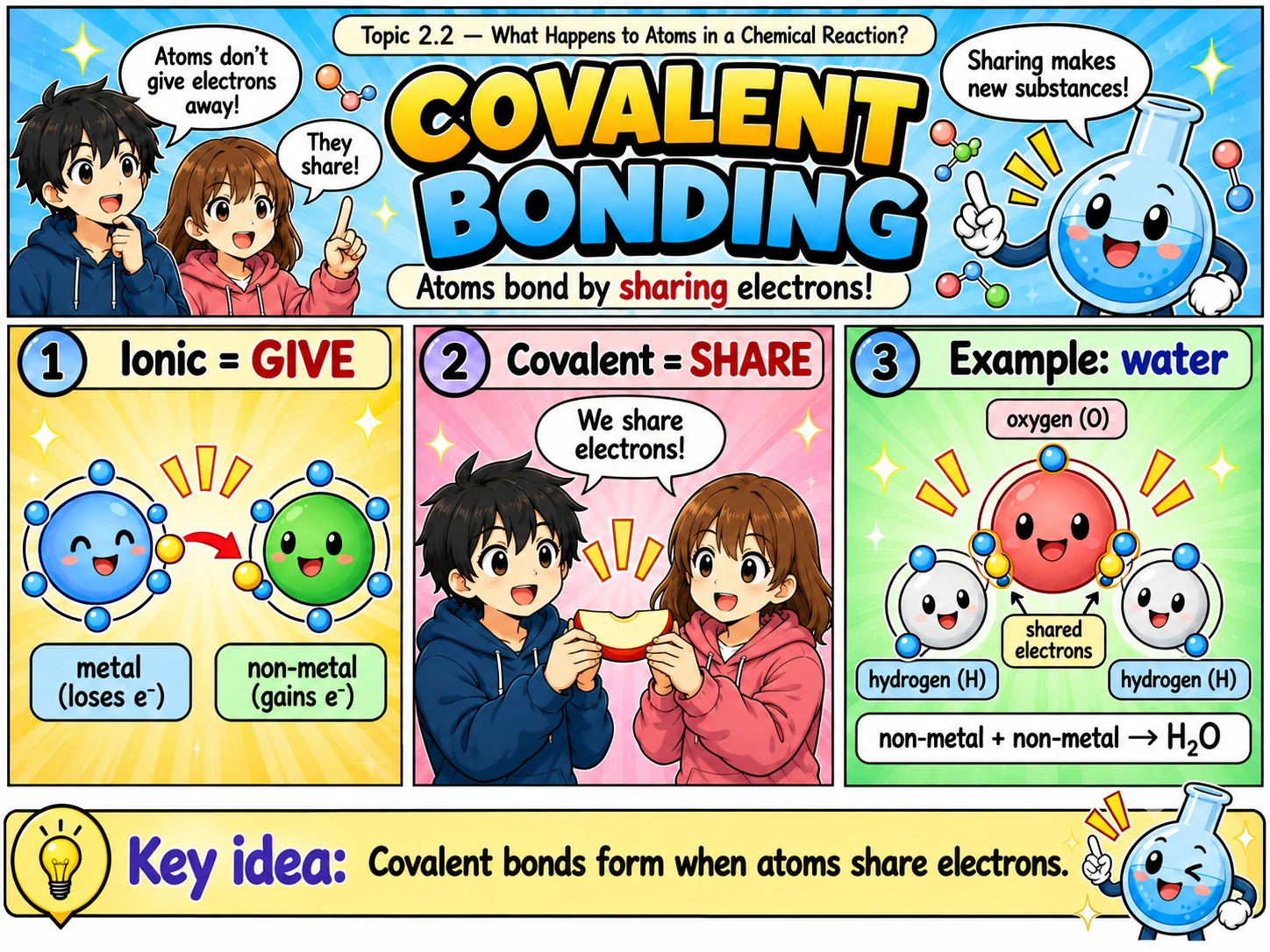
Covalent bonds are different from ionic bonds.

The electrons are not transferred.

They are shared.

Usually, covalent bonds form between non-metal atoms.

The atoms share valence electrons.

This helps the atoms fill their valence shells and become more stable.

Example: water

Water is:

H₂O

An oxygen atom shares electrons with hydrogen atoms.

The shared electrons make covalent bonds.

The connected atoms form a molecule.

In short:

non-metal + non-metal → share electrons → covalent bond

Pages 12–13

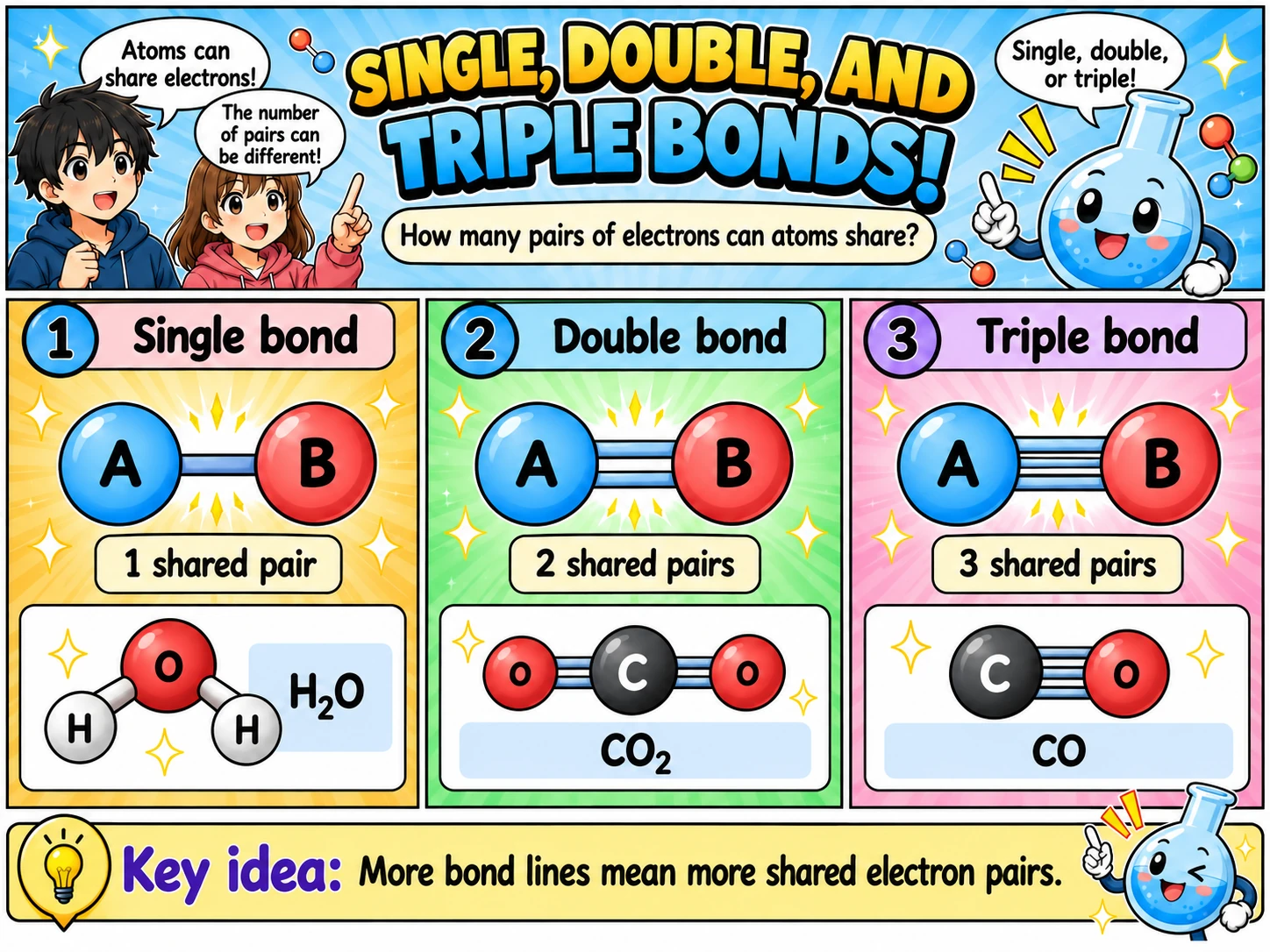
Single, Double, and Triple Bonds

MOSAIC Chemistry Topic 2.2: Single, Double, and Triple Bonds illustration from source PDF page 12
Original MOSAIC Chemistry visual · Topic 2.2, PDF page 12
VocabWhat it means
Single bondone shared pair of electrons
Double bondtwo shared pairs of electrons
Triple bondthree shared pairs of electrons

Easy explanation

Atoms can share different numbers of electron pairs.

One shared pair:

single bond

shown as:

A—B

Two shared pairs:

double bond

shown as:

A=B

Three shared pairs:

triple bond

shown as:

A≡B

For example:

Water has single bonds.

Carbon dioxide contains double bonds.

Carbon monoxide can be represented with a triple bond in the textbook example.

More lines between atoms = more shared electron pairs.

Pages 14–15

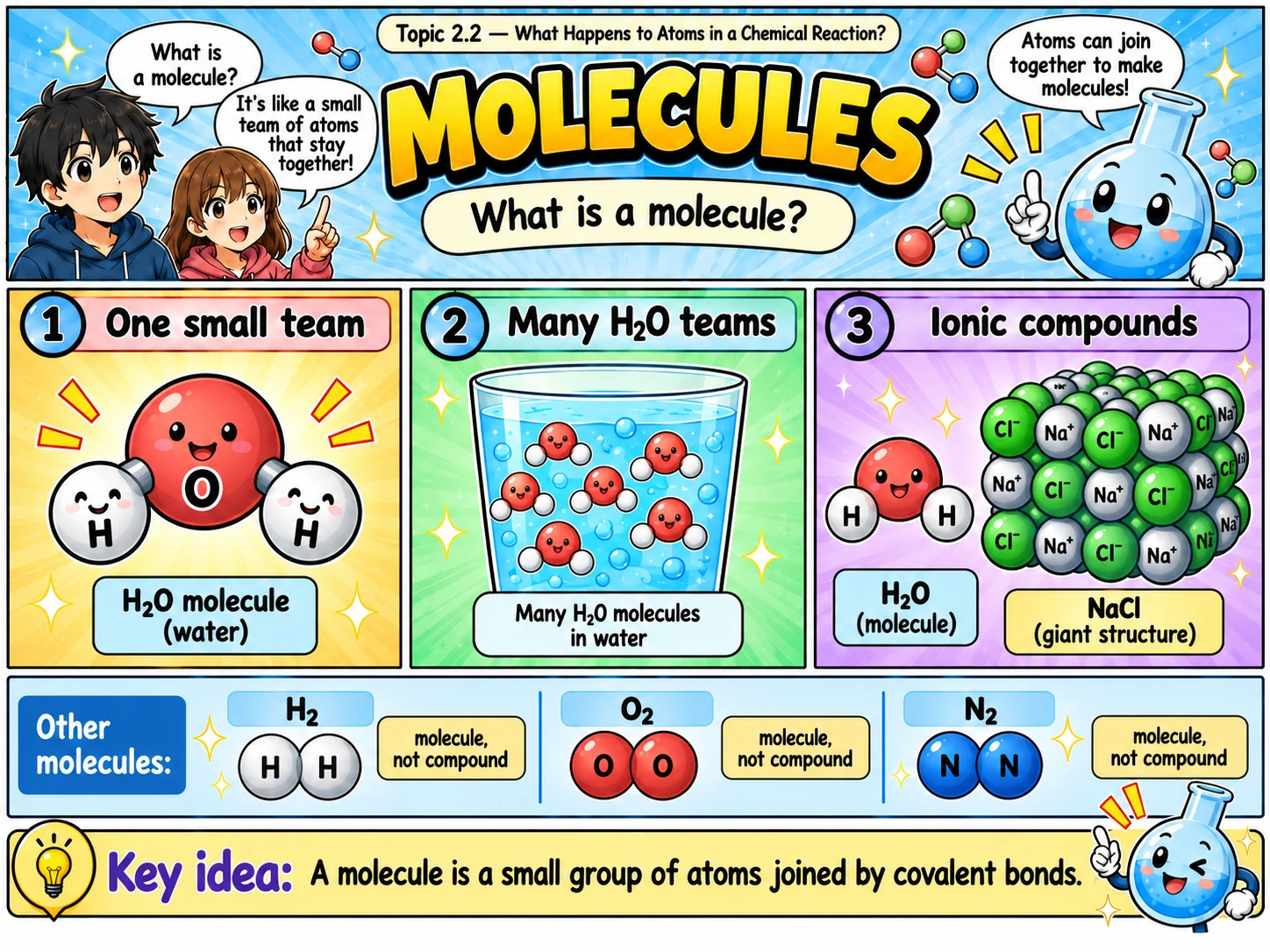
Molecules

MOSAIC Chemistry Topic 2.2: Molecules illustration from source PDF page 14
Original MOSAIC Chemistry visual · Topic 2.2, PDF page 14
VocabWhat it means
Moleculetwo or more atoms bonded by covalent bonds

Easy explanation

Most covalent compounds exist as molecules.

A molecule is a small independent group of atoms joined by covalent bonds.

For example:

one water molecule is:

H₂O

A glass of water contains many separate H₂O molecules.

Some molecules contain only one type of element.

Examples:

H₂

O₂

N₂

These are molecules, but they are not compounds because they contain only one element.

Pages 16–17

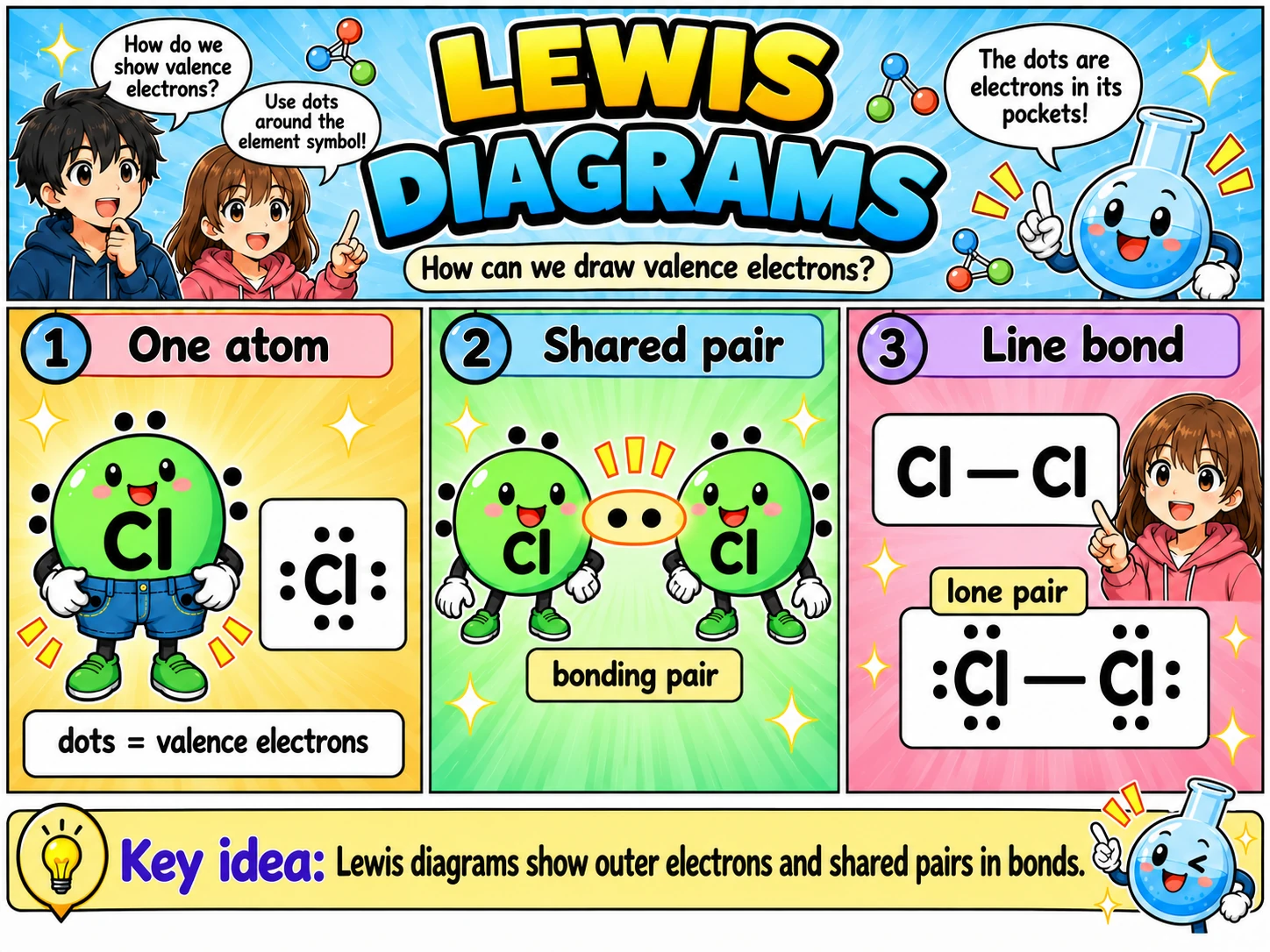
Lewis Diagrams

MOSAIC Chemistry Topic 2.2: Lewis Diagrams illustration from source PDF page 16
Original MOSAIC Chemistry visual · Topic 2.2, PDF page 16
VocabWhat it means
Lewis diagrama diagram showing an element symbol and its valence electrons
Bonding paira pair of electrons shared in a bond
Lone pairvalence electrons that are not part of a bond

Easy explanation

Lewis diagrams are a simple way to show valence electrons.

The element symbol goes in the middle.

Dots around the symbol represent valence electrons.

Example:

Cl with dots around it shows chlorine's outer electrons.

When two atoms share a pair of electrons, that bonding pair can also be drawn as a line.

So a line between atoms means:

shared pair of electrons

Lewis diagrams focus on the outer electrons involved in bonding.

Pages 18–19

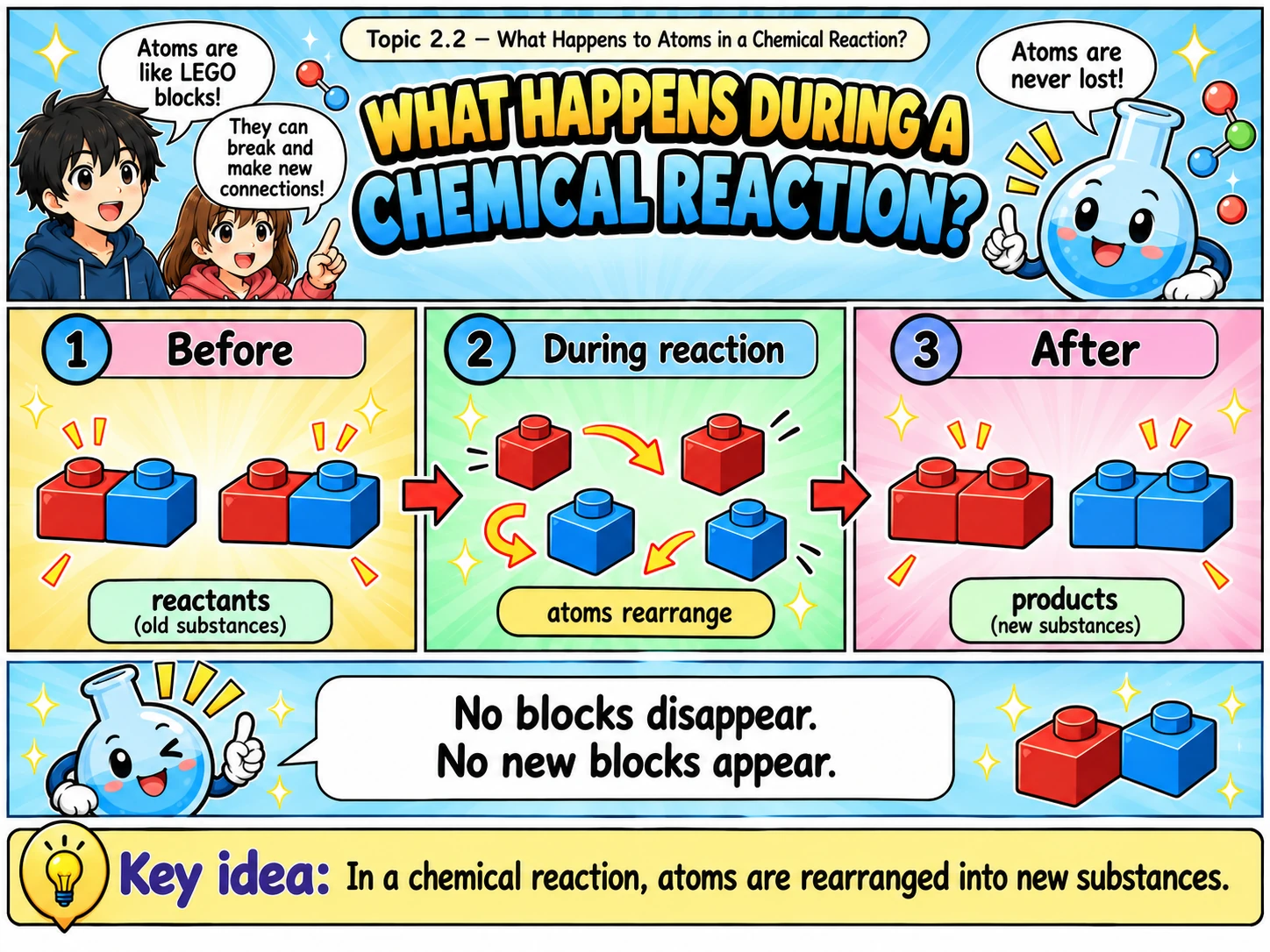
What Happens During a Chemical Reaction?

MOSAIC Chemistry Topic 2.2: What Happens During a Chemical Reaction? illustration from source PDF page 18
Original MOSAIC Chemistry visual · Topic 2.2, PDF page 18
VocabWhat it means
Reactanta starting substance in a chemical reaction
Producta new substance formed in a chemical reaction

Easy explanation

Atoms do not simply disappear during a chemical reaction.

Their connections change.

First:

old bonds break

Then:

atoms rearrange

Then:

new bonds form

This creates different substances.

Think of atoms like LEGO blocks.

You can take apart one model.

Then use the same blocks to build a different model.

Chemical reaction

old substances

↓

bonds break

↓

atoms rearrange

↓

new bonds form

↓

new substances

Pages 20–21

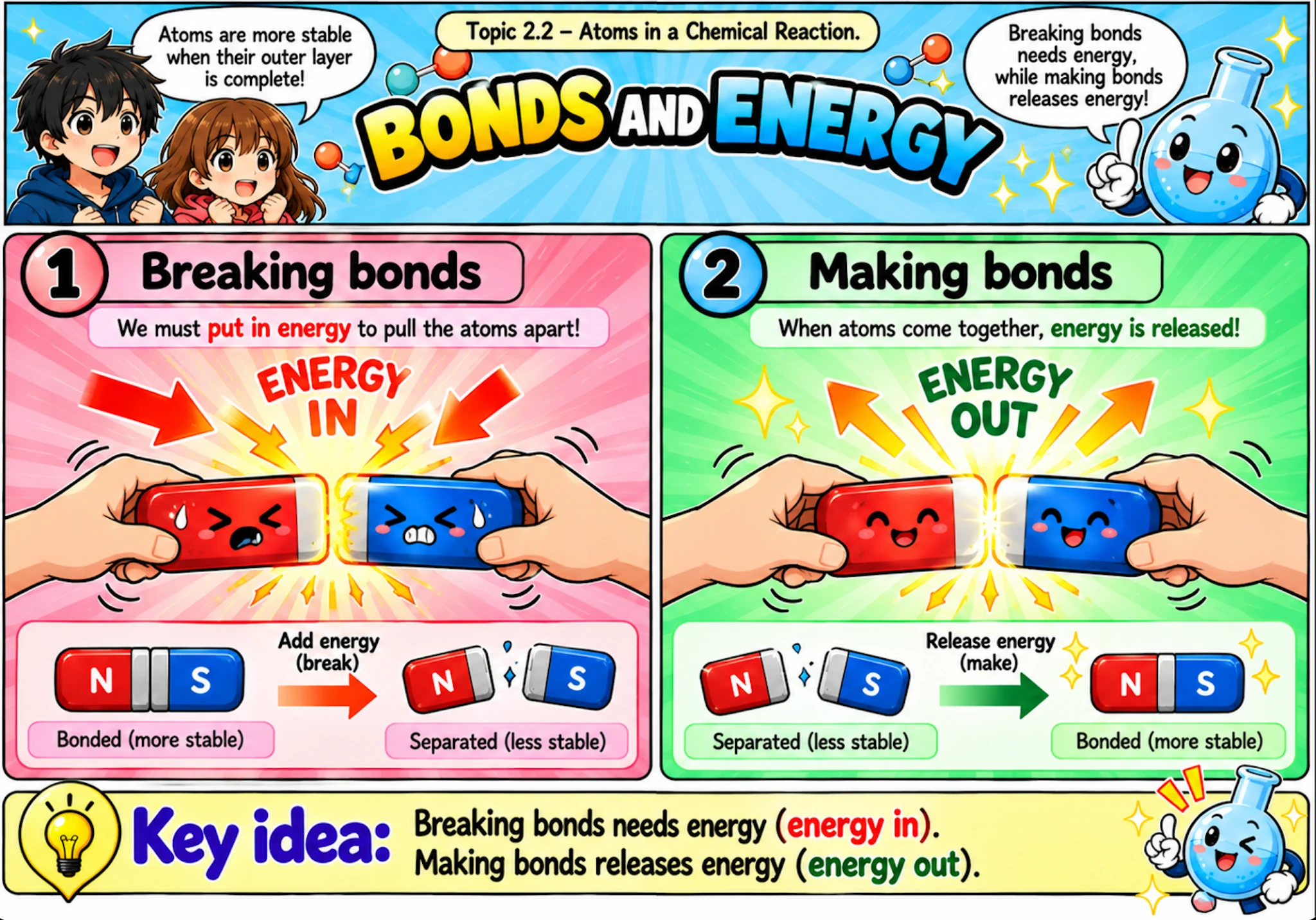
Bonds and Energy

MOSAIC Chemistry Topic 2.2: Bonds and Energy illustration from source PDF page 20
Original MOSAIC Chemistry visual · Topic 2.2, PDF page 20
VocabWhat it means
Bond energyenergy connected with breaking or forming a chemical bond

Easy explanation

Chemical bonds are attractions.

To separate bonded atoms, the attraction must be overcome.

So:

Breaking bonds requires energy.

When new bonds form:

energy is released.

The amount of energy needed depends on the bond.

Easy memory:

BREAK → energy IN

MAKE → energy OUT

Pages 22–23

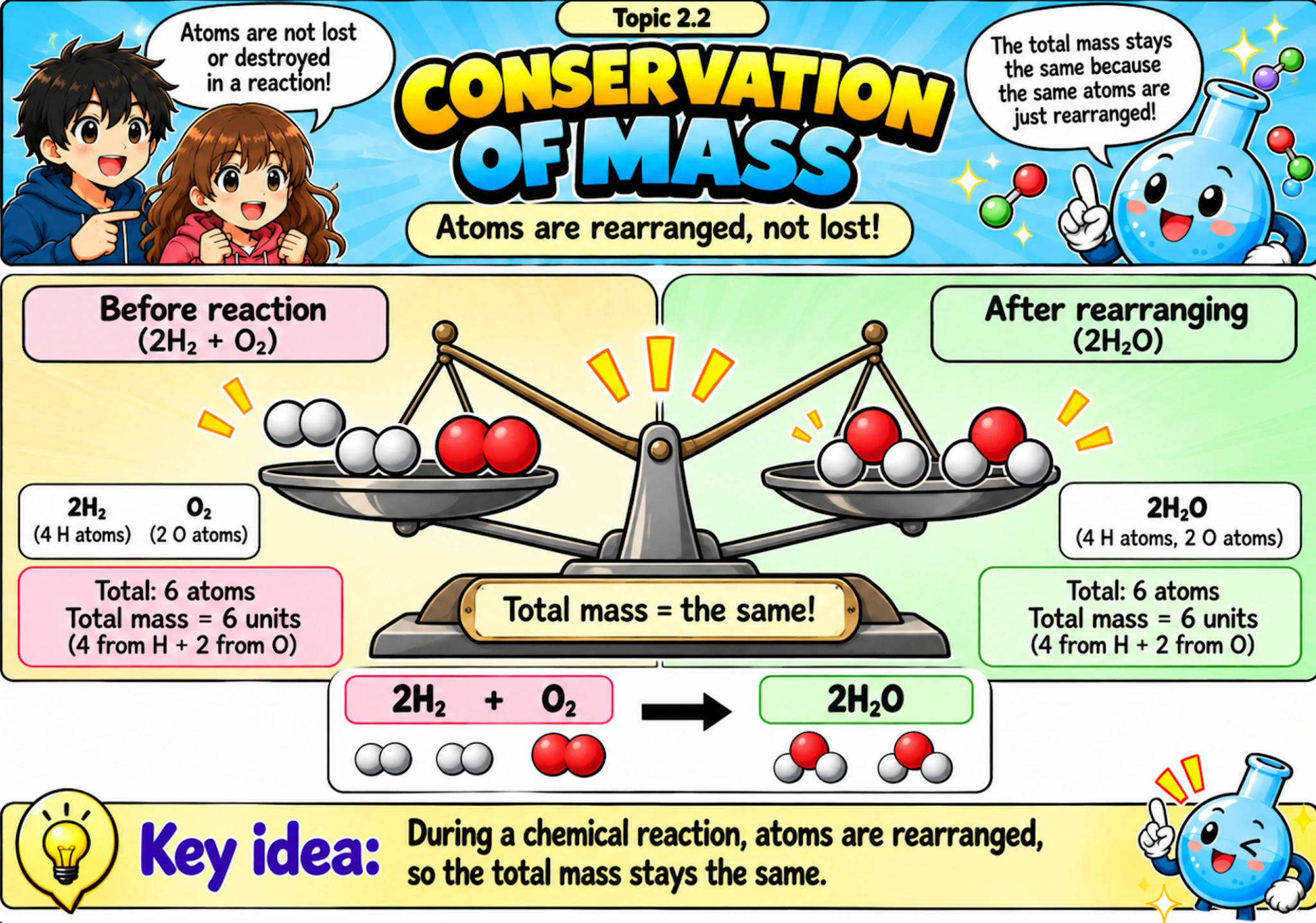
The Law of Conservation of Mass

MOSAIC Chemistry Topic 2.2: The Law of Conservation of Mass illustration from source PDF page 22
Original MOSAIC Chemistry visual · Topic 2.2, PDF page 22
VocabWhat it means
Law of conservation of masstotal mass before a reaction equals total mass after the reaction

Easy explanation

Atoms are not created or destroyed in a chemical reaction.

They are rearranged.

That means the atoms present before the reaction must still be present after the reaction.

So:

mass of reactants = mass of products

This is called the law of conservation of mass. The textbook describes it as the total mass of substances used in a reaction being equal to the total mass of the substances produced.

Example

Before:

2 hydrogen molecules + 1 oxygen molecule

2H₂ + O₂

After:

2 water molecules

2H₂O

Count the atoms.

Before:

H = 4​ O = 2

After:

H = 4​ O = 2

Same atoms.

They are just arranged differently.

Pages 24–25

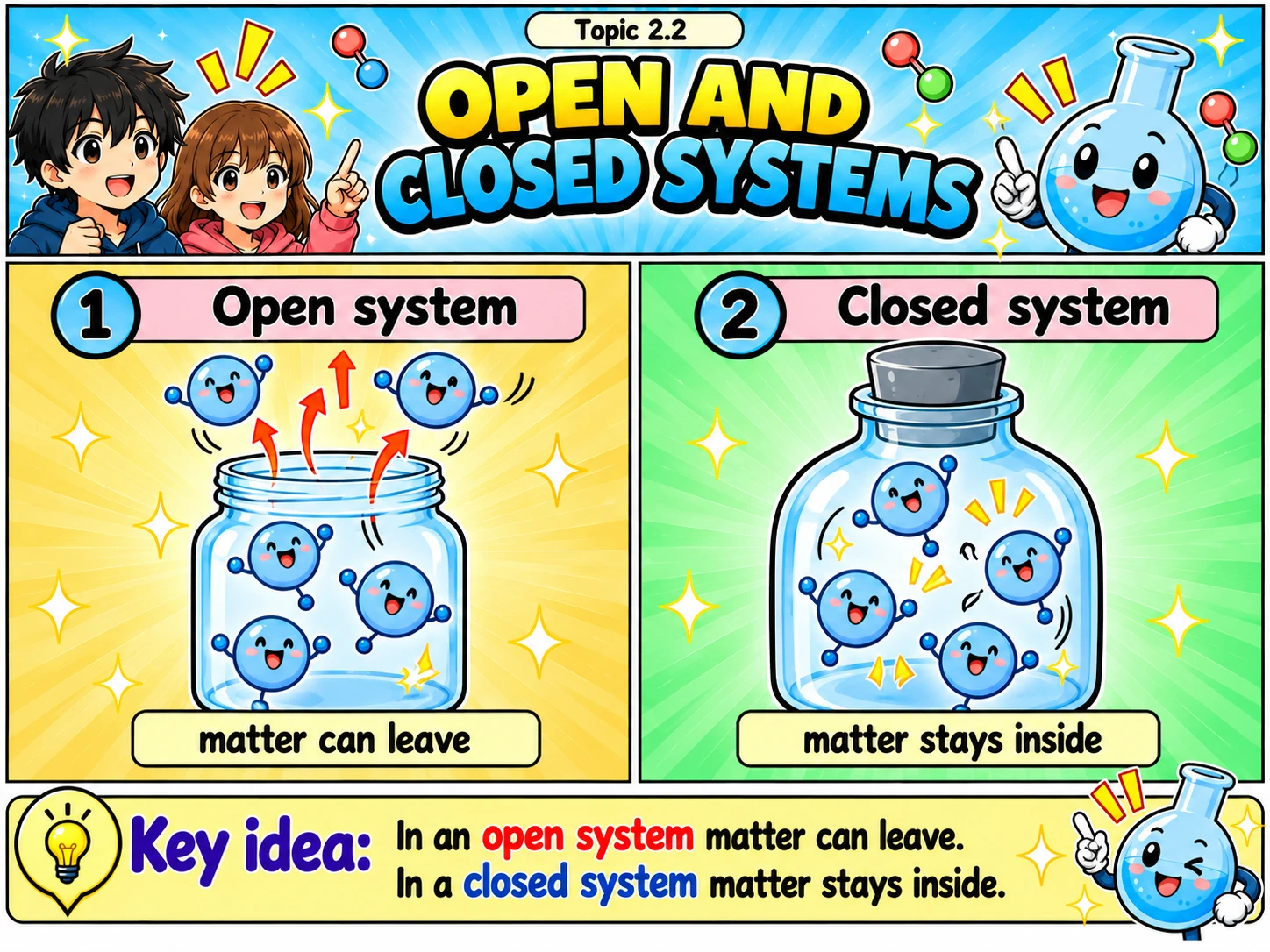
Open and Closed Systems

MOSAIC Chemistry Topic 2.2: Open and Closed Systems illustration from source PDF page 24
Original MOSAIC Chemistry visual · Topic 2.2, PDF page 24
VocabWhat it means
Open systemmatter and energy can enter or leave
Closed systemenergy can enter or leave, but matter cannot

Easy explanation

Imagine a reaction makes a gas.

Open system

The container is open.

Gas can escape.

Matter can enter or leave.

If you only weigh the container afterward, it may look like mass disappeared.

But the missing matter simply left the system.

Closed system

The container is sealed.

Matter cannot leave.

Gas made in the reaction stays inside.

This makes conservation of mass easier to measure experimentally.

The textbook distinguishes an open system, where matter and energy may enter or leave, from a closed system, where energy may enter or leave but matter cannot.

Pages 26–27

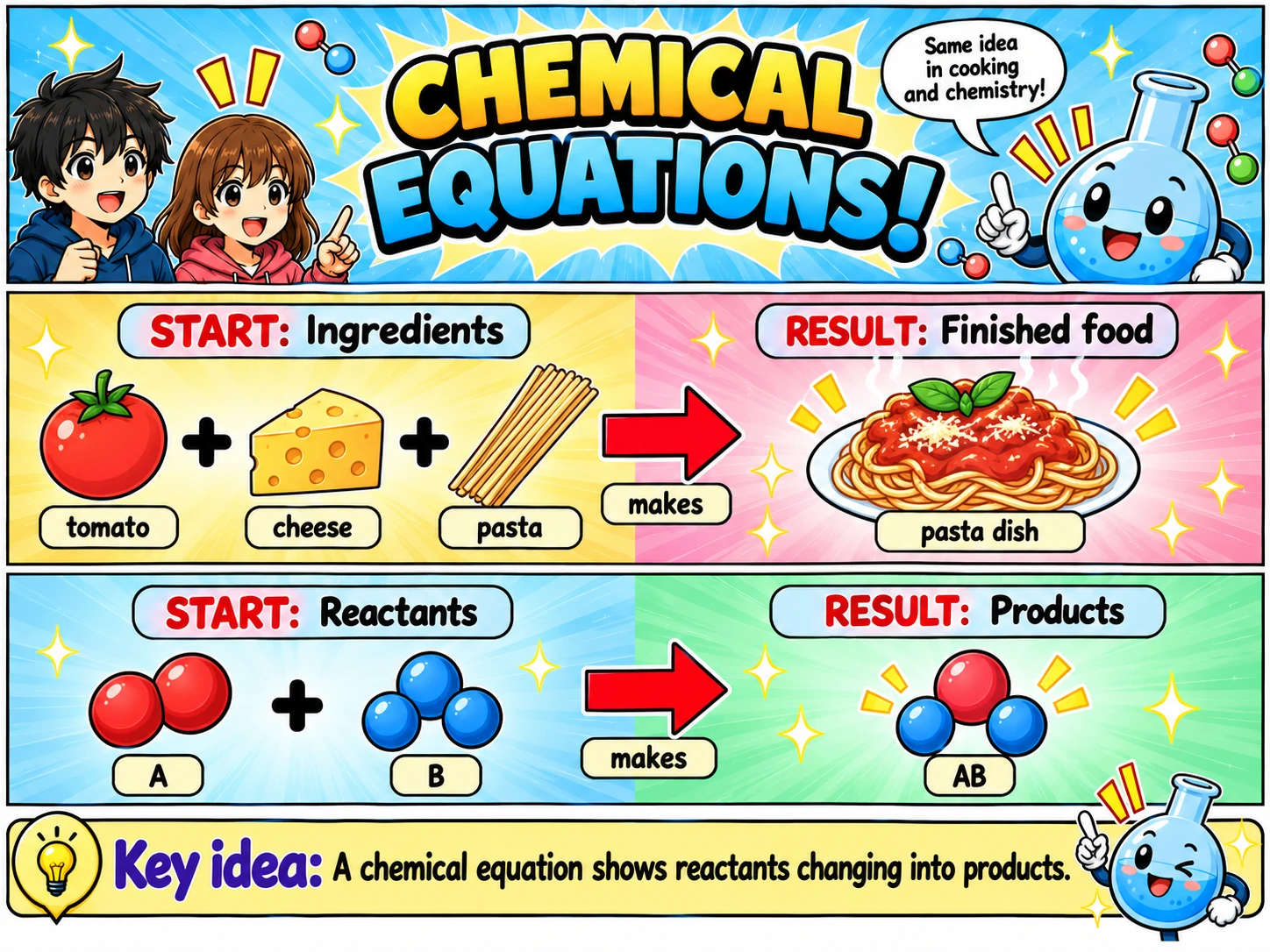
Chemical Equations

MOSAIC Chemistry Topic 2.2: Chemical Equations illustration from source PDF page 26
Original MOSAIC Chemistry visual · Topic 2.2, PDF page 26
VocabWhat it means
Chemical equationa way to represent a chemical reaction using words or chemical formulas
Reactanta substance that changes during a reaction
Producta new substance formed during a reaction

Easy explanation

A chemical equation is a short way to show a chemical reaction.

The starting substances are called reactants.

The new substances are called products.

Reactants go on the left.

Products go on the right.

Pattern

reactant + reactant → product + product

The arrow means:

“produces”

or

“yields.”

A plus sign on the reactant side means:

“reacts with.”

Easy memory:

Left = start

Right = result

Pages 28–29

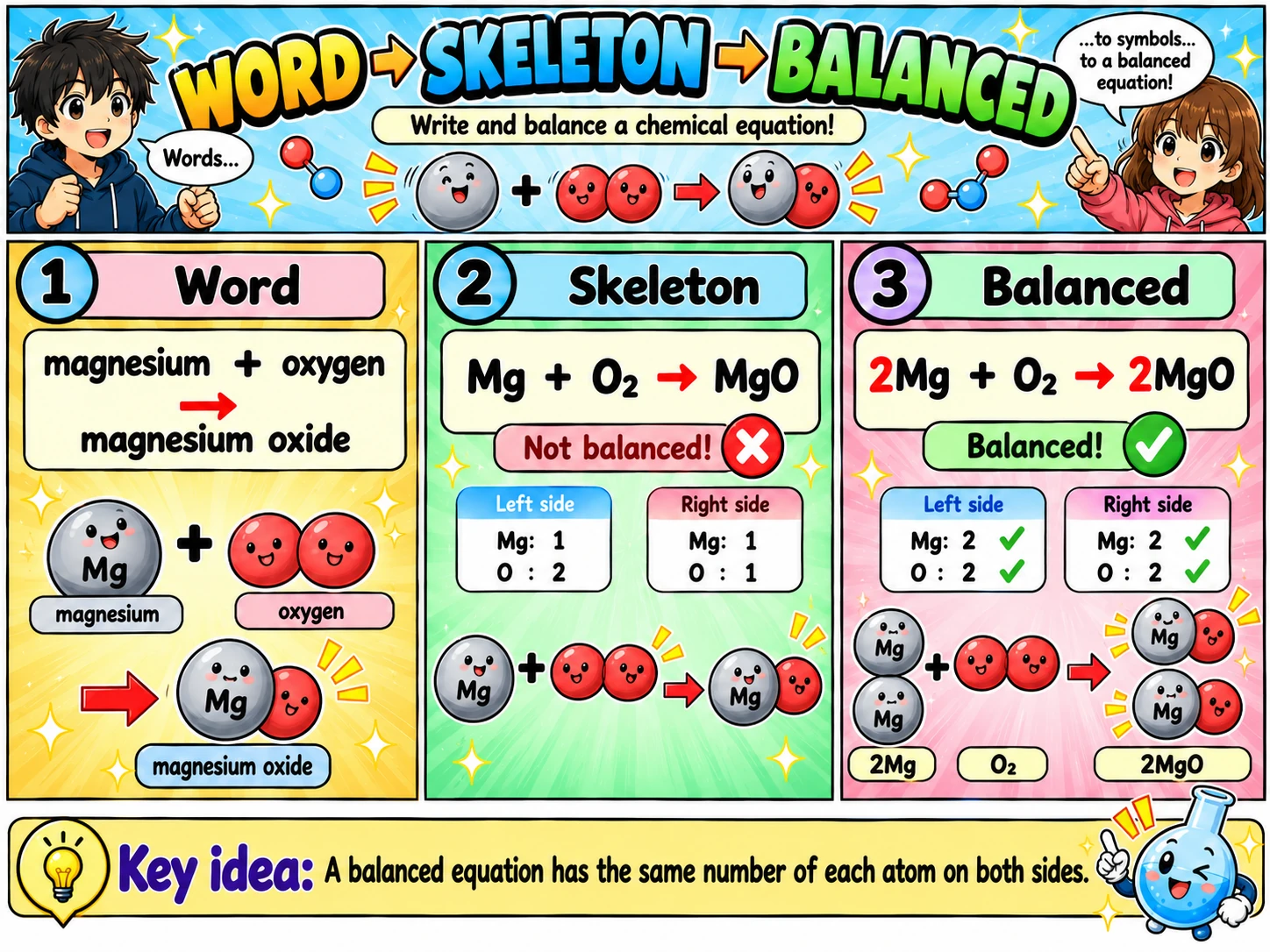
Word Equation → Skeleton Equation → Balanced Equation

MOSAIC Chemistry Topic 2.2: Word Equation → Skeleton Equation → Balanced Equation illustration from source PDF page 28
Original MOSAIC Chemistry visual · Topic 2.2, PDF page 28
VocabWhat it means
Word equationan equation written using chemical names
Skeleton equationan equation using formulas that is not necessarily balanced
Balanced chemical equationan equation with the same number of each type of atom on both sides

Easy explanation

We can write a reaction in different ways.

1. Word equation

Uses names.

magnesium + oxygen → magnesium oxide

This tells us what reacts.

2. Skeleton equation

Uses chemical formulas.

Mg + O₂ → MgO

But there is a problem.

Count oxygen:

Left = 2 O

Right = 1 O

It is not balanced.

3. Balanced equation

2Mg + O₂ → 2MgO

Now count:

Mg:

Left = 2​ Right = 2

O:

Left = 2​ Right = 2

Now the equation follows the law of conservation of mass.

Pages 30–31

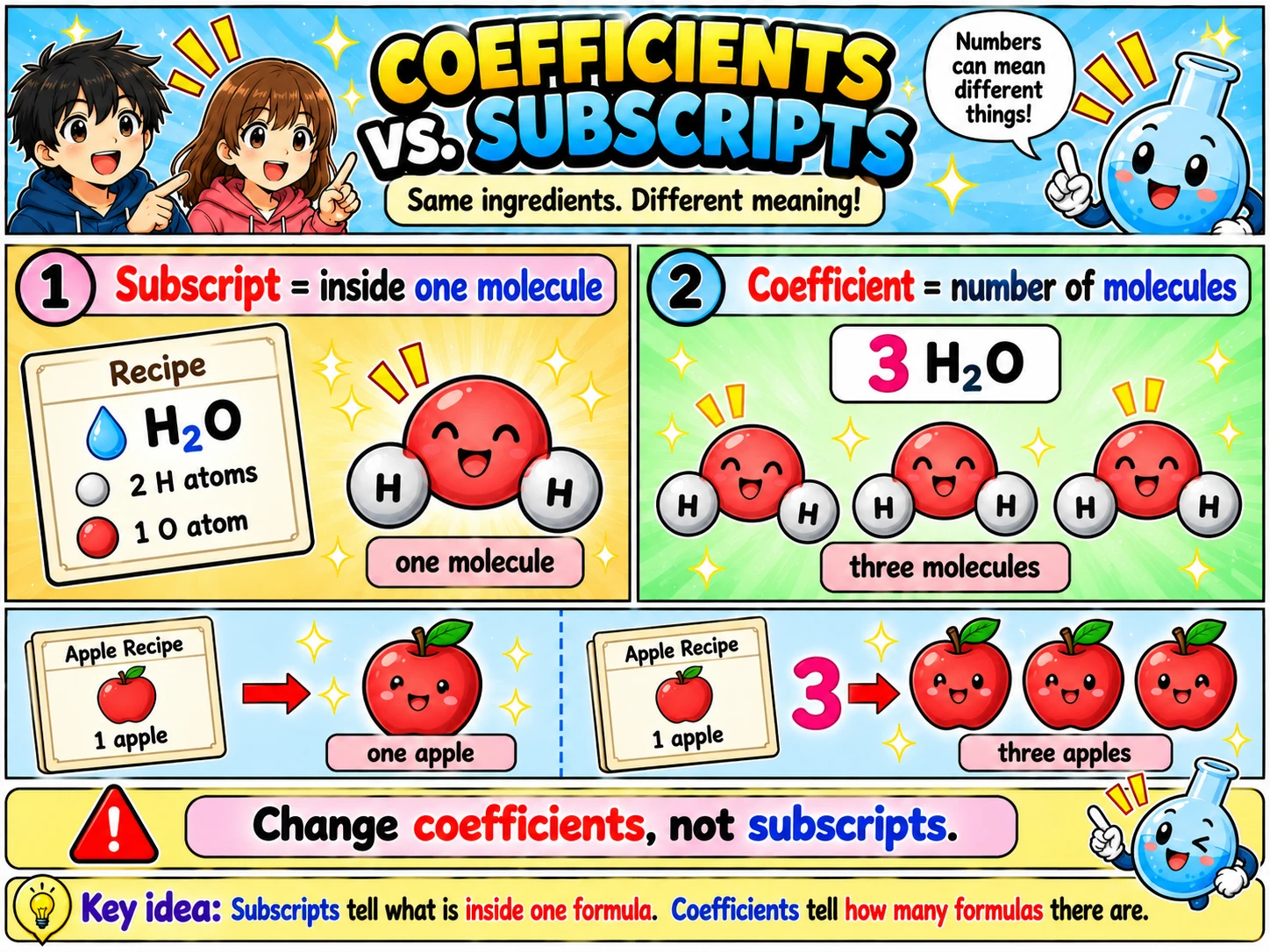
Coefficients vs. Subscripts

MOSAIC Chemistry Topic 2.2: Coefficients vs. Subscripts illustration from source PDF page 30
Original MOSAIC Chemistry visual · Topic 2.2, PDF page 30
VocabWhat it means
Coefficientnumber in front of a chemical formula
Subscriptsmall number inside a chemical formula

Easy explanation

Coefficients and subscripts are not the same.

Subscript

Look at:

H₂O

The small 2 belongs to the formula.

It means one water molecule contains:

2 H atoms

1 O atom

Changing the subscript changes the substance.

Coefficient

Look at:

3H₂O

The 3 is in front.

It means:

3 water molecules

Each water molecule still has H₂O inside it.

So altogether:

H = 3 × 2 = 6

O = 3 × 1 = 3

The textbook explains that subscripts tell how many atoms occur within one molecule or formula unit, whereas coefficients tell how many molecules or formula units are present.

Very important:

When balancing equations:

Change coefficients.

Do NOT change subscripts.

Changing a subscript changes the identity of the compound.

Pages 32–33

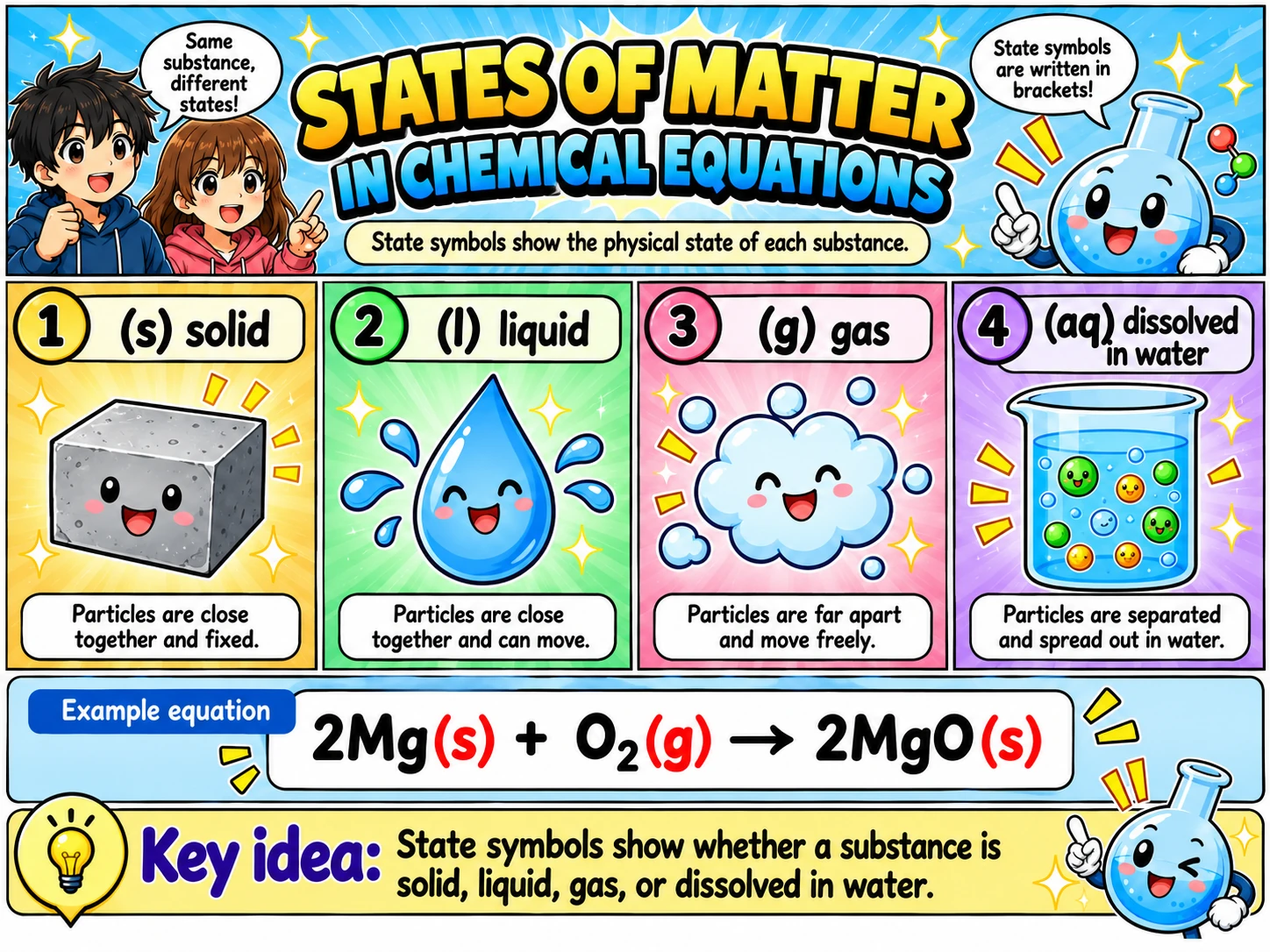
States of Matter in Chemical Equations

MOSAIC Chemistry Topic 2.2: States of Matter in Chemical Equations illustration from source PDF page 32
Original MOSAIC Chemistry visual · Topic 2.2, PDF page 32
SymbolWhat it means
(s)solid
(l)liquid
(g)gas
(aq)dissolved in water

Easy explanation

Chemical equations can also tell us the physical state of each substance.

(s) = solid

(l) = liquid

(g) = gas

(aq) = aqueous

Aqueous means the substance is dissolved in water.

Example:

2Mg(s) + O₂(g) → 2MgO(s)

Mg is solid.

O₂ is gas.

MgO is solid.

Pages 34–35

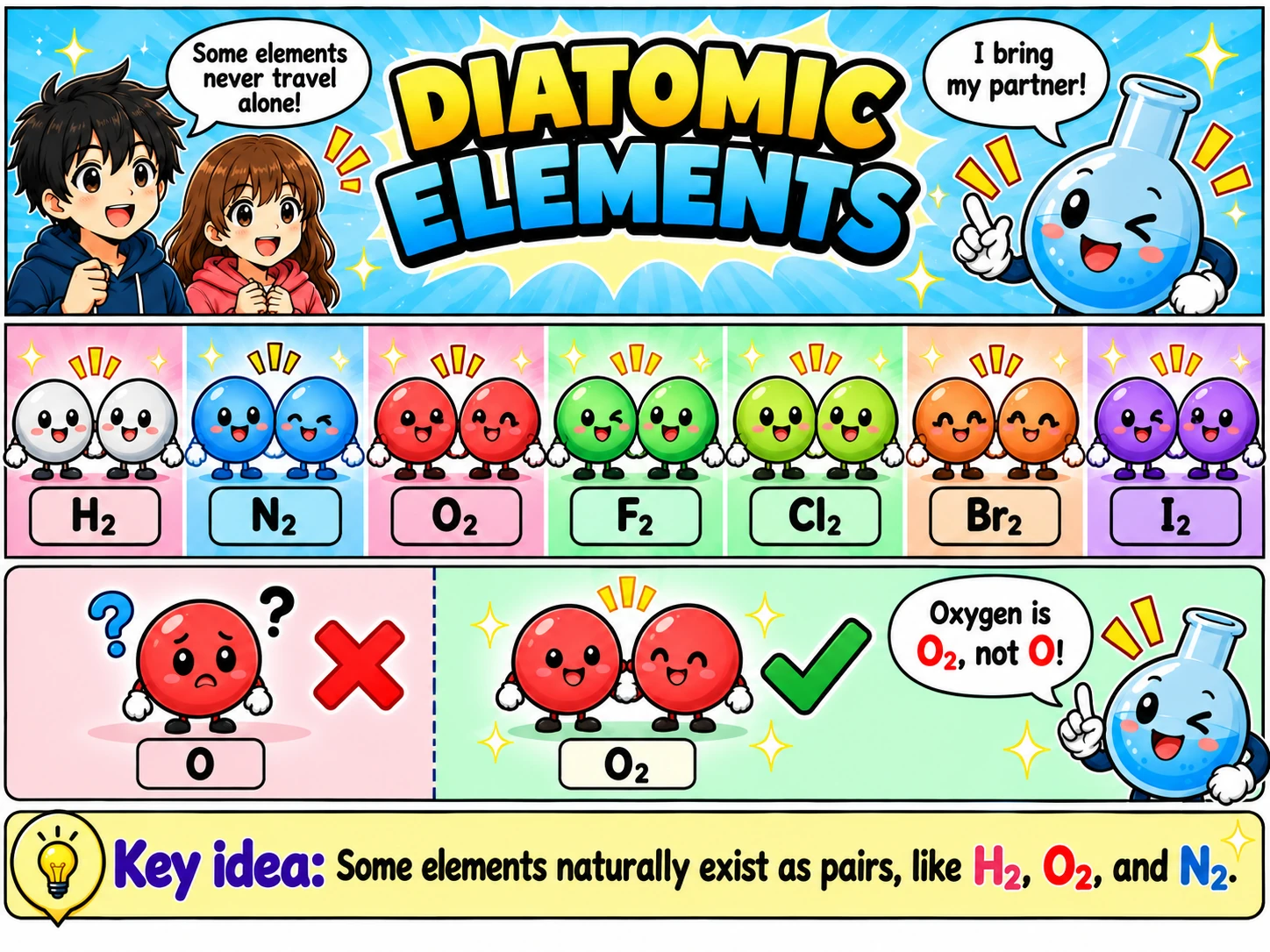
Diatomic Elements

MOSAIC Chemistry Topic 2.2: Diatomic Elements illustration from source PDF page 34
Original MOSAIC Chemistry visual · Topic 2.2, PDF page 34
VocabWhat it means
Diatomicnaturally existing as two bonded atoms

Easy explanation

Some elements normally travel in pairs.

They are called diatomic elements.

They are:

H₂, N₂, O₂, F₂, Cl₂, Br₂,I₂

So when oxygen appears by itself in a chemical equation, we normally write:

O₂

not

O

The textbook also identifies sulfur as S₈ and phosphorus as P₄ in their elemental forms.

Pages 36–37

Balancing Chemical Equations

MOSAIC Chemistry Topic 2.2: Balancing Chemical Equations illustration from source PDF page 36
Original MOSAIC Chemistry visual · Topic 2.2, PDF page 36

Easy explanation

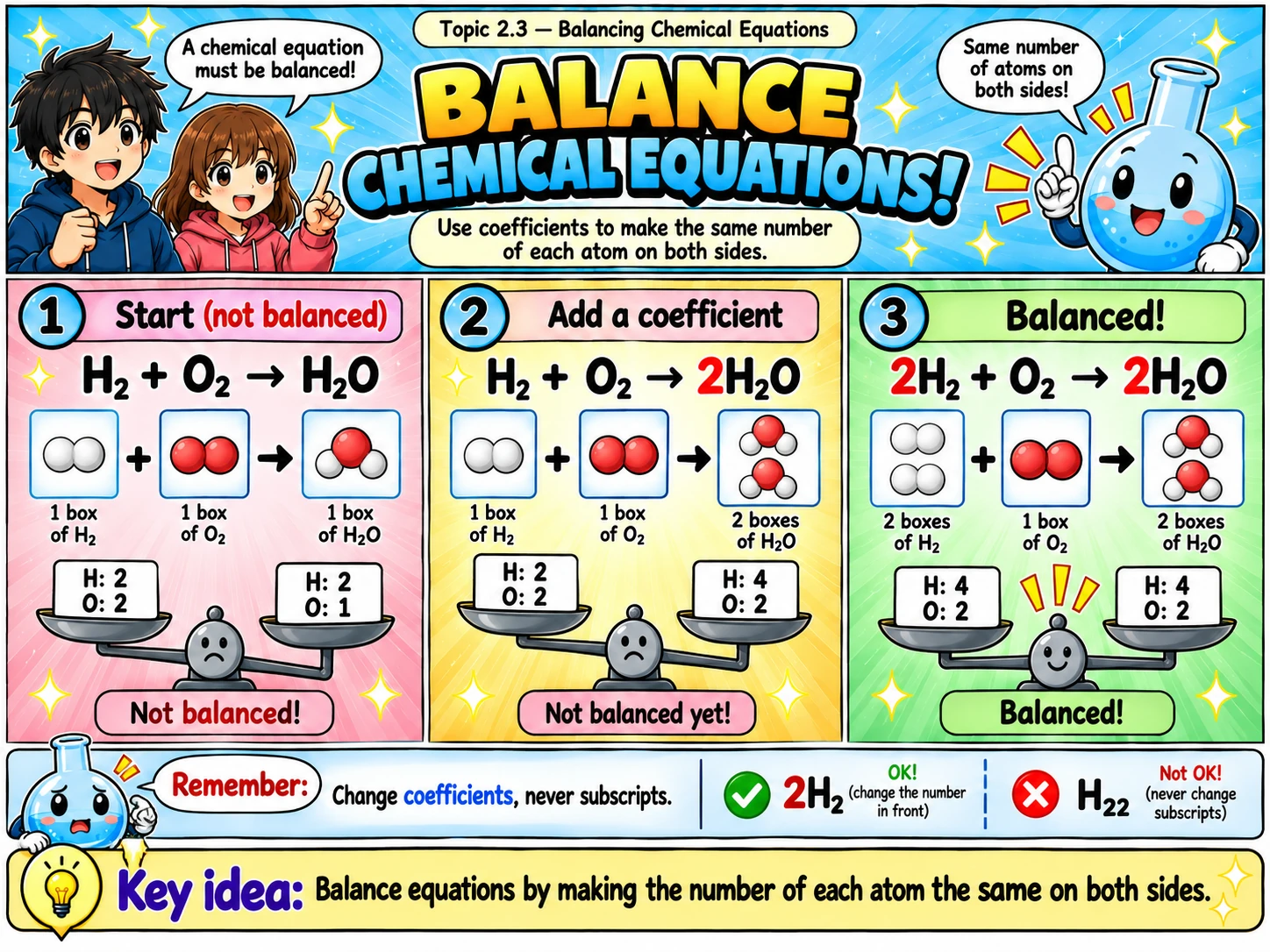
A chemical equation must follow the law of conservation of mass.

That means:

same number of each type of atom on both sides

Start with:

H₂ + O₂ → H₂O

Count:

ElementLeftRight
H22
O21

Not balanced.

Put a coefficient 2 before H₂O:

H₂ + O₂ → 2H₂O

Now:

H = 2 on left, 4 on right.

Still not balanced.

Put a coefficient 2 before H₂:

2H₂ + O₂ → 2H₂O

Now:

ElementLeftRight
H44
O22

Balanced!

The textbook uses this same sequence to show that equations are balanced by adjusting coefficients until each element has the same atom count on both sides.

Pages 38–39

How to Balance an Equation

MOSAIC Chemistry Topic 2.2: How to Balance an Equation illustration from source PDF page 38
Original MOSAIC Chemistry visual · Topic 2.2, PDF page 38

Easy explanation

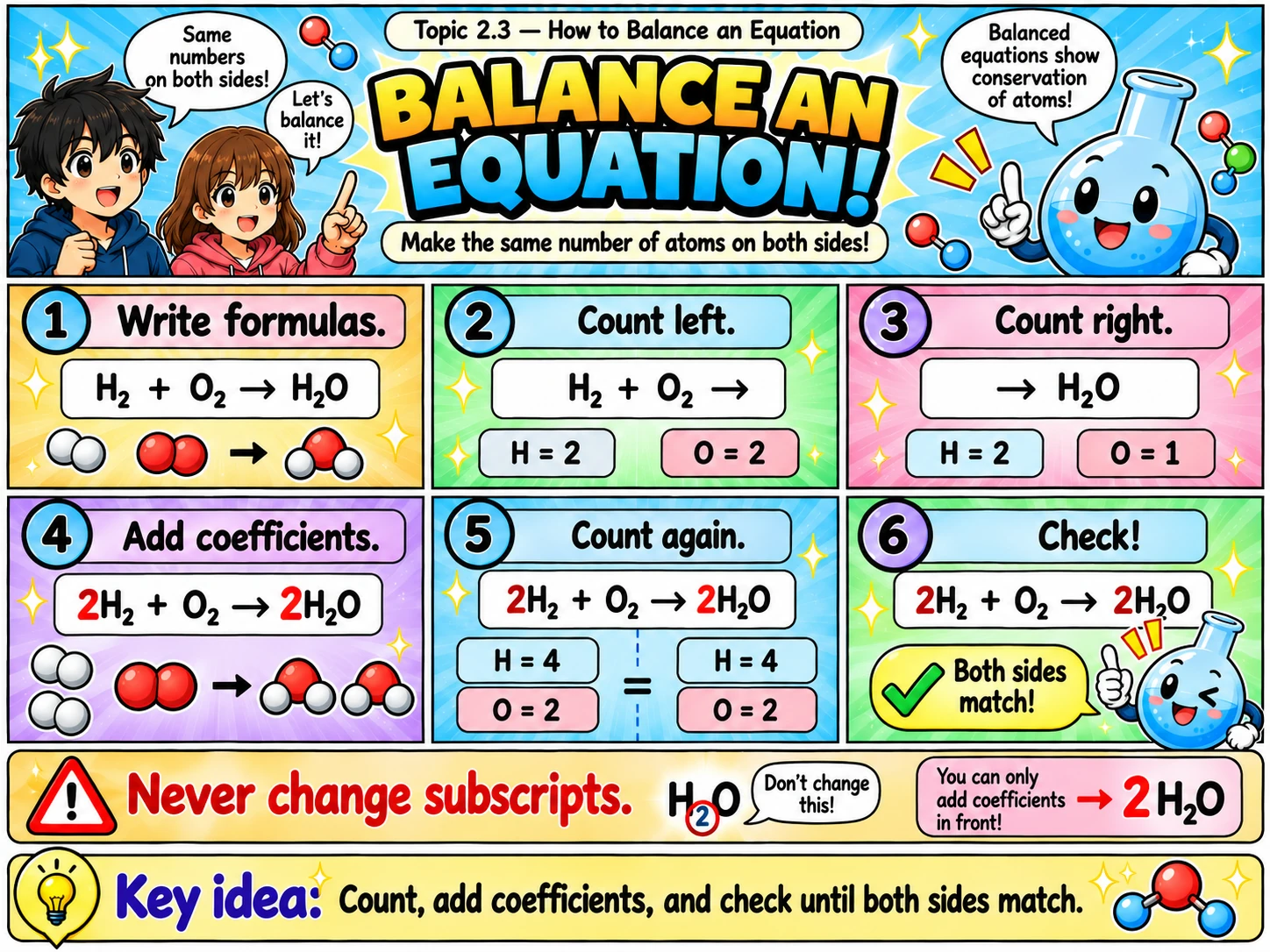
Step 1

Write the correct formulas.

Step 2

Count every type of atom on the left.

Step 3

Count every type of atom on the right.

Step 4

If the numbers are different, add coefficients.

Step 5

Count again.

Keep going until:

left atoms = right atoms

Step 6

Check your answer one last time.

Never change the subscripts.

The textbook also recommends balancing compounds before free elements, often leaving hydrogen and oxygen until later, and treating a polyatomic ion as one unit when it stays together on both sides.

Pages 40–41

The Big Picture

MOSAIC Chemistry Topic 2.2: The Big Picture illustration from source PDF page 40
Original MOSAIC Chemistry visual · Topic 2.2, PDF page 40

Easy explanation

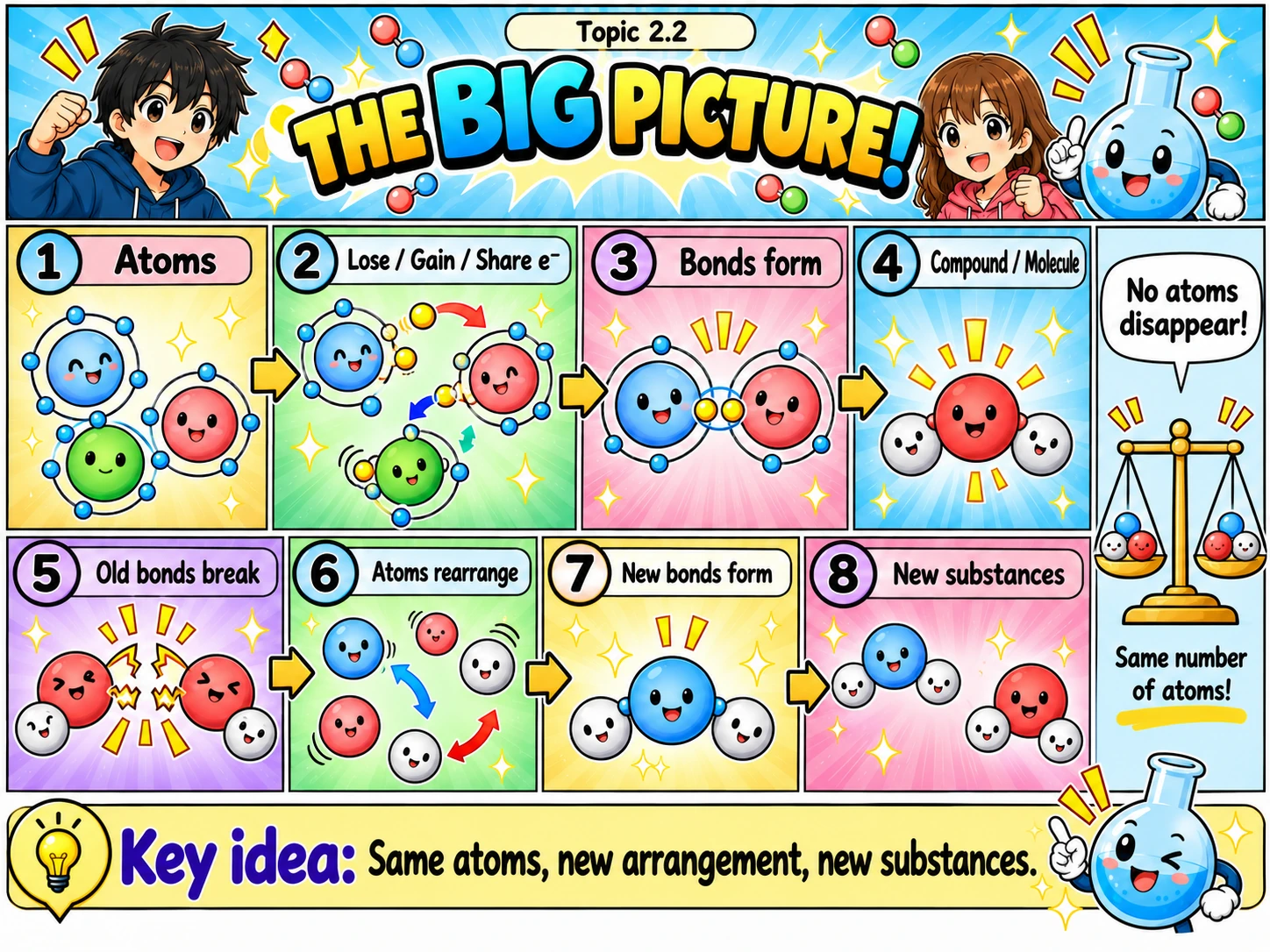
Atoms can bond together.

Ionic bonding

Electrons are transferred.

Positive and negative ions attract.

Covalent bonding

Electrons are shared.

Atoms form molecules.

During a chemical reaction

Old bonds break.

Atoms rearrange.

New bonds form.

But the atoms do not disappear.

The same atoms are present before and after.

So:

mass is conserved.

Chemical equations show this change.

Reactants are on the left.

Products are on the right.

A balanced equation has the same number of every type of atom on both sides.

Page 42

Summary

Short explanation

Atoms join together using chemical bonds.

Ionic bonds form when electrons are transferred.

Covalent bonds form when electrons are shared.

Covalent atoms can form molecules.

During a chemical reaction, bonds break and new bonds form.

Breaking bonds requires energy.

Forming bonds releases energy.

Atoms are rearranged, but they are not created or destroyed.

Because the same atoms remain, total mass is conserved.

Chemical equations show reactants changing into products.

Coefficients are used to balance equations.

Do not change subscripts when balancing.

Main idea:

Same atoms → different arrangement → new substances.

Topic 2.3

How Is Energy Involved in Chemical Processes?

Big Question: How does energy move during physical and chemical changes?

Pages 2–3

Matter and Energy Interact

MOSAIC Chemistry Topic 2.3: Matter and Energy Interact illustration from source PDF page 2
Original MOSAIC Chemistry visual · Topic 2.3, PDF page 2
VocabWhat it means
Energythe ability to cause change
Energy transferenergy moving from one place or object to another

Easy explanation

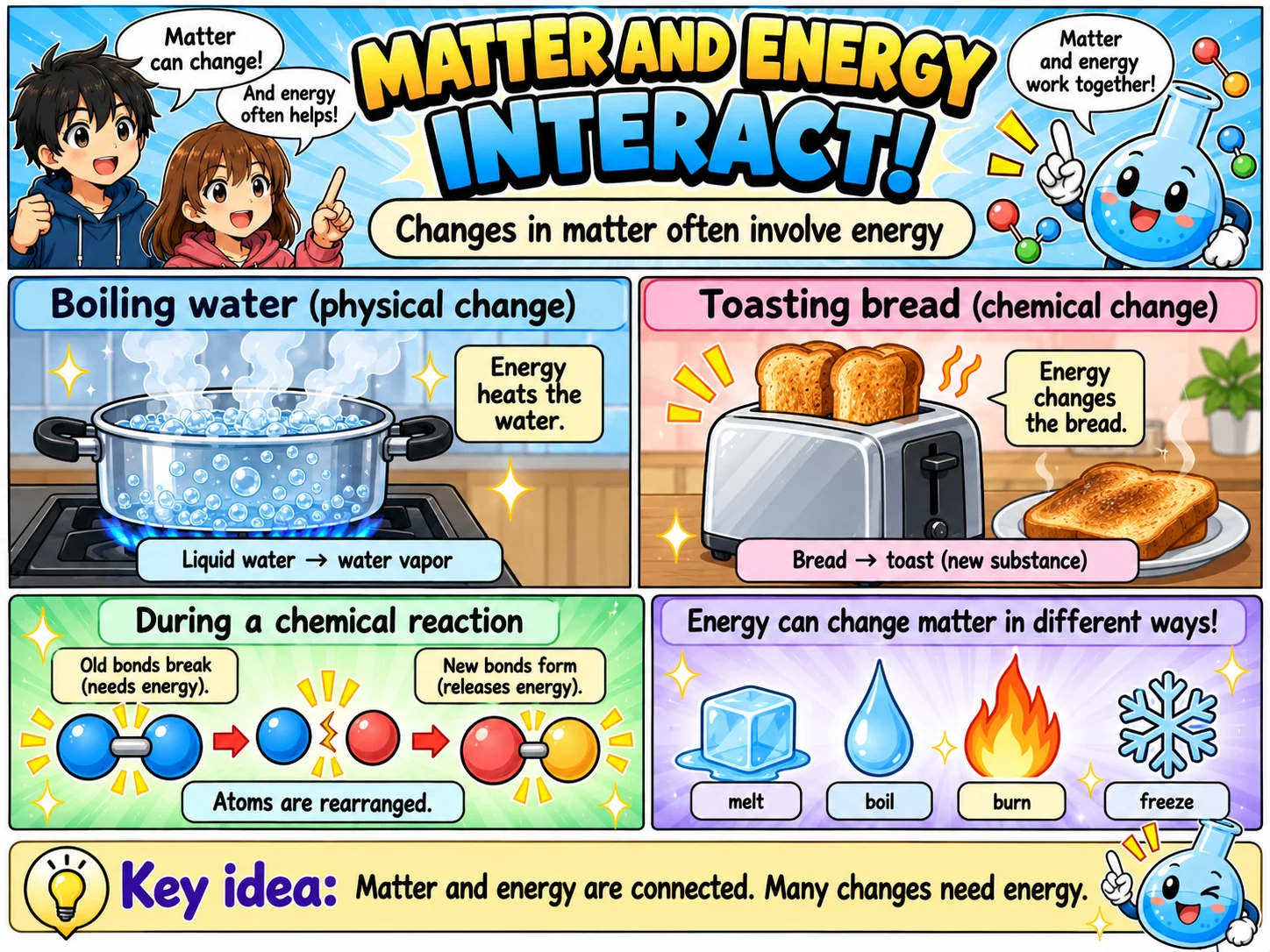
Matter and energy interact all around us.

Many changes need energy.

For example:

Boiling water needs energy from a stove.

Making toast needs energy from a toaster.

Chemical reactions also involve energy.

During a chemical reaction:

old bonds break

and

new bonds form

Energy is involved in both steps.

Big idea:

chemical change → energy change

Pages 4–5

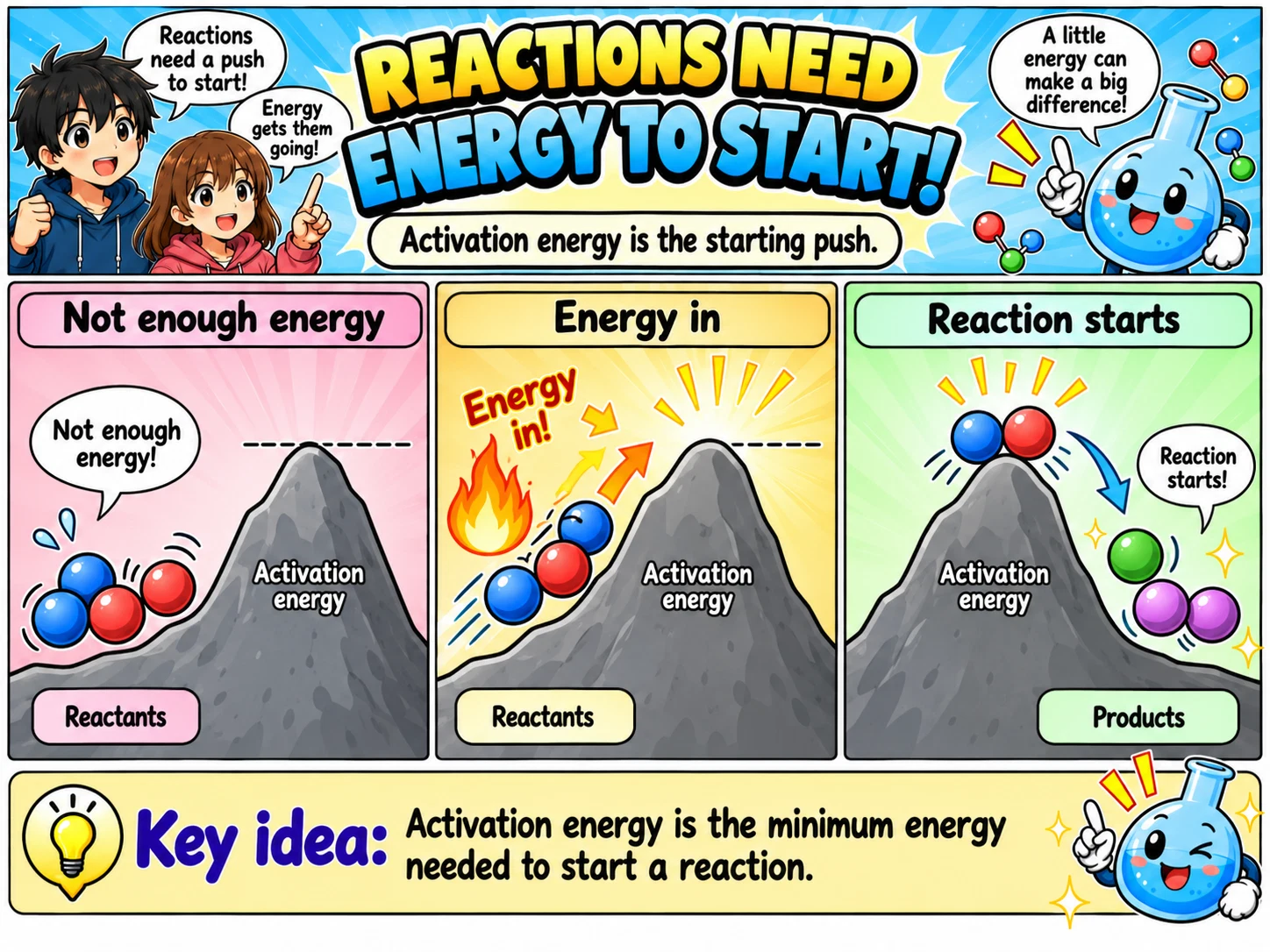
Reactions Need Energy to Start

MOSAIC Chemistry Topic 2.3: Reactions Need Energy to Start illustration from source PDF page 4
Original MOSAIC Chemistry visual · Topic 2.3, PDF page 4
VocabWhat it means
Activation energythe minimum energy needed to start a chemical reaction
Reactanta starting substance in a chemical reaction

Easy explanation

Reactant particles must collide for a reaction to happen.

But not every collision causes a reaction.

The particles need enough energy.

The minimum energy needed to start a reaction is called activation energy.

Think of activation energy like a hill.

The particles must have enough energy to get over the hill.

Example

Propane and oxygen do not immediately react strongly when they meet.

A spark can provide the energy needed to start the reaction.

Once the propane starts burning, the reaction releases energy.

Some of this energy helps more particles react.

Easy memory:

activation energy = starting push

Pages 6–7

Breaking and Forming Bonds

MOSAIC Chemistry Topic 2.3: Breaking and Forming Bonds illustration from source PDF page 6
Original MOSAIC Chemistry visual · Topic 2.3, PDF page 6
VocabWhat it means
Bond breakingseparating atoms that are chemically bonded
Bond formingmaking a new chemical bond between atoms

Easy explanation

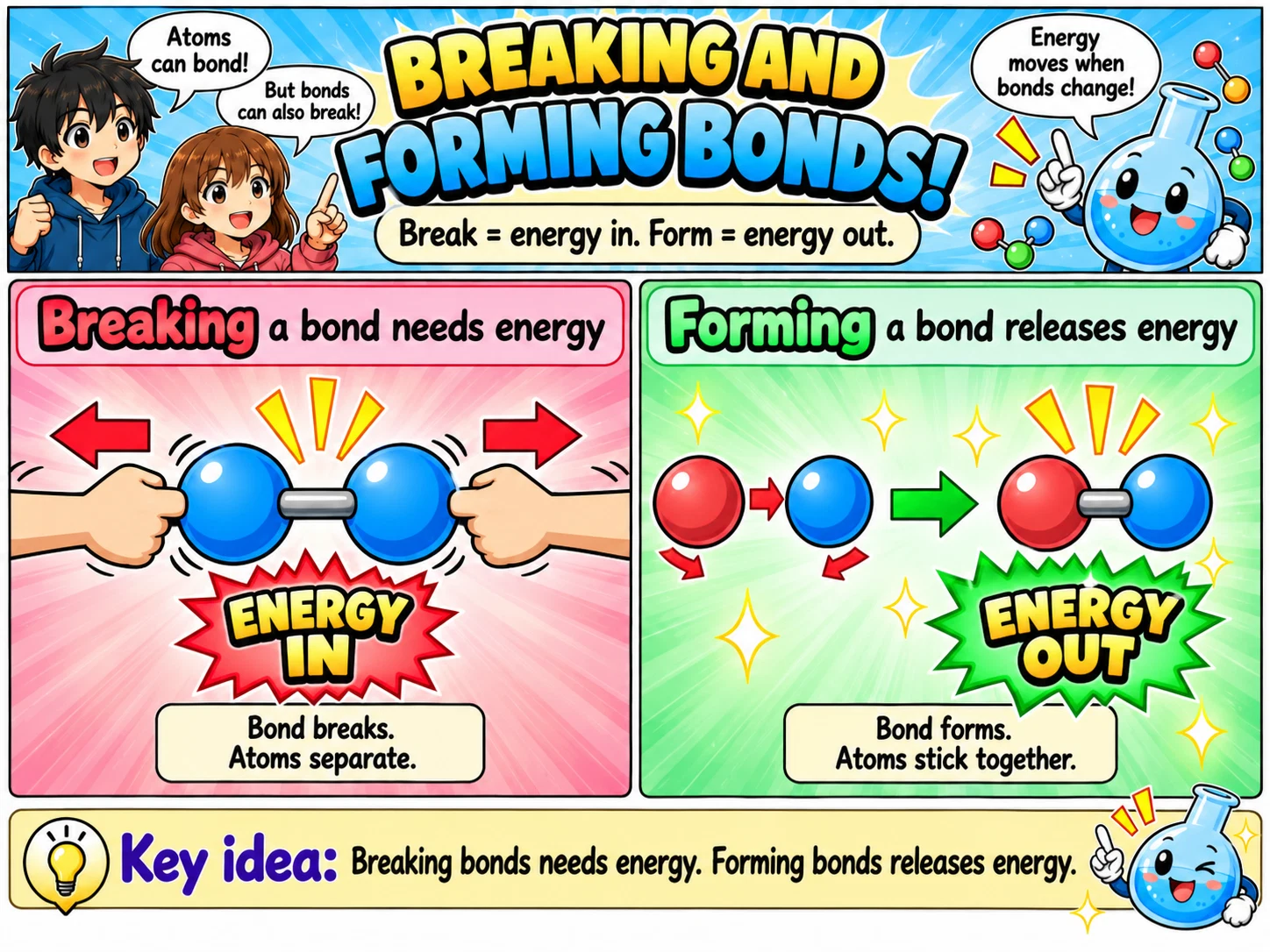
Chemical reactions involve changes in chemical bonds.

Two important rules are:

Breaking bonds requires energy.

Forming bonds releases energy.

Think of bonded atoms like magnets.

Pulling magnets apart takes energy.

When magnets snap together, energy is released.

So:

BREAK → energy IN

MAKE → energy OUT

Every chemical reaction includes both of these energy changes.

Pages 8–9

The System and the Surroundings

MOSAIC Chemistry Topic 2.3: The System and the Surroundings illustration from source PDF page 8
Original MOSAIC Chemistry visual · Topic 2.3, PDF page 8
VocabWhat it means
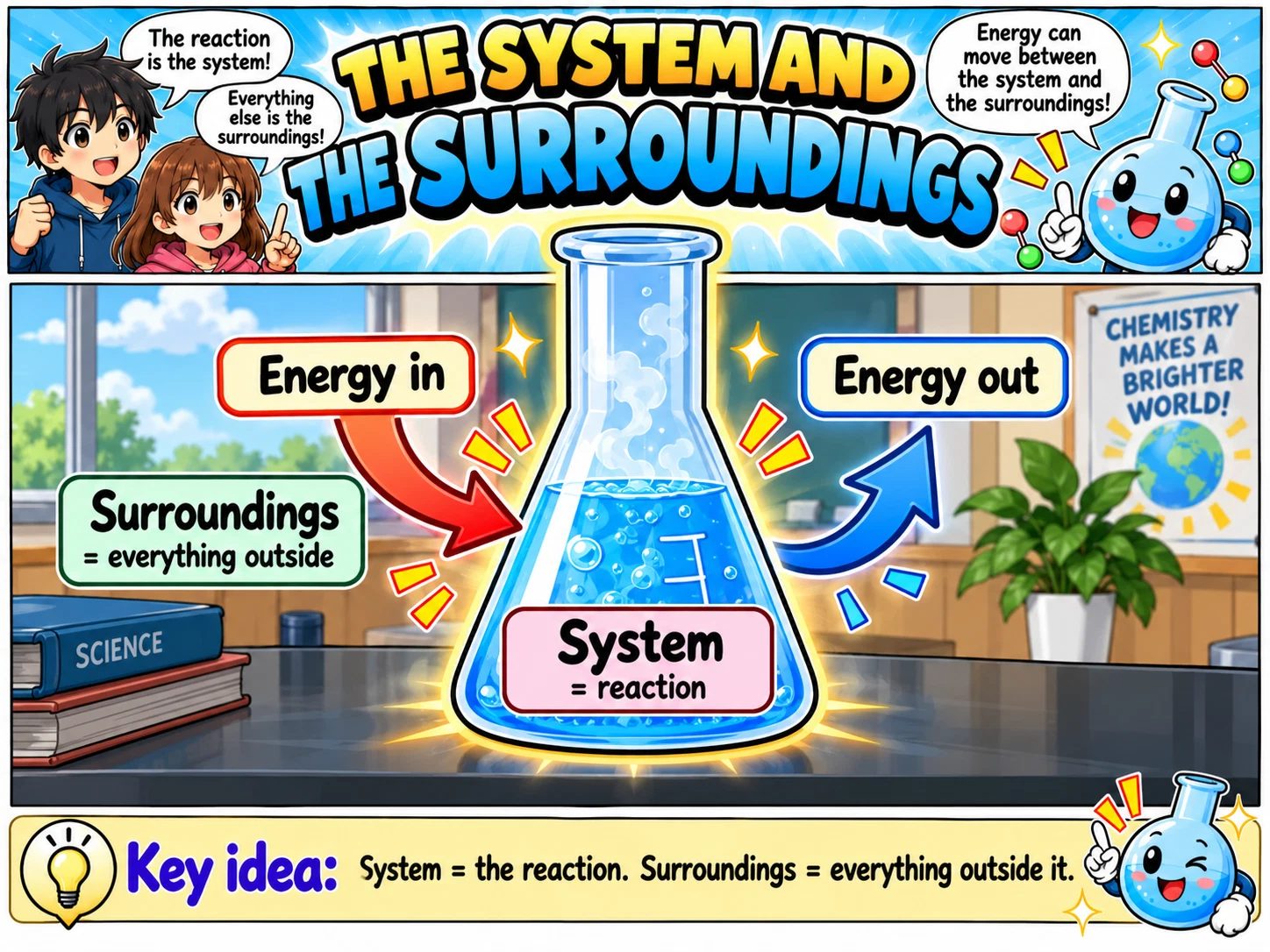
Systemthe materials involved in the chemical reaction
Surroundingseverything outside the system

Easy explanation

Chemists often divide a situation into two parts.

System

The system is the reaction being studied.

For example:

the reacting substances inside a flask.

Surroundings

The surroundings are everything outside the system.

This can include:

the flask

the air

the table

the student

the laboratory

Energy can move between the system and the surroundings.

system ⇄ energy ⇄ surroundings

If energy leaves the system, the surroundings gain energy.

If energy enters the system, that energy comes from the surroundings.

Pages 10–11

Conservation of Energy

MOSAIC Chemistry Topic 2.3: Conservation of Energy illustration from source PDF page 10
Original MOSAIC Chemistry visual · Topic 2.3, PDF page 10
VocabWhat it means
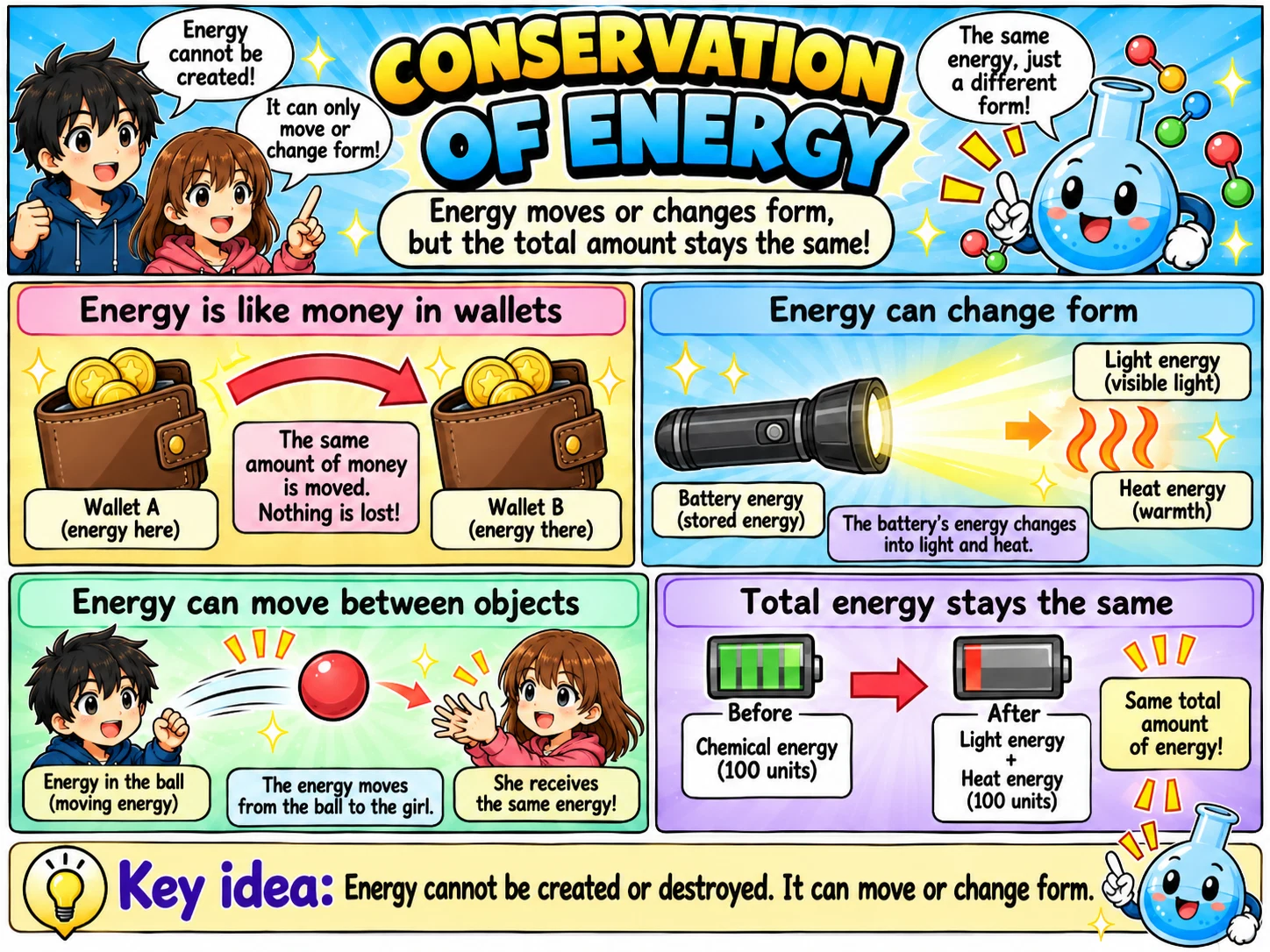
Law of conservation of energyenergy cannot be created or destroyed

Easy explanation

Energy does not disappear.

Energy cannot be created from nothing.

It can move from one place to another.

It can also change form.

But the total amount of energy stays the same.

This is called the law of conservation of energy.

During a chemical reaction:

energy leaving the system → enters the surroundings

or

energy entering the system → comes from the surroundings

Think of energy like money moving between two wallets.

One wallet loses money.

The other wallet gains money.

The money did not disappear.

Pages 12–13

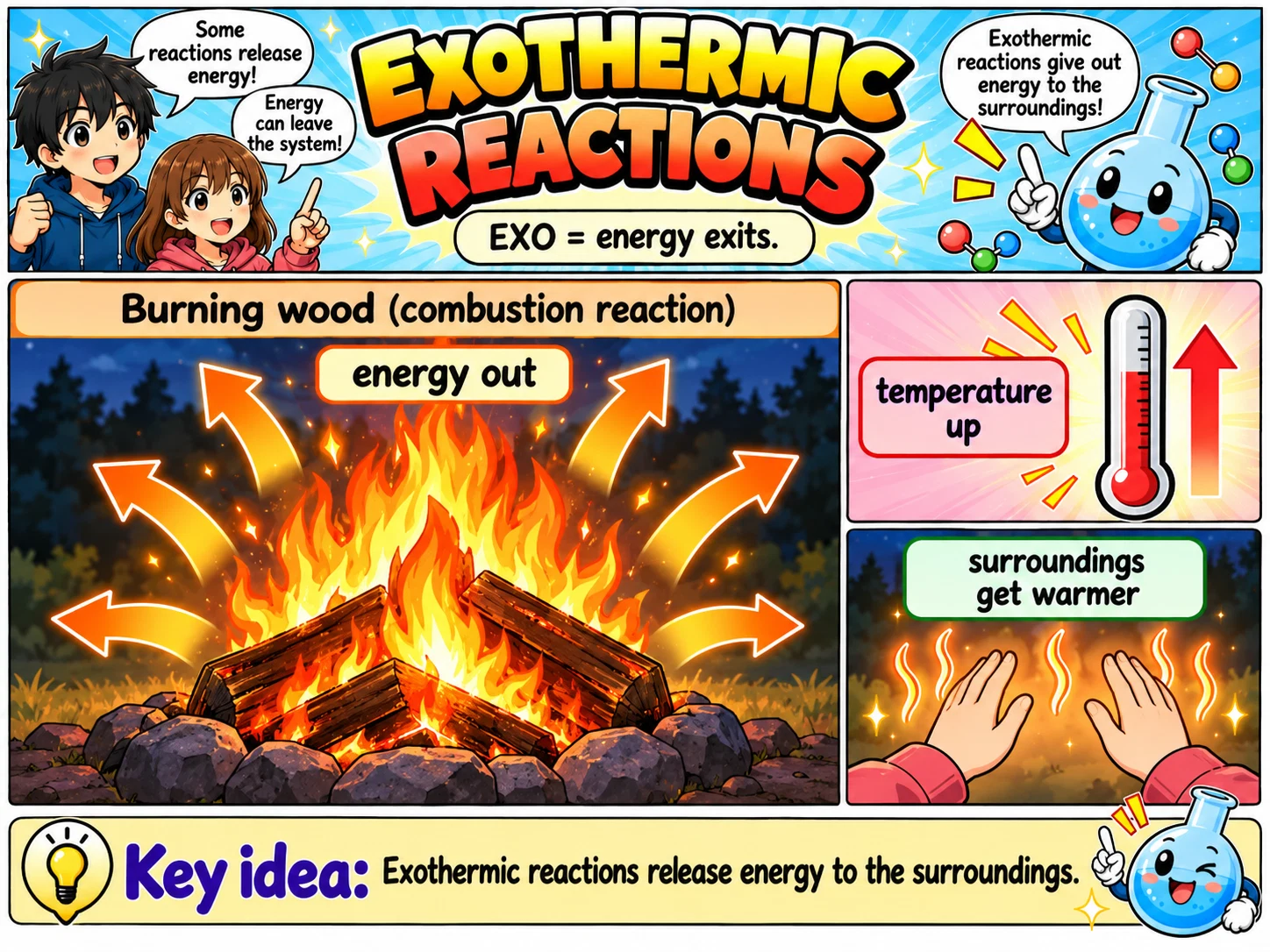
Exothermic Reactions

MOSAIC Chemistry Topic 2.3: Exothermic Reactions illustration from source PDF page 12
Original MOSAIC Chemistry visual · Topic 2.3, PDF page 12
VocabWhat it means
Exothermic reactiona chemical reaction with an overall release of energy to the surroundings

Easy explanation

An exothermic reaction releases energy overall.

During the reaction:

energy is needed to break bonds

but

energy is also released when new bonds form.

In an exothermic reaction:

more energy is released than absorbed

So energy moves:

system → surroundings

The surroundings gain energy.

The temperature often increases.

Easy memory

EXO = energy EXITS

In short

energy released > energy absorbed

↓

exothermic reaction

↓

energy OUT

Pages 14–15

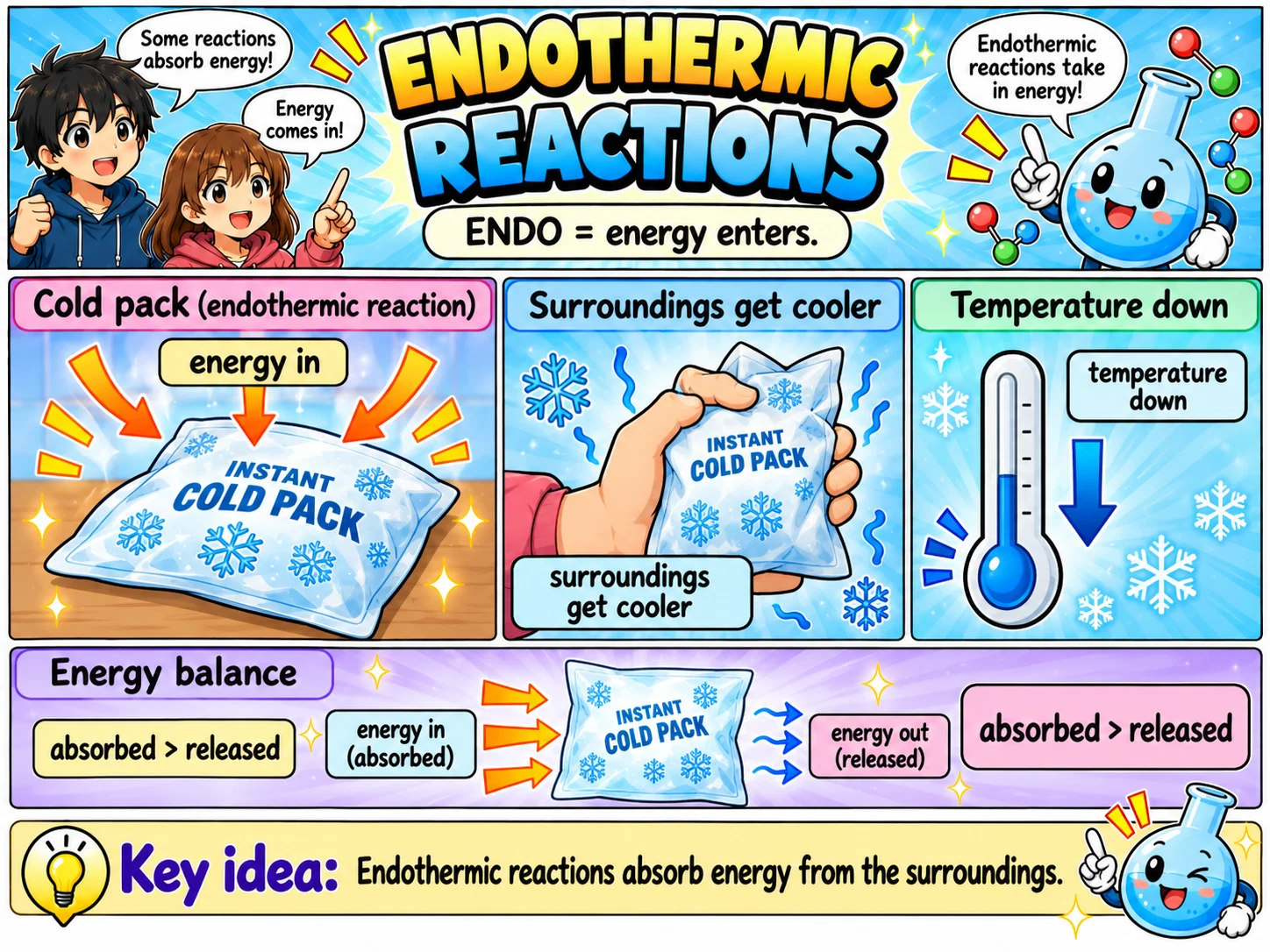
Endothermic Reactions

MOSAIC Chemistry Topic 2.3: Endothermic Reactions illustration from source PDF page 14
Original MOSAIC Chemistry visual · Topic 2.3, PDF page 14
VocabWhat it means
Endothermic reactiona chemical reaction with an overall absorption of energy from the surroundings

Easy explanation

An endothermic reaction absorbs energy overall.

During the reaction:

energy is needed to break bonds

and

energy is released when new bonds form.

In an endothermic reaction:

more energy is absorbed than released

So energy moves:

surroundings → system

The surroundings lose energy.

The temperature often decreases.

Easy memory

ENDO = energy ENTERS

In short

energy absorbed > energy released

↓

endothermic reaction

↓

energy IN

Pages 16–17

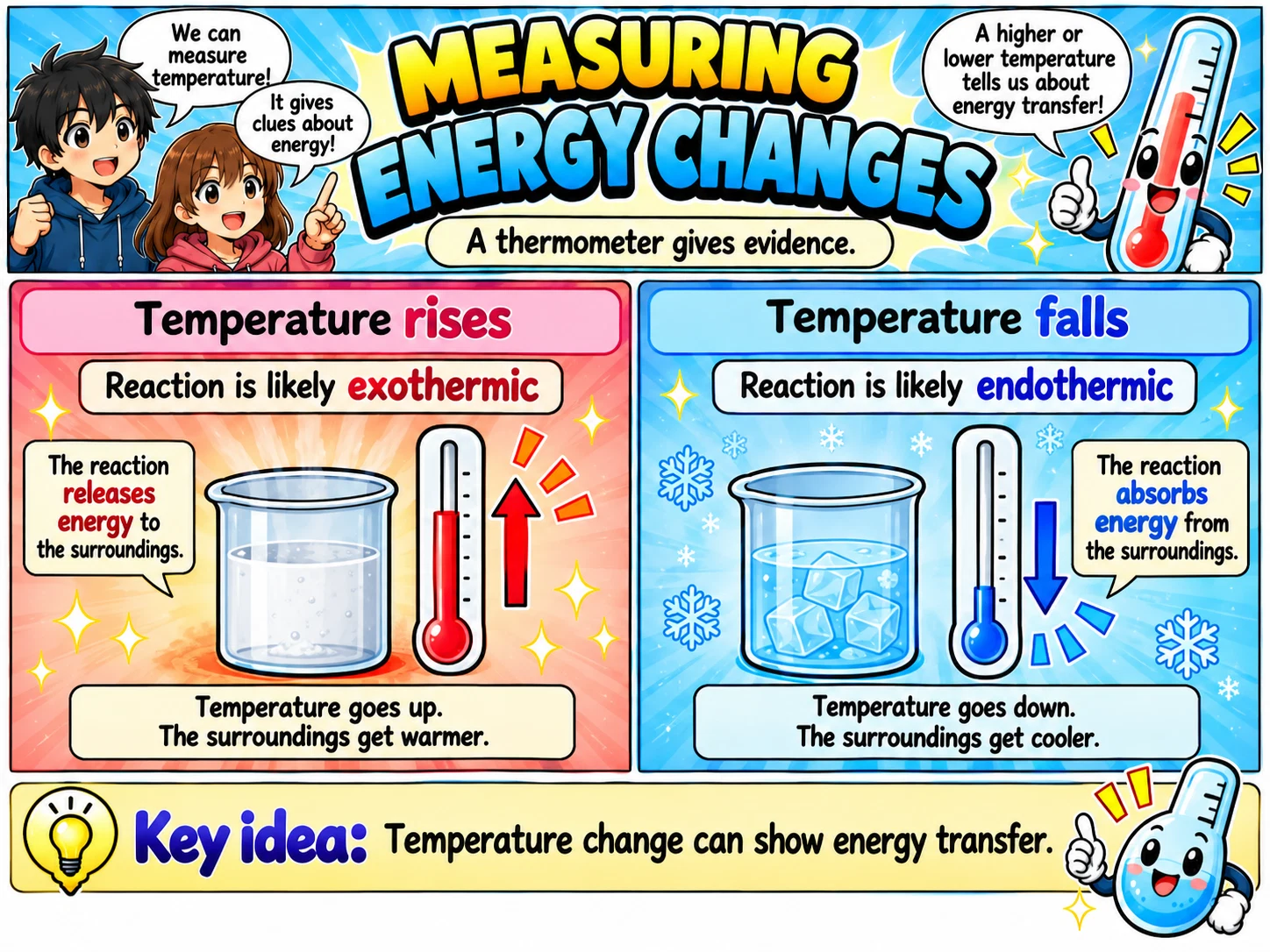
Measuring Energy Changes

MOSAIC Chemistry Topic 2.3: Measuring Energy Changes illustration from source PDF page 16
Original MOSAIC Chemistry visual · Topic 2.3, PDF page 16
ObservationWhat it usually means
temperature increasesenergy was released
temperature decreasesenergy was absorbed

Easy explanation

We can use temperature to study energy changes.

A thermometer can show whether energy moved into or out of the surroundings.

Exothermic reaction

The reaction releases energy.

The surroundings gain energy.

The temperature can increase.

temperature ↑ → energy released

Endothermic reaction

The reaction absorbs energy.

The surroundings lose energy.

The temperature can decrease.

temperature ↓ → energy absorbed

Temperature change gives us evidence about the reaction.

Pages 18–19

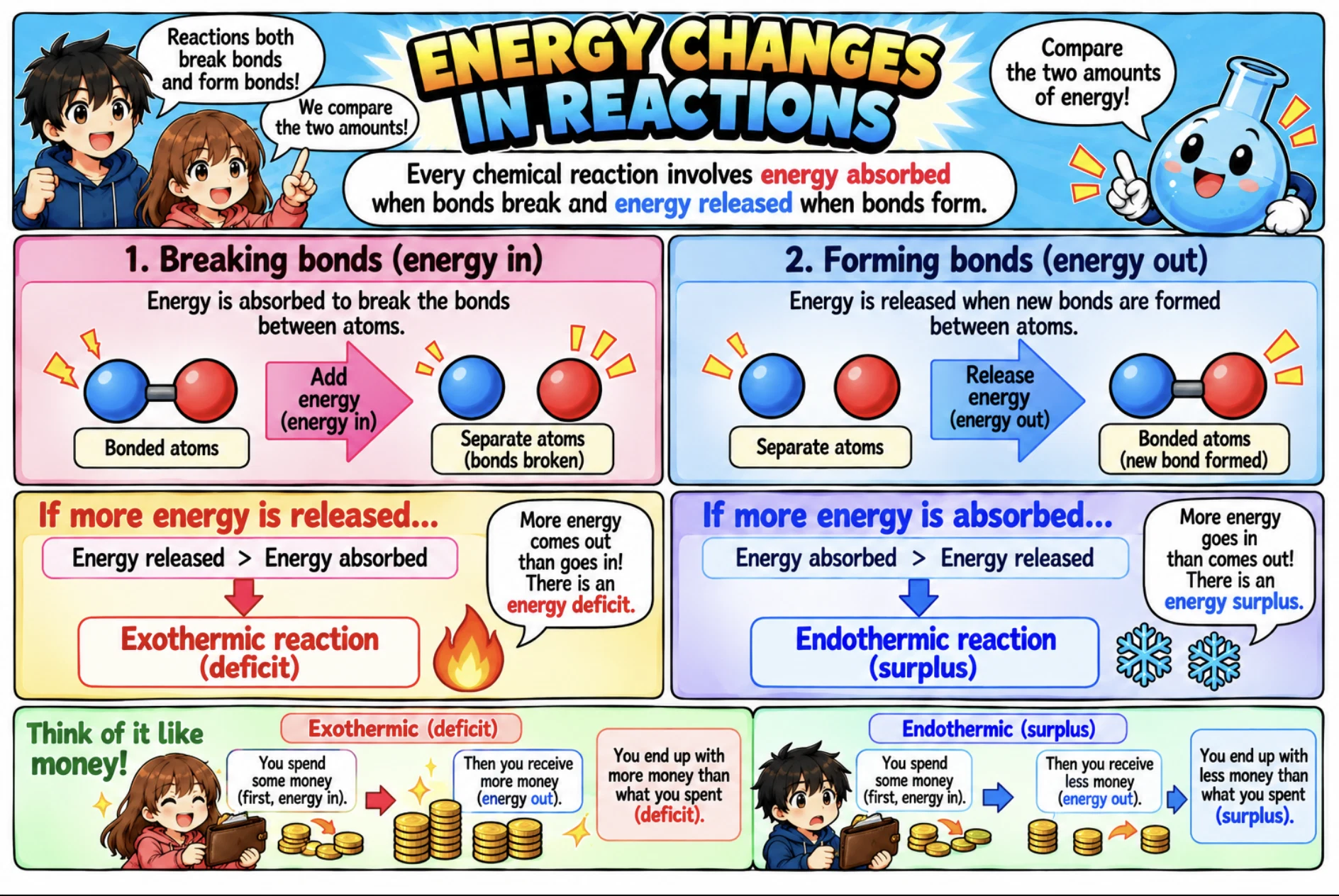
Overall Energy Change

MOSAIC Chemistry Topic 2.3: Overall Energy Change illustration from source PDF page 18
Original MOSAIC Chemistry visual · Topic 2.3, PDF page 18

Easy explanation

Every chemical reaction involves:

energy absorbed when bonds break

and

energy released when bonds form

We compare these two amounts.

If more energy is released:

energy released > energy absorbed

↓

exothermic

If more energy is absorbed:

energy absorbed > energy released

↓

endothermic

Think of it like money!

Imagine that the money represents energy in the surroundings.

Exothermic Reaction (Surplus)

You spend some money first (energy absorbed).

Then, you receive even more money (energy released).

You receive more than you spend.

→ Surplus: More energy enters the surroundings than leaves.

Endothermic Reaction (Deficit)

You receive some money first (energy released).

However, you spend even more money (energy absorbed).

You spend more than you receive.

→ Deficit: More energy leaves the surroundings than enters.

Key Idea: What matters is the final difference between energy absorbed and energy released. This determines the overall energy change.

That final difference is the overall energy change.

Pages 20–21

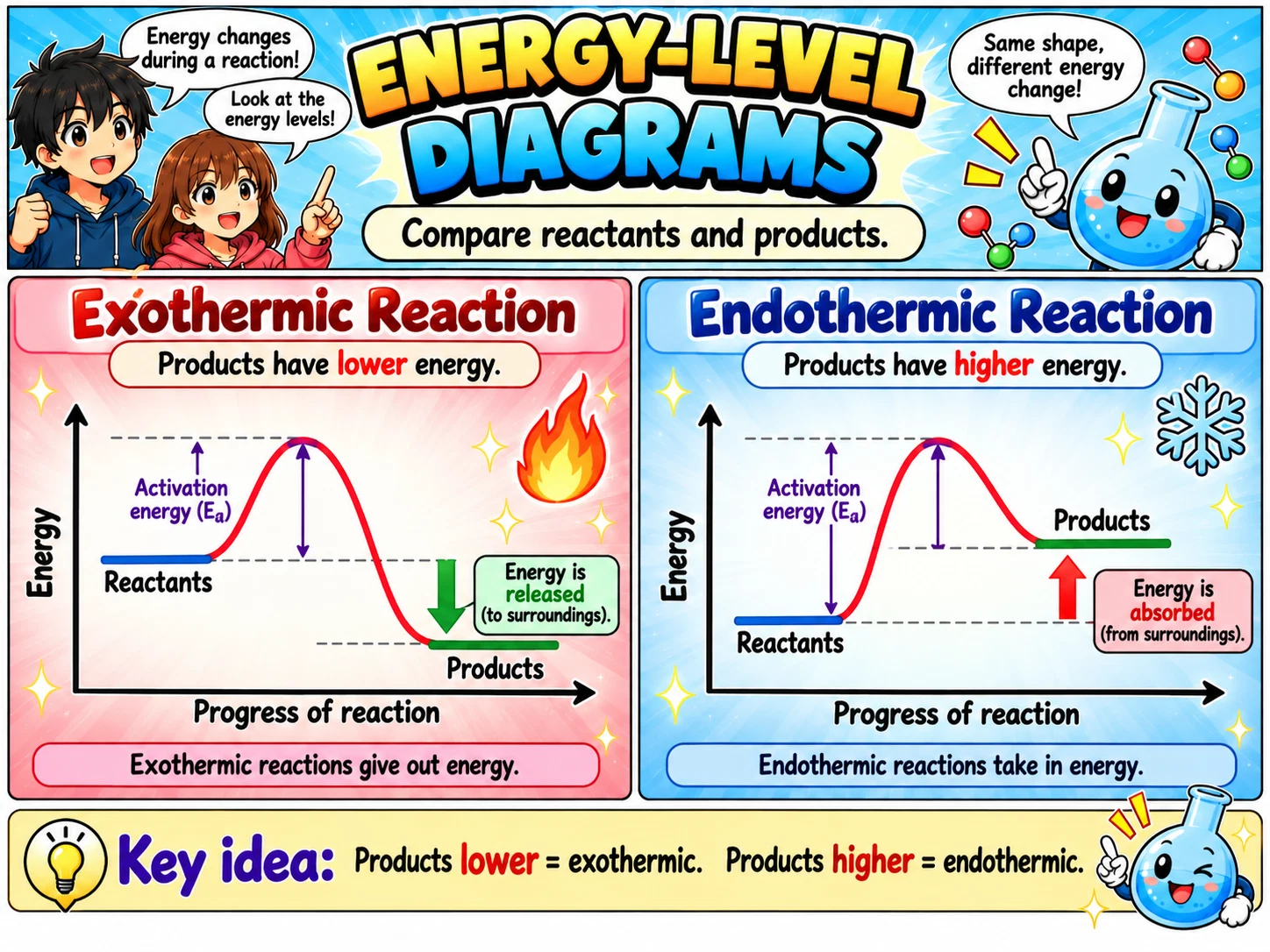
Energy-Level Diagrams

MOSAIC Chemistry Topic 2.3: Energy-Level Diagrams illustration from source PDF page 20
Original MOSAIC Chemistry visual · Topic 2.3, PDF page 20
VocabWhat it means
Energy-level diagrama diagram showing the energy of reactants and products

Easy explanation

An energy-level diagram shows how energy changes during a reaction.

The vertical direction shows:

energy

The horizontal direction shows:

progress of reaction

Endothermic reaction

The products have more energy than the reactants.

So:

reactants → lower energy

products → higher energy

Energy was absorbed overall.

Exothermic reaction

The products have less energy than the reactants.

So:

reactants → higher energy

products → lower energy

Energy was released overall.

Easy memory:

products higher → endothermic

products lower → exothermic

Pages 22–23

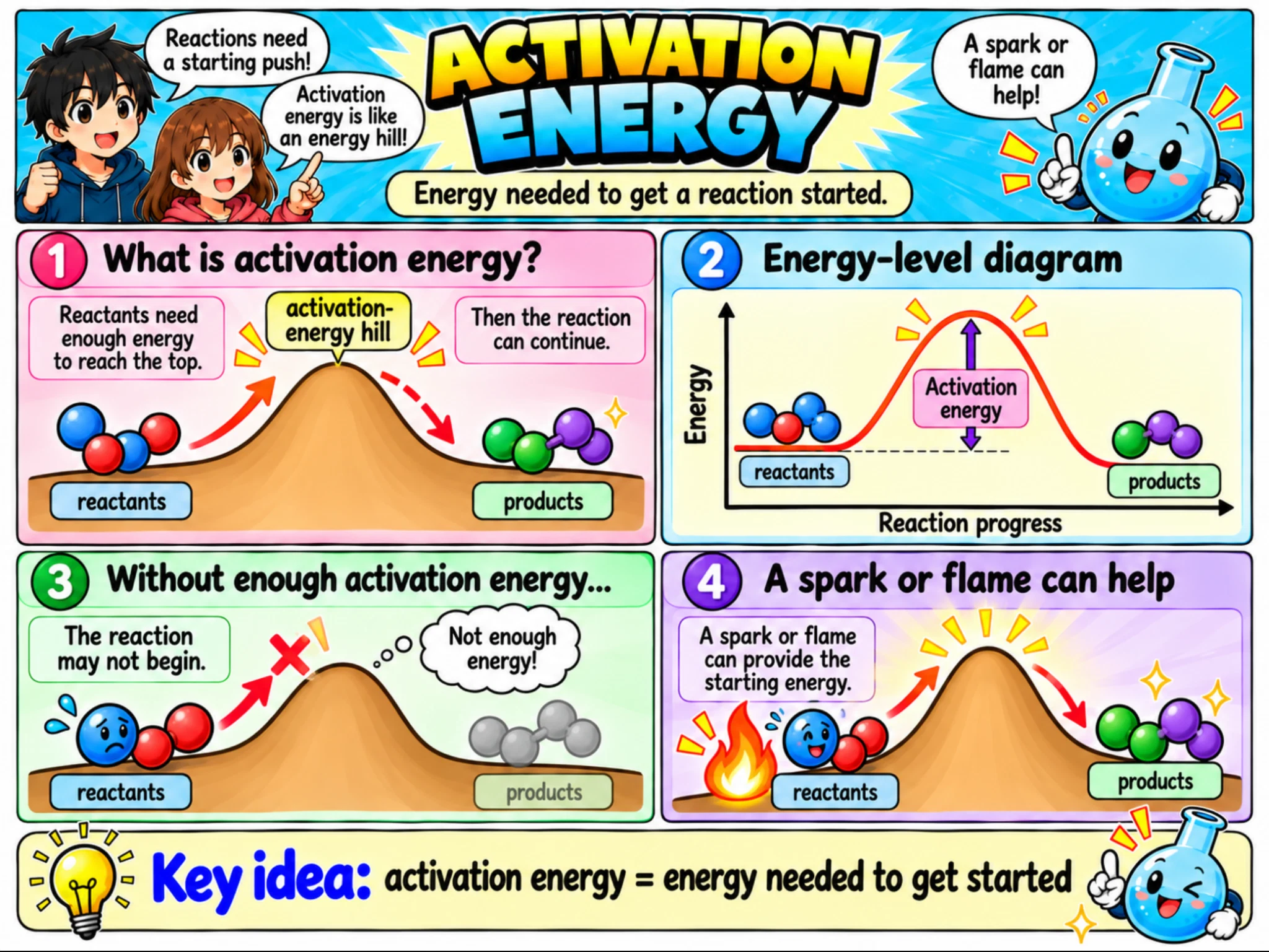
Activation Energy on an Energy Diagram

MOSAIC Chemistry Topic 2.3: Activation Energy on an Energy Diagram illustration from source PDF page 22
Original MOSAIC Chemistry visual · Topic 2.3, PDF page 22

Easy explanation

Activation energy can also be shown on an energy-level diagram.

It looks like an energy hill.

The reactants need enough energy to reach the top.

Then the reaction can continue.

reactants

↓

activation-energy hill

↓

products

Without enough activation energy, the reaction may not begin.

A spark or flame can sometimes provide this starting energy.

Easy memory:

activation energy = energy needed to get started

Pages 24–25

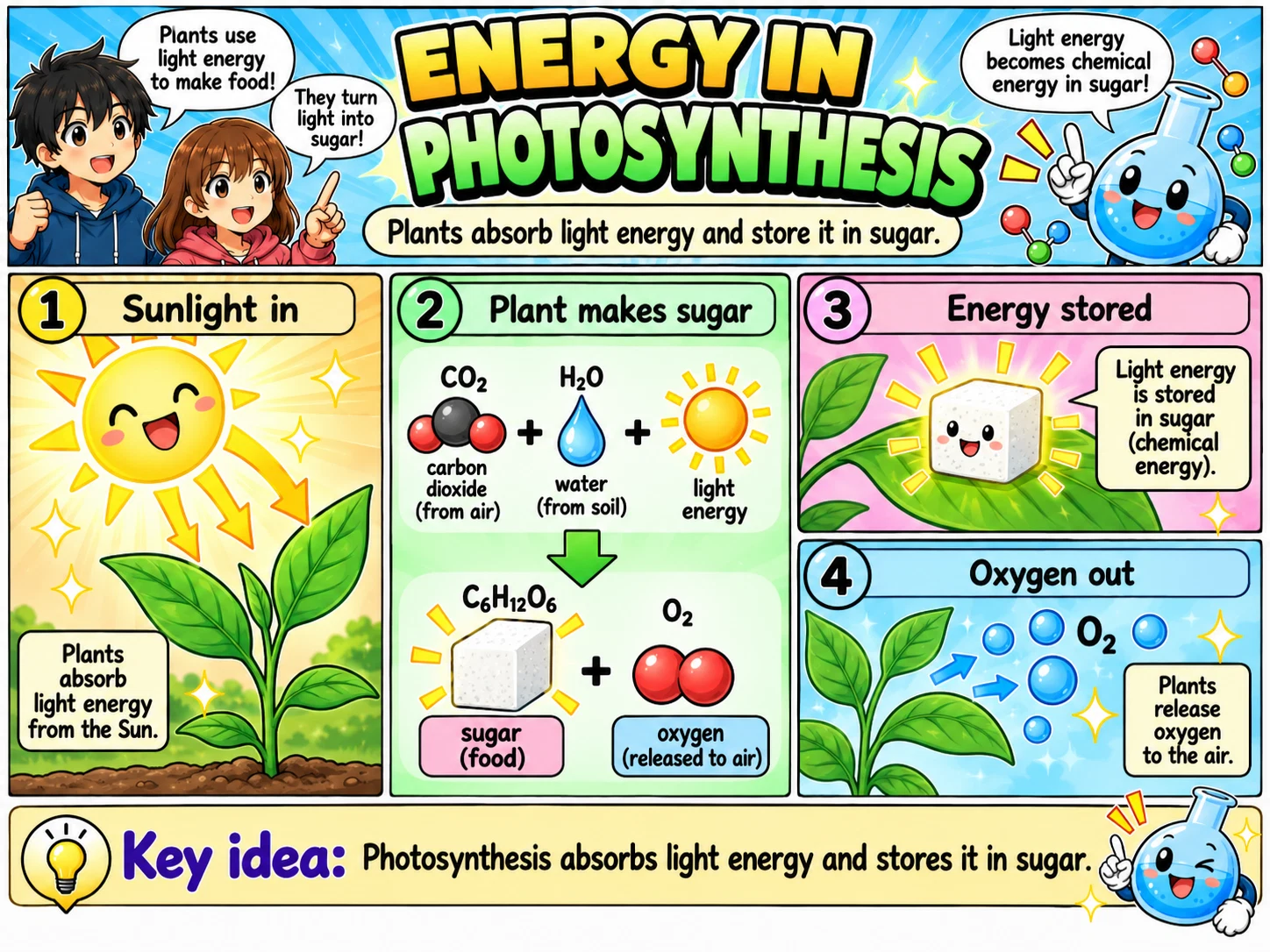
Energy in Photosynthesis

MOSAIC Chemistry Topic 2.3: Energy in Photosynthesis illustration from source PDF page 24
Original MOSAIC Chemistry visual · Topic 2.3, PDF page 24
VocabWhat it means
Photosynthesisa process that uses light energy to make sugar

Easy explanation

Plants use energy from sunlight.

During photosynthesis, plants use:

carbon dioxide + water + energy

to make:

sugar + oxygen

The light energy becomes stored in the chemical bonds of sugar.

So overall:

photosynthesis absorbs energy

Think of sugar like a charged battery.

The plant stores energy inside it.

Pages 26–27

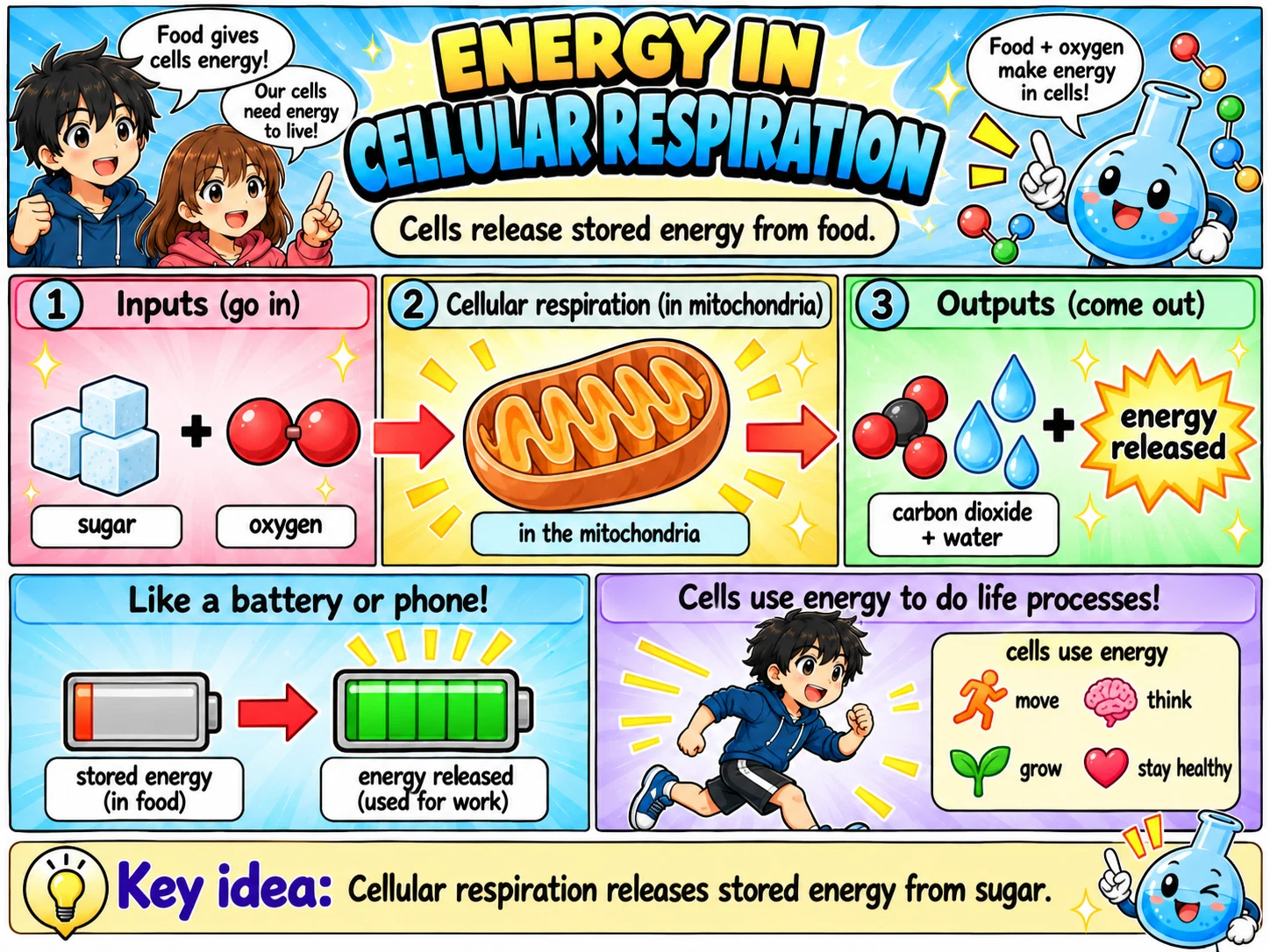
Energy in Cellular Respiration

MOSAIC Chemistry Topic 2.3: Energy in Cellular Respiration illustration from source PDF page 26
Original MOSAIC Chemistry visual · Topic 2.3, PDF page 26
VocabWhat it means
Cellular respirationa process that releases energy from food in cells

Easy explanation

Living things need energy to grow, move, and survive.

Cells can release stored energy from sugar through cellular respiration.

Overall:

sugar + oxygen

↓

carbon dioxide + water + energy

So:

cellular respiration releases energy

Think of sugar like a battery.

Photosynthesis helps charge the battery.

Cellular respiration helps use the stored energy.

Pages 28–29

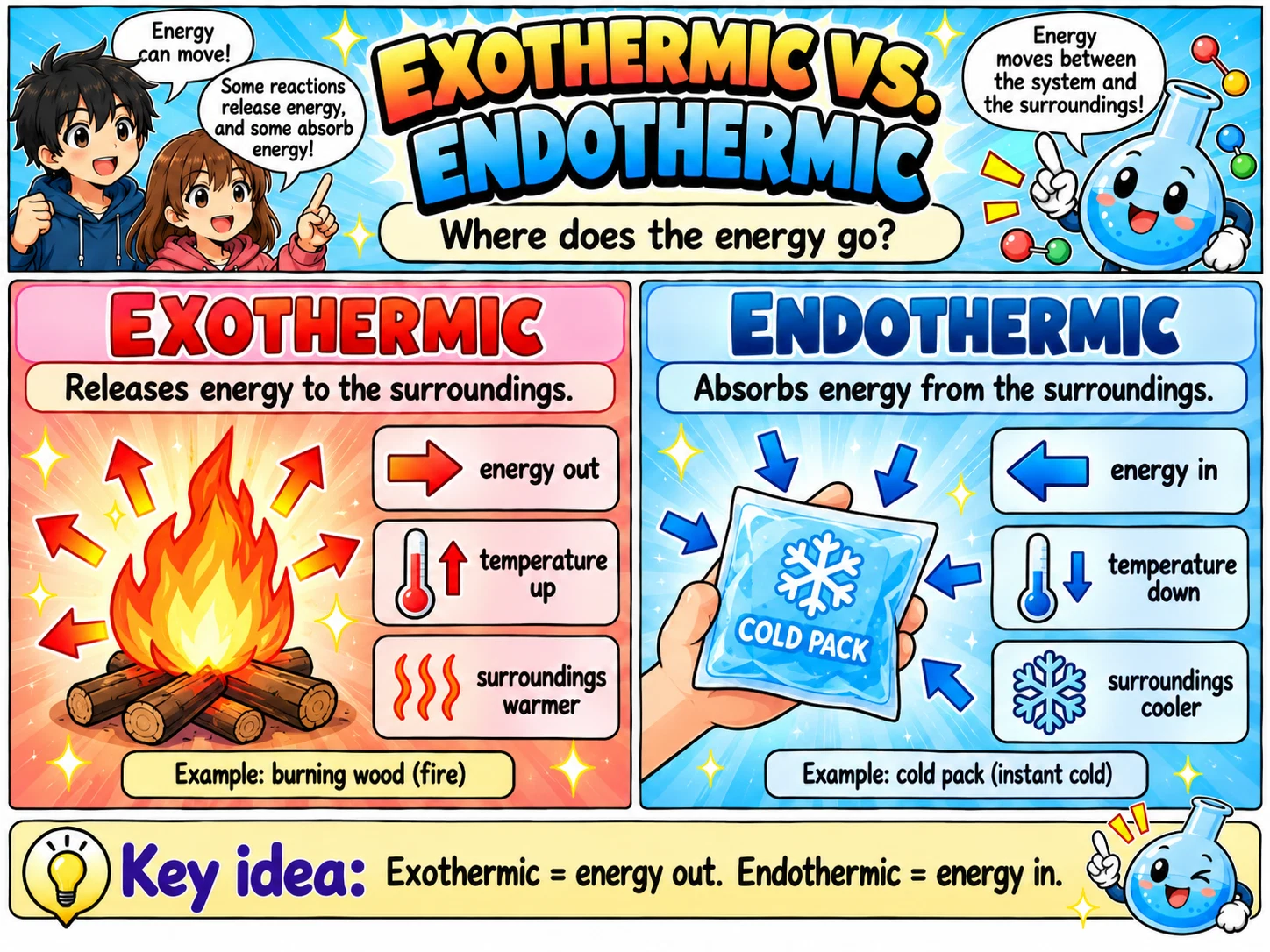
Exothermic vs. Endothermic

MOSAIC Chemistry Topic 2.3: Exothermic vs. Endothermic illustration from source PDF page 28
Original MOSAIC Chemistry visual · Topic 2.3, PDF page 28
ExothermicEndothermic
energy leaves the systemenergy enters the system
surroundings gain energysurroundings lose energy
temperature often increasestemperature often decreases
products have lower energyproducts have higher energy
energy OUTenergy IN

Easy explanation

Ask one important question:

Where does the energy go?

If energy moves:

system → surroundings

the reaction is:

EXOTHERMIC

If energy moves:

surroundings → system

the reaction is:

ENDOTHERMIC

Pages 30–31

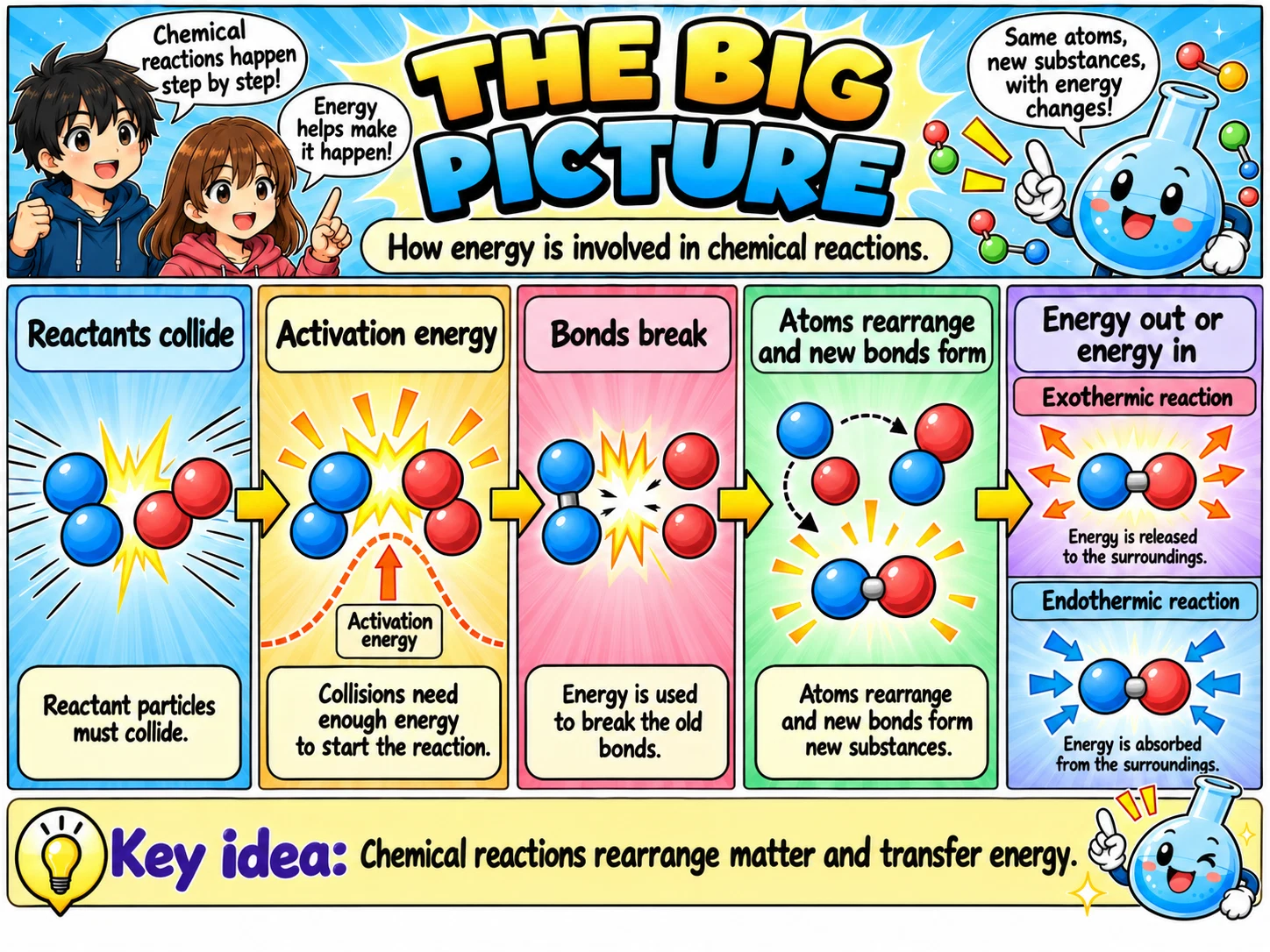
The Big Picture

MOSAIC Chemistry Topic 2.3: The Big Picture illustration from source PDF page 30
Original MOSAIC Chemistry visual · Topic 2.3, PDF page 30

Easy explanation

Chemical reactions involve both matter and energy.

First:

reactant particles collide

↓

They need enough:

activation energy

↓

old bonds break

↓

energy is absorbed

↓

atoms rearrange

↓

new bonds form

↓

energy is released

Then compare the two amounts.

More energy released

→ exothermic

→ energy moves to the surroundings

More energy absorbed

→ endothermic

→ energy comes from the surroundings

Energy moves during the reaction.

But energy is not created or destroyed.

Page 32

Summary

Short explanation

Matter and energy interact during physical and chemical changes.

Chemical reactions need enough activation energy to begin.

Breaking chemical bonds requires energy.

Forming chemical bonds releases energy.

The system is the reaction being studied.

The surroundings are everything outside the system.

Energy can move between the system and the surroundings.

An exothermic reaction releases energy overall.

An endothermic reaction absorbs energy overall.

Temperature changes can give evidence about energy transfer.

Energy-level diagrams compare the energy of reactants and products.

In an exothermic reaction, the products have lower energy than the reactants.

In an endothermic reaction, the products have higher energy than the reactants.

Photosynthesis absorbs and stores energy.

Cellular respiration releases stored energy.

Energy cannot be created or destroyed.

Main idea:

Chemical reactions rearrange matter and transfer energy.

Topic 2.4

How Do Atoms Rearrange in Different Types of Chemical Reactions?

Big Question: How can we recognize different kinds of chemical reactions?

Pages 2–3

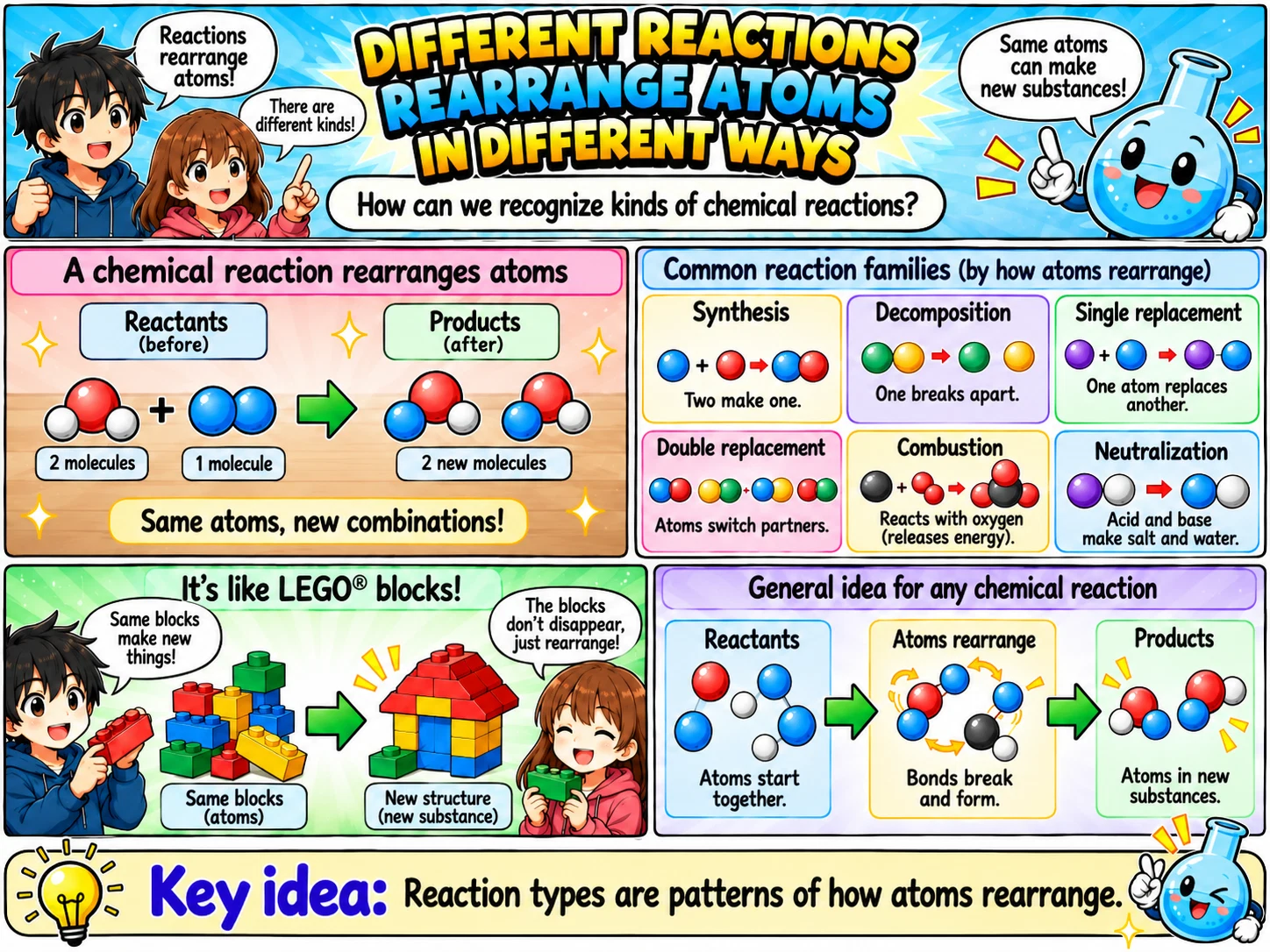
Different Reactions Rearrange Atoms in Different Ways

MOSAIC Chemistry Topic 2.4: Different Reactions Rearrange Atoms in Different Ways illustration from source PDF page 2
Original MOSAIC Chemistry visual · Topic 2.4, PDF page 2
VocabWhat it means
Reaction typea pattern showing how atoms rearrange
Reactanta starting substance
Producta substance formed in a reaction

Easy explanation

Chemical reactions do not all rearrange atoms in the same way.

Scientists group reactions by their patterns.

In this topic, we will look at:

synthesis

decomposition

single replacement

double replacement

combustion

neutralization

Think of atoms like LEGO pieces.

The pieces do not disappear.

They are simply connected in different ways.

reactants → atoms rearrange → products

Pages 4–5

Synthesis Reactions

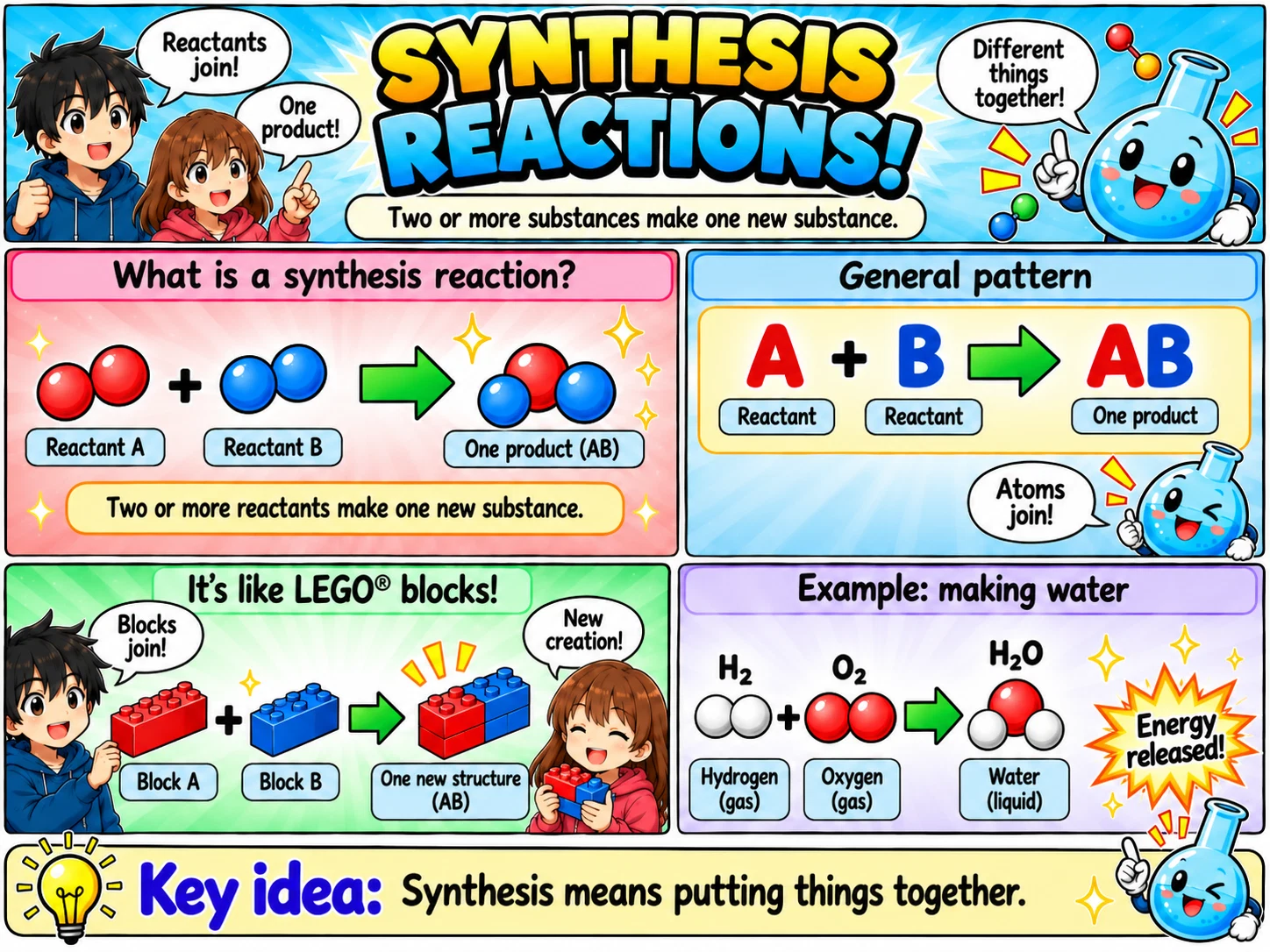
MOSAIC Chemistry Topic 2.4: Synthesis Reactions illustration from source PDF page 4
Original MOSAIC Chemistry visual · Topic 2.4, PDF page 4
VocabWhat it means
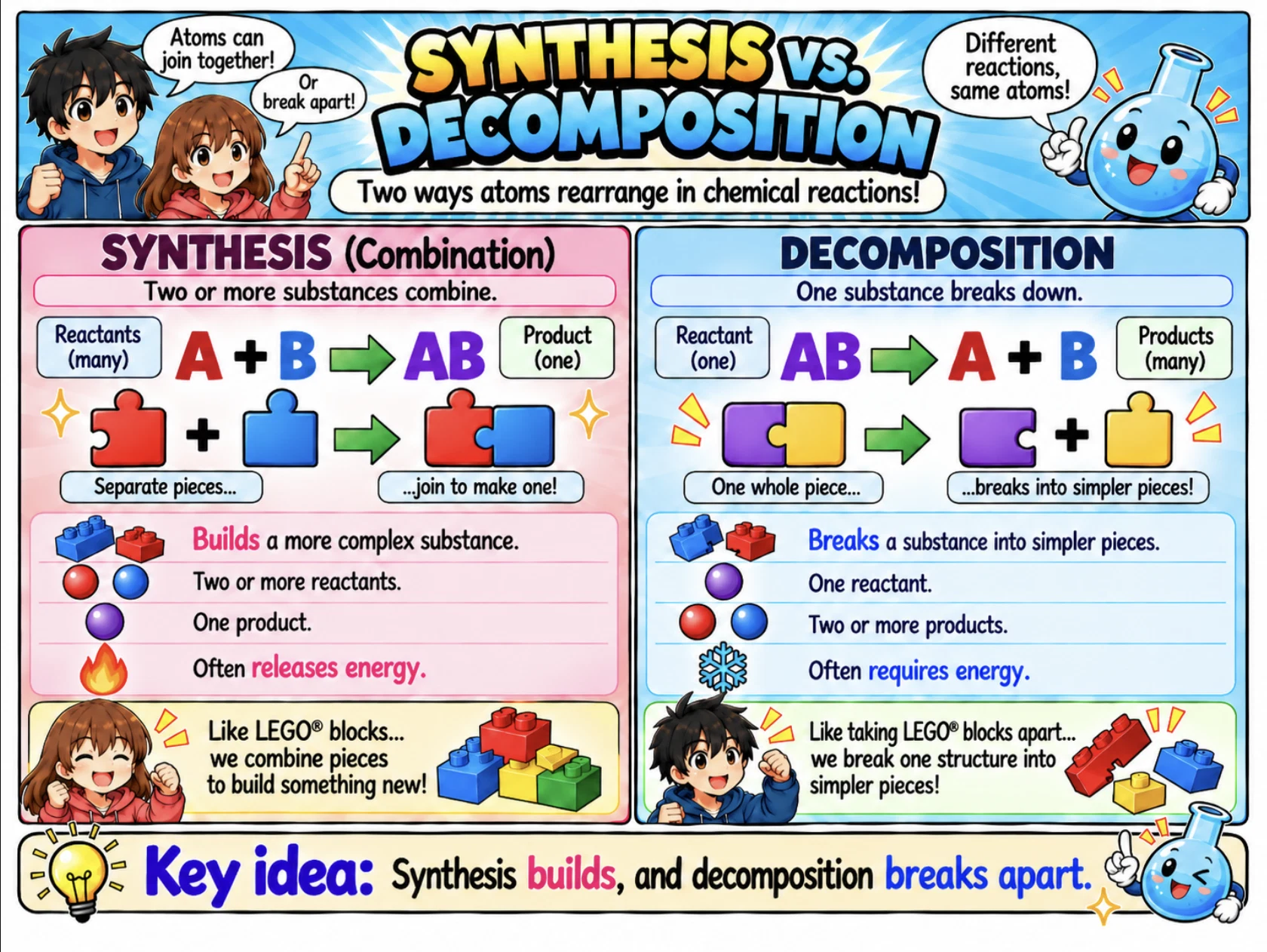
Synthesis reactiontwo or more reactants combine to make one product

Easy explanation

Synthesis means putting things together.

Two or more substances combine.

They make one new compound.

General pattern

A + B → AB

Think of two puzzle pieces joining.

separate pieces → one larger piece

Example

hydrogen + oxygen → water

2H₂ + O₂ → 2H₂O

Two reactants combine to form one compound.

Most synthesis reactions are exothermic.

This means they release energy overall.

Easy memory:

Synthesis = JOIN

Pages 6–7

Synthesis Reactions Around Us

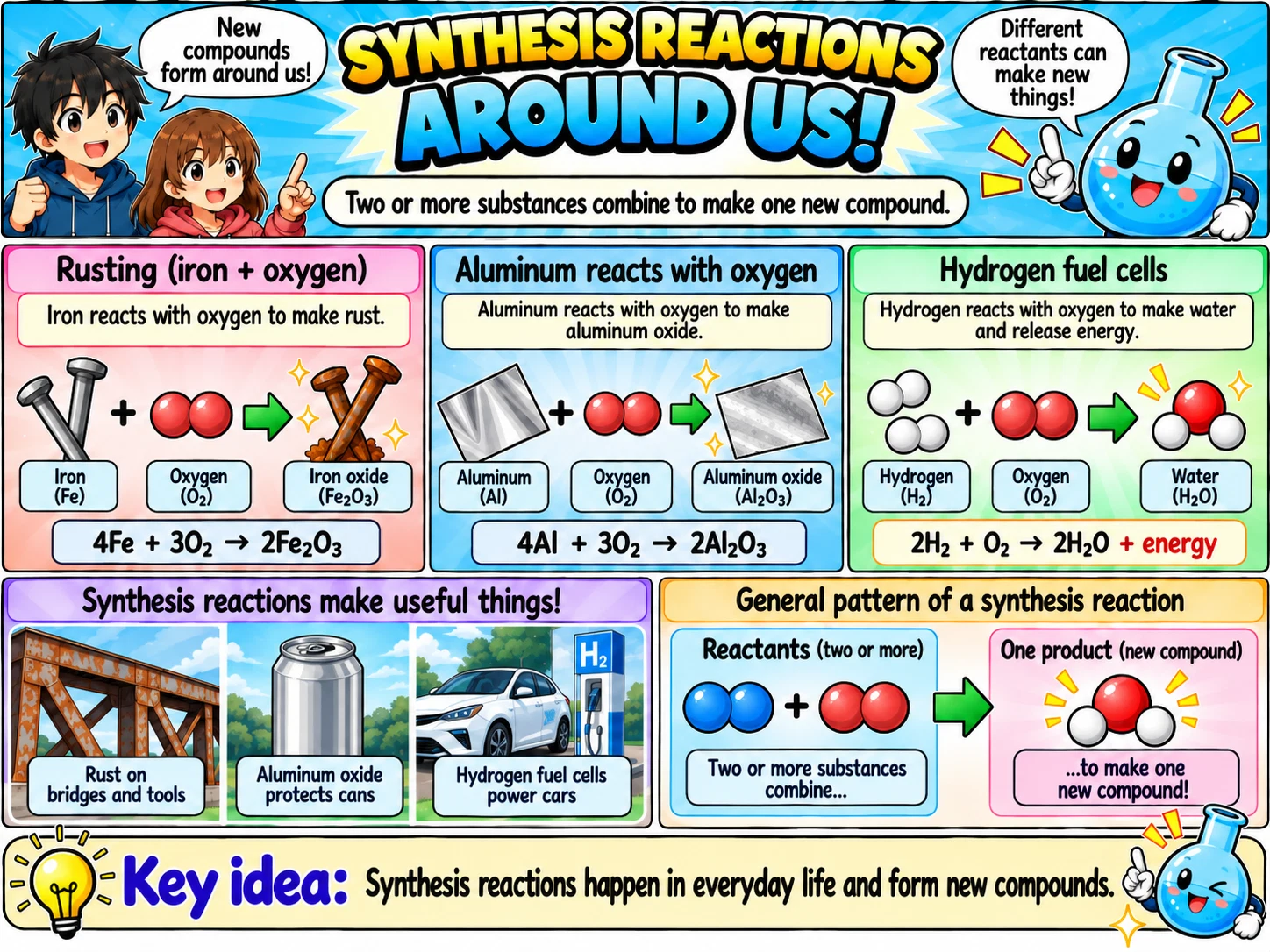
MOSAIC Chemistry Topic 2.4: Synthesis Reactions Around Us illustration from source PDF page 6
Original MOSAIC Chemistry visual · Topic 2.4, PDF page 6

Easy explanation

Synthesis reactions happen in many places.

Rusting

Iron combines with oxygen.

iron + oxygen → iron oxide

Iron oxide is rust.

Aluminum in air

Aluminum combines with oxygen.

aluminum + oxygen → aluminum oxide

The oxide forms a dull layer on the metal.

Hydrogen fuel cells

Hydrogen and oxygen combine to make water.

2H₂ + O₂ → 2H₂O

Energy from this reaction can be converted into electricity.

Big idea:

many reactants → one compound

Pages 8–9

Decomposition Reactions

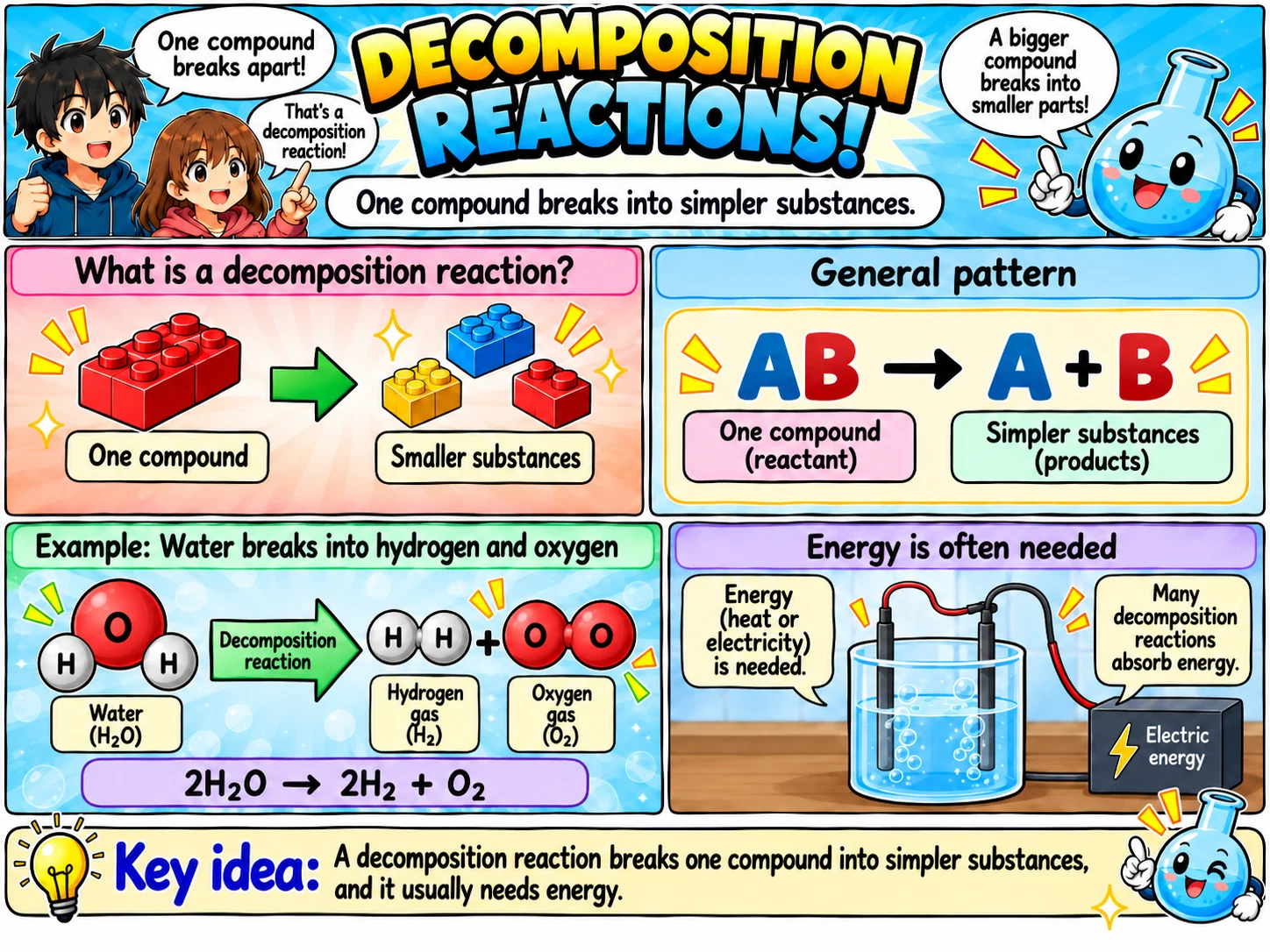
MOSAIC Chemistry Topic 2.4: Decomposition Reactions illustration from source PDF page 8
Original MOSAIC Chemistry visual · Topic 2.4, PDF page 8
VocabWhat it means
Decomposition reactionone compound breaks into two or more simpler substances

Easy explanation

Decomposition means breaking apart.

One compound is the reactant.

It breaks into smaller substances.

General pattern

AB → A + B

Think of taking apart a LEGO model.

one structure → separate pieces

Energy is often needed to break the bonds.

The energy can come from:

heat

electricity

or another source.

Most decomposition reactions are endothermic because they absorb energy overall.

Easy memory:

Decomposition = BREAK APART

Pages 10–11

Synthesis vs. Decomposition

MOSAIC Chemistry Topic 2.4: Synthesis vs. Decomposition illustration from source PDF page 10
Original MOSAIC Chemistry visual · Topic 2.4, PDF page 10
SynthesisDecomposition
substances join (Builds a more complex substance.)a substance breaks apart (Breaks a substance into simpler pieces.)
2 or more reactantsusually 1 reactant
usually 1 product2 or more products
A + B → ABAB → A + B

Easy explanation

These reactions are like opposites.

Synthesis

put together

A + B → AB

Decomposition

take apart

AB → A + B

Think of building and taking apart a toy.

build → synthesis

take apart → decomposition

Pages 12–13

Decomposition Reactions Around Us

MOSAIC Chemistry Topic 2.4: Decomposition Reactions Around Us illustration from source PDF page 12
Original MOSAIC Chemistry visual · Topic 2.4, PDF page 12

Easy explanation

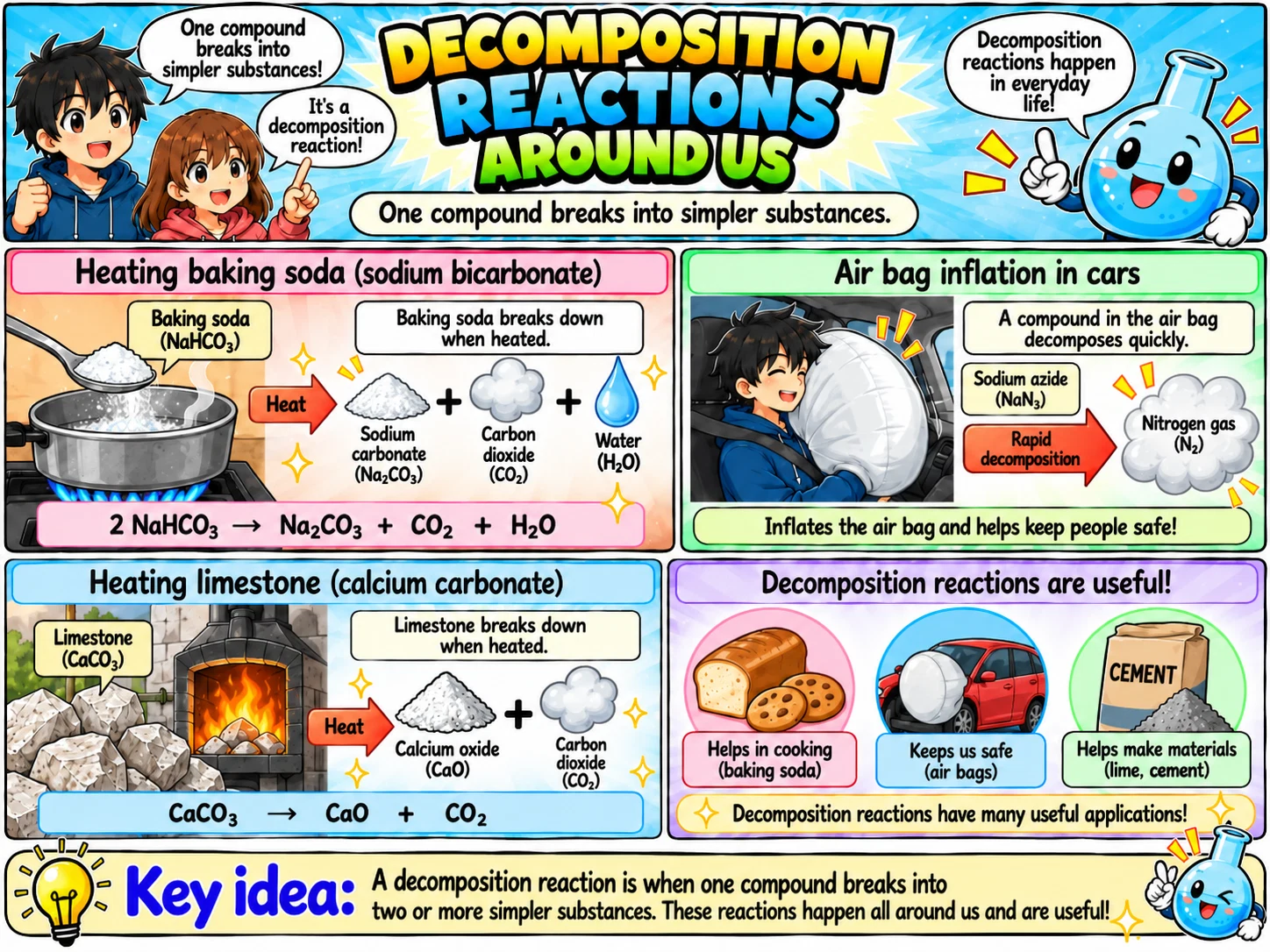
Decomposition reactions also have useful applications.

Baking soda

When baking soda is heated, it breaks down.

It produces:

sodium carbonate + water vapour + carbon dioxide

Air bags

Some air bags use a compound that decomposes very quickly.

The reaction produces nitrogen gas.

The gas fills the air bag.

Limestone

When calcium carbonate is heated:

CaCO₃ → CaO + CO₂

The calcium oxide produced can be used in cement.

Big idea:

one compound → simpler substances

Pages 14–15

Single Replacement Reactions

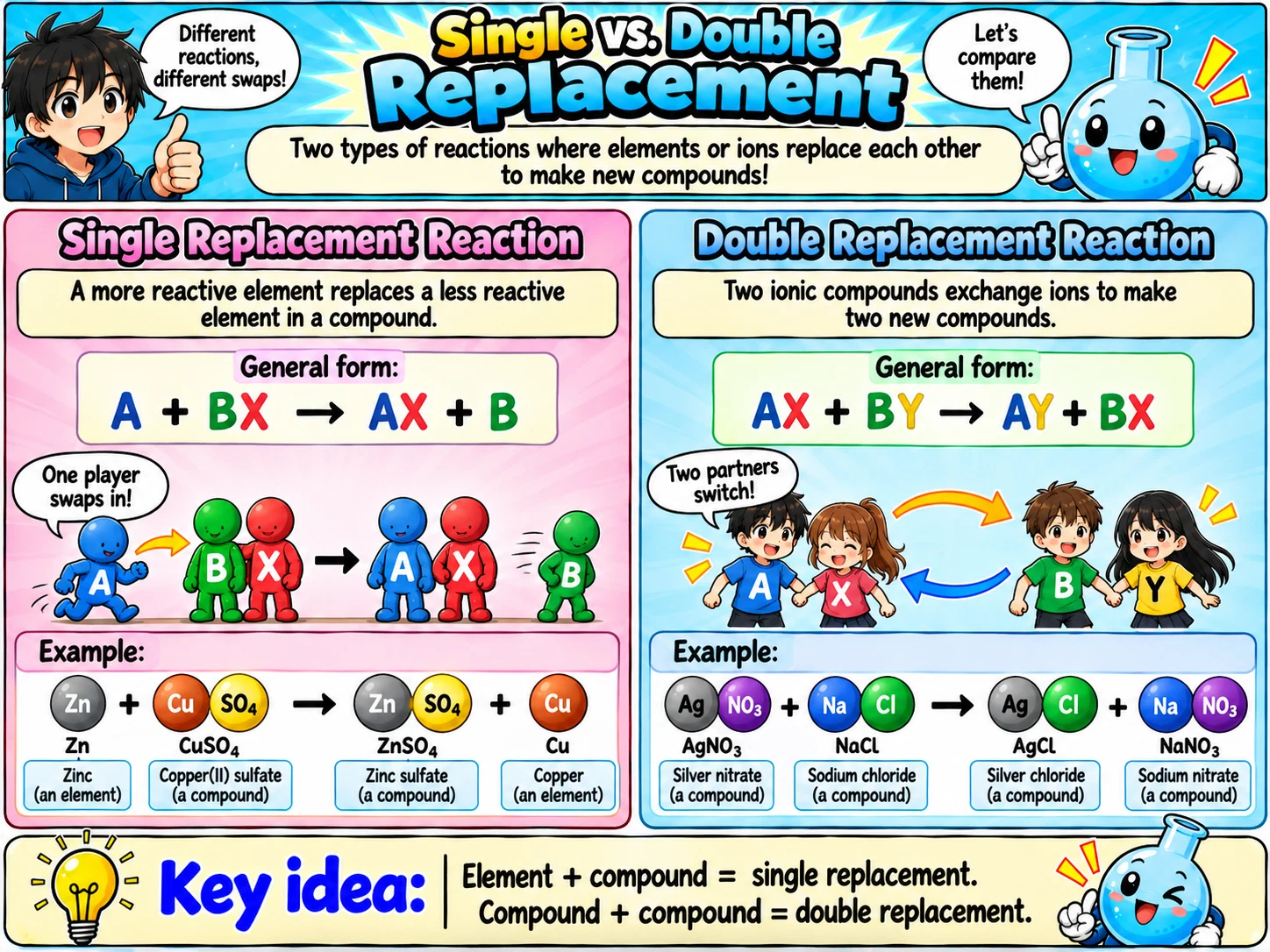
MOSAIC Chemistry Topic 2.4: Single Replacement Reactions illustration from source PDF page 14
Original MOSAIC Chemistry visual · Topic 2.4, PDF page 14
VocabWhat it means
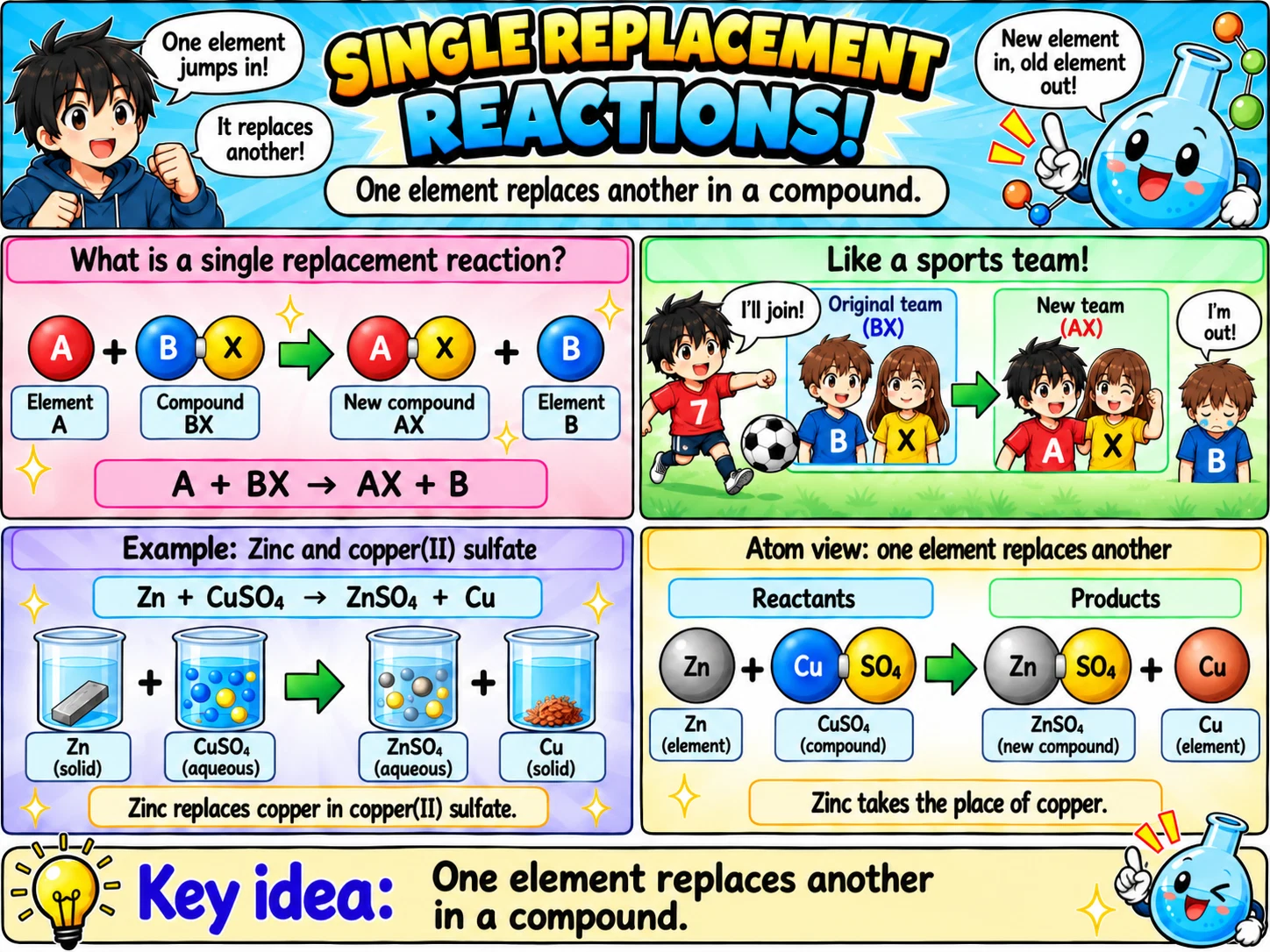
Single replacement reactionone element replaces another element in a compound

Easy explanation

Think of a sports team.

One player comes in.

Another player leaves.

That is similar to a single replacement reaction.

An element reacts with a compound.

The element replaces another element in the compound.

General pattern

A + BX → AX + B

One element switches places.

Easy memory:

Single replacement = ONE SWITCH

Pages 16–17

A Metal Can Replace a Metal

MOSAIC Chemistry Topic 2.4: A Metal Can Replace a Metal illustration from source PDF page 16
Original MOSAIC Chemistry visual · Topic 2.4, PDF page 16

Easy explanation

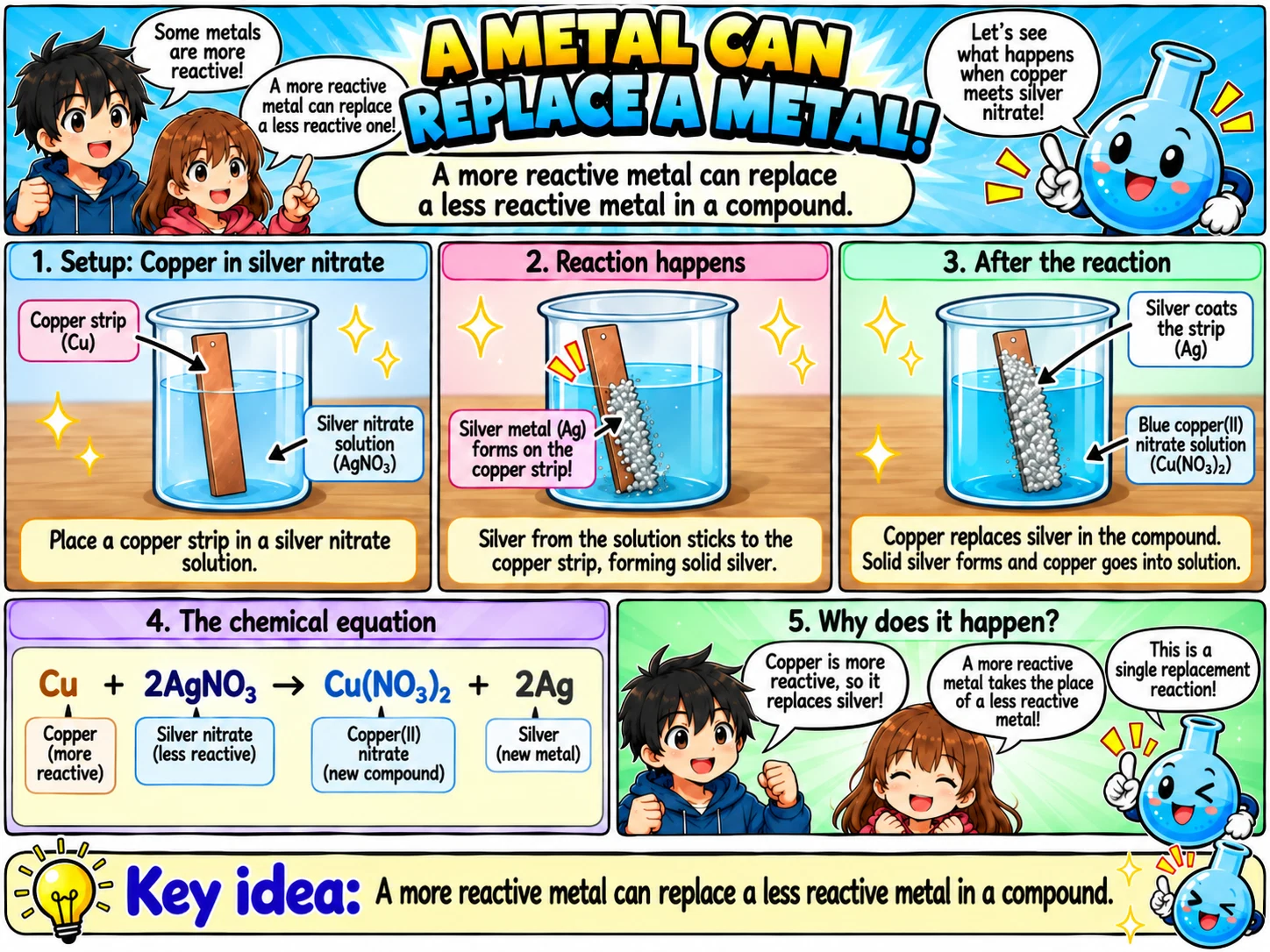
A metal can sometimes replace another metal in a compound.

Example

Copper reacts with silver nitrate.

Cu + 2AgNO₃ → Cu(NO₃)₂ + 2Ag

Copper takes the place of silver.

Think of it like changing one player on a team.

Before:

silver is in the compound

After:

copper is in the compound

and silver is by itself.

Page 18

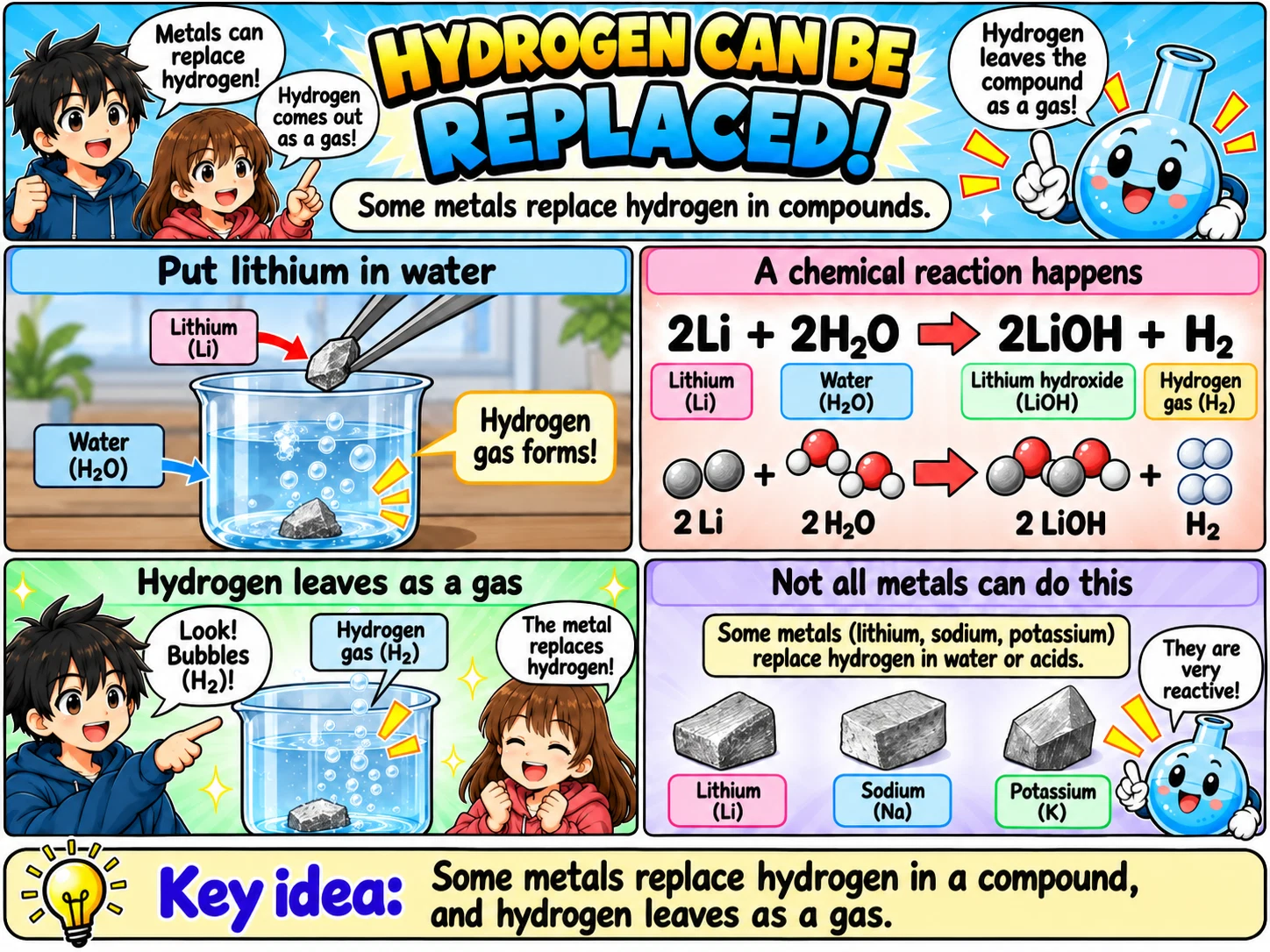
Hydrogen Can Be Replaced

MOSAIC Chemistry Topic 2.4: Hydrogen Can Be Replaced illustration from source PDF page 18
Original MOSAIC Chemistry visual · Topic 2.4, PDF page 18

Easy explanation

In some single replacement reactions, a metal can replace hydrogen.

Example

Lithium reacts with water.

2Li + 2H₂O → 2LiOH + H₂

Lithium replaces hydrogen.

Hydrogen leaves as hydrogen gas.

Gas bubbles can be evidence that a chemical reaction happened.

Page 19

A Non-Metal Can Replace a Non-Metal

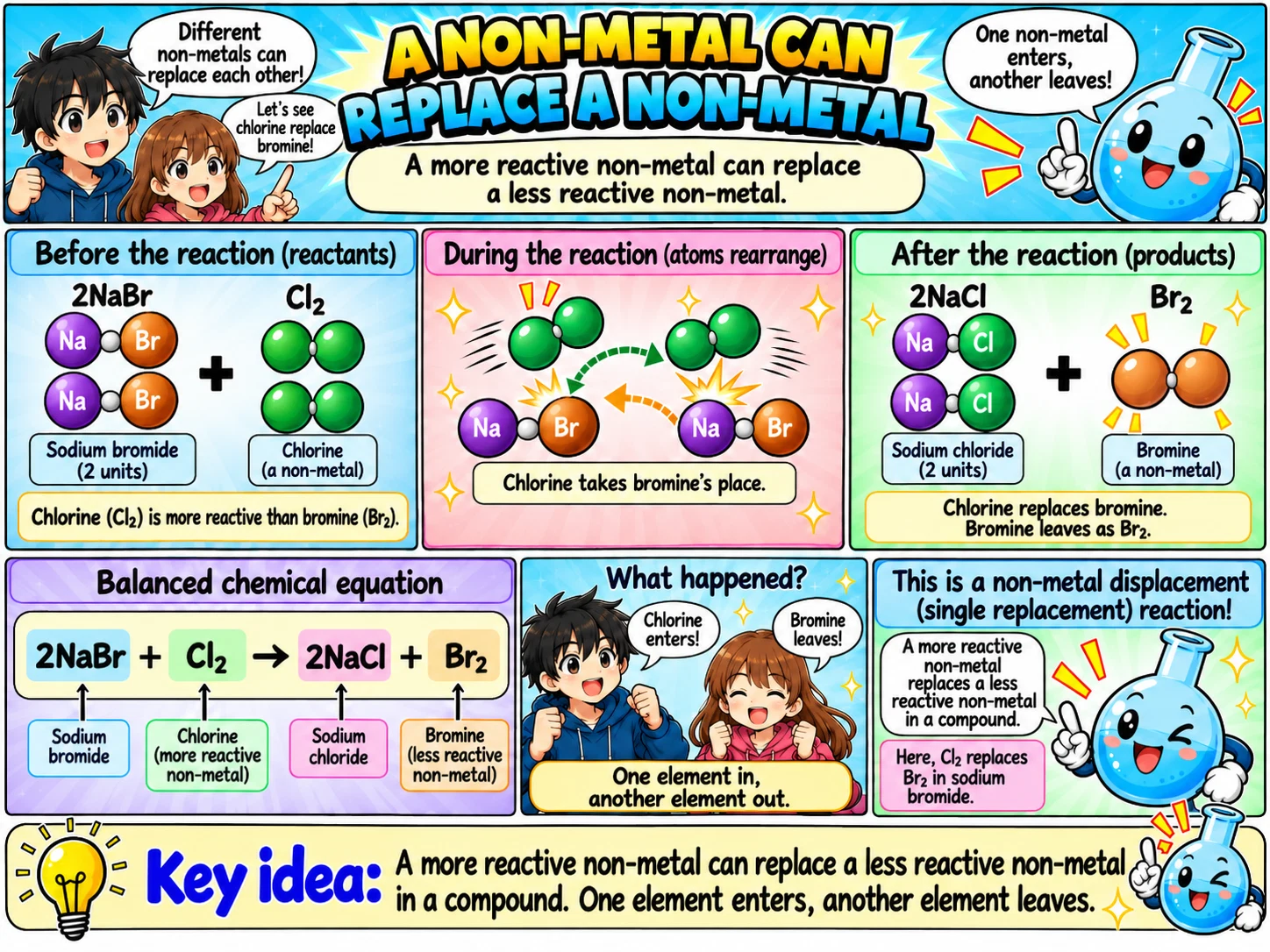
MOSAIC Chemistry Topic 2.4: A Non-Metal Can Replace a Non-Metal illustration from source PDF page 19
Original MOSAIC Chemistry visual · Topic 2.4, PDF page 19

Easy explanation

Non-metals can also replace other non-metals.

Example

Chlorine reacts with sodium bromide.

2NaBr + Cl₂ → 2NaCl + Br₂

Chlorine replaces bromine.

one element enters

and

one element leaves

That is still a single replacement reaction.

Pages 20–21

Double Replacement Reactions

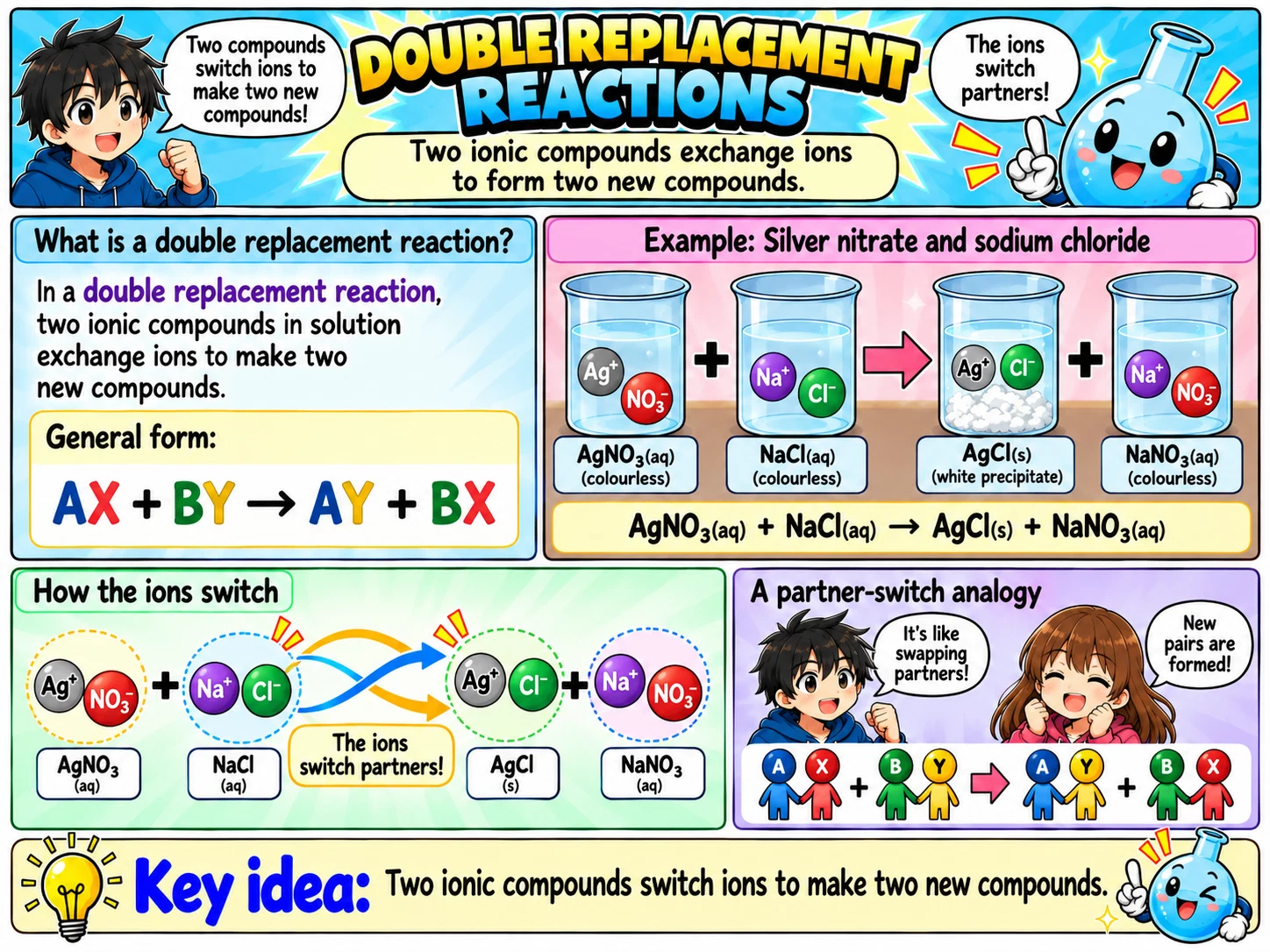
MOSAIC Chemistry Topic 2.4: Double Replacement Reactions illustration from source PDF page 20
Original MOSAIC Chemistry visual · Topic 2.4, PDF page 20
VocabWhat it means
Double replacement reactiontwo ionic compounds exchange ions to make two new compounds

Easy explanation

In a double replacement reaction:

two compounds switch partners.

Think of two dancing couples.

They switch partners.

General pattern

AX + BY → AY + BX

The positive ions change partners with the negative ions.

These reactions usually happen when ionic compounds are dissolved in water.

Easy memory:

Double replacement = TWO PARTNERS SWITCH

Pages 22–23

A Solid Can Form

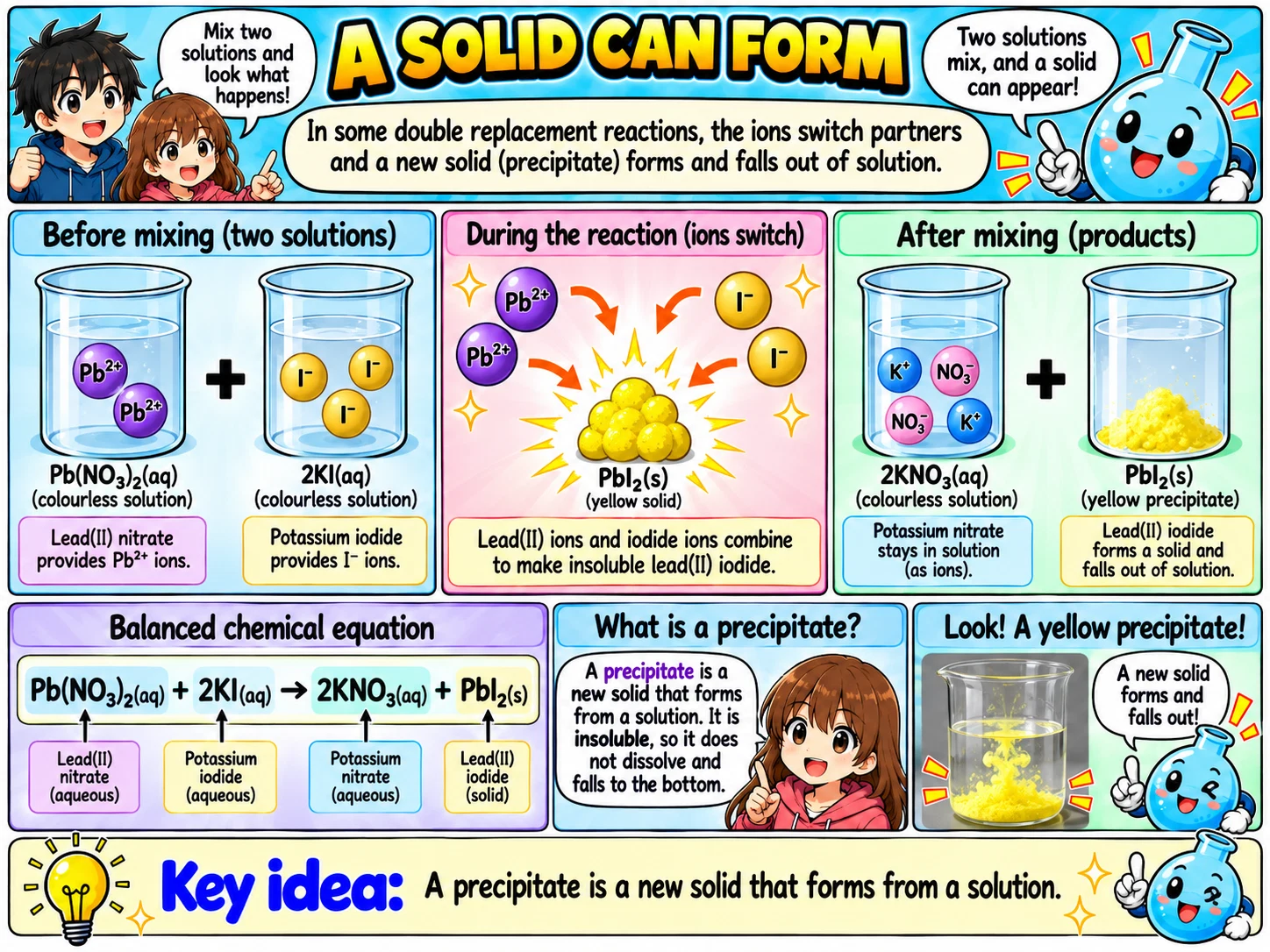
MOSAIC Chemistry Topic 2.4: A Solid Can Form illustration from source PDF page 22
Original MOSAIC Chemistry visual · Topic 2.4, PDF page 22
VocabWhat it means
Precipitatea solid that forms from substances dissolved in a solution

Easy explanation

A common sign of a double replacement reaction is a new solid.

This solid is called a precipitate.

Example

Lead(II) nitrate reacts with potassium iodide.

A bright yellow solid forms.

That solid is lead(II) iodide.

Pb(NO₃)₂ + 2KI → 2KNO₃ + PbI₂

Think of particles floating in water.

After they switch partners, some particles stick together and fall out as a solid.

Pages 24–25

Single vs. Double Replacement

MOSAIC Chemistry Topic 2.4: Single vs. Double Replacement illustration from source PDF page 24
Original MOSAIC Chemistry visual · Topic 2.4, PDF page 24
Single replacementDouble replacement
one element + one compoundtwo compounds
one element replaces anotherions switch partners
A + BX → AX + BAX + BY → AY + BX
one switchtwo-partner switch

Easy explanation

Look at the reactants first.

Element + compound

Usually:

single replacement

Compound + compound

Usually:

double replacement

Pages 26–27

Combustion Reactions

MOSAIC Chemistry Topic 2.4: Combustion Reactions illustration from source PDF page 26
Original MOSAIC Chemistry visual · Topic 2.4, PDF page 26
VocabWhat it means
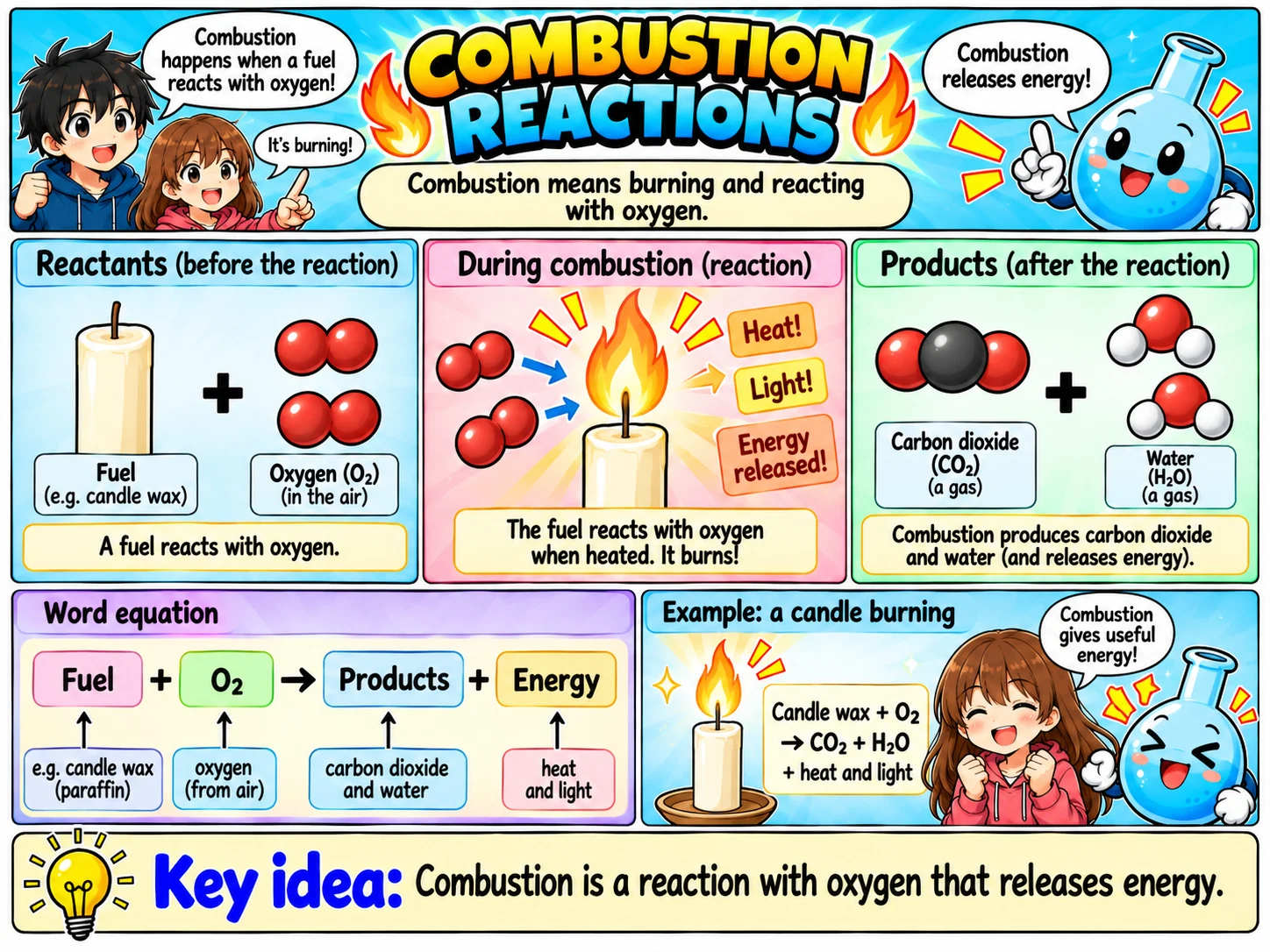
Combustion reactiona reaction in which a substance reacts with oxygen

Easy explanation

Combustion means burning.

A substance reacts with oxygen.

Many combustion reactions release:

heat and light

That is why we often see a flame.

Example

A hydrocarbon burns in oxygen.

hydrocarbon + oxygen → carbon dioxide + water

The textbook notes that combustion reactions involving fuels such as natural gas, gasoline, and propane commonly produce heat and light.

Easy memory:

Combustion = oxygen + burning

Pages 28–29

Hydrocarbon Combustion

MOSAIC Chemistry Topic 2.4: Hydrocarbon Combustion illustration from source PDF page 28
Original MOSAIC Chemistry visual · Topic 2.4, PDF page 28
VocabWhat it means
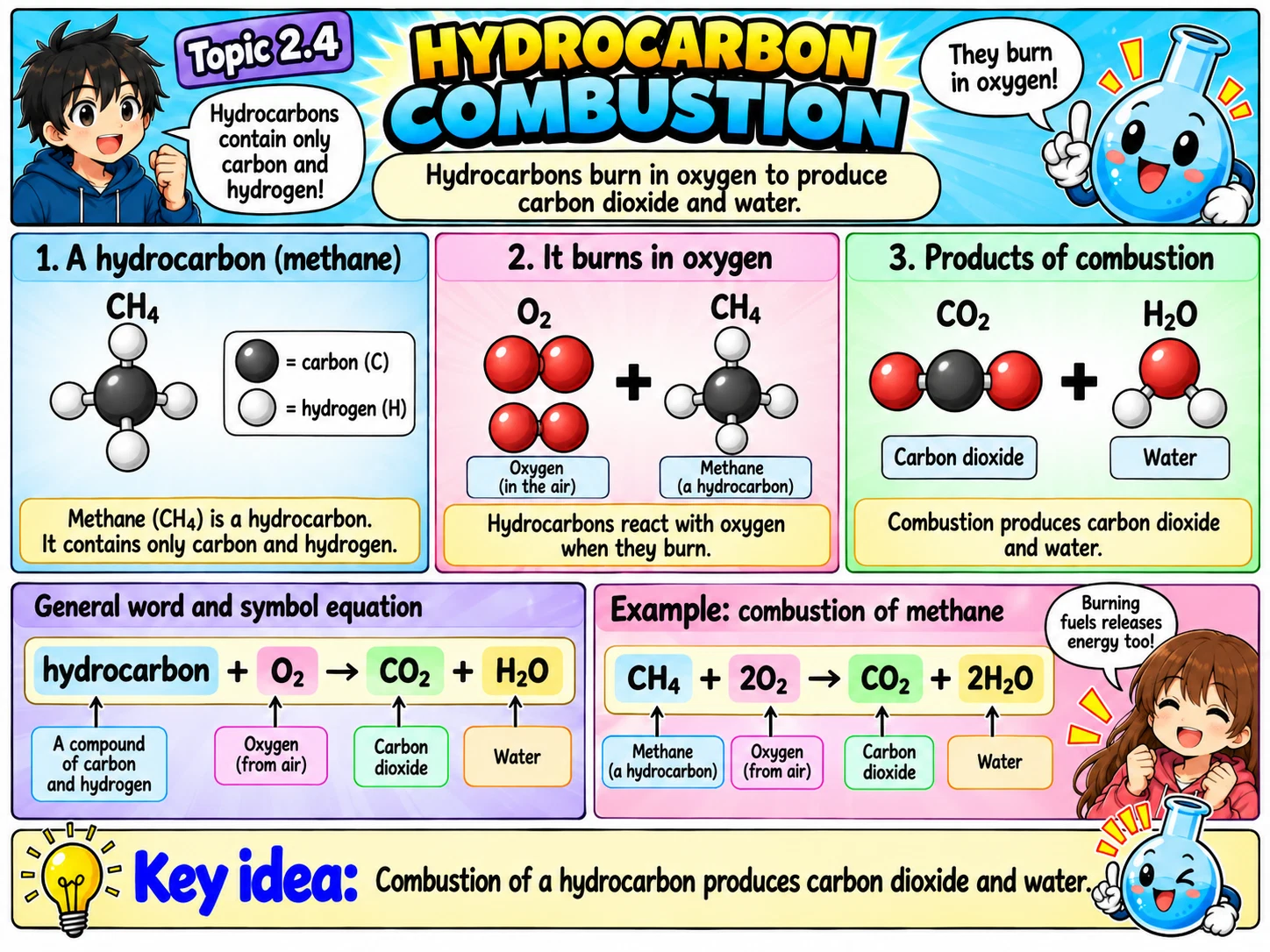
Hydrocarbona compound containing only carbon and hydrogen

Easy explanation

Many fuels are hydrocarbons.

Examples include:

methane

propane

components of gasoline

When a hydrocarbon burns completely:

hydrocarbon + O₂ → CO₂ + H₂O

Example: methane

CH₄ + 2O₂ → CO₂ + 2H₂O

Example: propane

C₃H₈ + 5O₂ → 3CO₂ + 4H₂O

These reactions release energy.

That energy can be used for:

cooking

heating

transportation

Pages 30–31

Complete and Incomplete Combustion

MOSAIC Chemistry Topic 2.4: Complete and Incomplete Combustion illustration from source PDF page 30
Original MOSAIC Chemistry visual · Topic 2.4, PDF page 30

Easy explanation

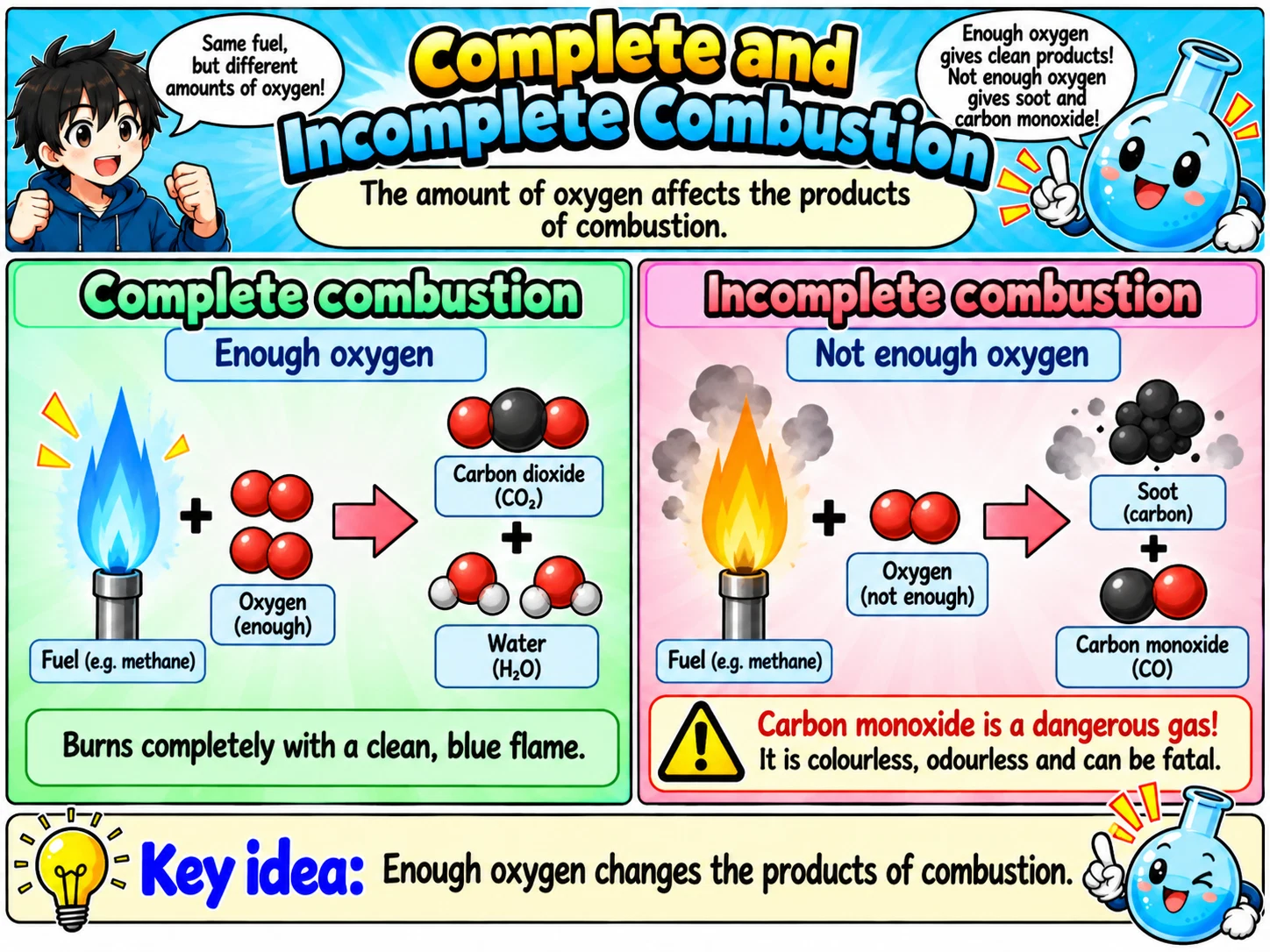
Combustion needs oxygen.

Enough oxygen

The fuel can undergo complete combustion.

For hydrocarbons, the main products are:

carbon dioxide + water

Not enough oxygen

Incomplete combustion can occur.

It may produce:

carbon dioxide

water

carbon / soot

and

carbon monoxide

Carbon monoxide is a colourless, odourless, highly toxic gas.

This is why fuel-burning equipment needs good ventilation.

Easy memory:

less oxygen → incomplete combustion

Pages 32–33

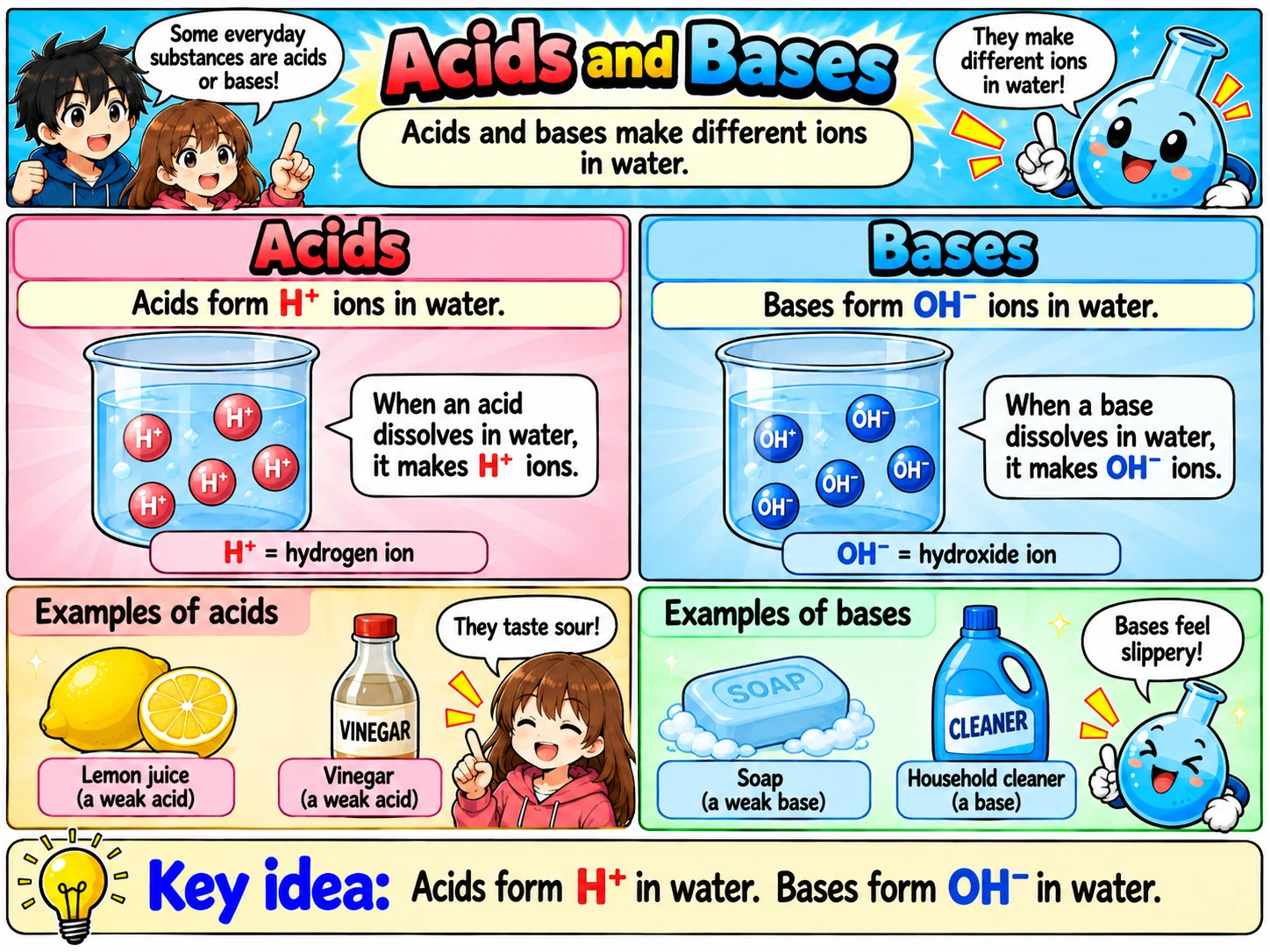
Acids and Bases

MOSAIC Chemistry Topic 2.4: Acids and Bases illustration from source PDF page 32
Original MOSAIC Chemistry visual · Topic 2.4, PDF page 32
VocabWhat it means
Acida substance that forms H⁺ ions in water
Basea substance that forms OH⁻ ions in water

Easy explanation

Many everyday substances are acids or bases.

Acids

Acids form H⁺ ions in water.

Examples include:

lemon juice

vinegar

stomach acid

Acids often taste sour.

Bases

Bases form OH⁻ ions in water.

Examples include:

soap

some cleaners

Milk of Magnesia

Bases can feel slippery.

Easy memory:

Acid → H⁺

Base → OH⁻

Pages 34–35

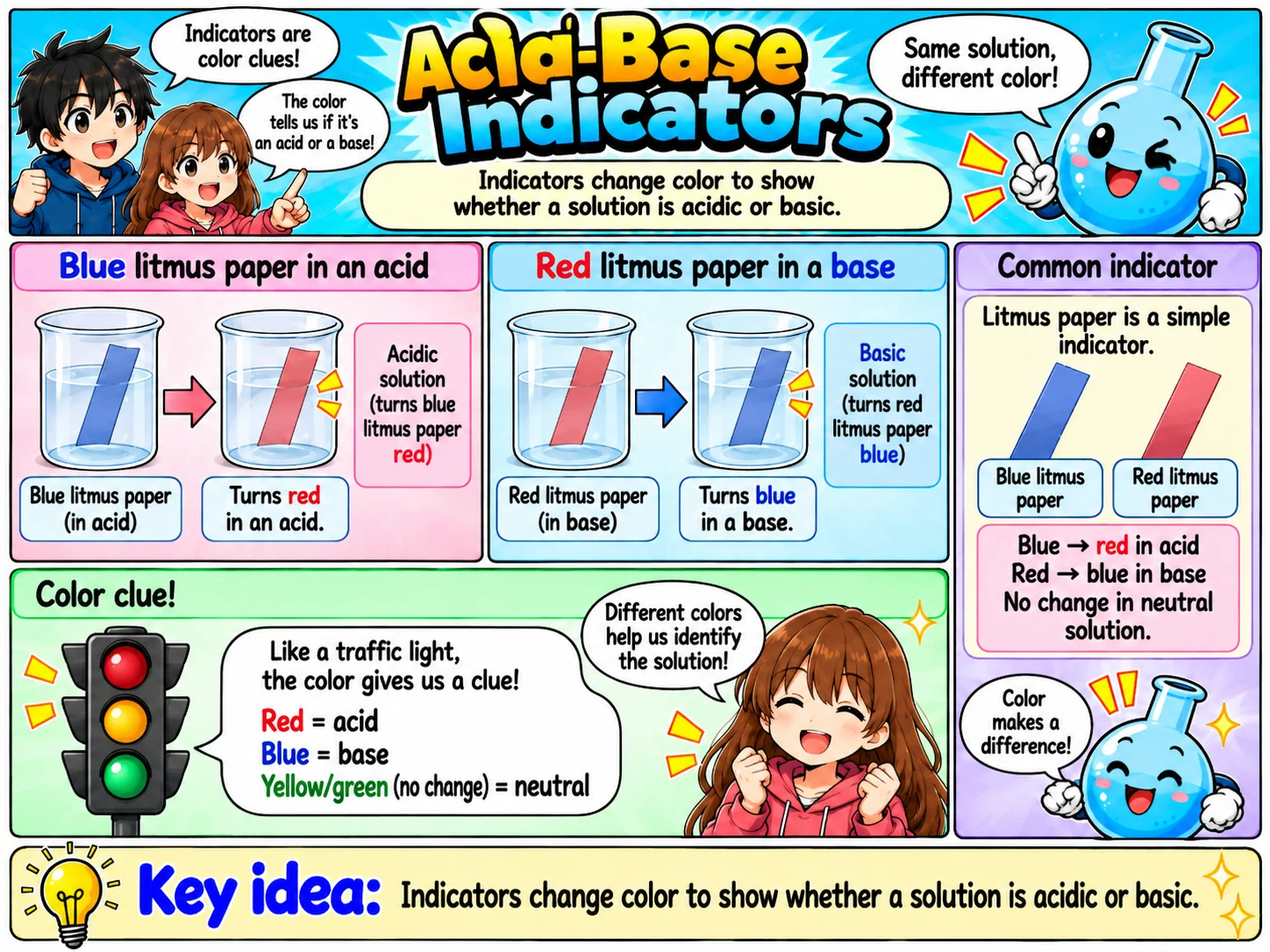
Acid-Base Indicators

MOSAIC Chemistry Topic 2.4: Acid-Base Indicators illustration from source PDF page 34
Original MOSAIC Chemistry visual · Topic 2.4, PDF page 34
VocabWhat it means
Acid-base indicatora chemical that changes colour depending on acidity or basicity

Easy explanation

Many acid and base solutions look colourless.

So how can we tell them apart?

We can use an indicator.

An indicator changes colour.

Litmus paper

blue litmus + acid → red

red litmus + base → blue

Pure water does not cause these changes because it is neutral.

Think of an indicator like a chemical traffic light.

Its colour gives us information about the solution.

Pages 36–37

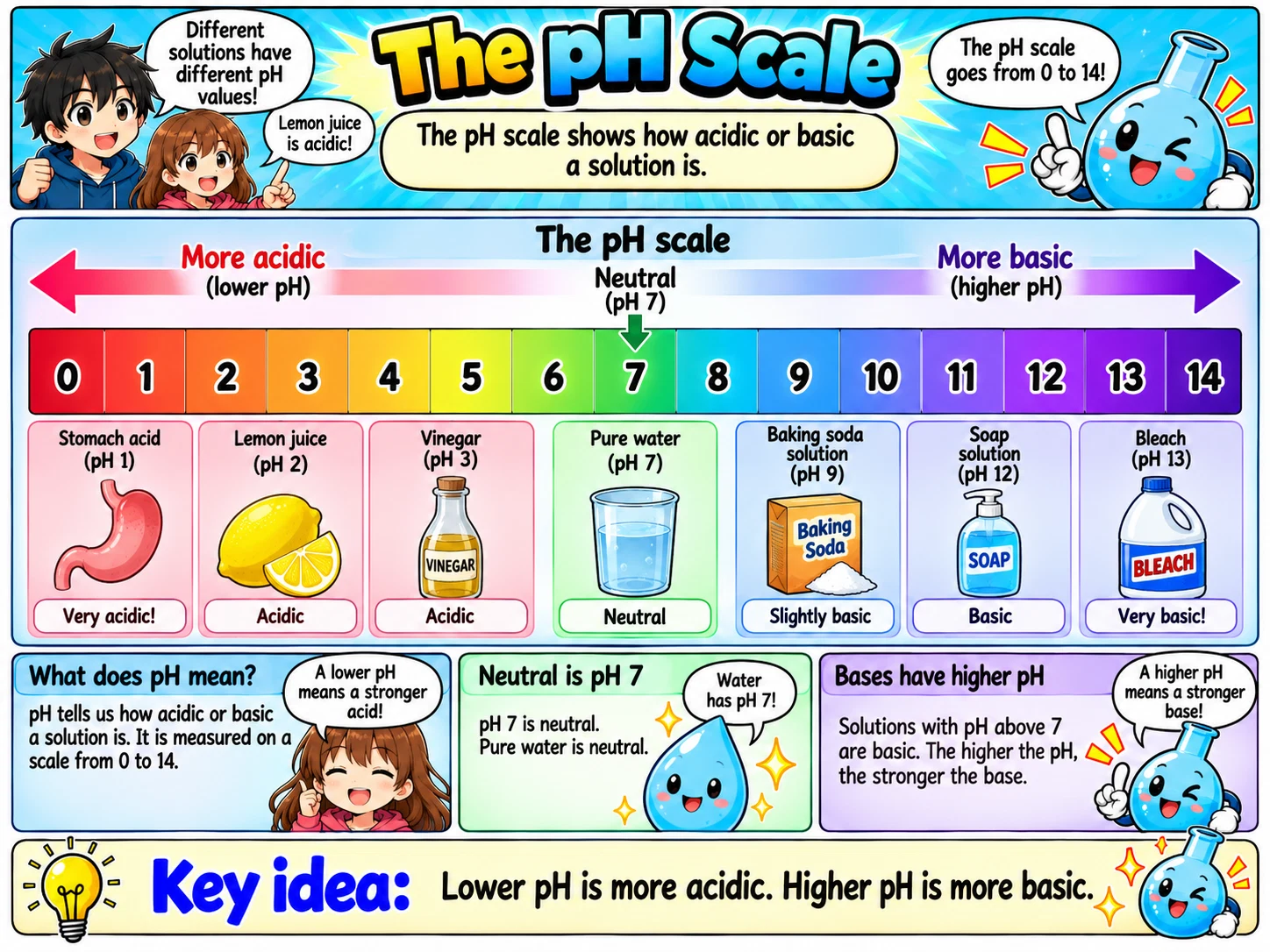
The pH Scale

MOSAIC Chemistry Topic 2.4: The pH Scale illustration from source PDF page 36
Original MOSAIC Chemistry visual · Topic 2.4, PDF page 36
VocabWhat it means
pH scalea scale from 0 to 14 showing how acidic or basic a solution is

Easy explanation

The pH scale usually goes from:

0 → 14

Acidic

pH < 7

The lower the pH:

the more acidic the solution.

Neutral

pH = 7

Pure water is neutral.

Basic

pH > 7

The higher the pH:

the more basic the solution.

Easy memory

0 — ACID — 7 — BASE — 14

Pages 38–39

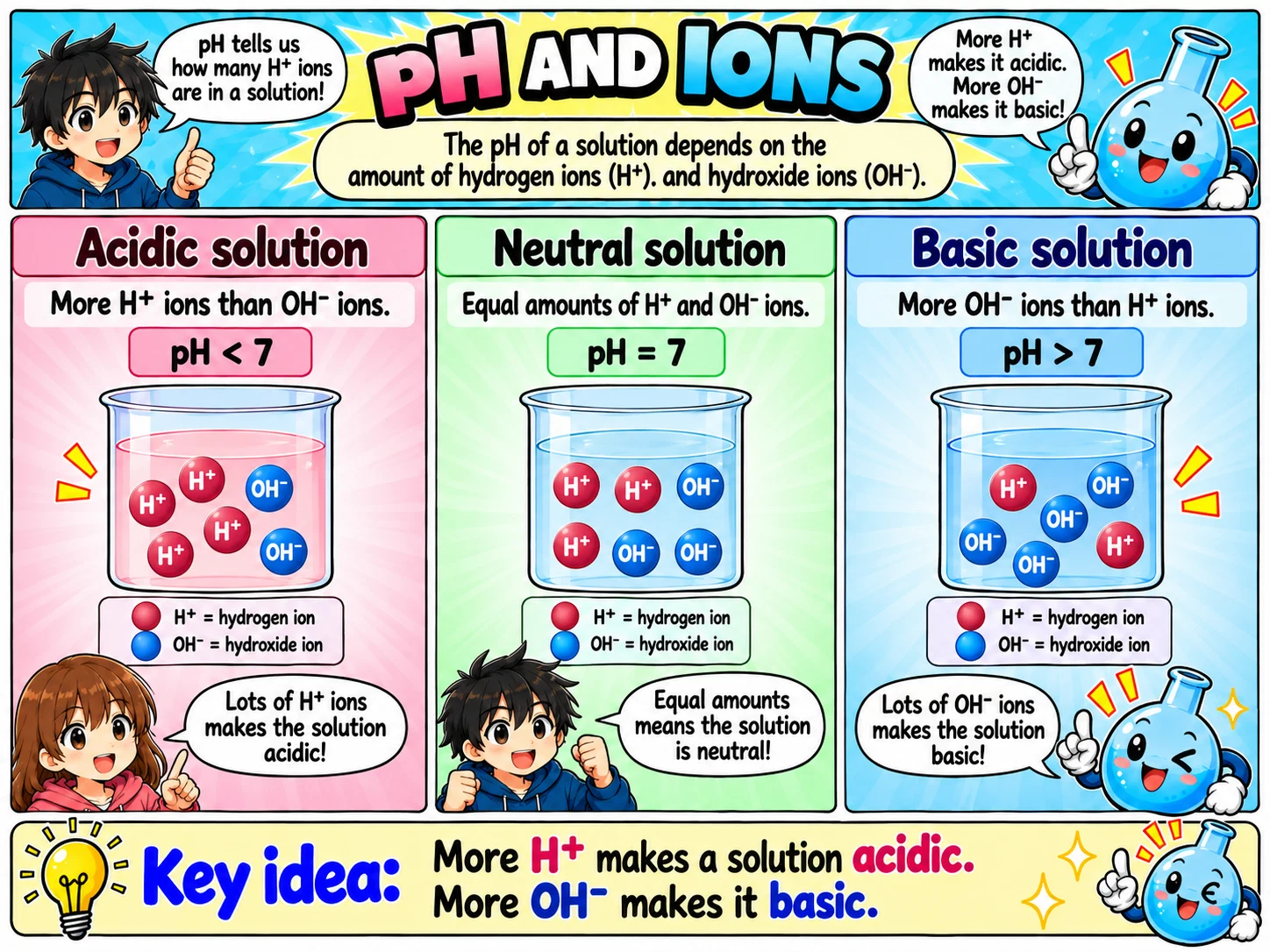
pH and Ions

MOSAIC Chemistry Topic 2.4: pH and Ions illustration from source PDF page 38
Original MOSAIC Chemistry visual · Topic 2.4, PDF page 38

Easy explanation

The pH scale is connected to ions.

Acidic solution

More:

H⁺ ions

than OH⁻ ions.

Neutral solution

Equal amounts of:

H⁺ and OH⁻

Basic solution

More:

OH⁻ ions

than H⁺ ions.

So:

more H⁺ → acidic

more OH⁻ → basic

The textbook also explains that a change of one pH unit represents a tenfold change in H⁺ concentration.

Pages 40–41

Neutralization Reactions

MOSAIC Chemistry Topic 2.4: Neutralization Reactions illustration from source PDF page 40
Original MOSAIC Chemistry visual · Topic 2.4, PDF page 40
VocabWhat it means
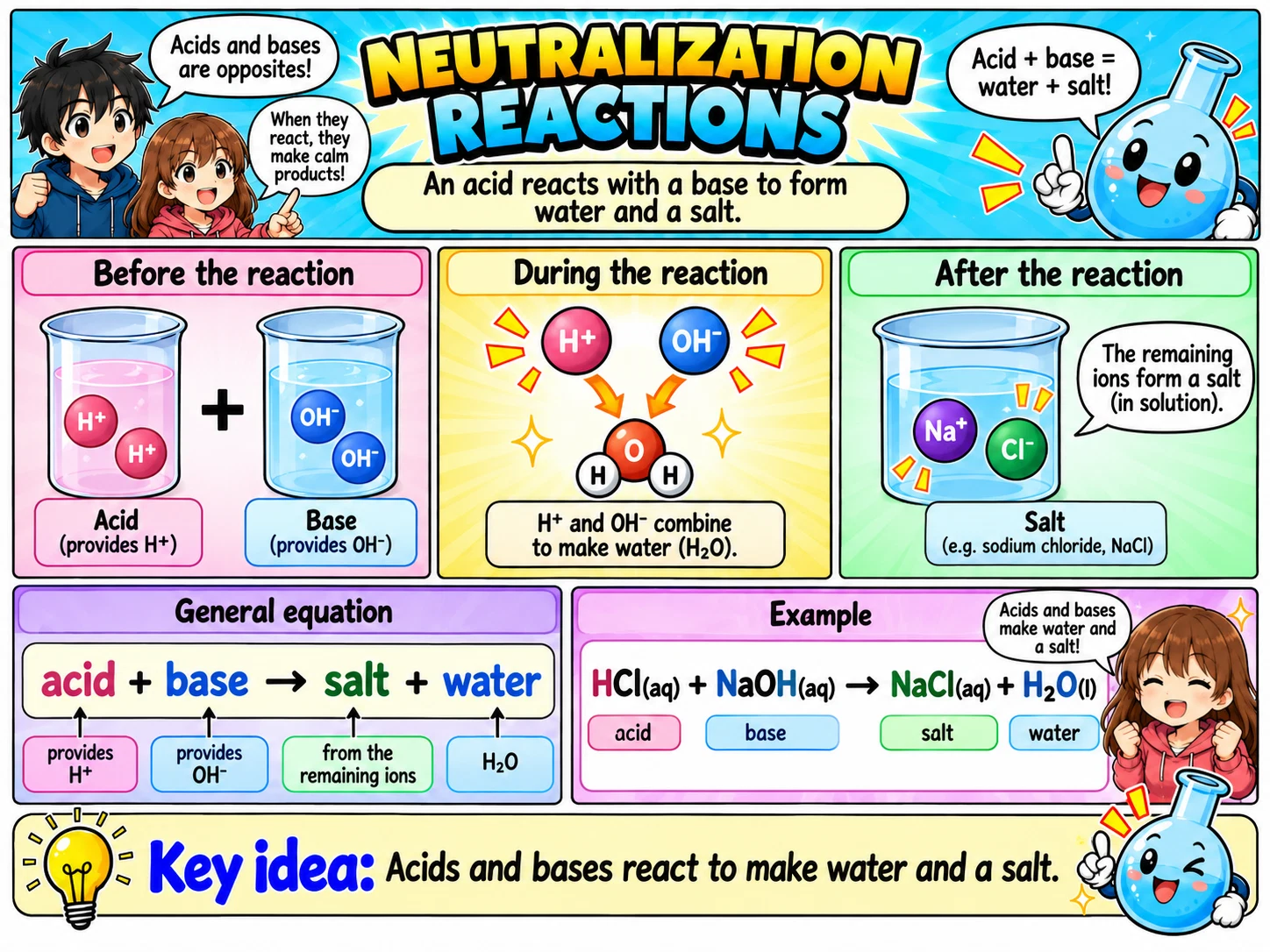
Neutralization reactiona reaction in which an acid reacts with a base to form water and a salt

Easy explanation

An acid and a base can react together.

This is called neutralization.

General pattern

acid + base → salt + water

Think of acid and base as two opposites balancing each other.

The acid provides:

H⁺

The base provides:

OH⁻

These combine:

H⁺ + OH⁻ → H₂O

The remaining ions form a salt.

Neutralization is also a type of double replacement reaction because the ions switch partners.

Pages 42–43

Example of Neutralization

MOSAIC Chemistry Topic 2.4: Example of Neutralization illustration from source PDF page 42
Original MOSAIC Chemistry visual · Topic 2.4, PDF page 42

Easy explanation

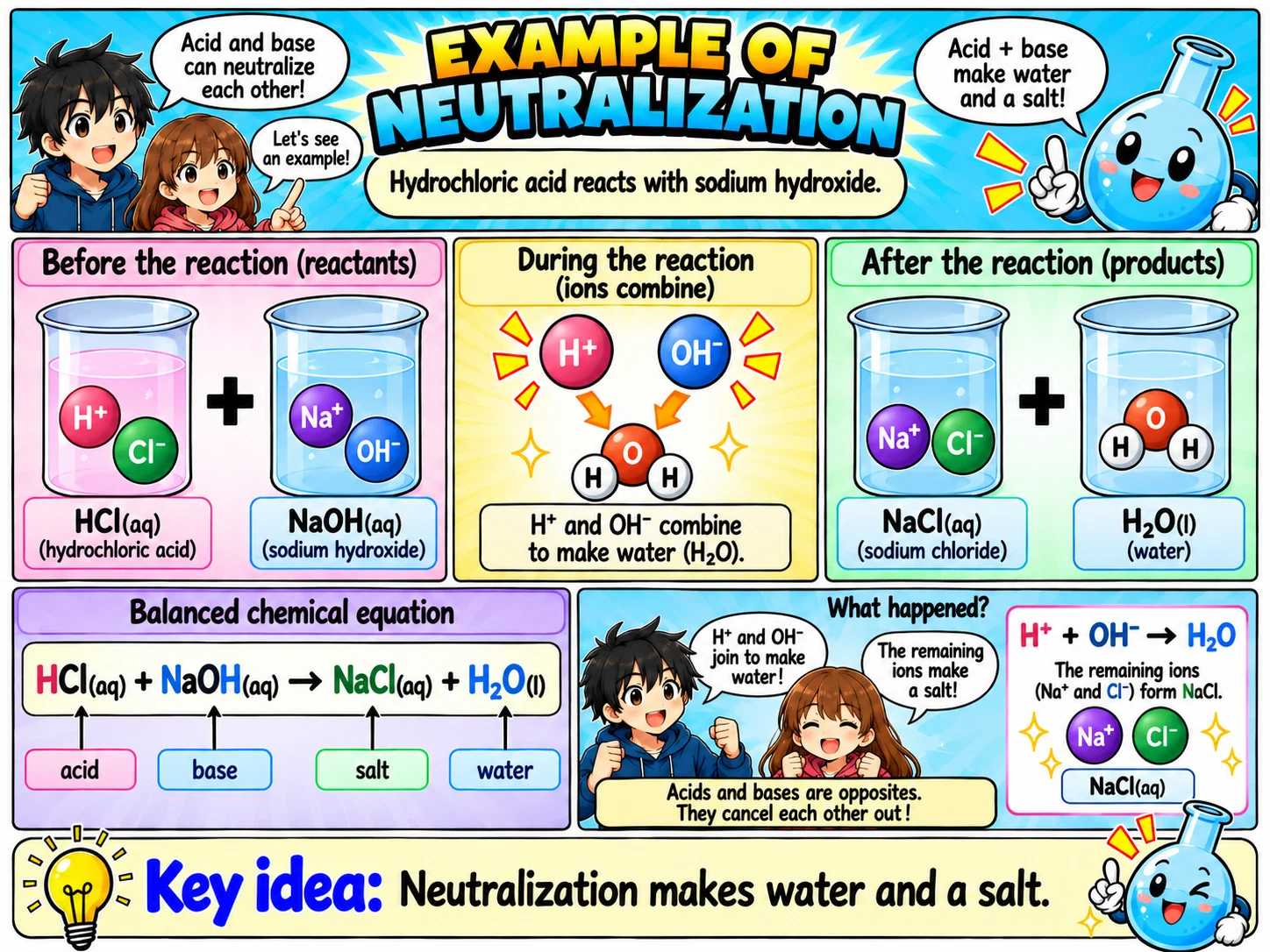
Hydrochloric acid can react with sodium hydroxide.

HCl + NaOH → NaCl + H₂O

What happens?

HCl provides:

H⁺

NaOH provides:

OH⁻

They combine to make:

H₂O

The other ions make:

NaCl

So:

acid + base → salt + water

As neutralization happens, the pH moves toward 7.

Page 44

Neutralization and Energy

MOSAIC Chemistry Topic 2.4: Neutralization and Energy illustration from source PDF page 44
Original MOSAIC Chemistry visual · Topic 2.4, PDF page 44

Easy explanation

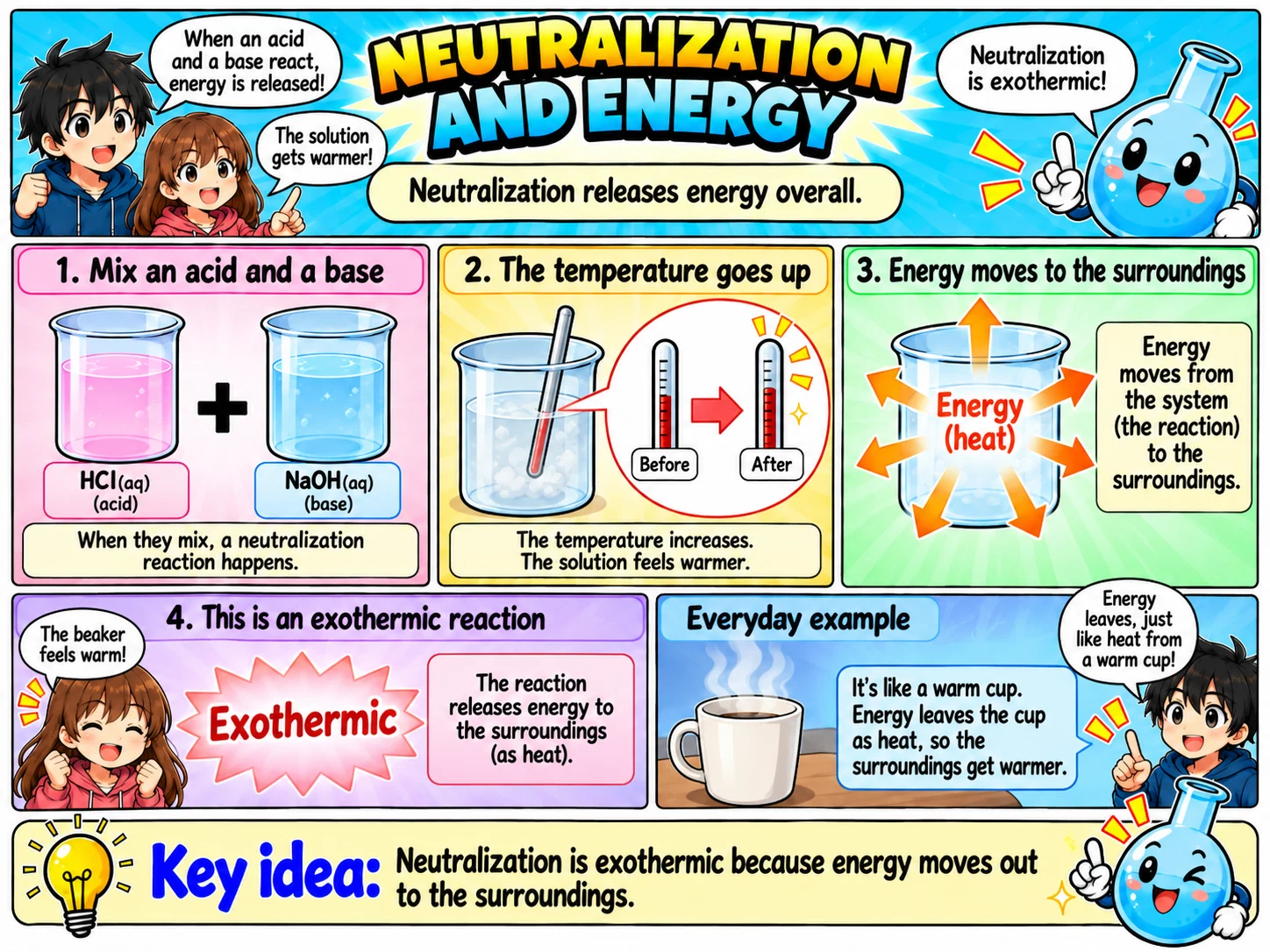
Neutralization reactions also involve energy.

According to the textbook, neutralization reactions have a net transfer of energy:

system → surroundings

That means they are exothermic.

So the surroundings may get warmer.

Easy connection to Topic 2.3:

energy out → exothermic

Pages 45–46

Neutralization in Everyday Life

MOSAIC Chemistry Topic 2.4: Neutralization in Everyday Life illustration from source PDF page 45
Original MOSAIC Chemistry visual · Topic 2.4, PDF page 45

Easy explanation

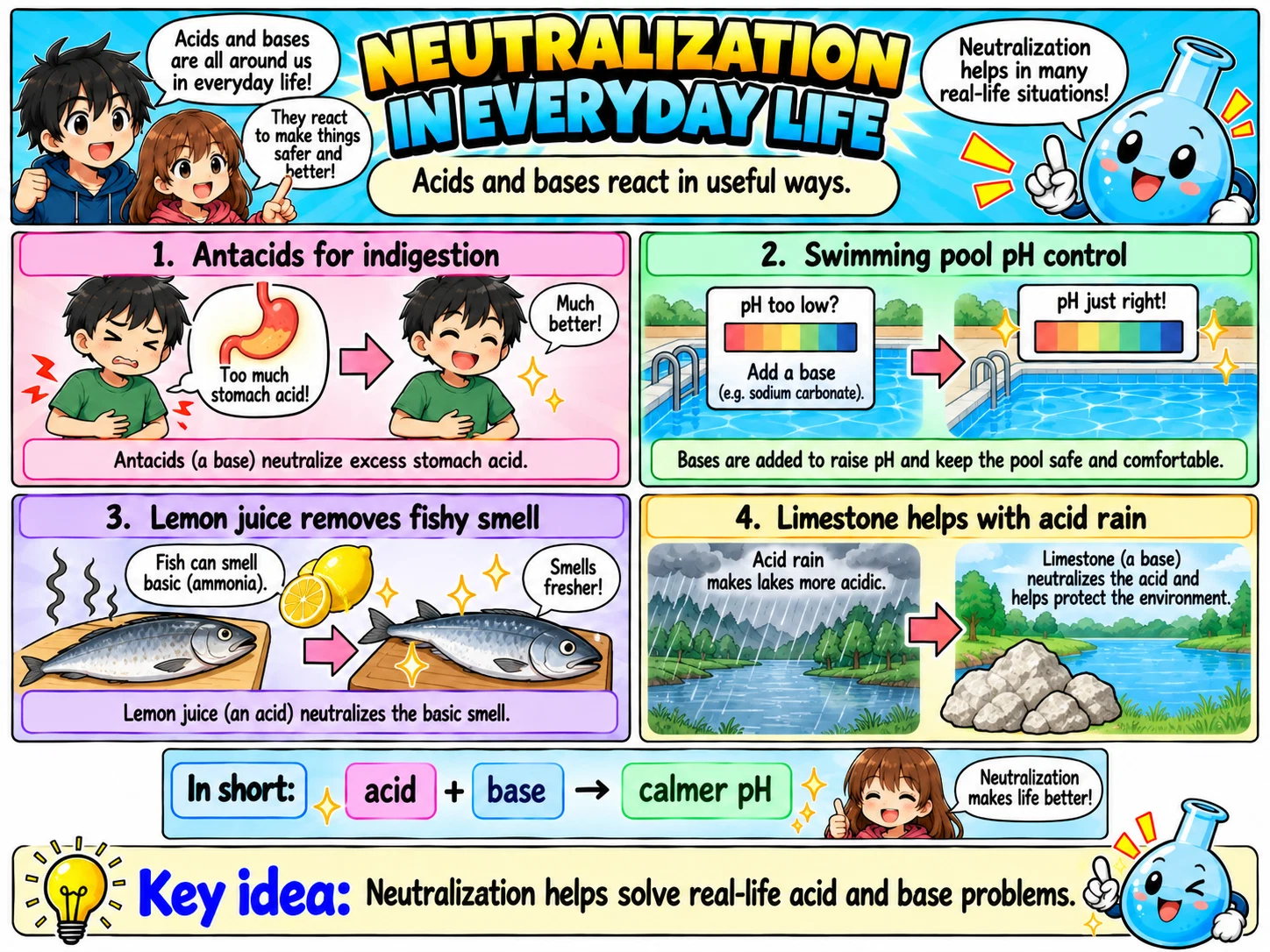
Neutralization happens outside the laboratory too.

Antacids

Stomach acid can cause discomfort.

Basic compounds in antacids react with some of the acid.

Pools and aquariums

Chemicals can be added to adjust pH.

Fish odours

Some fishy-smelling substances are basic.

Acid in lemon juice can react with them.

Acid precipitation

Crushed limestone can be added to affected environments to help raise the pH.

These are all examples of acids and bases reacting in useful ways.

Pages 47–48

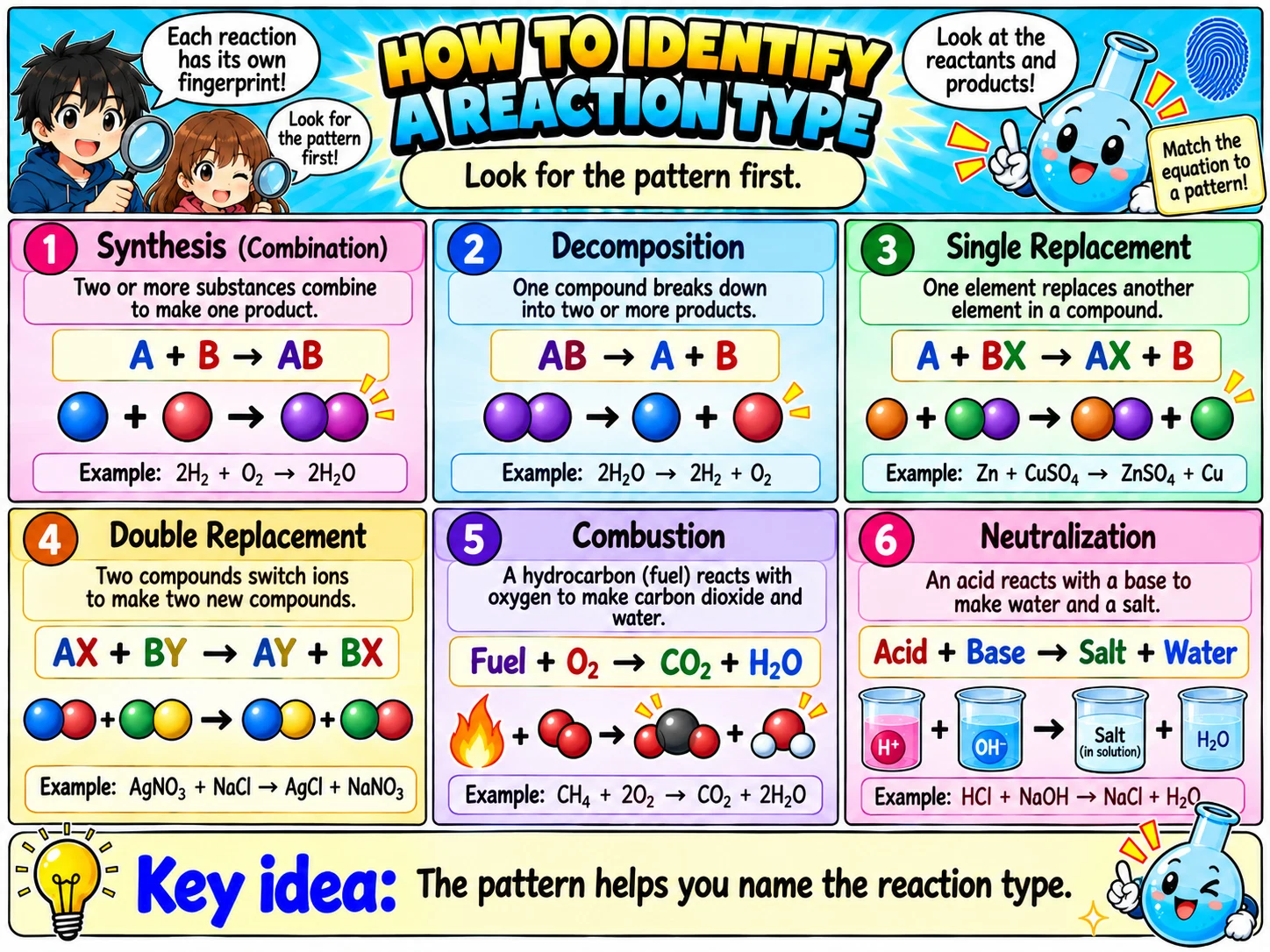
How to Identify a Reaction Type

MOSAIC Chemistry Topic 2.4: How to Identify a Reaction Type illustration from source PDF page 47
Original MOSAIC Chemistry visual · Topic 2.4, PDF page 47

Easy explanation

Look at the pattern of the reactants and products.

Synthesis

A + B → AB

Many things join.

→ one product

Decomposition

AB → A + B

One compound breaks apart.

→ many products

Single replacement

A + BX → AX + B

One element replaces another.

Double replacement

AX + BY → AY + BX

Two compounds switch ions.

Combustion

A substance reacts with:

O₂

Often produces heat and light.

For hydrocarbons:

hydrocarbon + O₂ → CO₂ + H₂O

Neutralization

acid + base → salt + water

Pages 49–50

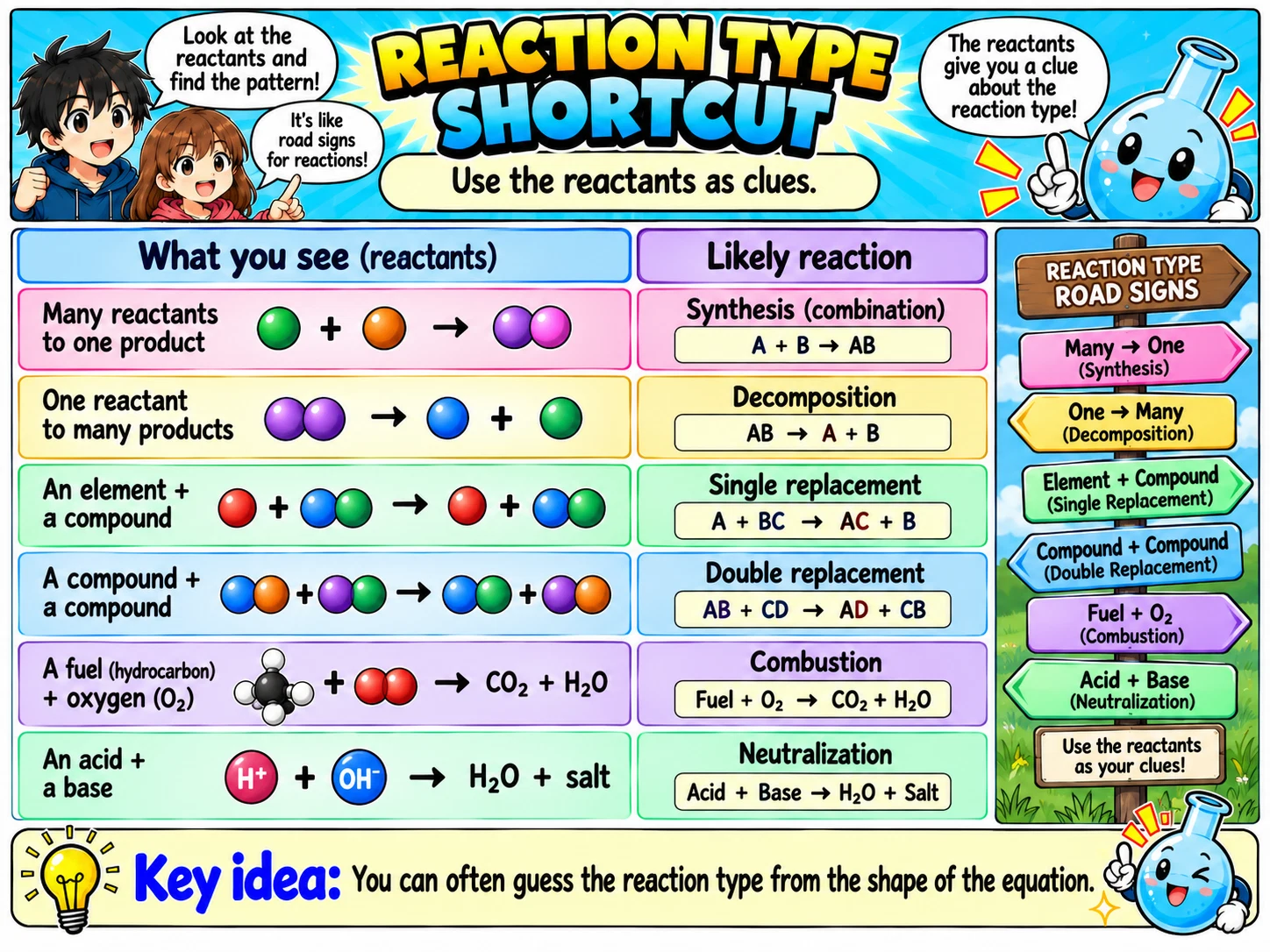
Reaction Type Shortcut

MOSAIC Chemistry Topic 2.4: Reaction Type Shortcut illustration from source PDF page 49
Original MOSAIC Chemistry visual · Topic 2.4, PDF page 49
What you seeLikely reaction
several reactants → one productsynthesis
one reactant → several productsdecomposition
element + compoundsingle replacement
compound + compounddouble replacement
fuel + O₂combustion
acid + baseneutralization

Easy explanation

Think of each reaction type as having its own shape.

You do not need to memorize every chemical equation.

First look for the pattern.

Then identify the reaction.

Then predict the products.

Then balance the equation.

Pages 51–52

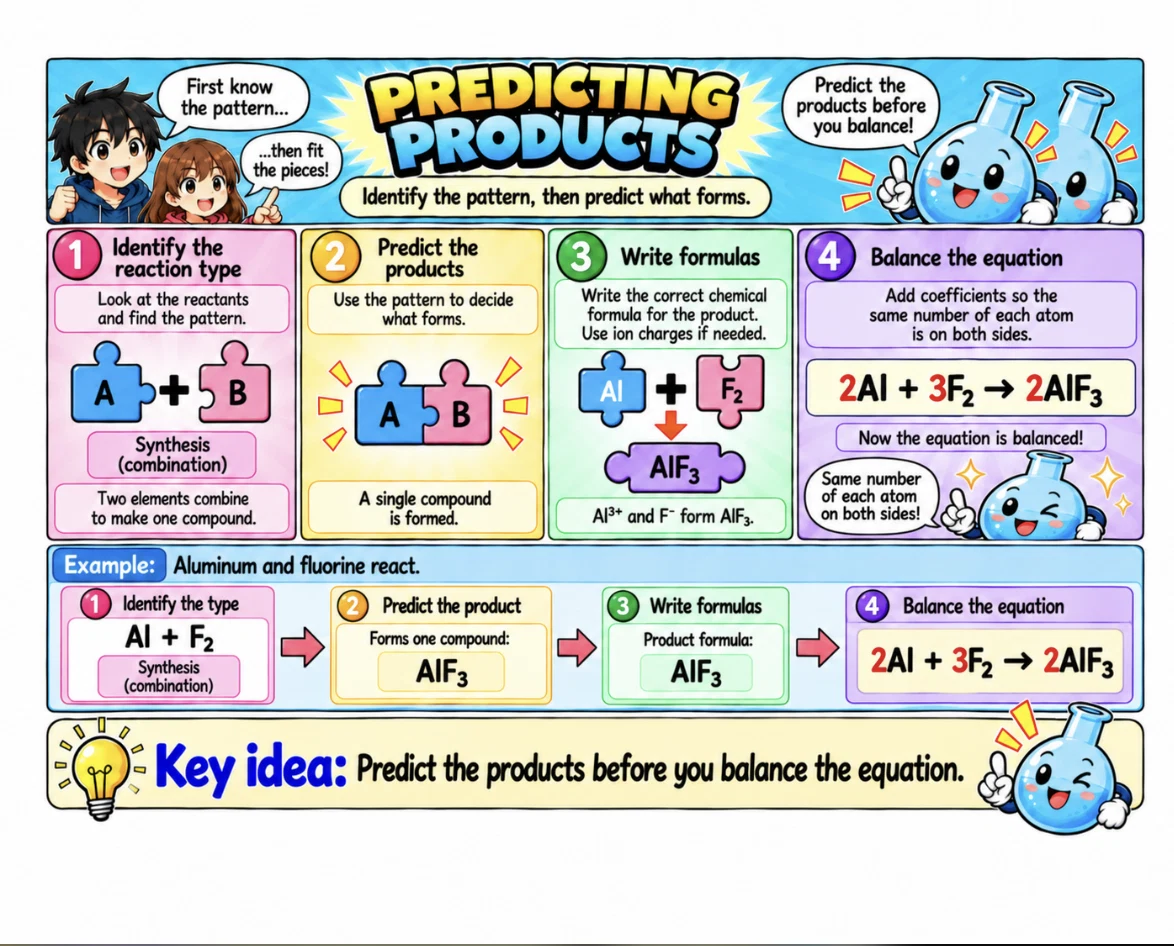
Predicting Products

MOSAIC Chemistry Topic 2.4: Predicting Products illustration from source PDF page 51
Original MOSAIC Chemistry visual · Topic 2.4, PDF page 51

Easy explanation

When solving reaction questions:

Step 1

Identify the reaction type.

Step 2

Use the reaction pattern to predict the products.

Step 3

Write the correct chemical formulas.

Step 4

Balance the equation.

Example: synthesis

Al + F₂

Two elements combine.

So this is synthesis.

Product:

AlF₃

Skeleton equation:

Al + F₂ → AlF₃

Balanced:

2Al + 3F₂ → 2AlF₃

Pages 53–54

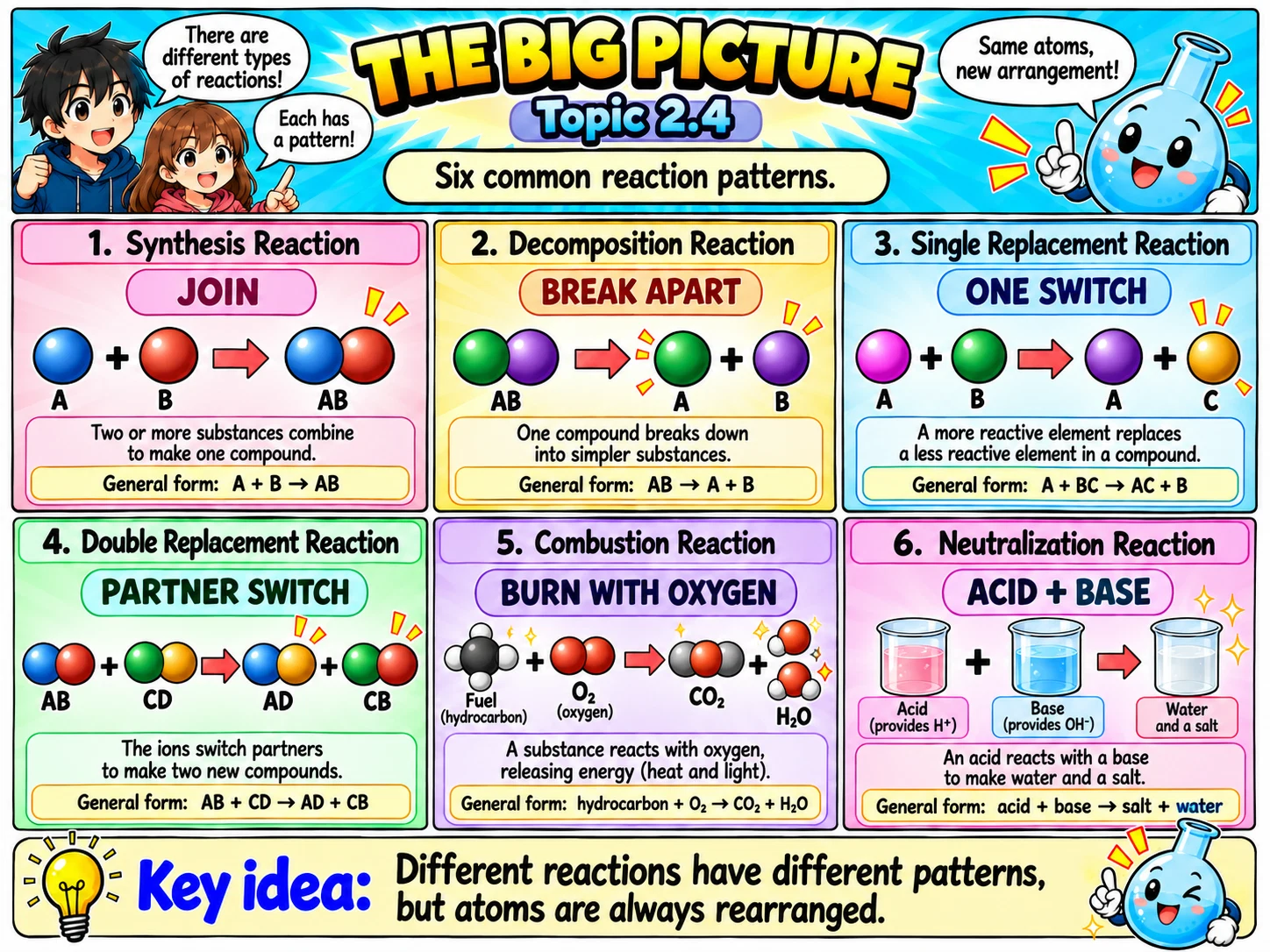
The Big Picture

MOSAIC Chemistry Topic 2.4: The Big Picture illustration from source PDF page 53
Original MOSAIC Chemistry visual · Topic 2.4, PDF page 53

Easy explanation

Chemical reactions rearrange atoms in different patterns.

Synthesis

JOIN

A + B → AB

Decomposition

BREAK

AB → A + B

Single replacement

ONE SWITCH

A + BX → AX + B

Double replacement

PARTNERS SWITCH

AX + BY → AY + BX

Combustion

BURN WITH OXYGEN

fuel + O₂ → products + energy

Neutralization

ACID + BASE

→ salt + water

The atoms are not created or destroyed.

They simply move into new combinations.

Page 55

Summary

Short explanation

Chemical reactions can be grouped by how their atoms rearrange.

A synthesis reaction combines two or more reactants to make one compound.

A decomposition reaction breaks one compound into simpler substances.

A single replacement reaction happens when one element replaces another element in a compound.

A double replacement reaction happens when ions in two compounds switch partners.

A combustion reaction involves oxygen and usually releases heat and light.

Complete hydrocarbon combustion produces carbon dioxide and water.

Incomplete combustion can also produce soot and dangerous carbon monoxide.

An acid forms H⁺ ions in water.

A base forms OH⁻ ions in water.

An acid-base indicator changes colour depending on the solution.

The pH scale usually ranges from 0 to 14.

pH < 7 → acidic

pH = 7 → neutral

pH > 7 → basic

A neutralization reaction occurs when an acid reacts with a base.

It produces:

salt + water

Neutralization is also a type of double replacement reaction.

Main idea:

Different reaction types have different patterns, but all chemical reactions rearrange atoms to form new substances.

DOWNLOAD WORKSHEETS

Choose a topic

PDFs are included locally in this website package; upload the worksheets/chemistry folder with the page.

← Back to Home↑ Back to Top